Noise Analysis

White noise
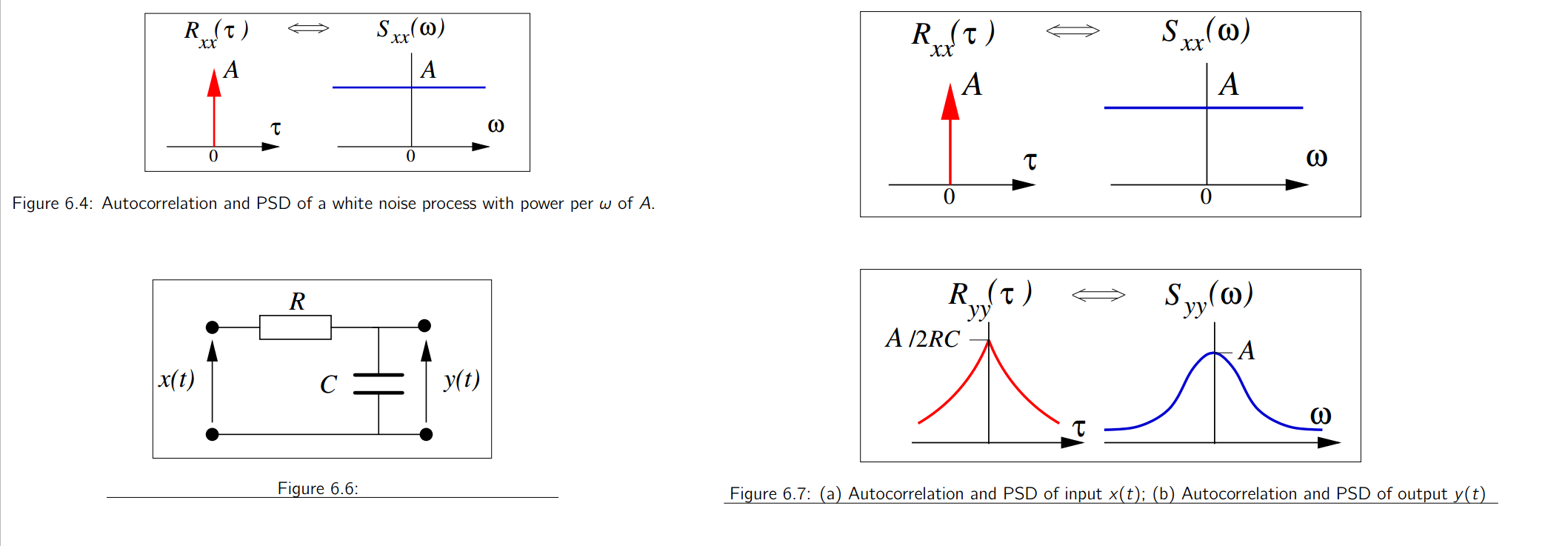
David Murray. Topic 6: Random Processes and Signals [slides notes]
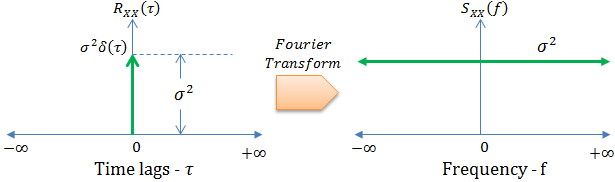
Mathuranathan. White Noise : Simulation and Analysis using Matlab [https://www.gaussianwaves.com/2013/11/simulation-and-analysis-of-white-noise-in-matlab/]
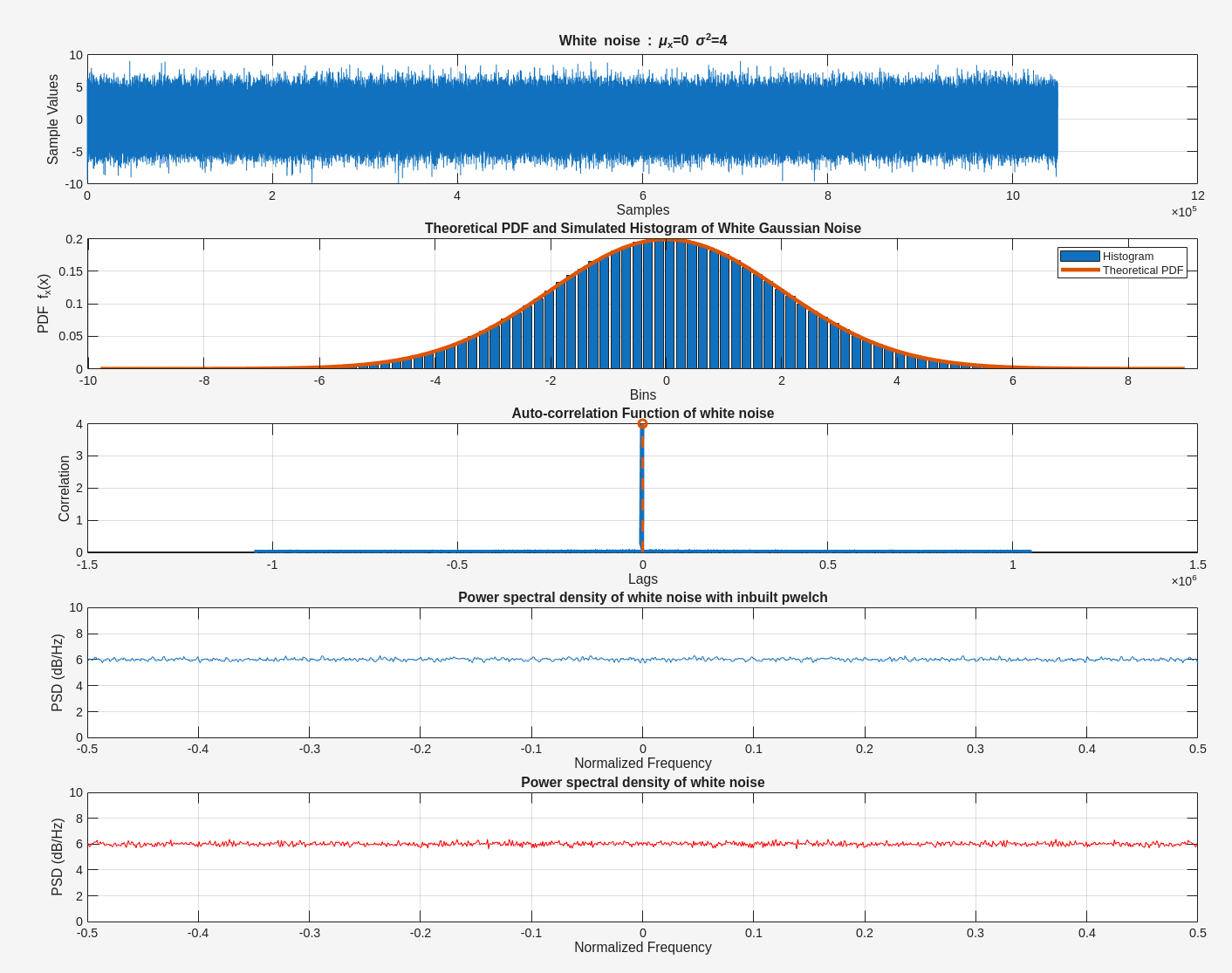
1 | clear all; clc; close all; |
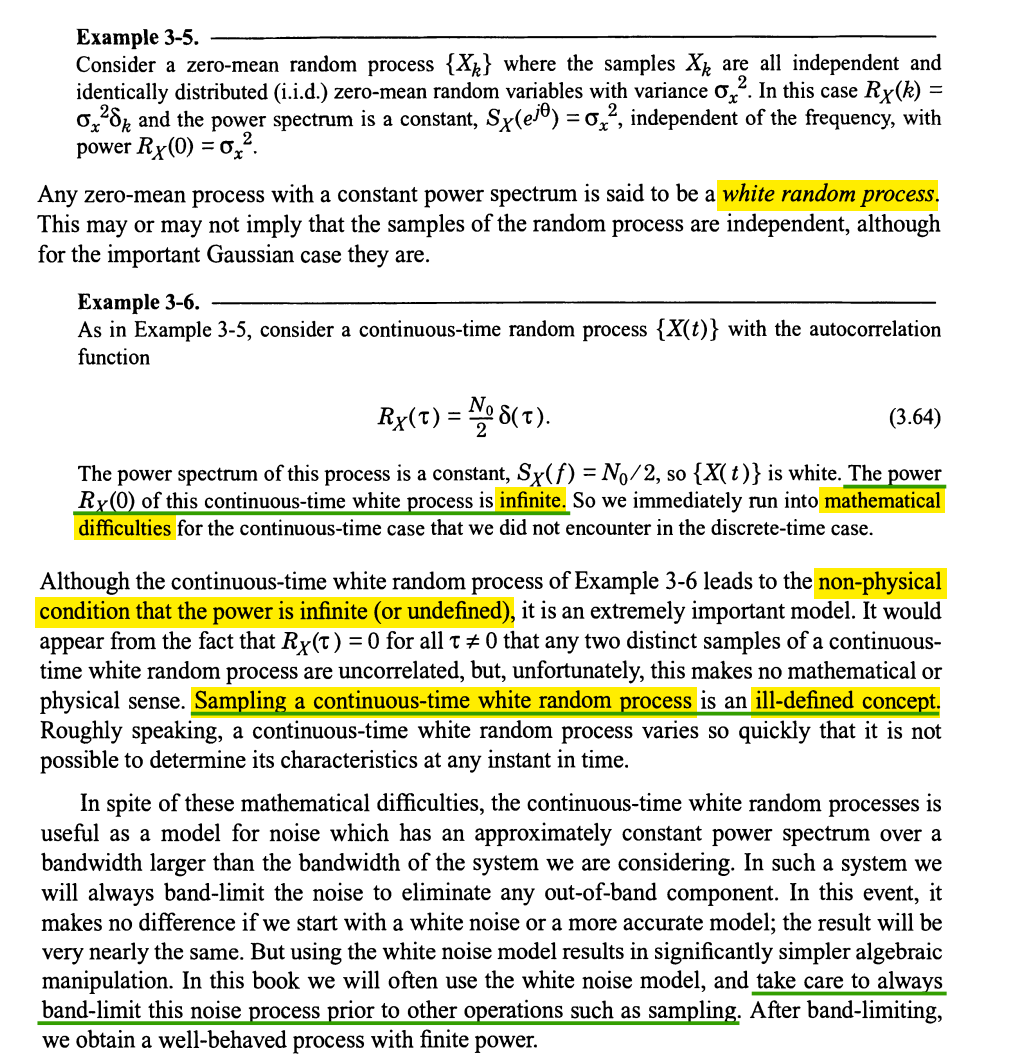
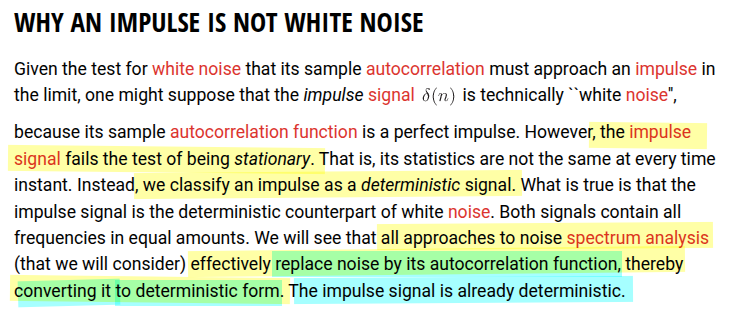
Julius Orion Smith III. Why an Impulse is Not White [https://www.dsprelated.com/freebooks/sasp/Why_Impulse_Not_White.html]
I.I.D. Noise
Independent and Identically Distributed
Kevin Zheng. The Frequency Domain Trap – Beware of Your AC Analysis [https://circuit-artists.com/the-frequency-domain-trap-beware-of-your-ac-analysis/]
Mathuranathan. White Noise : Simulation and Analysis using Matlab [https://www.gaussianwaves.com/2013/11/simulation-and-analysis-of-white-noise-in-matlab/]
white noise doesn't mean it has a Gaussian/normal distribution
The only criteria for a (discrete) signal to be "white" is for each sample to be independently taken from the same probability distribution
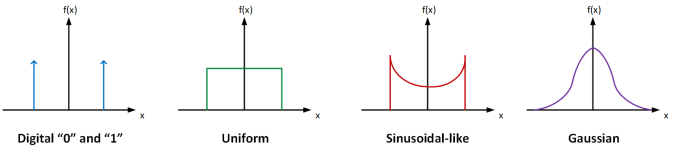
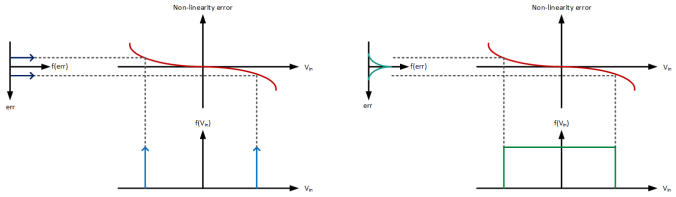
By understanding input signal's statistical nature, we can gather more insights about certain requirements for our circuits than just from frequency domain
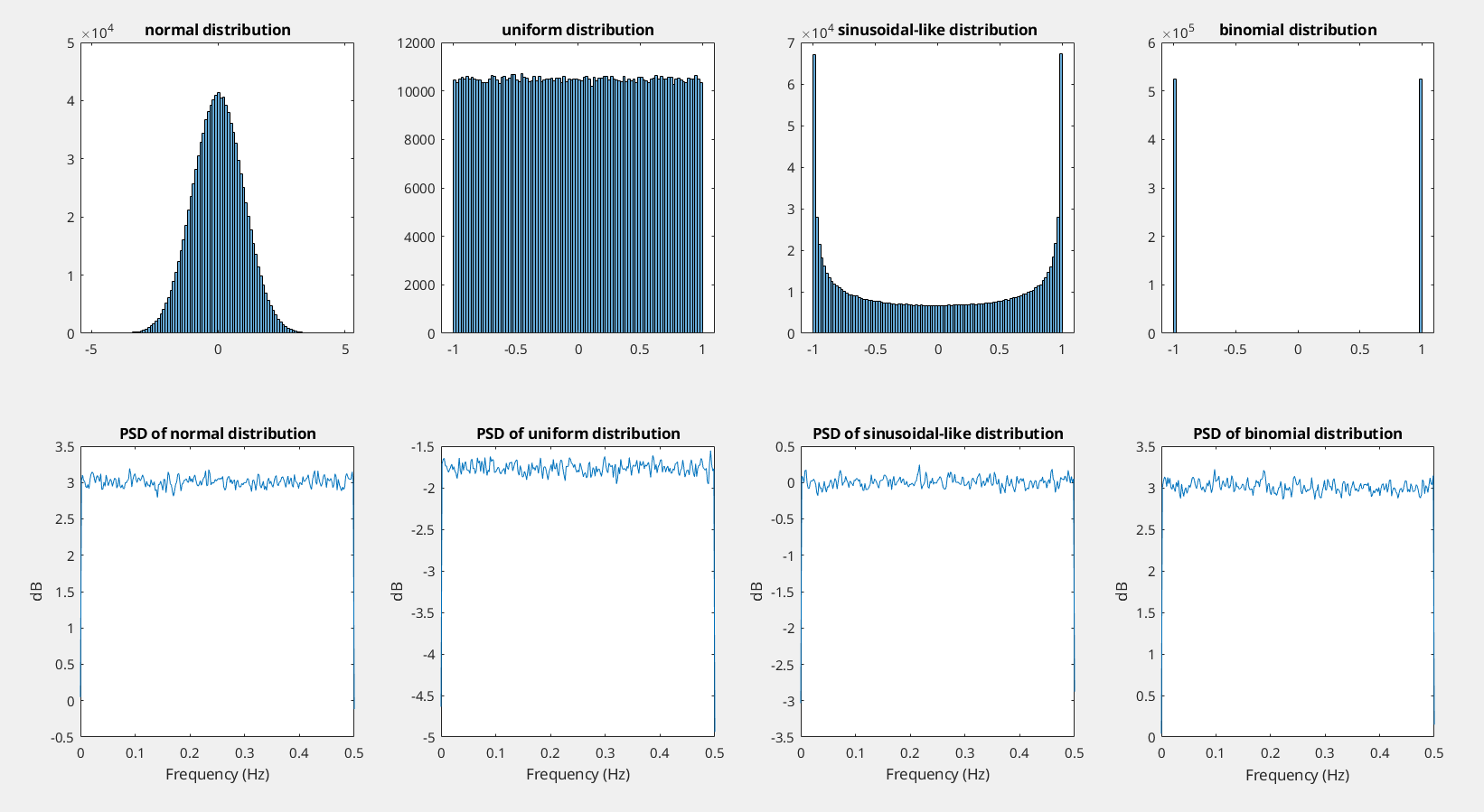
1 | fs = 1; |
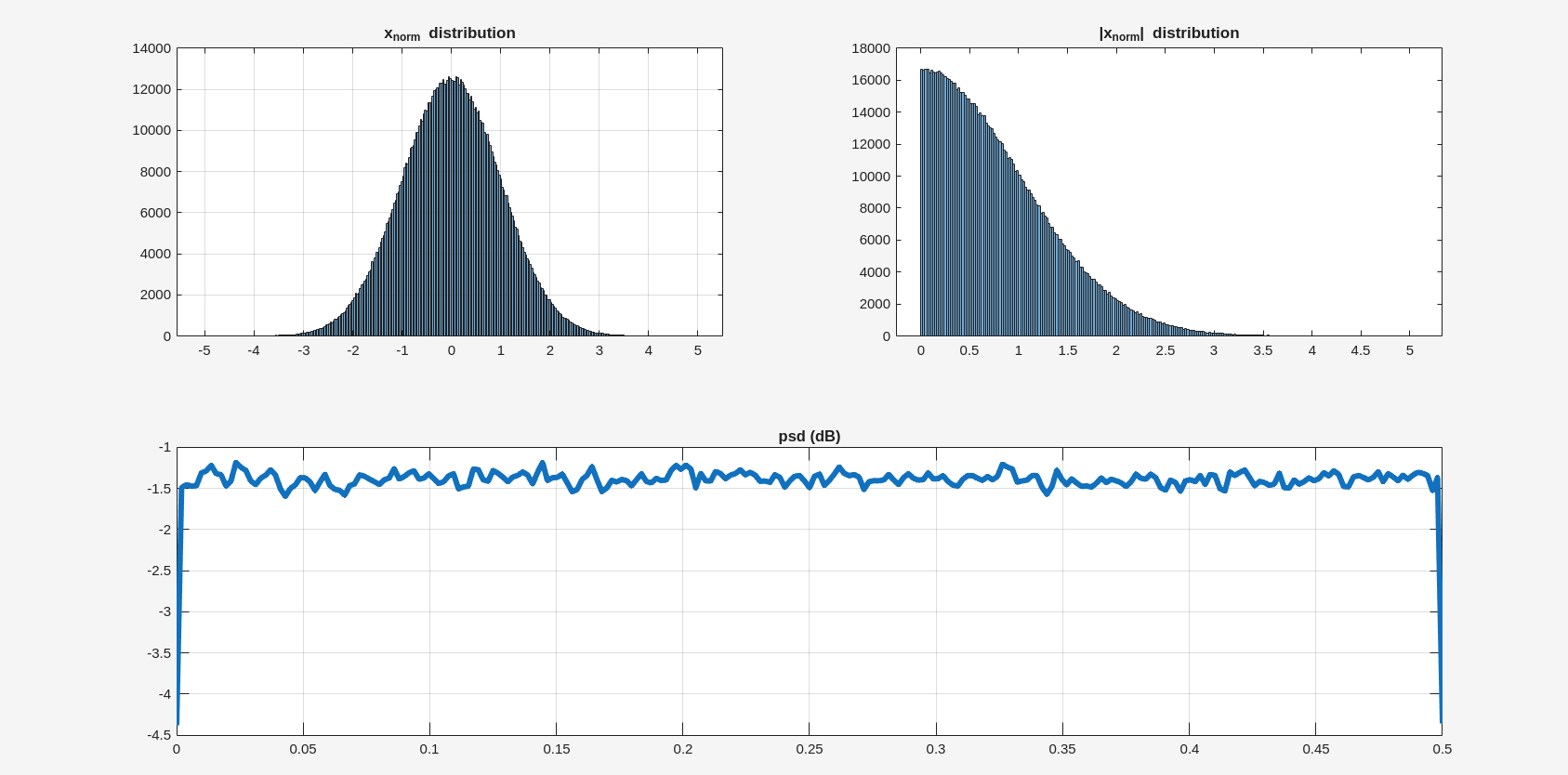
1 | val = randn(1, 2^20,1); |
Additive White Gaussian Noise (AWGN)
Qasim Chaudhari. Additive White Gaussian Noise (AWGN) [https://wirelesspi.com/additive-white-gaussian-noise-awgn/]
Mathuranathan. Simulate additive white Gaussian noise (AWGN) channel [https://www.gaussianwaves.com/2015/06/how-to-generate-awgn-noise-in-matlaboctave-without-using-in-built-awgn-function/]
Does PSD (dBm/Hz) of white noise depend on sampling rate?. Does PSD (dBm/Hz) of white noise depend on sampling rate? [https://dsp.stackexchange.com/a/87654/59253]
Matthew Schubert. Colouring Noise - Generating coloured noise to simulate physical processes [https://blog.ioces.com/matt/posts/colouring-noise/]
\[ \text{PSD}_s = \frac{\sigma^2}{f_s} \space\space \text{for two-sided PSD} \space\space\space \text{or}\space\space\space =\frac{\sigma^2}{f_s/2}\space\space \text{for one-sided PSD} \]
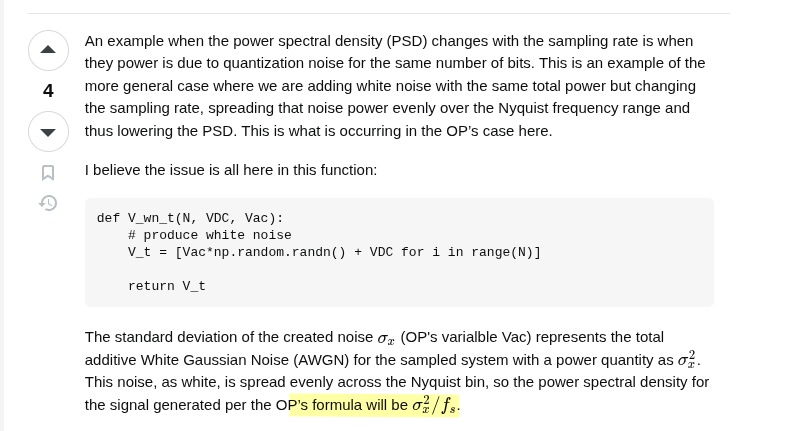
that total power will always be the same for any sampling rate used (as long as the histogram of those samples is still \(\sigma_x\)). Thus the power spectral density will be \(\sigma_x^2/f_s\).

How to generate white noise signal from a given PSD? [https://www.mathworks.com/matlabcentral/answers/1968-how-to-generate-white-noise-signal-from-a-given-psd#answer_1498849]
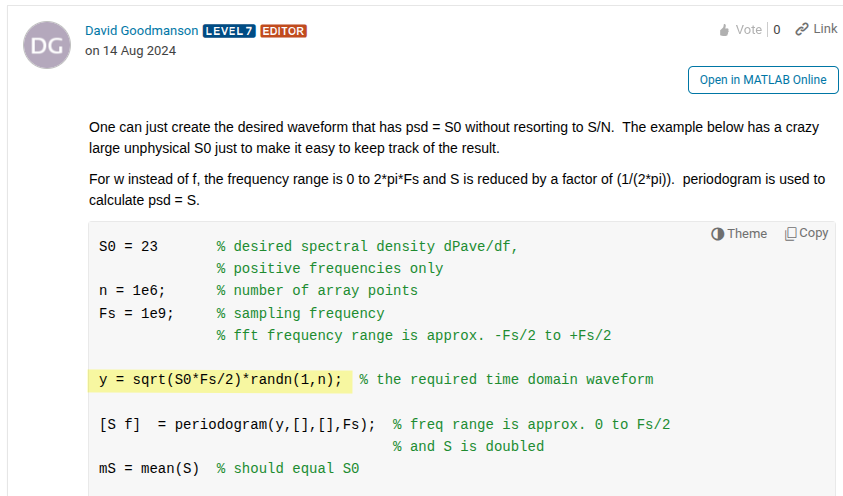
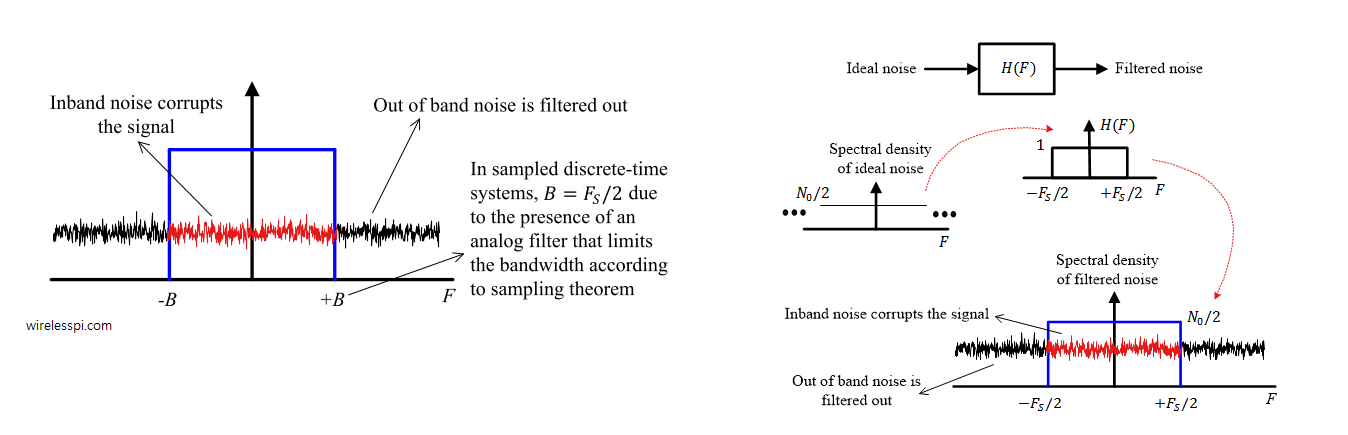
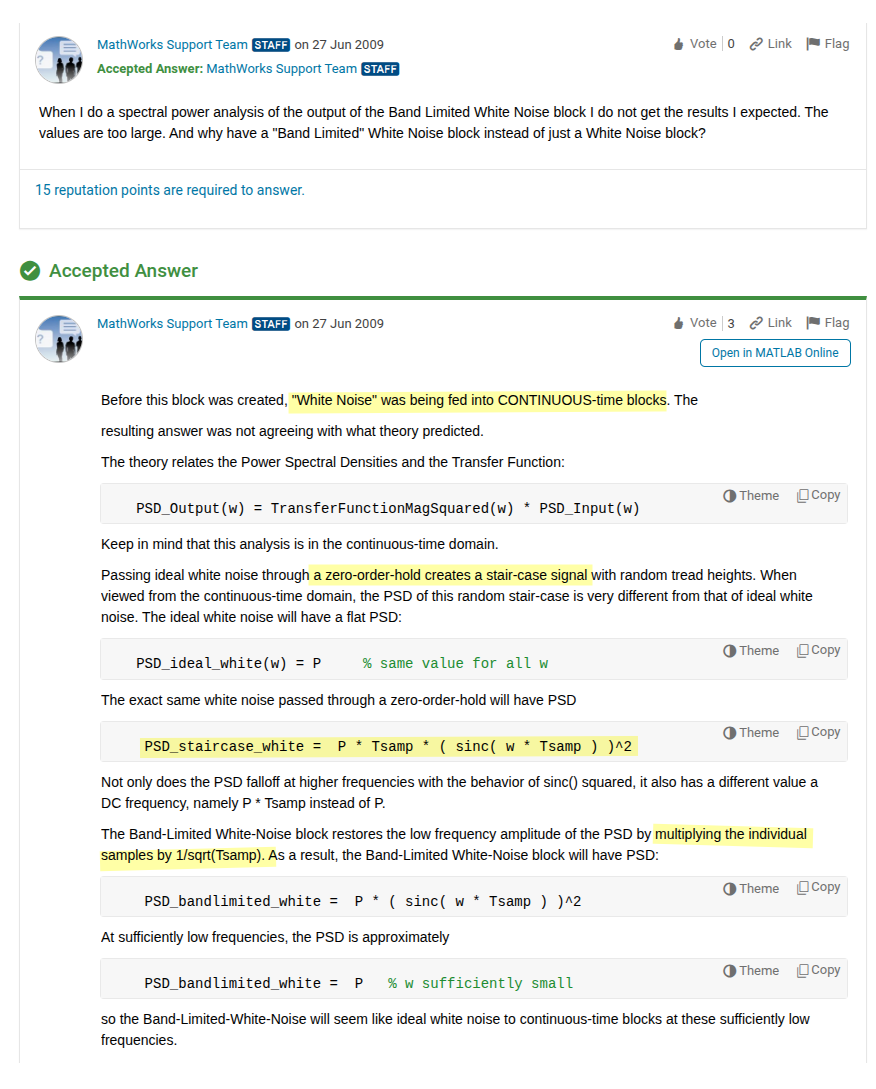
White noise in continuous-time blocks
MathWorks Support Team. [https://www.mathworks.com/matlabcentral/answers/100763-why-have-a-band-limited-white-noise-generator-block-instead-of-just-a-white-noise-generator-block#answer_110112]

Transient Noise and VerilogA Modeling
Integrated Analog Systems D - Lecture 15S CAD (Transient Noise and VerilogA Modeling) [https://youtu.be/YW2nnI3DD_c]
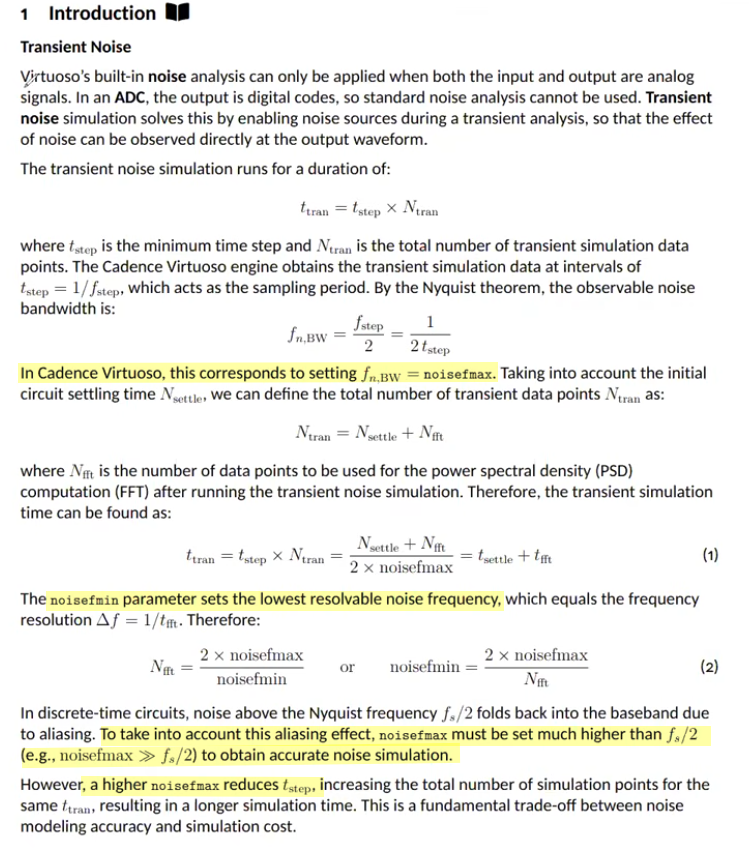
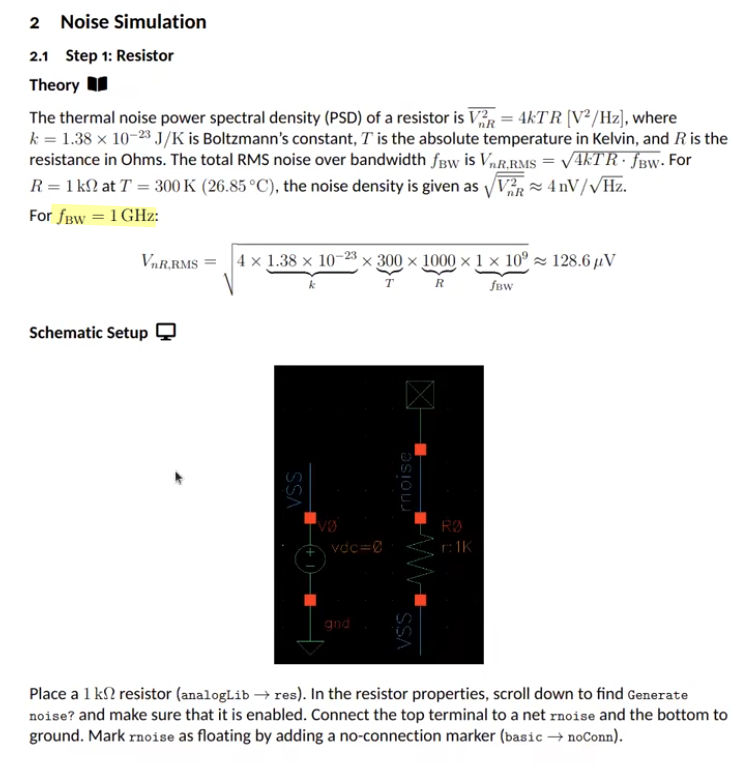
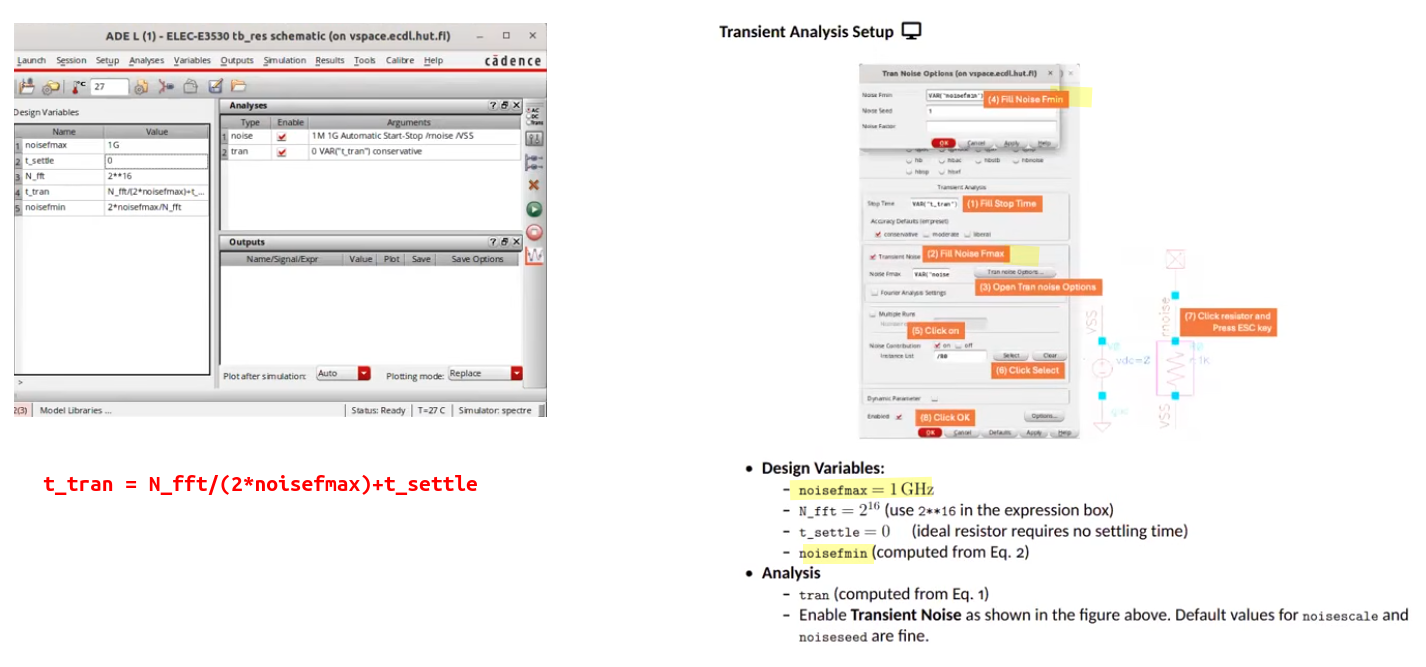
fs=2*noisefmax guarantee zero aliasing
within FFT
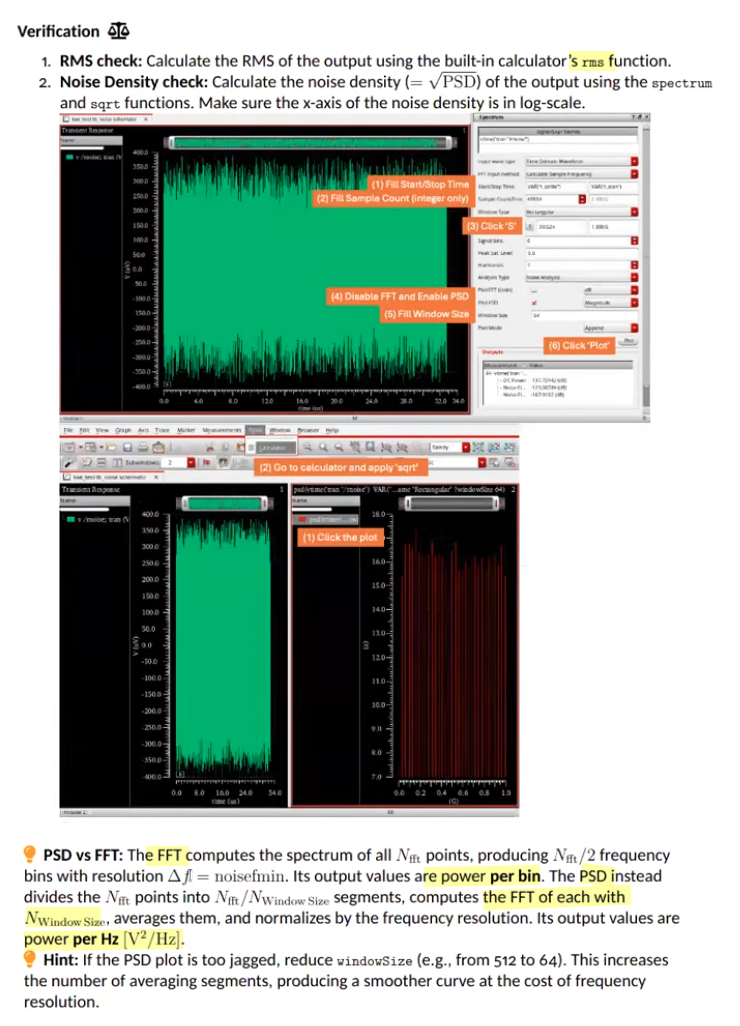
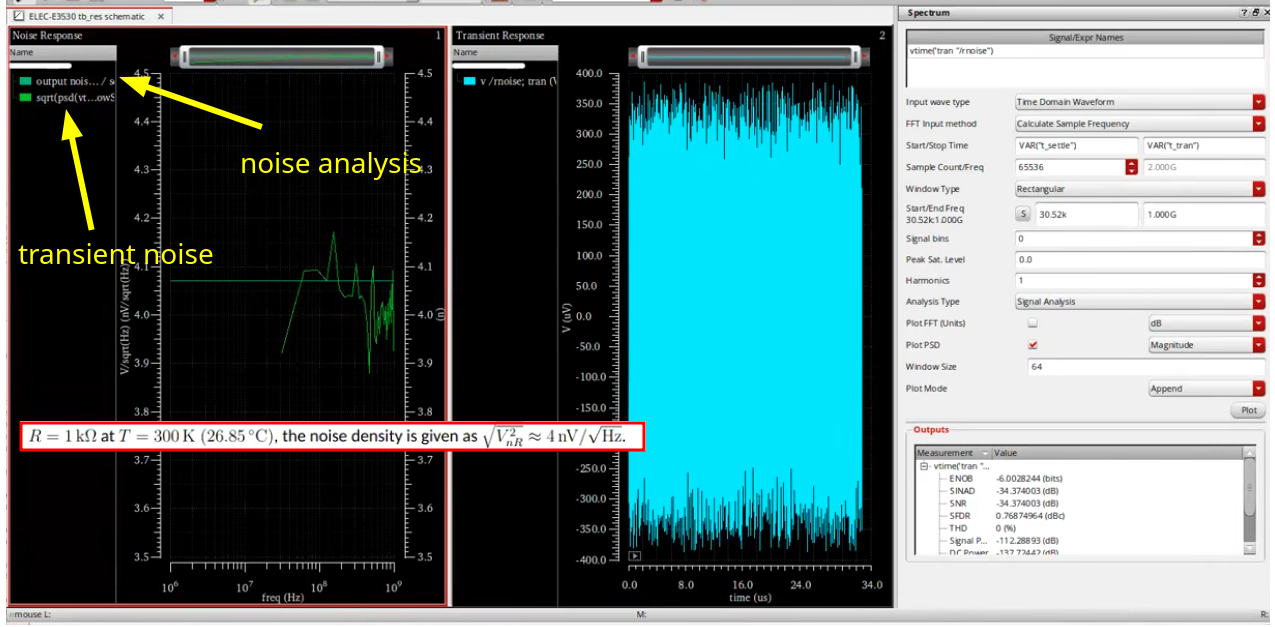
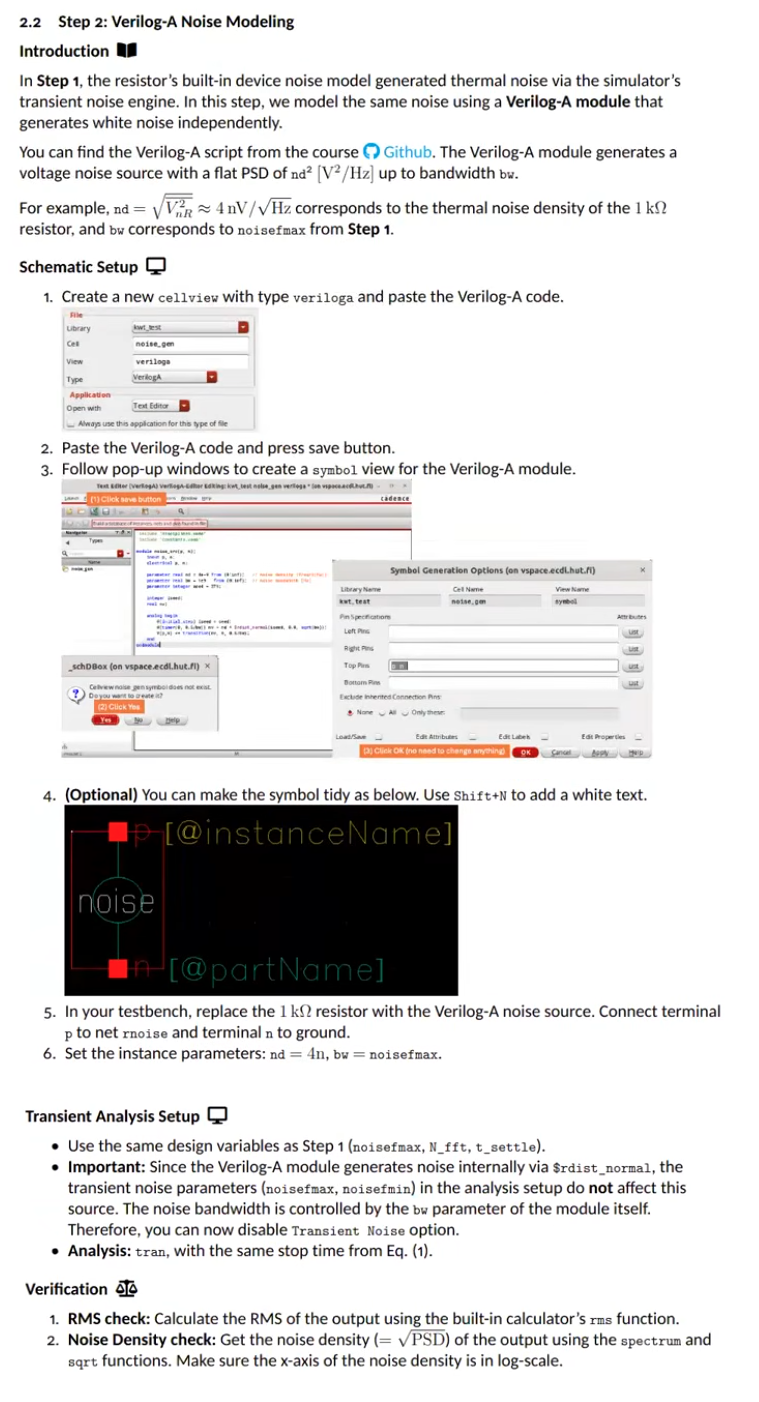
1 |
|
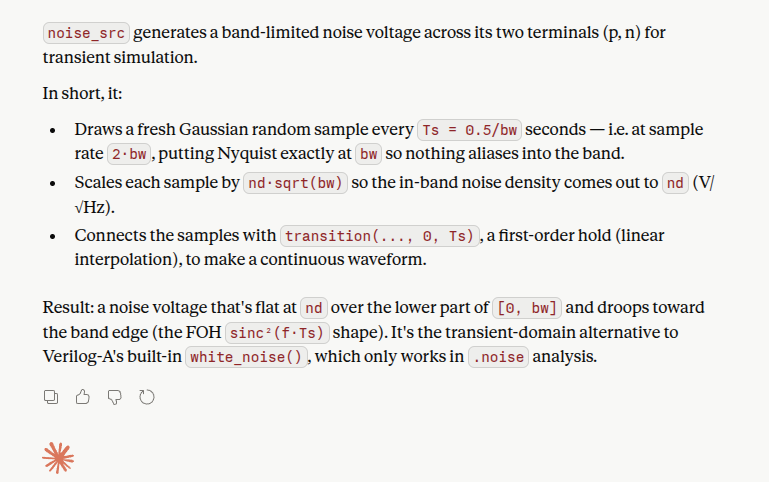
Colored Noise Generation
Allen B. Downey. Think DSP - Digital Signal Processing in Python [book repo]
Chembian Thambidurai, "Comparison Of Noise Power At Lowpass Filter Output" [link]
—, "On Noise Power At The Bandpass Filter Output" [link]
Steve Smith. An Interesting Fourier Transform - 1/f Noise [https://www.dsprelated.com/showarticle/40.php]
Mathuranathan. Generate correlated Gaussian sequence (colored noise) [https://www.gaussianwaves.com/2019/10/generating-correlated-gaussian-sequences/]
Jeruchim et., al, Simulation of communication systems – modeling, methodology, and techniques, second edition, Kluwer academic publishers, 2002
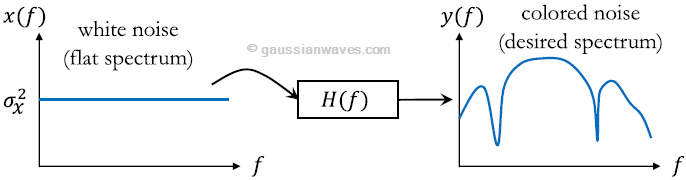
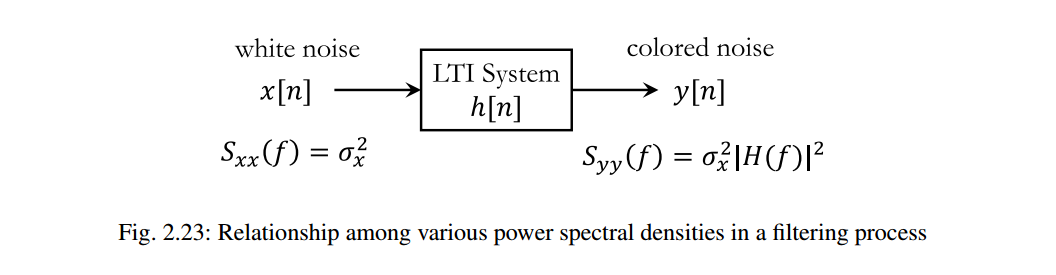
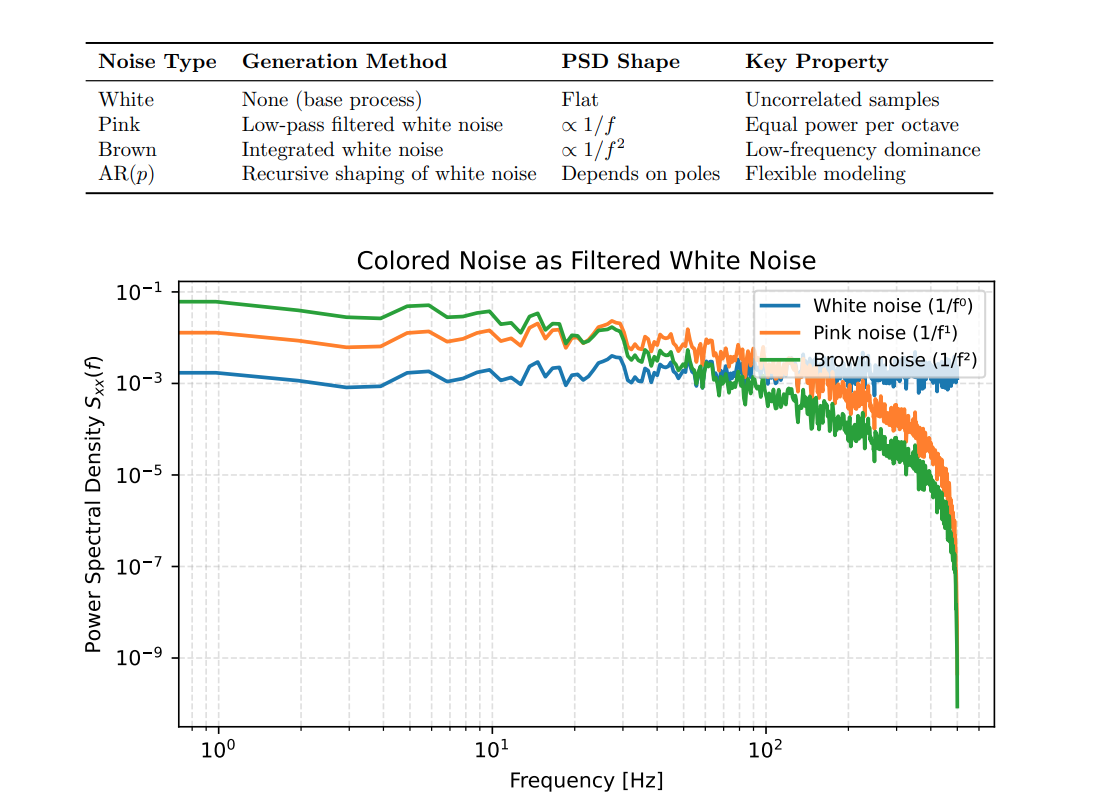
Two methods to generate colored Gaussian noise for given mean and PSD shape
- Spectral Factorization Method
- Auto-Regressive (AR) Model
Filtering in Time domain
Alessandro Cudazzo. noise generator developed in C99 (white, brown) [https://github.com/alessandrocuda/noise_generator]
Julius Orion Smith III. Spectral Audio Signal Processing [https://www.dsprelated.com/freebooks/sasp/Filtered_White_Noise.html]
with Derivatives approximation, \(H_p(s) = \frac{1}{s\tau + 1} \to H_p(z)=\frac{\alpha}{1 +(\alpha -1)z^{-1}}\), where \(\alpha = \frac{T}{\tau+T}\)
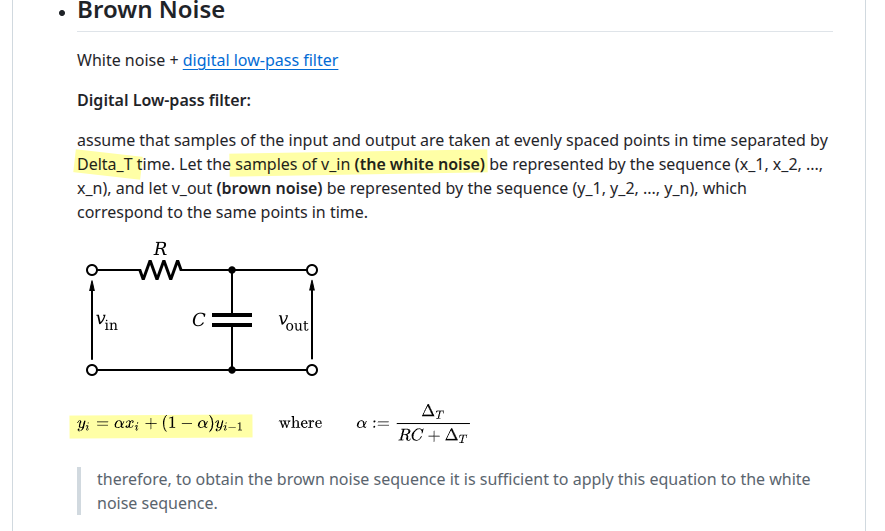
1 | get_bnoise(){ |
Viswanathan, M. (2020). Simulation of Digital Communication Systems Using Matlab (2nd ed.). GaussianWaves
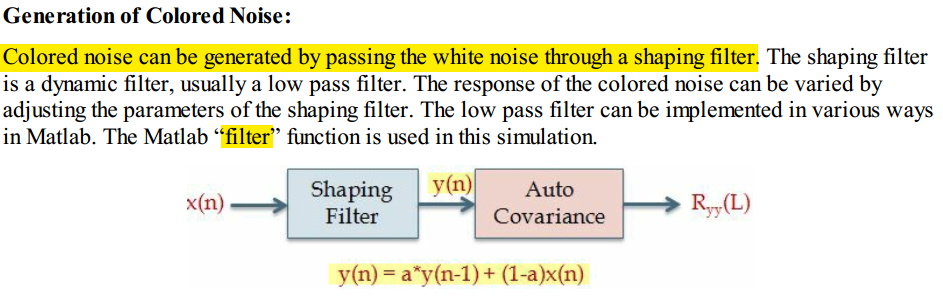
1 | %Generation of colored noise in Matlab |
The input sequence \(x[n]\) is zero-mean discrete-time white Gaussian noise with variance \(\sigma_x^2\). Its one-sided power spectral density is
\[ S_x^{(1)}(f)= \begin{cases} \dfrac{\sigma_x^2}{F_s}, & f=0 \ \text{or}\ f=\dfrac{F_s}{2}, \\[6pt] \dfrac{2\sigma_x^2}{F_s}, & 0<f<\dfrac{F_s}{2}. \end{cases} \label{eq:white_noise_psd} \]
The colored-noise sequence is generated using the first-order digital low-pass filter
\[ y[n]=a\,y[n-1]+(1-a)x[n], \label{eq:colored_noise_filter} \]
whose transfer function is \[ H(z)=\frac{Y(z)}{X(z)} =\frac{1-a}{1-a z^{-1}}. \label{eq:digital_filter_transfer} \]
1 | [y zf]=filter(1-a,[1 -a],x); |
Evaluating the transfer function on the unit circle gives \[ H\!\left(e^{j2\pi f/F_s}\right) = \frac{1-a} {1-ae^{-j2\pi f/F_s}}, \]
and therefore
\[ \left|H\!\left(e^{j2\pi f/F_s}\right)\right|^2 = \frac{(1-a)^2} {1+a^2-2a\cos\!\left(2\pi f/F_s\right)}. \label{eq:digital_filter_magnitude} \]
Consequently, the theoretical one-sided colored-noise PSD is \[ S_y^{(1)}(f) = S_x^{(1)}(f) \frac{(1-a)^2} {1+a^2-2a\cos\!\left(2\pi f/F_s\right)}. \label{eq:colored_noise_psd} \]
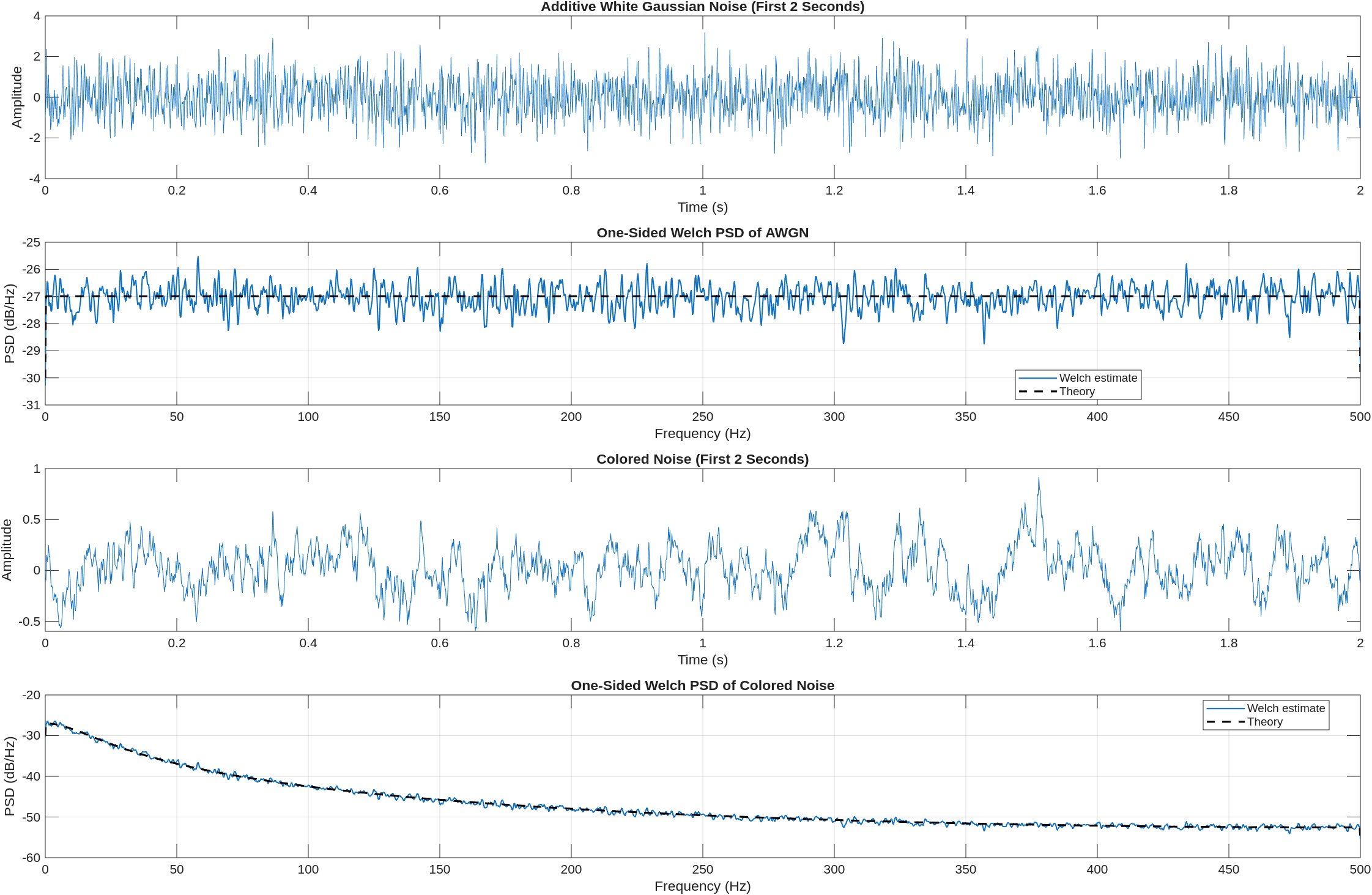
specifically, it is the backward-Euler approximation of a continuous first-order low-pass filter: \[ \tau\frac{dy}{dt}+y=x,\qquad \frac{dy}{dt}\approx F_s(y[n]-y[n-1]) \] This produces: \[ y[n]=a\,y[n-1]+(1-a)x[n],\qquad a=\frac{\tau F_s}{1+\tau F_s} \] Therefore the corresponding continuous-time cutoff is: \[ \boxed{\omega_c=\frac{1-a}{a}F_s\ \text{rad/s}} \]
However, this is not the exact −3 dB frequency of the resulting digital filter. Its exact digital cutoff is: \[ \boxed{\omega_{3\text{dB,digital}} =F_s\cos^{-1}\!\left(1-\frac{(1-a)^2}{2a}\right)\ \text{rad/s}} \]
For a = 0.9 and Fs = 1000:
- Backward-Euler continuous cutoff:
111.11 rad/s(17.68 Hz) - Exact digital −3 dB cutoff:
105.46 rad/s(16.78 Hz)
Now we derive \(\omega_{3\text{dB,digital}}\), Start with the digital transfer function: \(H(z)=\frac{1-a}{1-az^{-1}}\)
Evaluate it on the unit circle, \(z=e^{j\Omega}\), where \(Omega\) is digital frequency in rad/sample: \(H(e^{j\Omega})=\frac{1-a}{1-ae^{-j\Omega}}\)
Its magnitude squared is \(|H(e^{j\Omega})|^2 =\frac{(1-a)^2}{|1-ae^{-j\Omega}|^2}\)
Expanding the denominator: \[ \begin{aligned} |1-ae^{-j\Omega}|^2 &=(1-a\cos\Omega)^2+(a\sin\Omega)^2\\ &=1+a^2-2a\cos\Omega\\ &=(1-a)^2+2a(1-\cos\Omega). \end{aligned} \]
The DC gain is one: \(|H(e^{j0})|^2=1\)
At the −3 dB frequency, power is half its DC value: \(|H(e^{j\Omega_{3\mathrm{dB}}})|^2=\frac{1}{2}\)
Therefore, \(\frac{(1-a)^2} {(1-a)^2+2a(1-\cos\Omega_{3\mathrm{dB}})} =\frac12\)
and hence \[ \boxed{ \Omega_{3\mathrm{dB}} =\cos^{-1}\!\left(1-\frac{(1-a)^2}{2a}\right) } \quad\text{rad/sample} \] Since (=F_s), \[ \boxed{ \omega_{3\mathrm{dB}} =F_s\cos^{-1}\!\left(1-\frac{(1-a)^2}{2a}\right) } \quad\text{rad/s} \]
For (a=0.9) and (F_s=1000):
\(\Omega_{3\mathrm{dB}}\approx0.10546\ \text{rad/sample}\), \(\omega_{3\mathrm{dB}}\approx105.46\ \text{rad/s} \approx16.78\ \text{Hz}\)
Filtering in Frequency domain
Matthew Schubert. Colouring Noise - Generating coloured noise to simulate physical processes [https://blog.ioces.com/matt/posts/colouring-noise/] [https://gist.github.com/m-schubert/45c562146c6607b8990f1e8f34ff87b0]
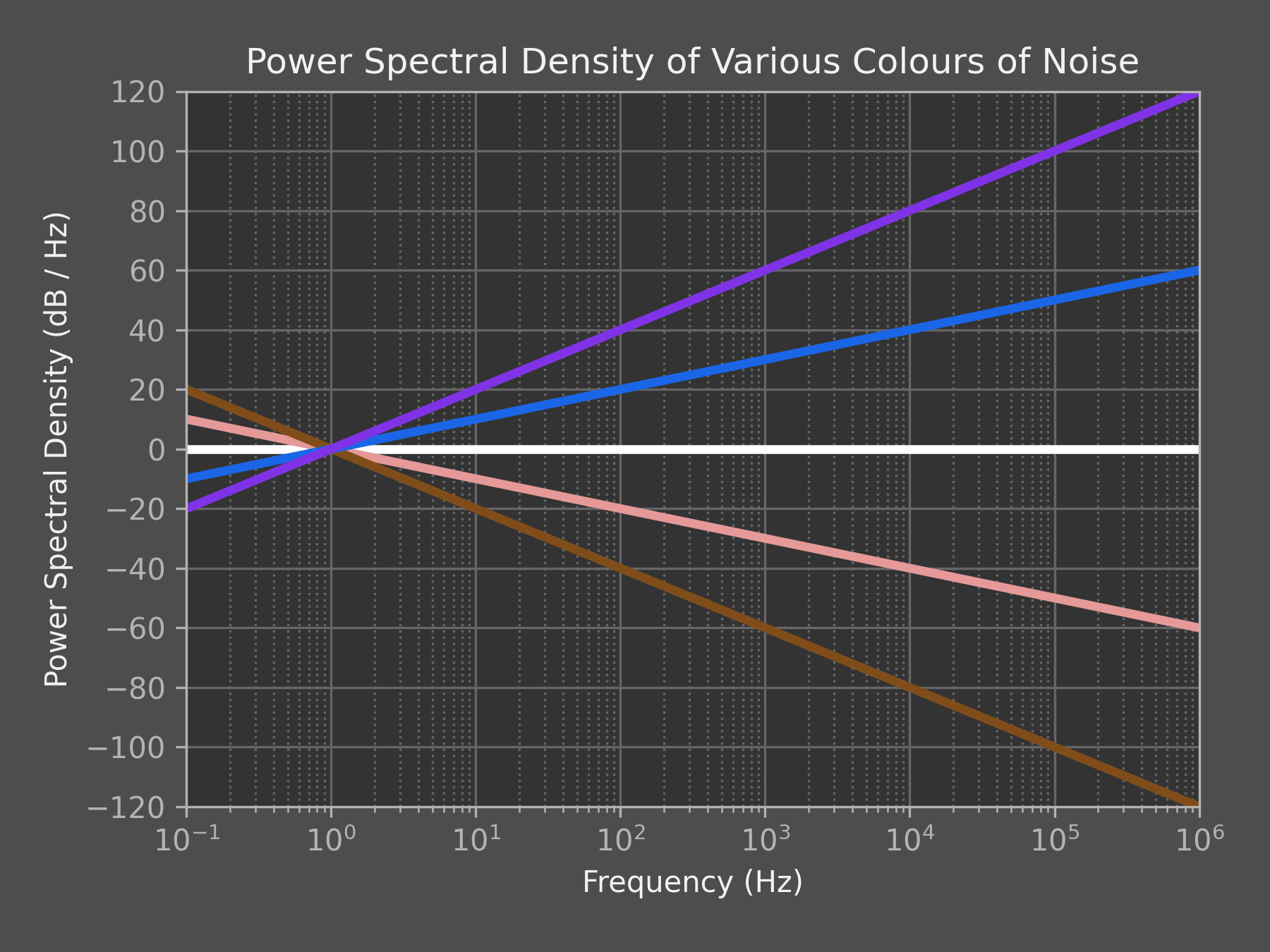
White, Pink \(1/f\), Brownian \(1/f^2\), Blue \(f\), Violet \(f^2\)
The process of generating coloured noise is relatively simple:
- Start with a representation of white noise signal in the frequency domain
- Shape the signal in the frequency domain according to the PSD you'd like to achieve
- Take the inverse Fourier transform of the shaped signal
Sampling shaping transfer function (not scaled by \(1/T_s\)) make sense in time domain convolution between sampled noise and sampled impulse response of filter
AR(N) Model Method
Generate color noise using Auto-Regressive (AR) model [https://www.gaussianwaves.com/2019/12/color-noise-generation-using-auto-regressive-ar-model-power-law-noises/]
Konstantinos Chatzilygeroudis. Lecture 9 & 10: Noise Models & Linear Filters [notes, slides]
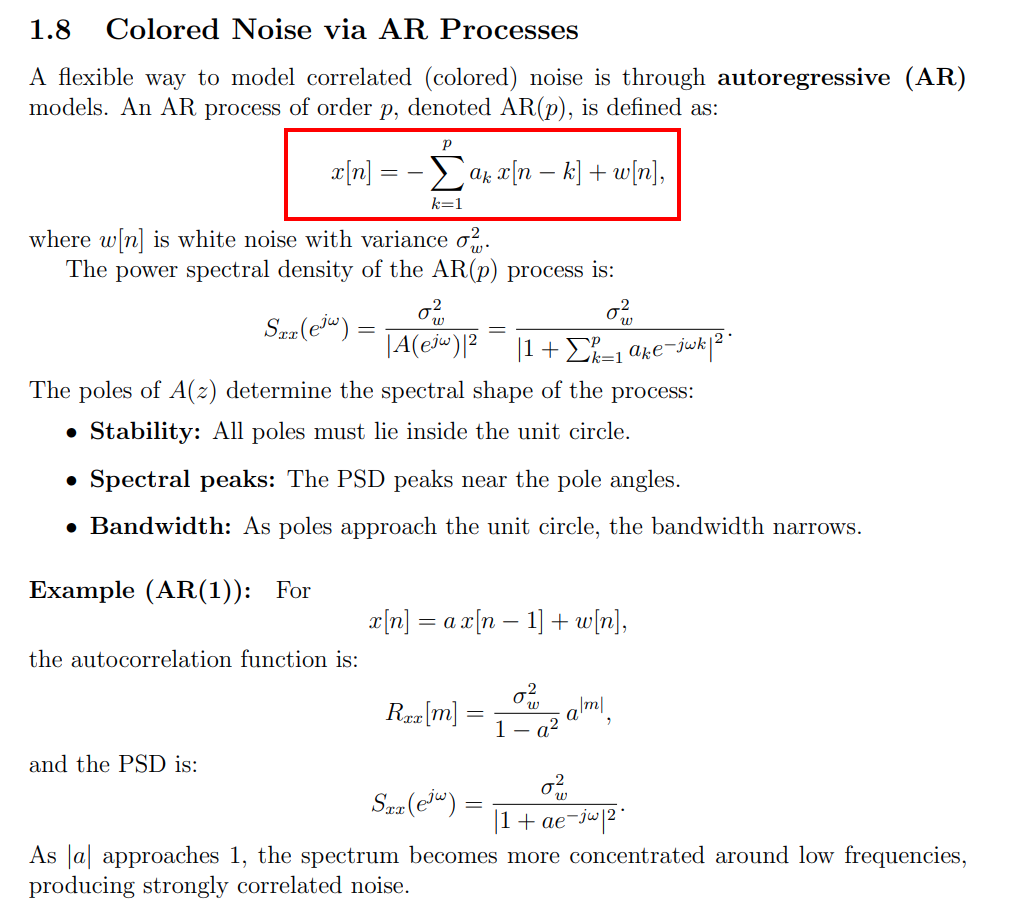
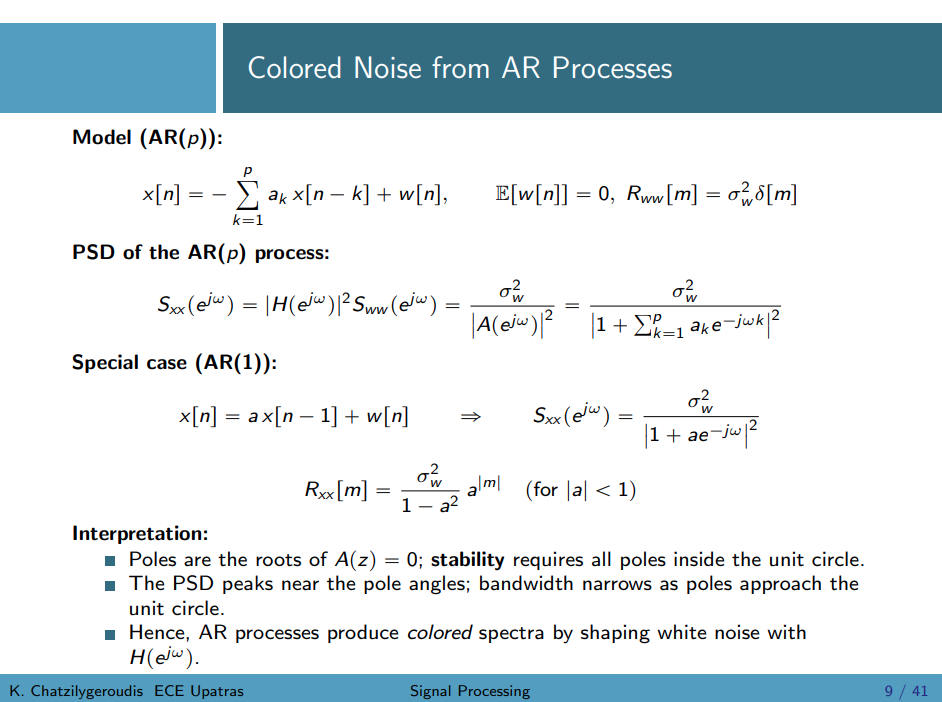
Autoregressive (AR) modeling in signal processing represents a signal as a linear combination of its own previous values plus a white noise error term, effectively acting as an all-pole IIR filter
Google AI Mode [https://share.google/aimode/QAuvWdwJFng54cYZo]
1 | % https://github.com/vineel49/colored_noise/blob/master/RUN_ME.m |
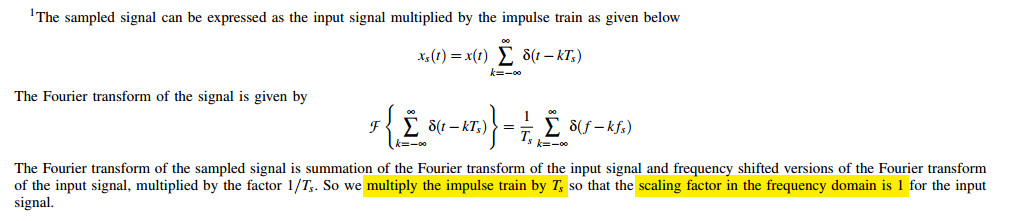
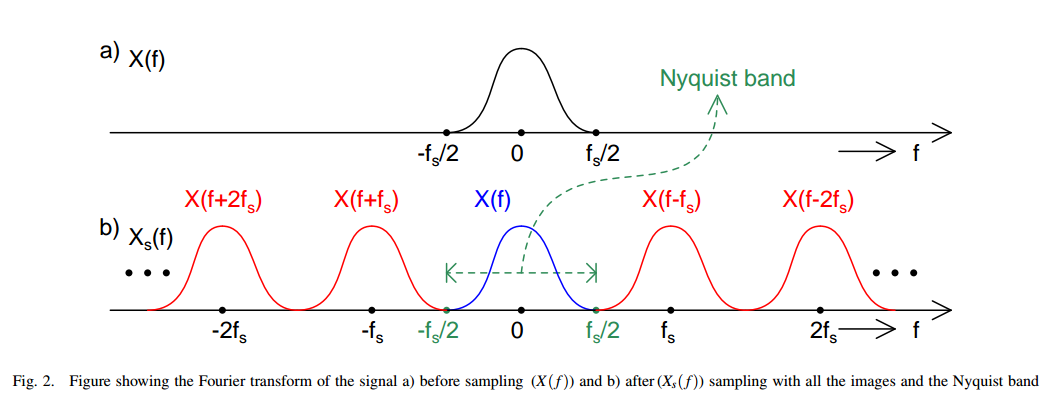
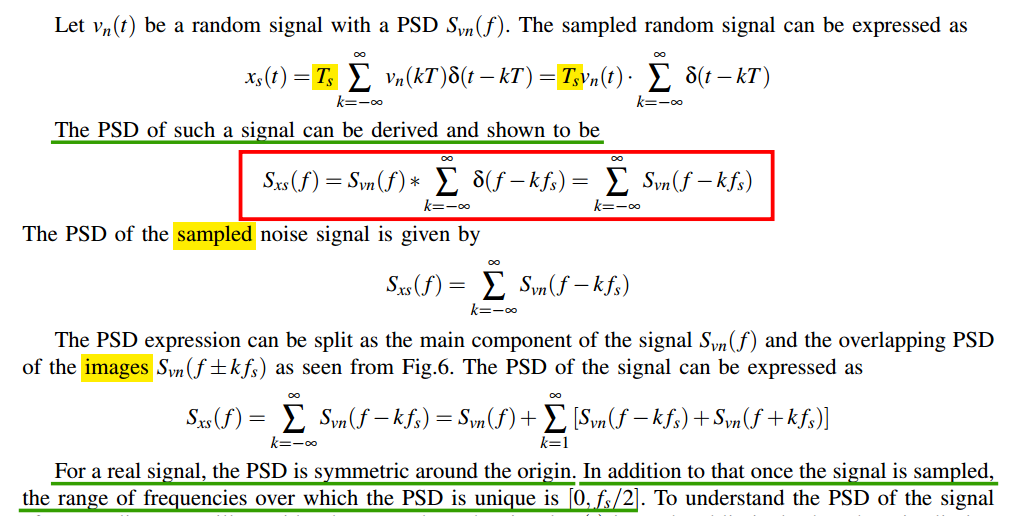
impulse sampling noise
Chembian Thambidurai, "Noise, Sampling and Zeta Functions" [link]
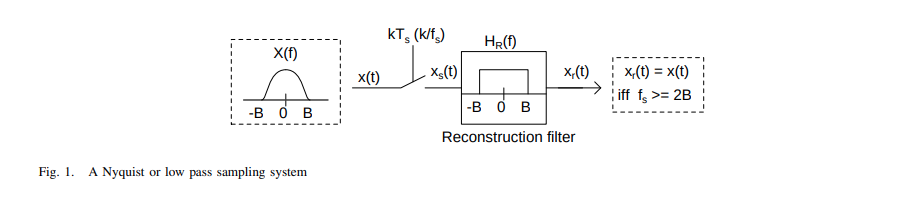
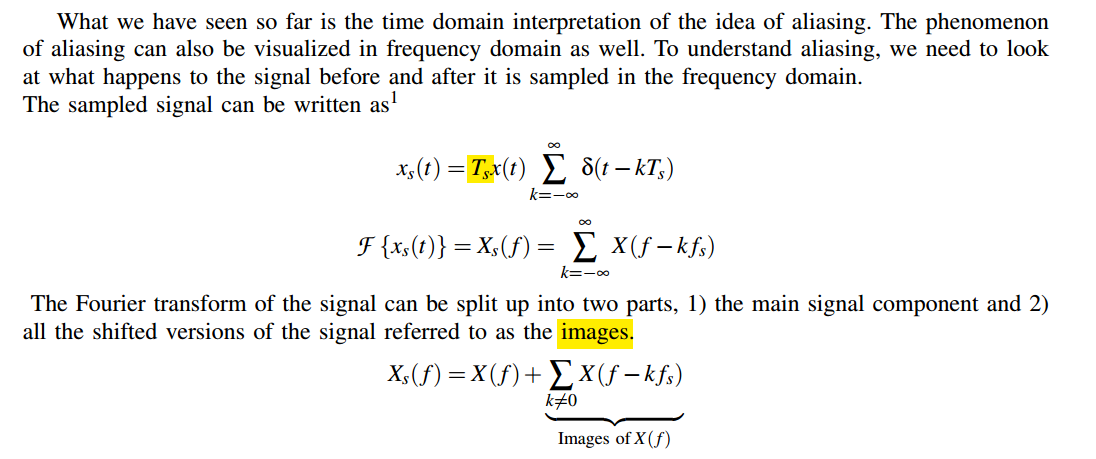
A random signal \(v_n(t)\) is sampled using an ideal impulse sampler
Sampling coloured noise
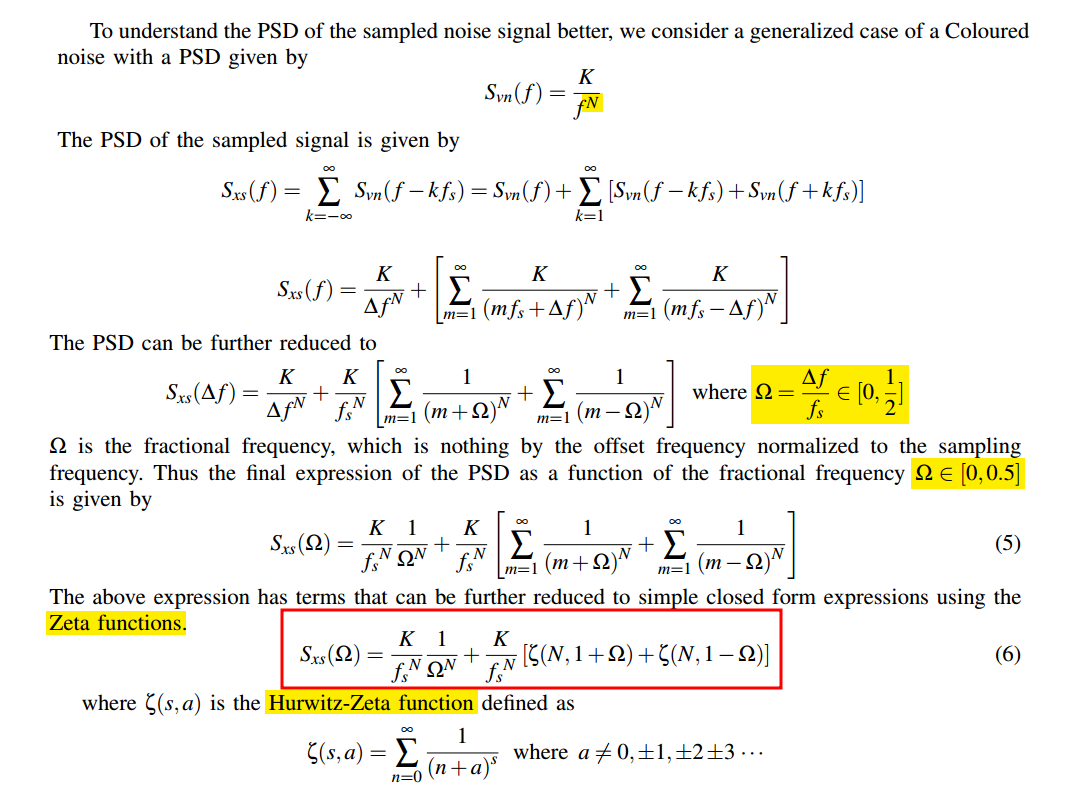
converging PSD
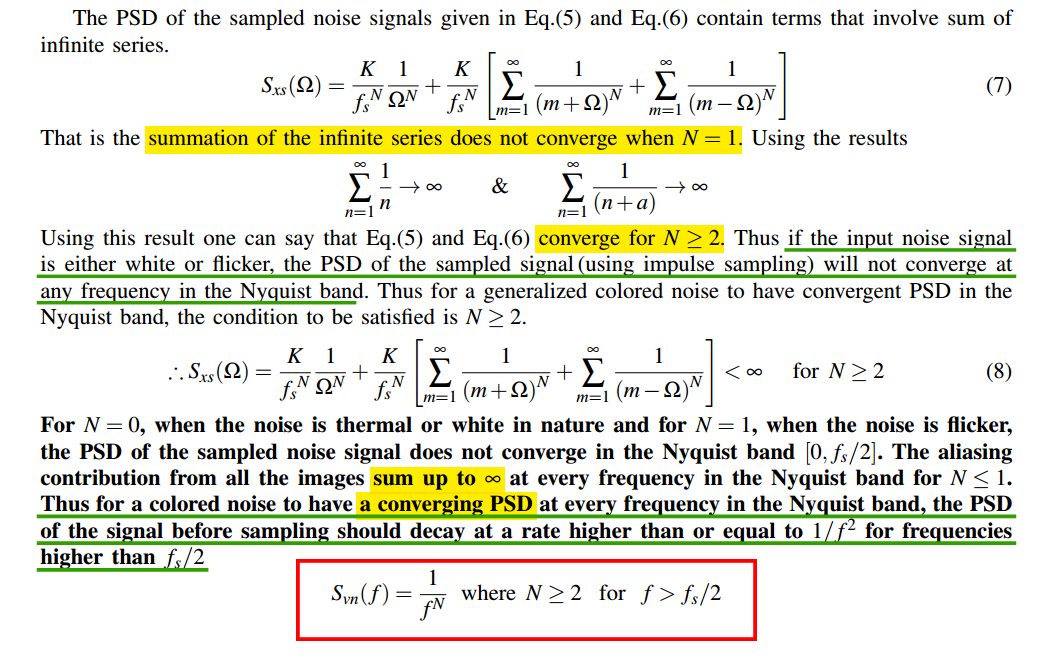
integrated power of the sampled signal in the Nyquist band
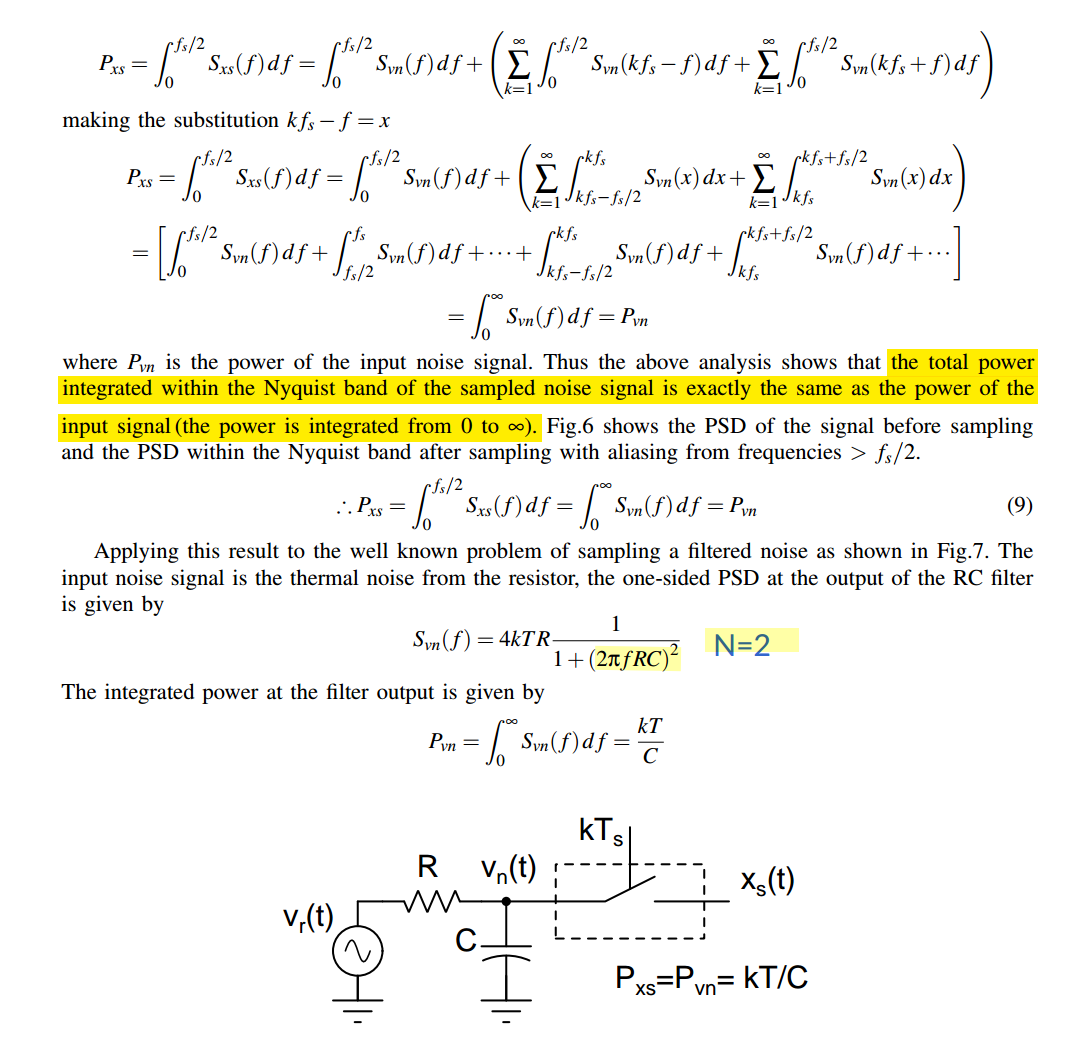
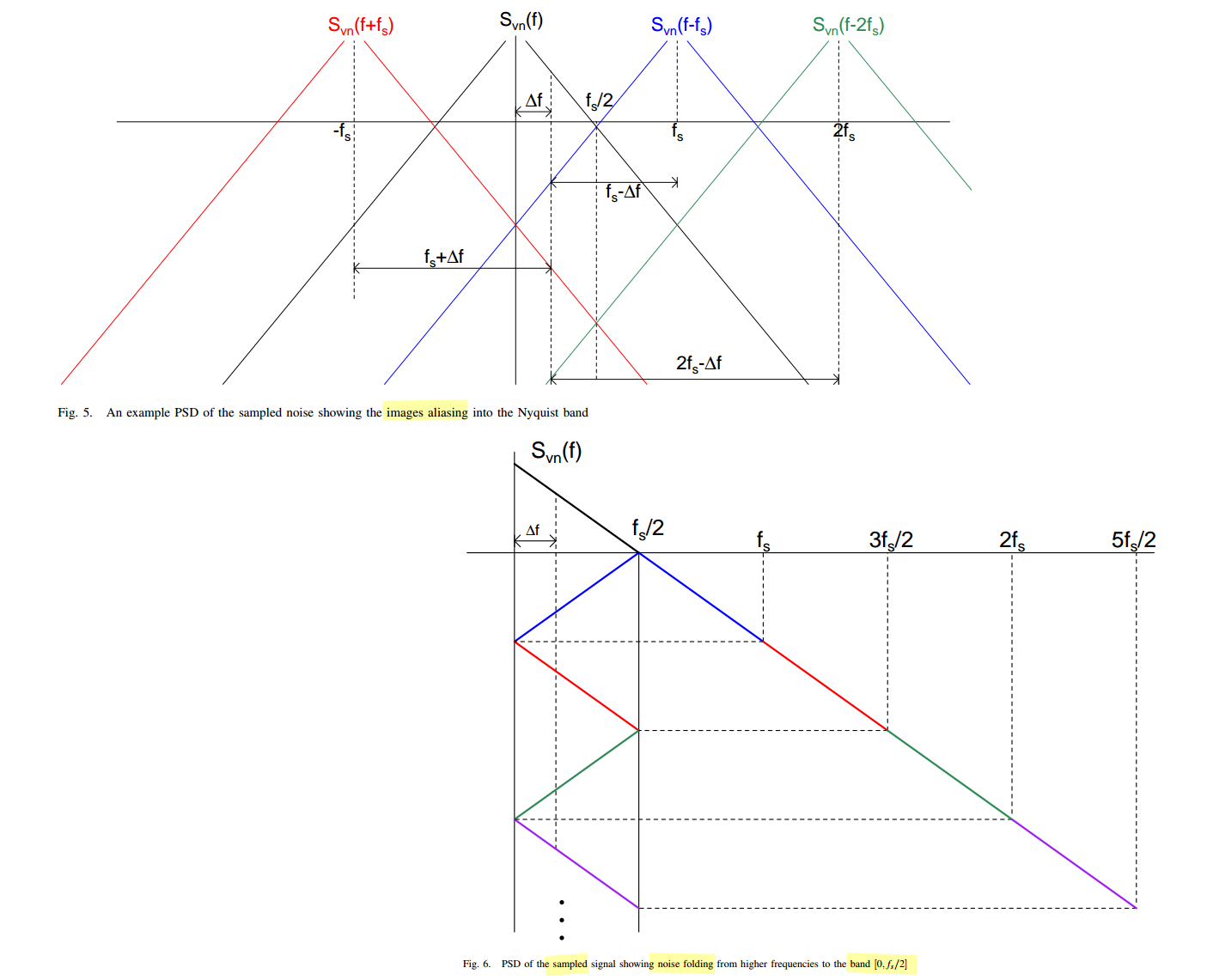
sampling bandlimited white noise
Kundert, Ken. (2006). Simulating Switched-Capacitor Filters with SpectreRF [https://designers-guide.org/analysis/sc-filters.pdf]
Pavan, Schreier and Temes, "Understanding Delta-Sigma Data Converters, Second Edition" ISBN 978-1-119-25827-8
Tania Khanna, ESE568 Fall 2019, Mixed Signal Circuit Design and Modeling URL: https://www.seas.upenn.edu/~ese568/fall2019/
Matt Pharr, Wenzel Jakob, and Greg Humphreys. 2016. Physically Based Rendering: From Theory to Implementation (3rd. ed.). Morgan Kaufmann Publishers Inc., San Francisco, CA, USA.
R. Gregorian and G. C. Temes. Analog MOS Integrated Circuits for Signal Processing. Wiley-Interscience, 1986
Trevor Caldwell, Lecture 9 Noise in Switched-Capacitor Circuits [http://individual.utoronto.ca/trevorcaldwell/course/NoiseSC.pdf]
Christian-Charles Enz. High precision CMOS micropower amplifiers [pdf]
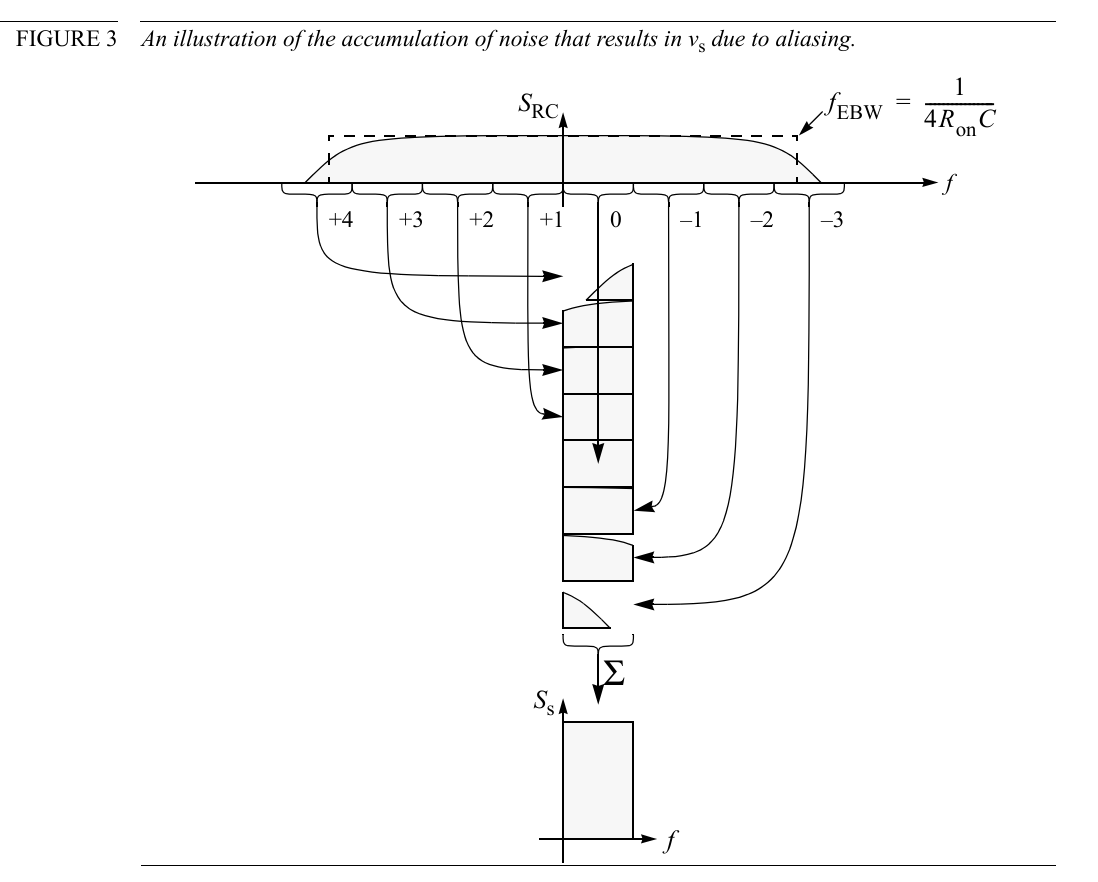
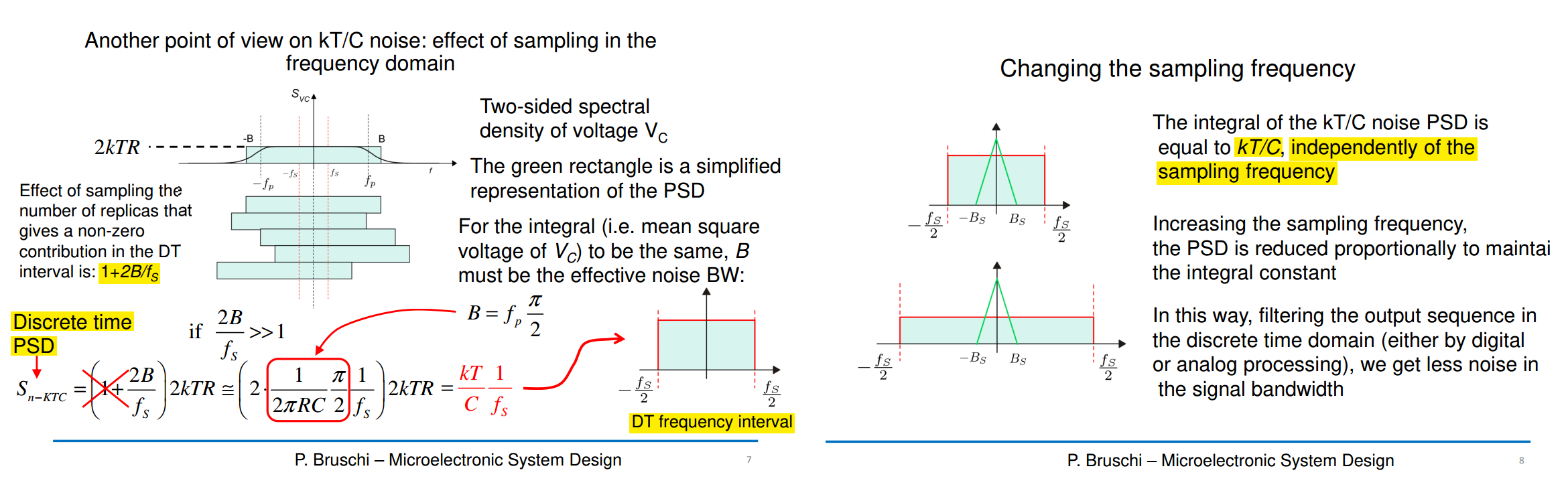
The aliasing of the noise, or noise folding, plays an important role in switched-capacitor as it does in all switched-capacitor filters
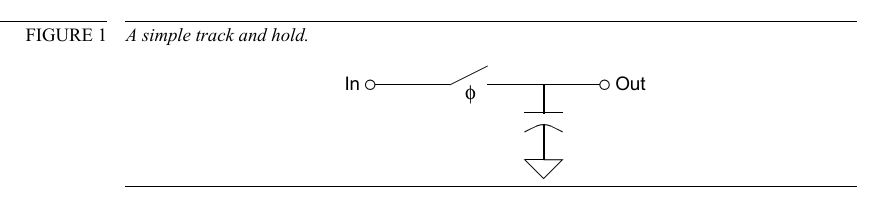
Assume for the moment that the switch is always closed (that there is no hold phase), the single-sided noise density would be
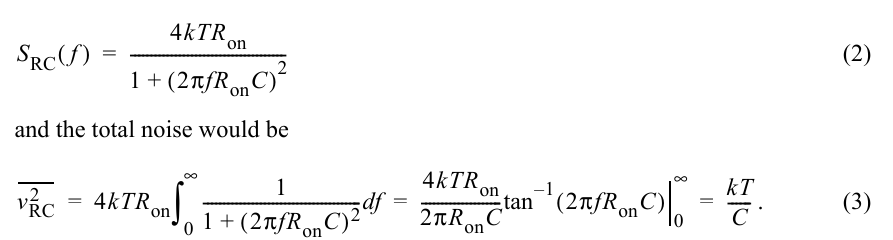
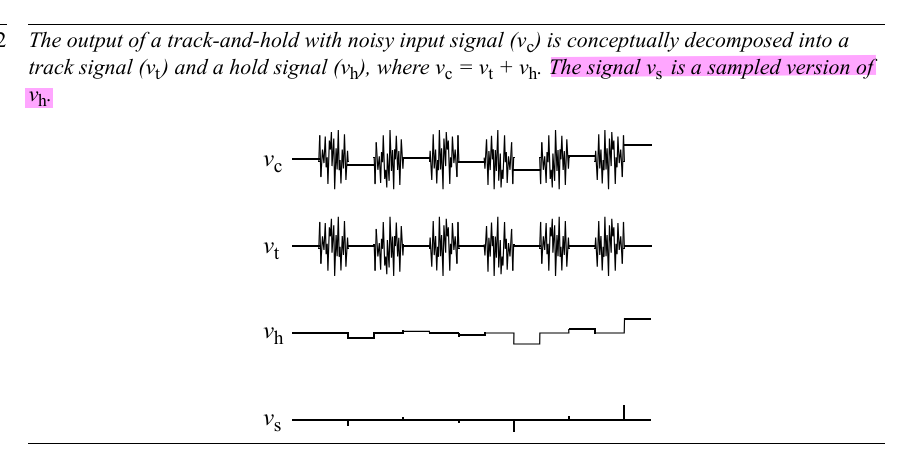
\(v_s[n]\) is the sampled version of \(v_{RC}(t)\), i.e. \(v_s[n]= v_{RC}(nT_C)\) \[ S_s(e^{j\omega}) = \frac{1}{T_C} \sum_{k=-\infty}^{\infty}S_{RC}(j(\frac{\omega}{T_C}-\frac{2\pi k}{T_C})) \cdot \mathrm{d}\omega \] where \(\omega \in [-\pi, \pi]\), furthermore \(\frac{\mathrm{d}\omega}{T_C}= \mathrm{d}\Omega\) \[ S_s(j\Omega) = \sum_{k=-\infty}^{\infty}S_{RC}(j(\Omega-k\Omega_s)) \cdot \mathrm{d}\Omega \]

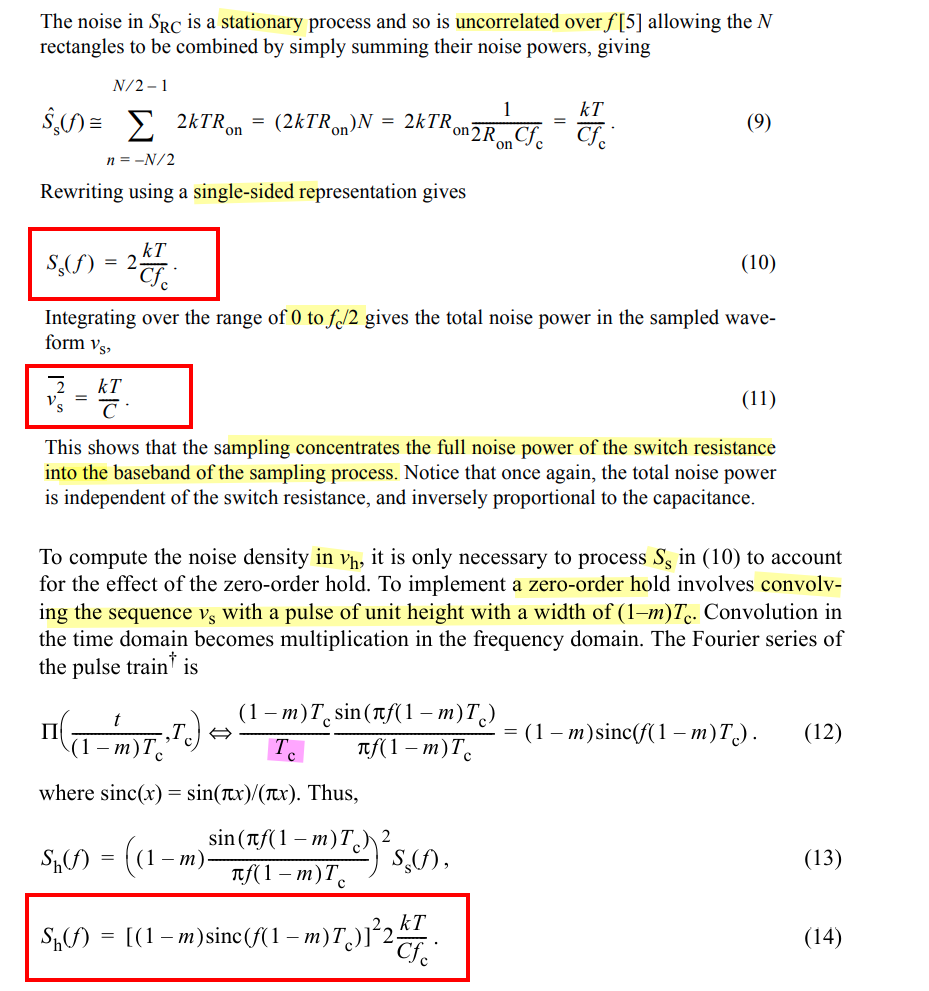
To implement a zero-order hold involves convolving the sequence \(v_s\) with a pulse of unit height with a width of \((1-m)T_c\) and the highlighting \(T_c\) bridge sequence to impulse
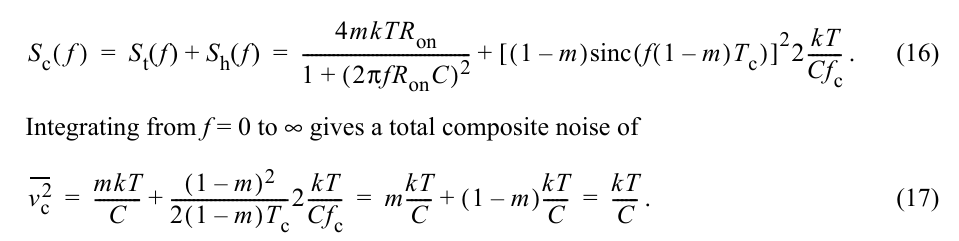
where \(m\) is the duty cycle
\[ \boxed{\color{purple}\overline{v_c^2} = \overline{v_s^2} = \frac{kT}{C}} \]
Below analysis focusing on sampled noise \(v_s\)
Boris Murmann. Noise Analysis in Switched-Capacitor Circuits, ISSCC 2011 / tutorials [slides, transcript]
—. EE315A VLSI Signal Conditioning Circuits [pdf]
—. EE315B VLSI Data Conversion Circuits, Autumn 2013 [pdf]
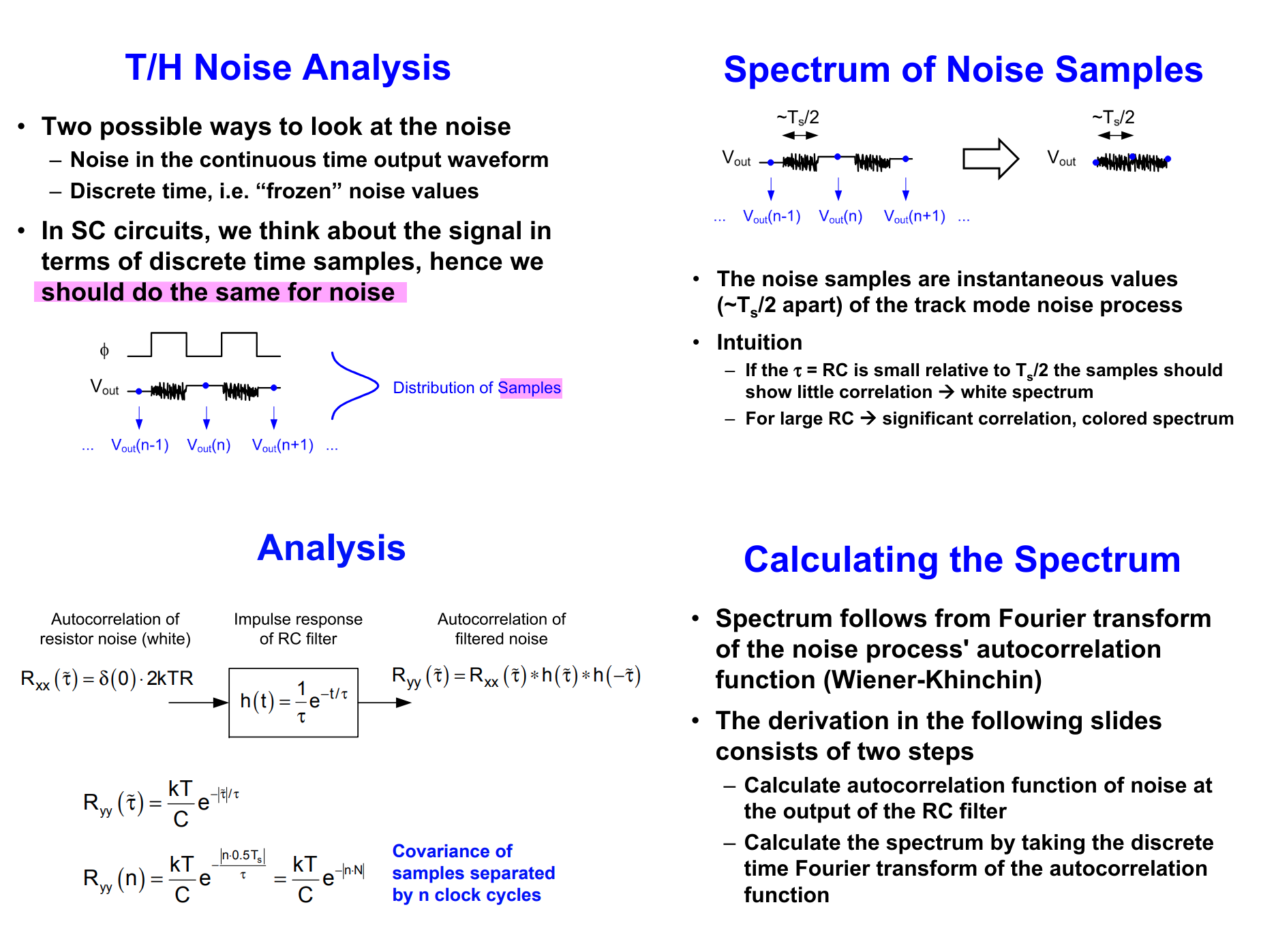
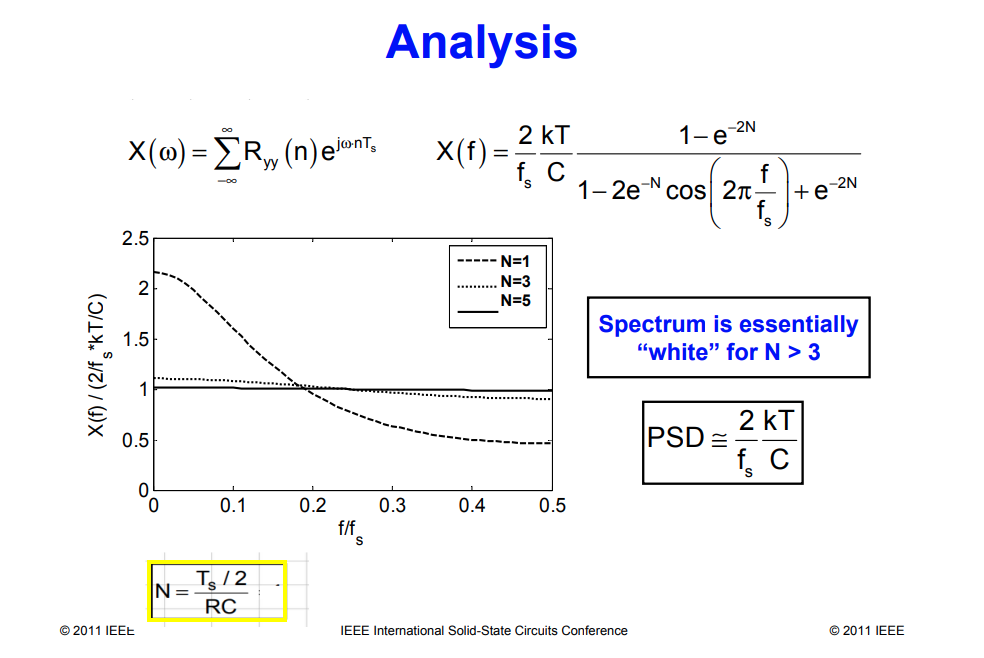
- Calculate autocorrelation function of noise at the output of the RC filter
- Calculate the spectrum by taking the discrete time Fourier transform of the autocorrelation function
Bernhard E. Boser . Advanced Analog Integrated Circuits Switched Capacitor Gain Stages [https://people.eecs.berkeley.edu/~boser/courses/240B/lectures/M05%20SC%20Gain%20Stages.pdf]
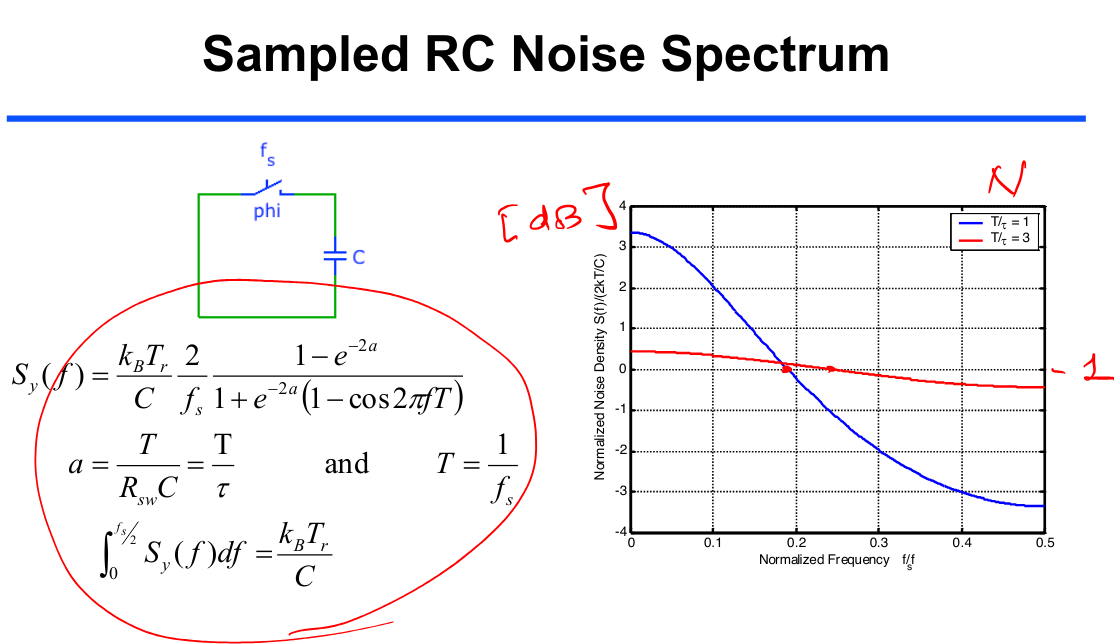
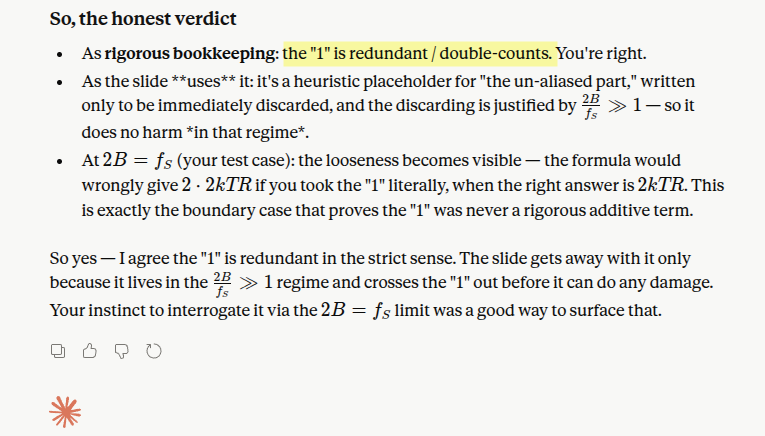
P. Bruschi, Microelectronic System Design, [https://docenti.ing.unipi.it/~a008309/mat_stud/MIXED/2023/Slides_pdf/05_Switches_and_caps.pdf]
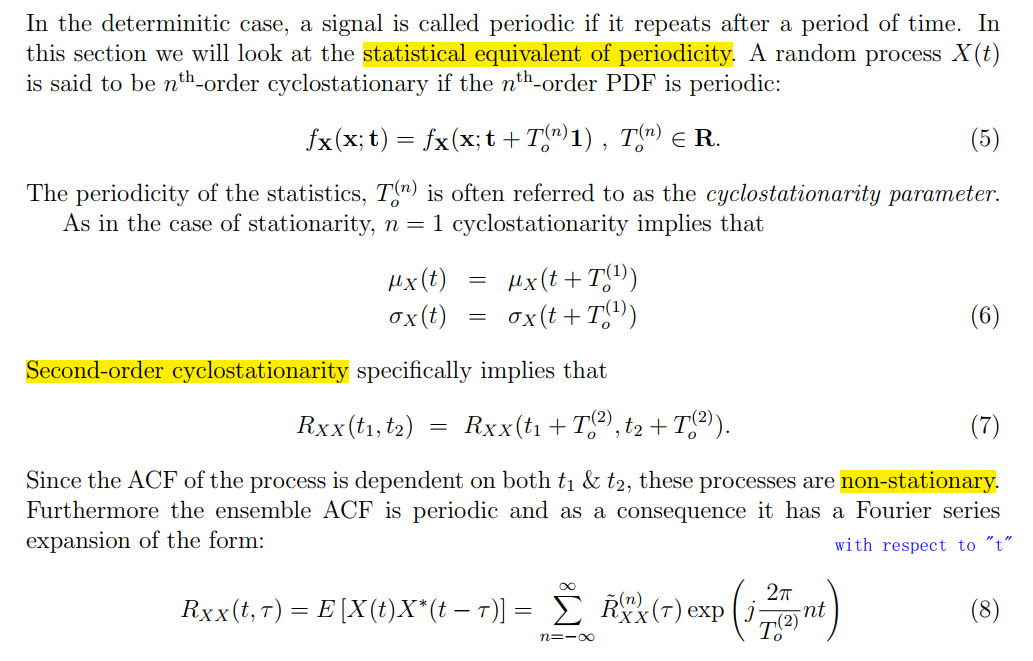
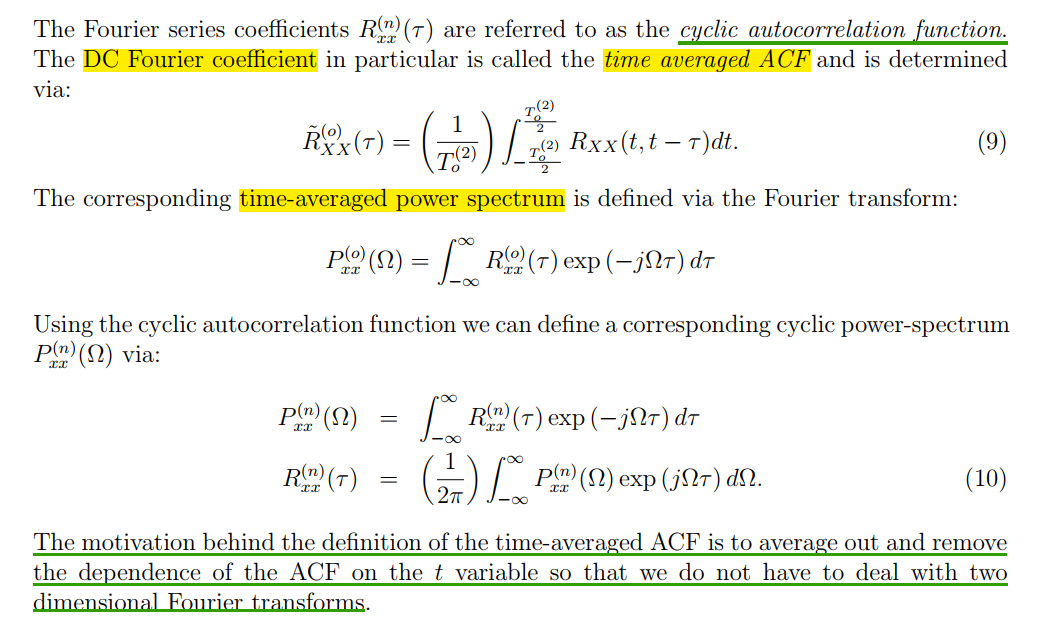
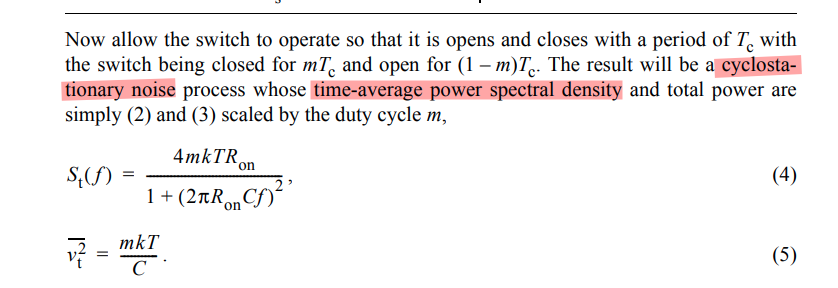
Cyclostationary Noise (Modulated Noise)
[https://ece-research.unm.edu/bsanthan/ece541/cyclo.pdf]
Chembian Thambidurai, "Power Spectral Density of Pulsed Noise Signals" [link]
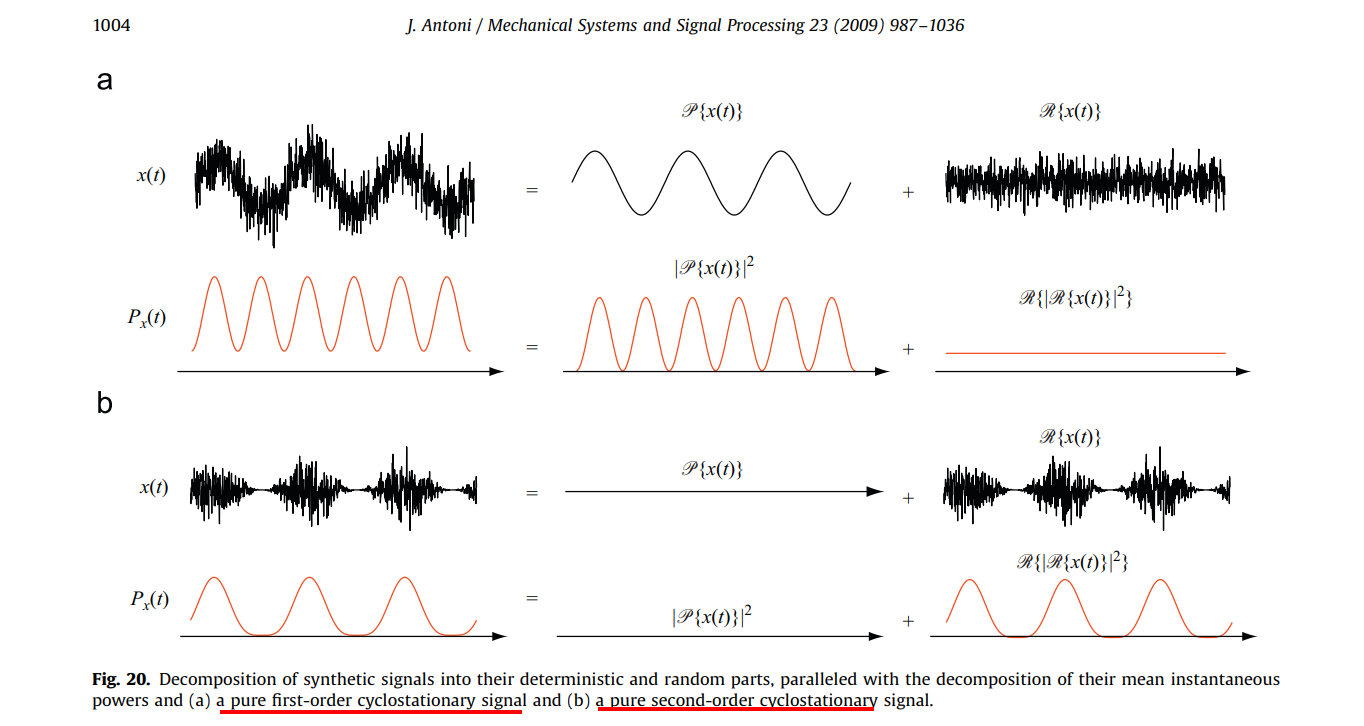
White Noise Modulation
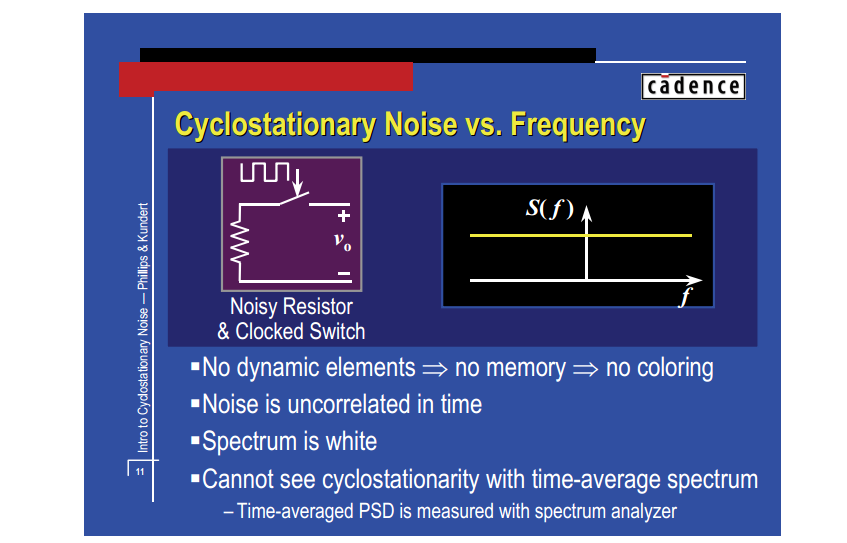
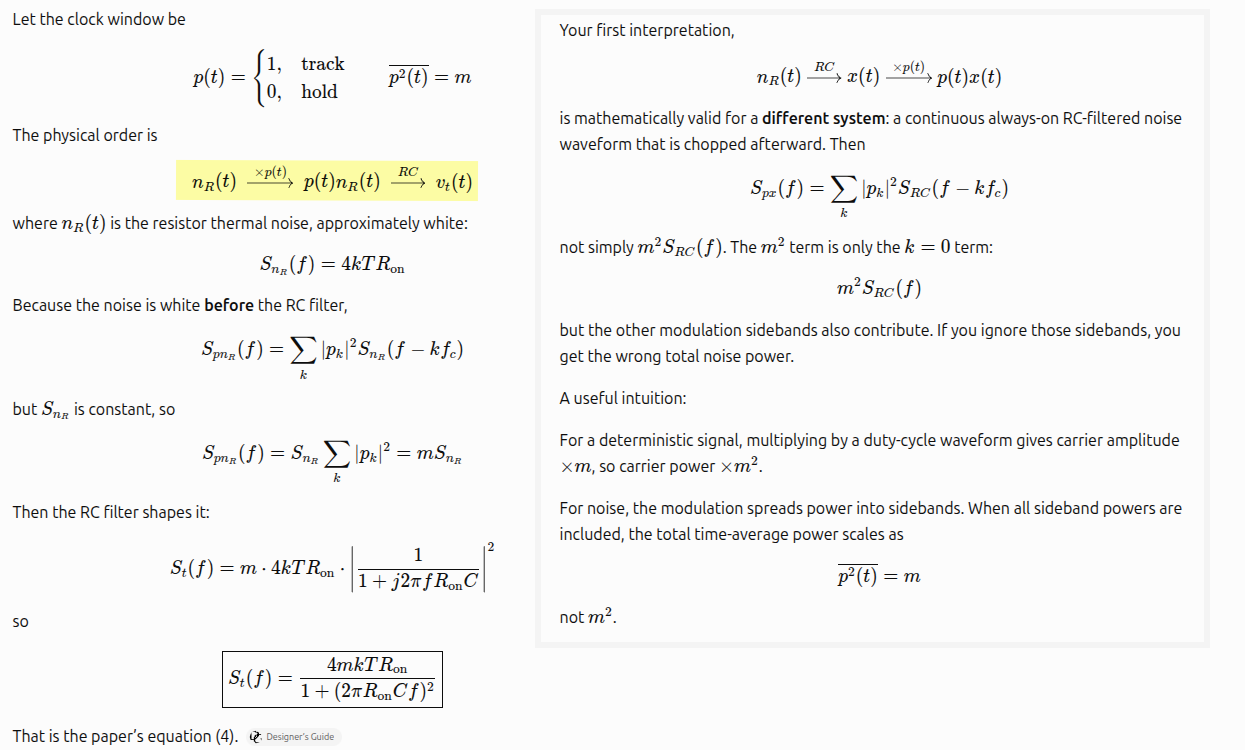
Noisy Resistor & Clocked Switch
\[ v_t (t) = v_i(t)\cdot m_t(t) \]
where \(v_i(t)\) is input white noise, whose autocorrelation is \(A\delta(\tau)\), and \(m_t(t)\) is periodically operating switch, then autocorrelation of \(v_t(t)\) \[ R_t (t_1, t_2) = E[v_t(t_1)\cdot v_t(t_2)] = R_i(t_1, t_2)\cdot m_t(t_1)m_t(t_2) \]
Then \[ R_t(t, t-\tau) = R_i(\tau)\cdot m_t(t)m_t(t-\tau) = A\delta(\tau) \cdot m_t(t)m_t(t-\tau) = A\delta(\tau) \cdot m_t(t) \] Because \(m_t(t)=m_t(t+T)\), \(R_t(t, t-\tau)\) is is periodic in the variable \(t\) with period \(T\)
The time-averaged ACF is denoted as \(\tilde{R_t}(\tau)\)
\[ \tilde{R}_{t}(\tau) = m\cdot A\delta(\tau) \] That is, \[ \boxed{S_t(f) = m\cdot S_{A}(f)} \]
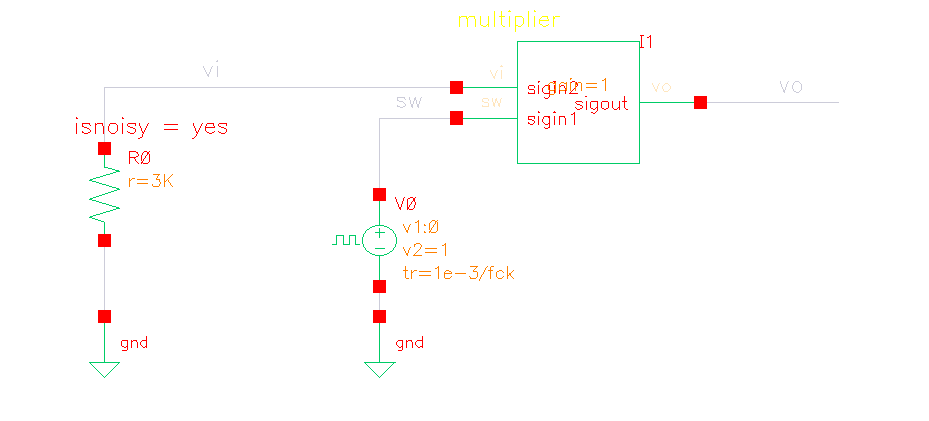
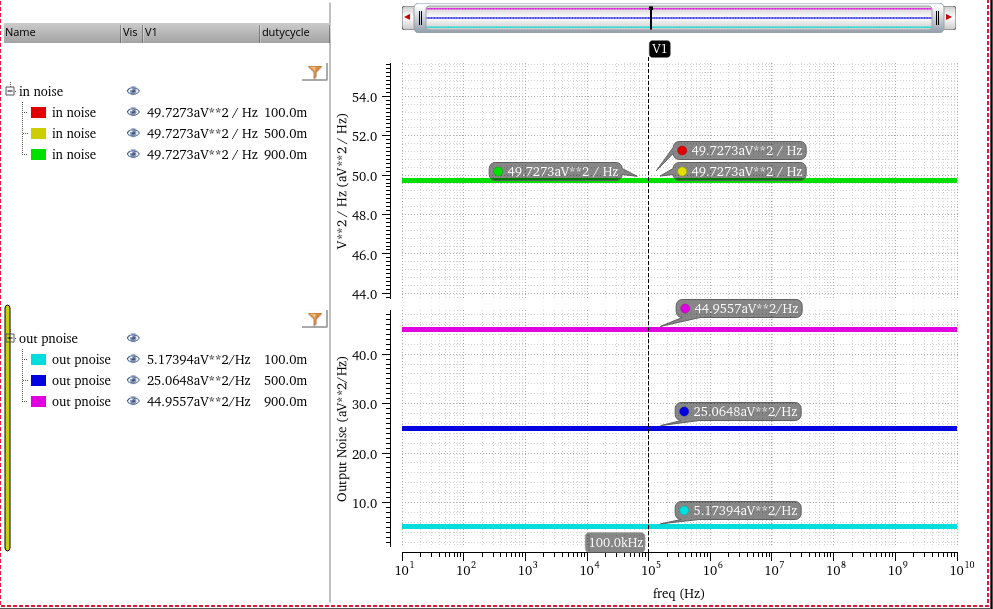
alternative method, inspired by Claude
 \[
\boxed{S_O=H^2*S_I=S_I\sum_{m=-\infty}^{\infty}|c_m|^2}
\] with CTFS's Parseval's Relation — \(\frac{1}{T} \int_{0}^{T} \vert{}f(x)\vert{}^2 \,
dx = \sum_{n=-\infty}^{\infty} \vert{}c_n\vert{}^2\) \[
\sum_{m=-\infty}^{\infty}|c_m|^2 = \mathcal{D}\cdot \mathcal{h}^2
\] where \(\mathcal{D}\) is
duty cycle and \(\mathcal{h}\) is height of periodic
pulse
\[
\boxed{S_O=H^2*S_I=S_I\sum_{m=-\infty}^{\infty}|c_m|^2}
\] with CTFS's Parseval's Relation — \(\frac{1}{T} \int_{0}^{T} \vert{}f(x)\vert{}^2 \,
dx = \sum_{n=-\infty}^{\infty} \vert{}c_n\vert{}^2\) \[
\sum_{m=-\infty}^{\infty}|c_m|^2 = \mathcal{D}\cdot \mathcal{h}^2
\] where \(\mathcal{D}\) is
duty cycle and \(\mathcal{h}\) is height of periodic
pulse
Then, Two-sided PSD is \[ \boxed{S_O=S_I\cdot \mathcal{D}\cdot \textcolor{blue}{\mathcal{h}^2}} \]
Colored Noise Modulation
 \[
\tilde{R_t}(\tau) = R_i(\tau)\cdot m_{tac}(\tau)
\]
\[
\tilde{R_t}(\tau) = R_i(\tau)\cdot m_{tac}(\tau)
\]
where \(m_t(t)m_t(t-\tau)\) averaged on \(t\) is denoted as \(m_{tac}(\tau)\) or \(\overline{m_t(t)m_t(t-\tau)}\)
The DC value of \(m_{tac}(\tau)\) can be calculated as below
for \(m\le 0.5\), the DC value of \(m_{tac}(\tau)\) \[ \frac{m\cdot mT}{T} = m^2 \]
for \(m\gt 0.5\), the DC value of \(m_{tac}(\tau)\) \[ \frac{(m+2m-1)(1-m)T + (2m-1)\{mT -(1-m)T\}}{T} = m^2 \]
Therefore, time-average power spectral density and total power are scaled by \(m^2\) in fundamental frequency sideband
\[ \boxed{S_t(f) = m^2\cdot S_{A}(f)} \]
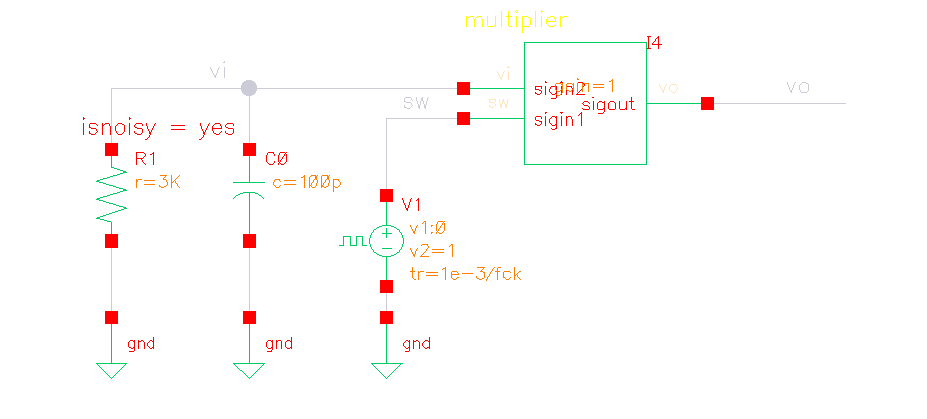
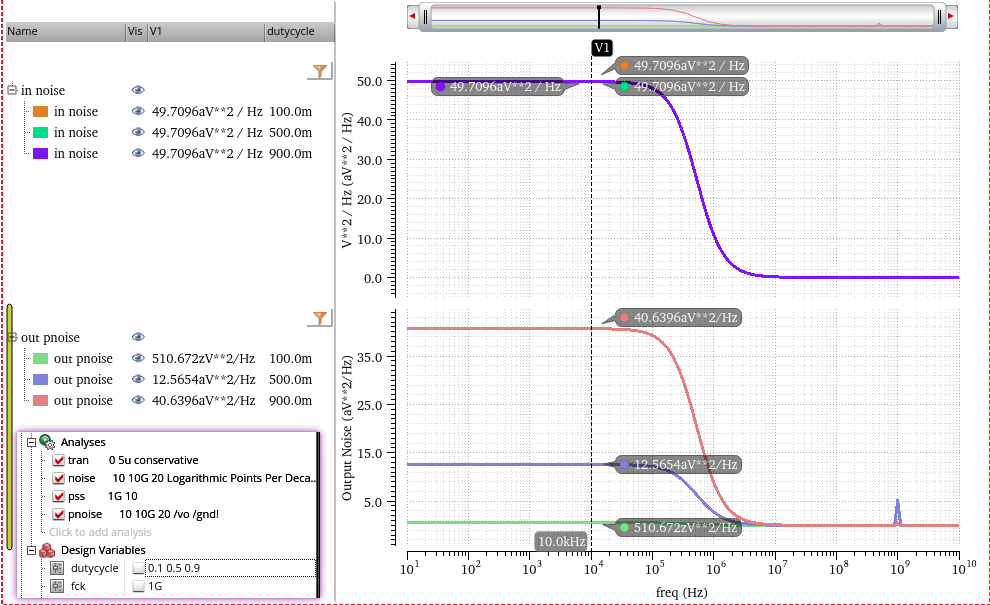
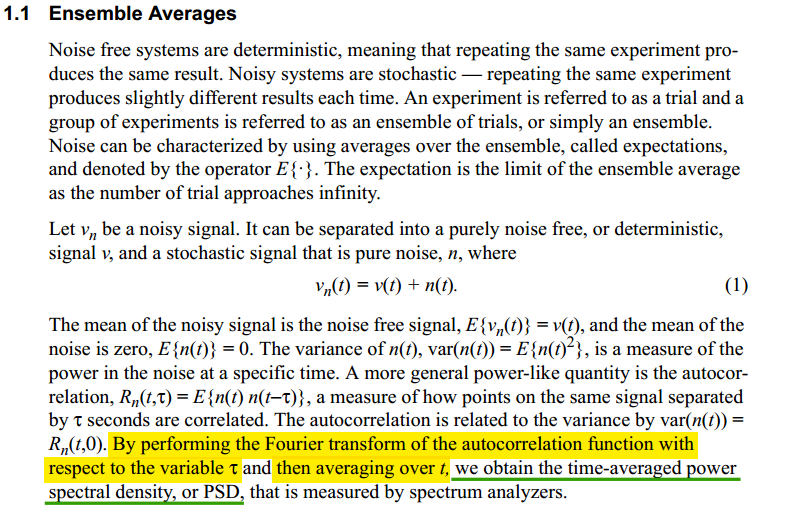
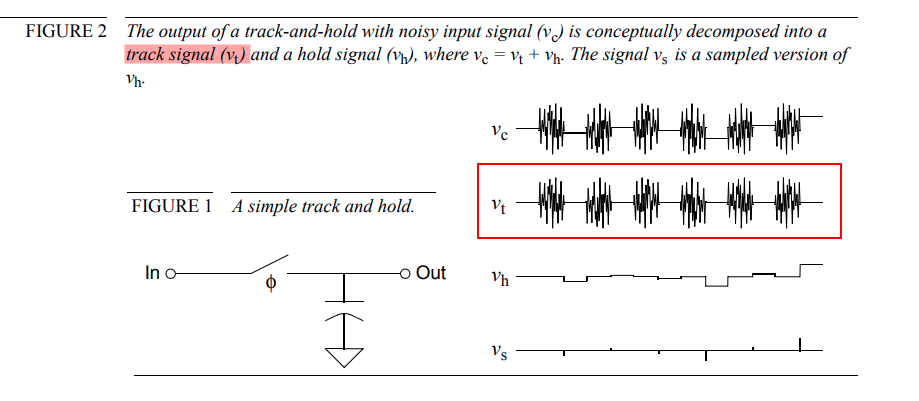
Track signal in Switched-Capacitor
 \[
\color{blue}\boxed{\text{switch thermal noise is modulated by the clock
first, then shaped by the RC low-pass}}
\]
\[
\color{blue}\boxed{\text{switch thermal noise is modulated by the clock
first, then shaped by the RC low-pass}}
\] 
track signal pnoise (sc)
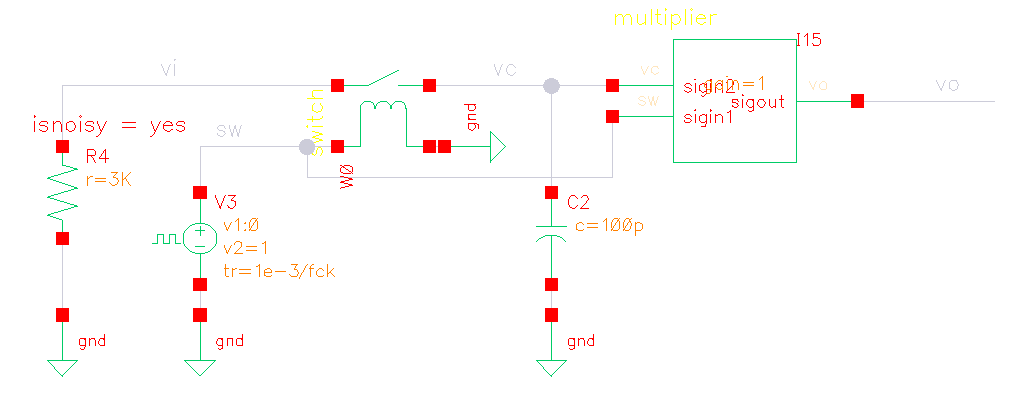
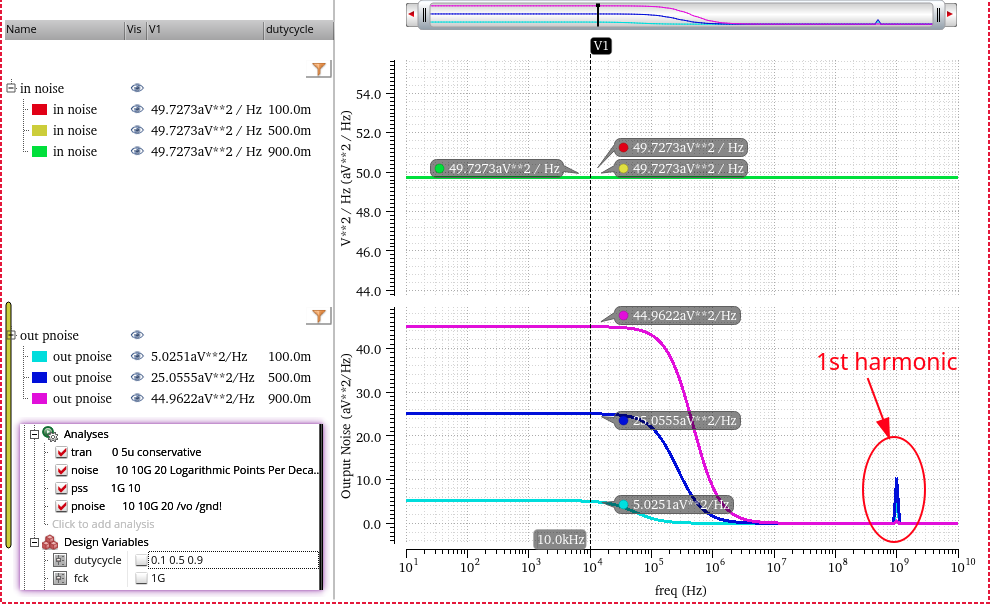
zoom in first harmonic by linear step of pnoise
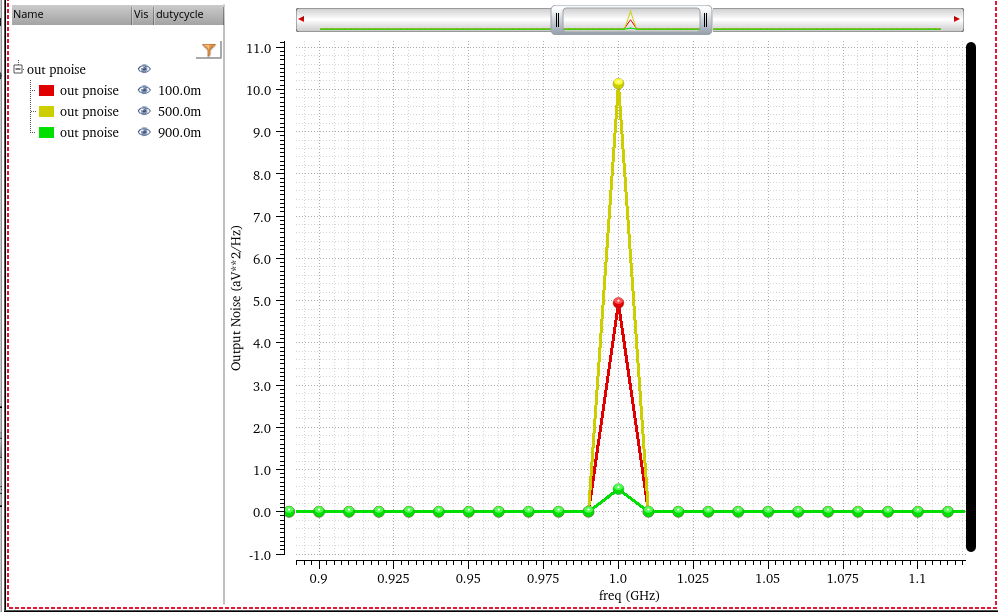
decreasing the rising/falling time of clock, the harmonics still retain
equivalent circuit for pnoise (eq)
- thermal noise of R is modulated at first
- then filtered by ideal filter
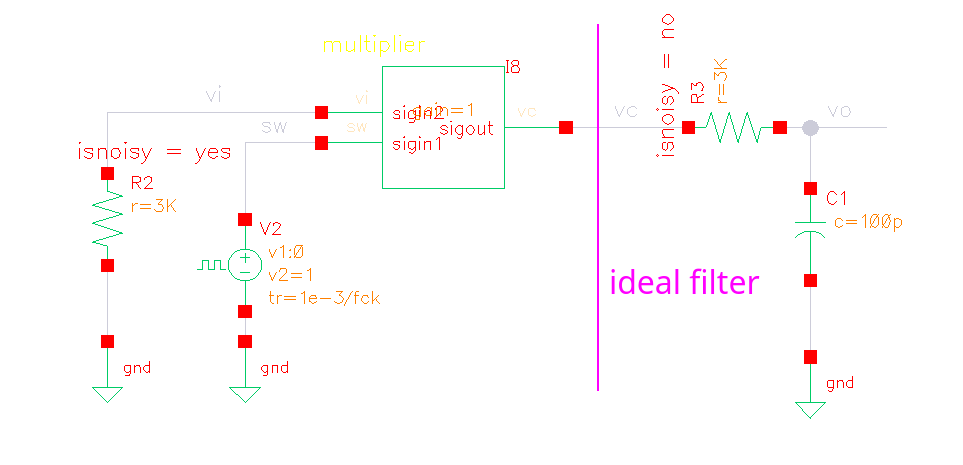
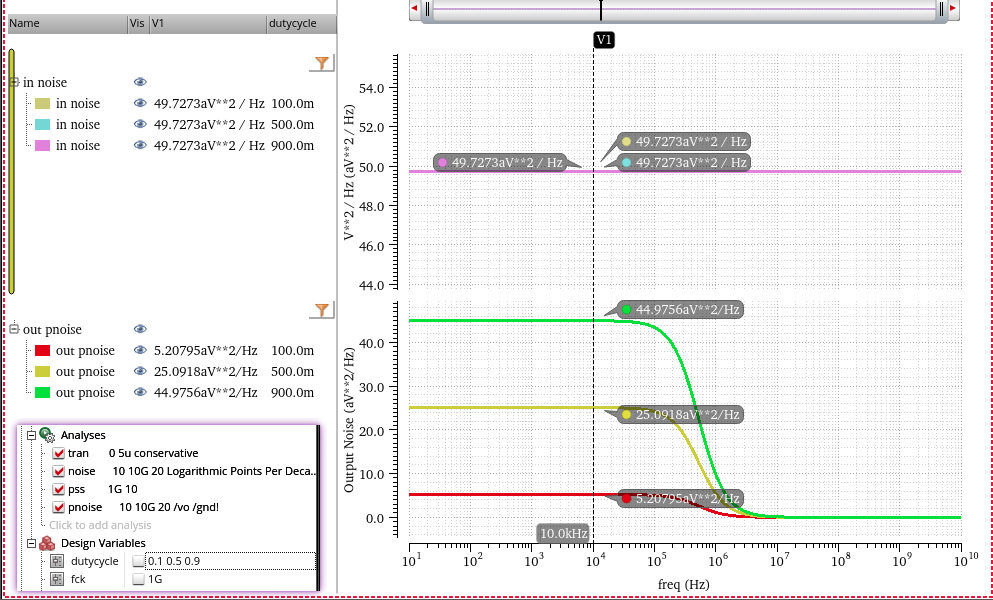
sc vs eq
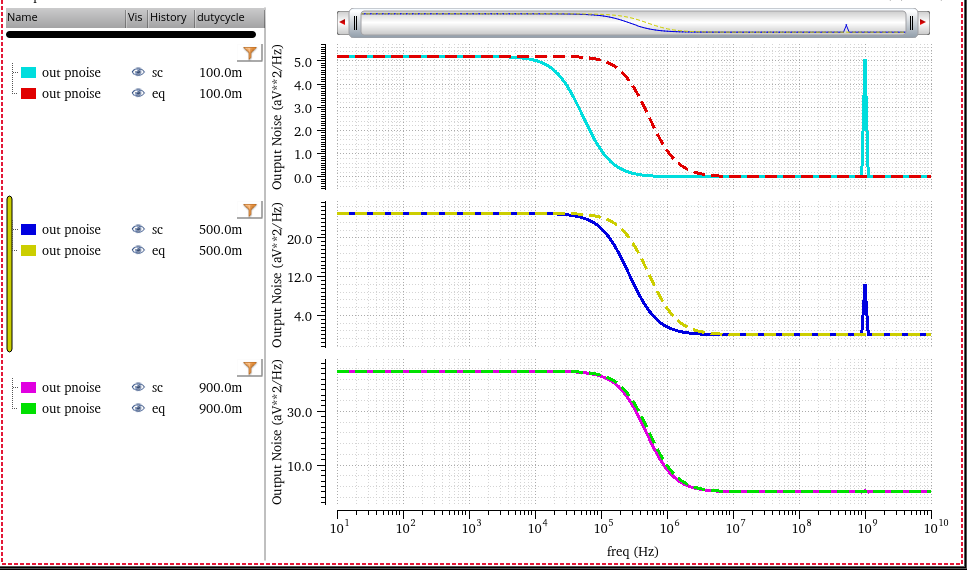
- sc: harmonic distortion
- eq: no harmonic distortion
Non-Stationary Processes (Comparator)
T. Sepke, P. Holloway, C. G. Sodini and H. -S. Lee, "Noise Analysis for Comparator-Based Circuits," in IEEE Transactions on Circuits and Systems I: Regular Papers, vol. 56, no. 3, pp. 541-553, March 2009 [https://dspace.mit.edu/bitstream/handle/1721.1/61660/Speke-2009-Noise%20Analysis%20for%20Comparator-Based%20Circuits.pdf]
—. "Comparator design and analysis for comparator-based switched-capacitor circuits." (2006). [https://dspace.mit.edu/handle/1721.1/38925]
| WSS white noise input |  |
 |
| white noise step input |  |
 |
Wide-Sense-Stationary Noise
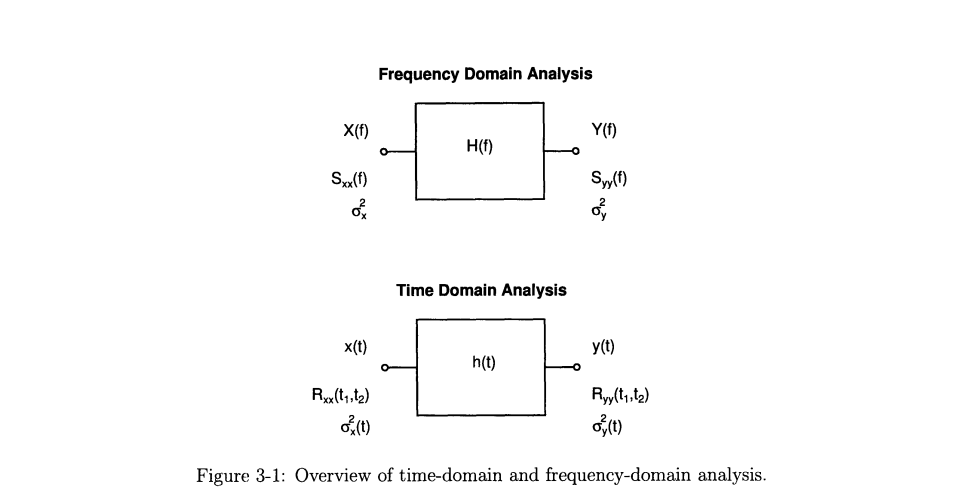
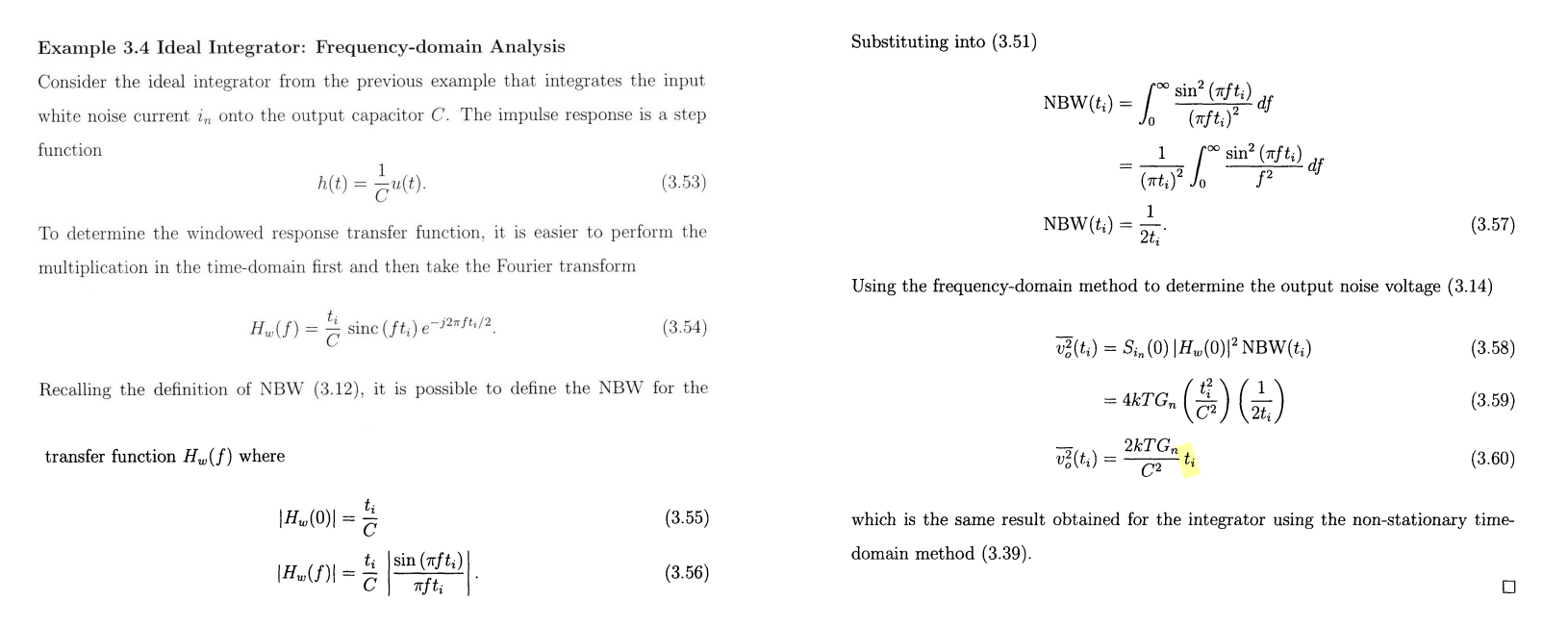
Much like sinusoidal-steady-state signal analysis, steady-state noise analysis methods assume an input \(x(t)\) of infinite duration, which is a Wide-Sense Stationary (WSS) random process
Frequency-domain Analysis
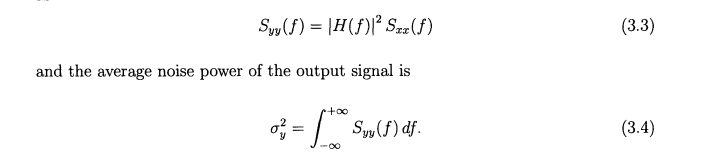
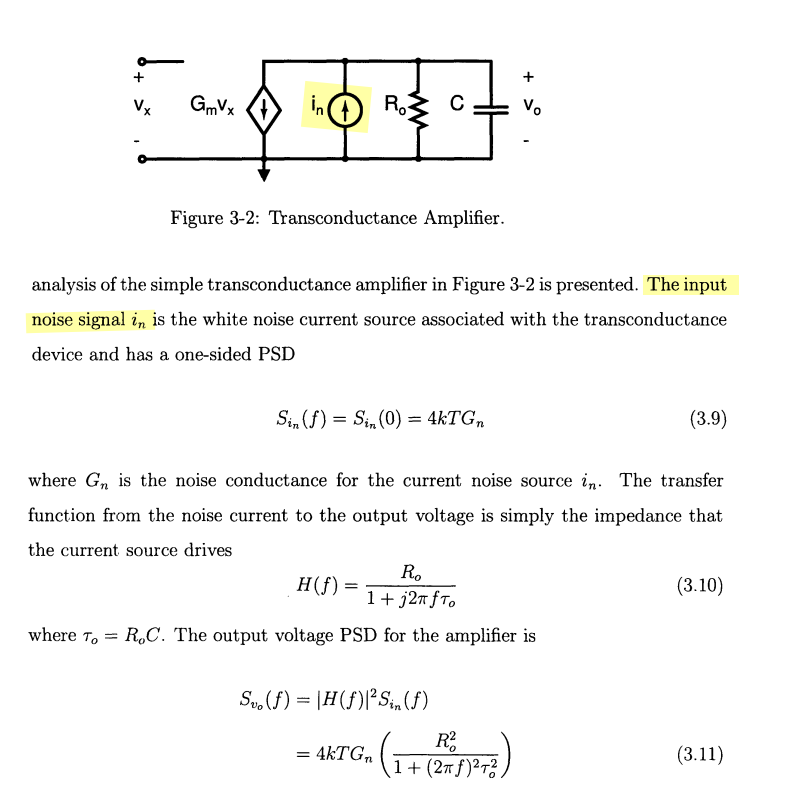
Time-domain Analysis
The output \(y(t)\) of a linear time-invariant (LTI) system \(h(t)\) \[\begin{align} R_{yy}(\tau) &= R_{xx}(\tau)*[h(\tau)*h(-\tau)] \\ &= S_{xx}(0)\delta(\tau) * [h(\tau)*h(-\tau)] \\ &= S_{xx}(0)[h(\tau)*h(-\tau)] \\ &= S_{xx}(0) \int_\alpha h(\alpha)h(\alpha-\tau)d\alpha \end{align}\]
with WSS white noise input \(x(t)\), \(R_{xx}(\tau)=S_{xx}(0)\delta(\tau)\), therefore

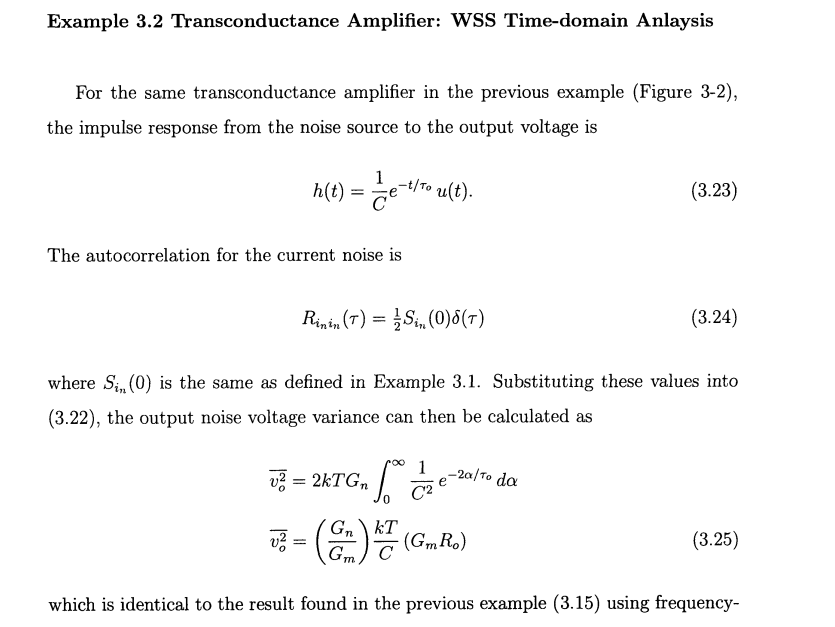
\[ V_o(s) = \frac{1}{C}\frac{RC}{1+sRC}\cdot I_n(s) \overset{\mathcal{L}} {\longrightarrow} \frac{1}{C}e^{-t/\tau_0} \]
where \(\tau_0 = RC\)
Non-stationary Noise
Assuming the noise applied duration is much less than the time constant, the output voltage does not reach steady-state and WSS noise analysis does not apply
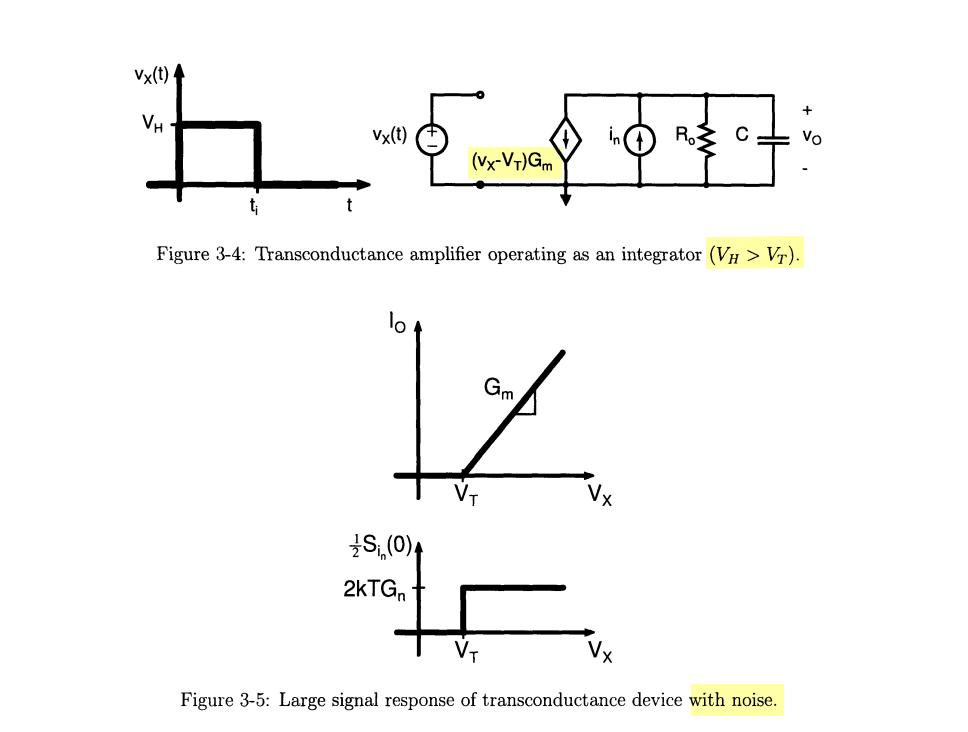
Time-domain Analysis
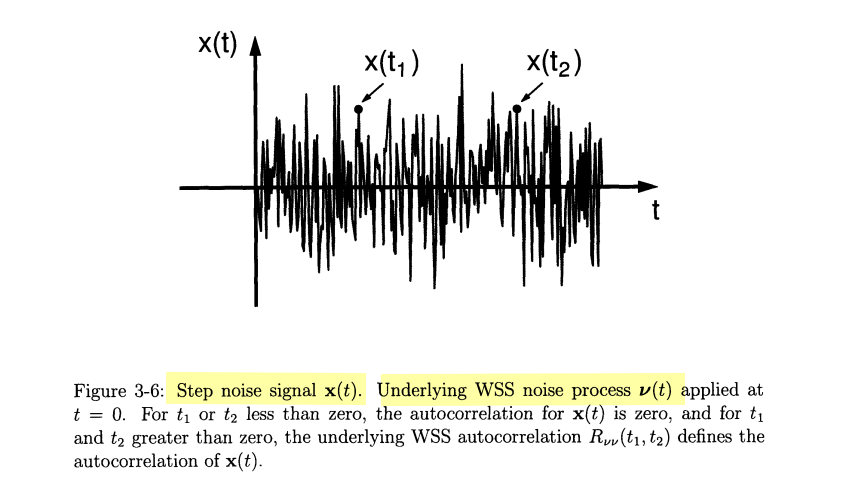
The step noise input \(x(t) = \nu(t)u(t)\) where an underlying
WSS process \(\nu(t)\) \[
R_{xx}(t_1,t_2) = E[x(t_1)x(t_2)] = R_{\nu\nu}(t_1,
t_2)u(t_1)u(t_2)=R_{\nu\nu}(t_1, t_2) \tag{3.28}
\] 
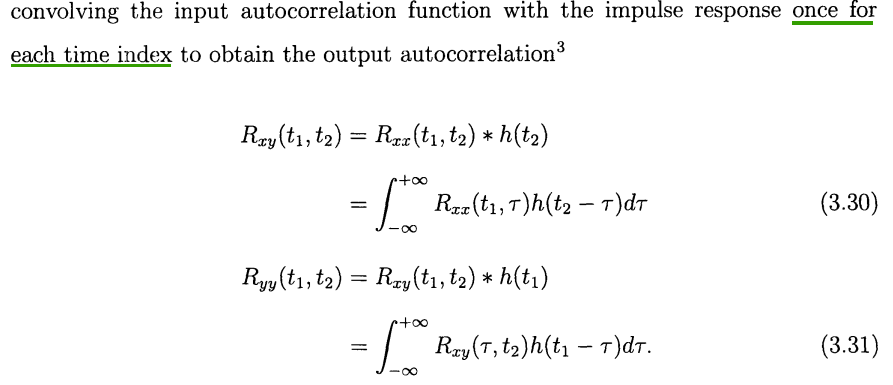
\[ R_{xy}(t_1, t_2) = E[x(t_1)y(t_2)] = E[x(t_1)(x(t_2)*h(t_2))] = E(x(t_1)x(t_2))*h(t_2) = R_{xx}(t_1,t_2)*h(t_2) \]
\[ R_{yy}(t_1,t_2) = E[y(t_1)y(t_2)] = E[(x(t_1)*h(t_1))y(t_2)] = E[x(t_1)y(t_2)]*h(t_1)=R_{xy}(t_1,t_2)*h(t_1) \]

the absolute value of each time index is important for a non-stationary signal, and only the time difference was important for WSS signals
\[\begin{align} R_{yy}(t_1,t_2) &= h(t_1)*R_{\nu\nu}(t_1, t_2)*h(t_2) \\ &= h(t_1)*S_{xx}(0)\delta(t_2-t_1)*h(t_2) \\ &=S_{xx}(0) h(t_1)*(\delta(t_2-t_1)*h(t_2)) \\ &= S_{xx}(0)h(t_1)*h(t_2-t_1) \\ &= S_{xx}(0)\int_\tau h(\tau)h(t_2-t_1+\tau))d\tau \end{align}\]
That is \[ \sigma^2_y (t)= R_{yy}(t_1,t_2)|_{t_1=t_2=t}=S_{xx}(0)\int_{-\infty}^t |h(\tau)|^2d\tau \tag{3.33} \]
\(t\), the upper limit of integration is just intuitive, which lacks strict derivation
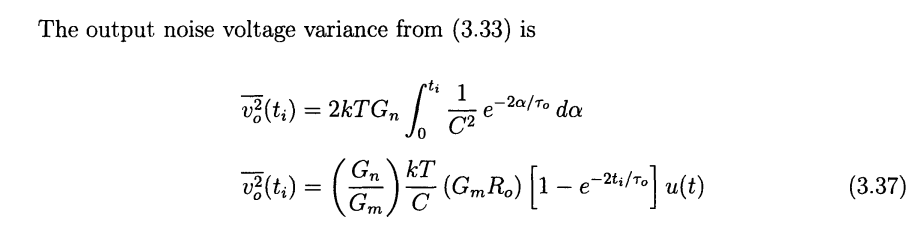
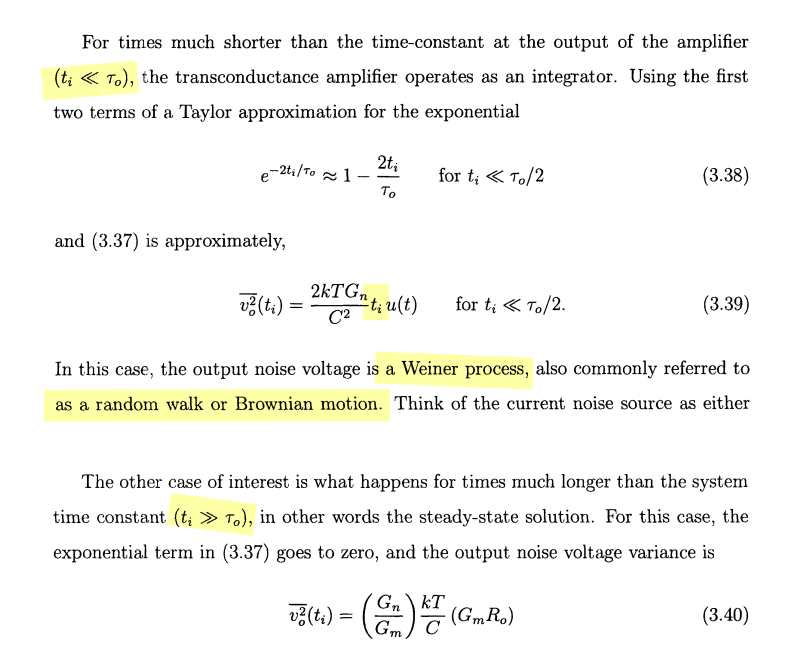
Because stable systems have impulse responses that decay to zero as time goes to infinity, the output noise variance approaches the WSS result as time approaches infinity
Richard Schreier. ECE1371 Advanced Analog Circuits Lecture 8 - COMPARATOR & FLASH ADC DESIGN [http://individual.utoronto.ca/schreier/lectures/2015/8-6.pdf]
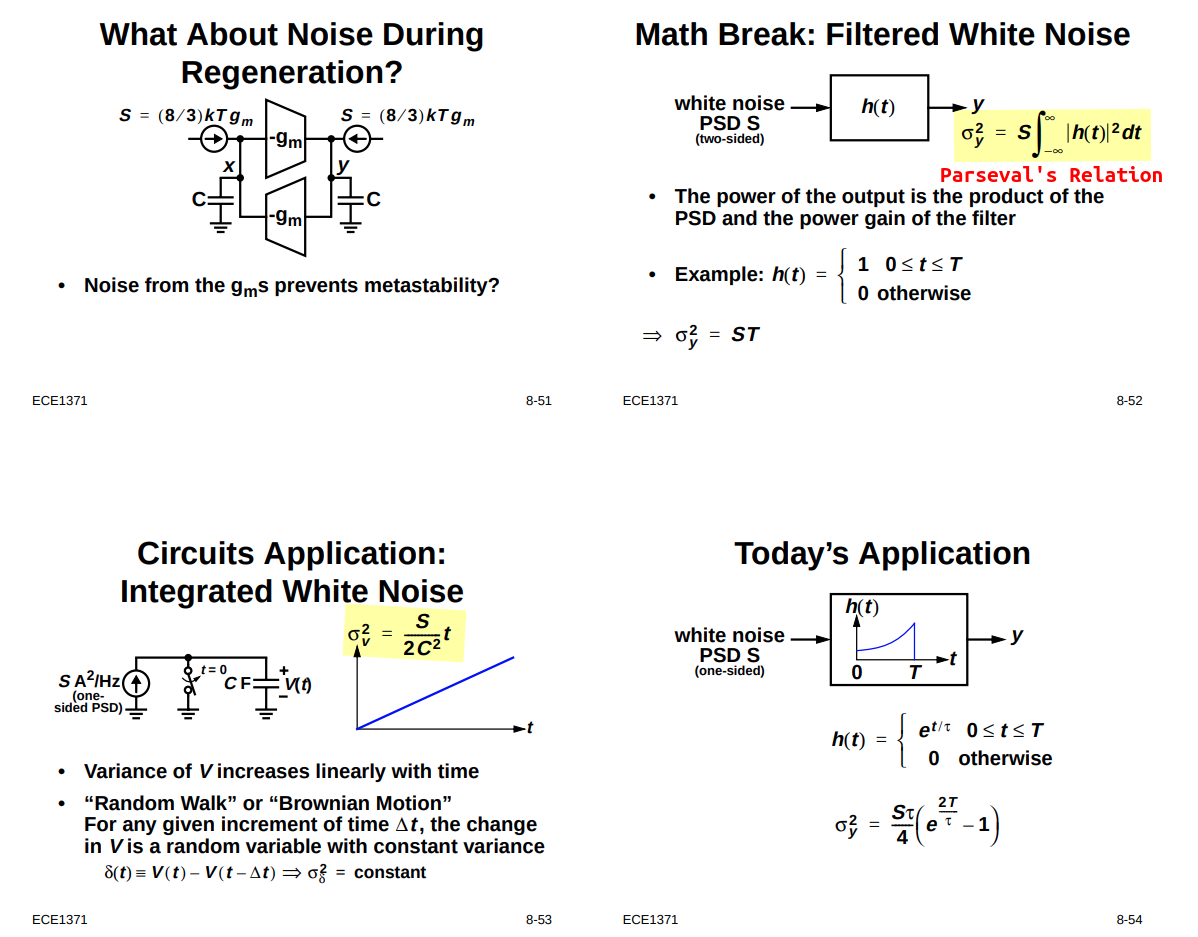
\[ R_{yy}(0) = \frac{1}{2\pi}\int_{-\infty}^{\infty}|H(\omega)|^2S_{xx}(\omega)\mathrm{d}\omega = S \cdot \frac{1}{2\pi}\int_{-\infty}^{\infty}|H(\omega)|^2\mathrm{d}\omega \overset{\text{Parseval's Relation}}{=} S\cdot \int_{-\infty}^{\infty}|h(t)|^2\mathrm{d}t \]
Frequency-domain Analysis
Because the definition of the PSD assumes that the variance of the noise process is independent of time, the PSD of a non-stationary process is not very meaningful
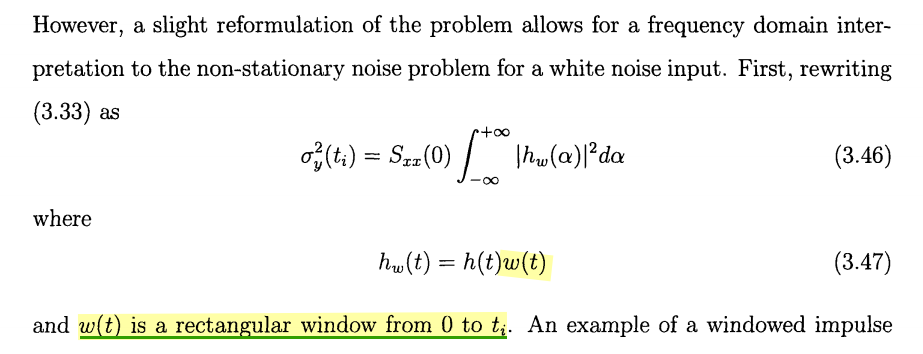
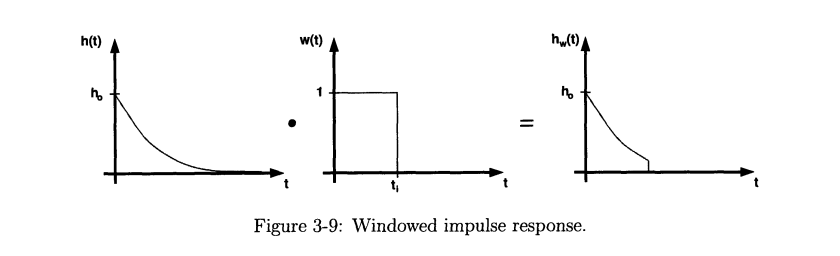
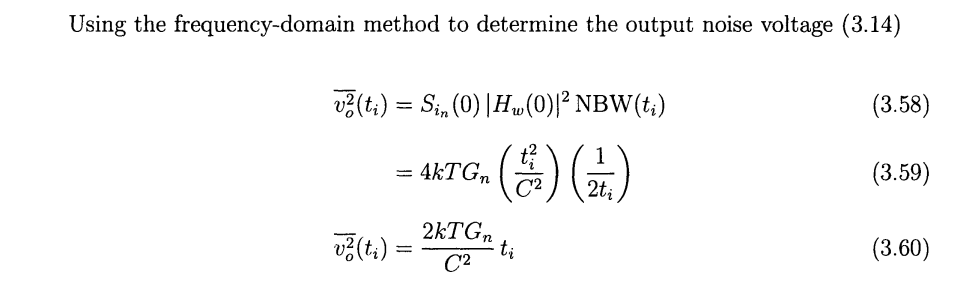
Input Referred Noise
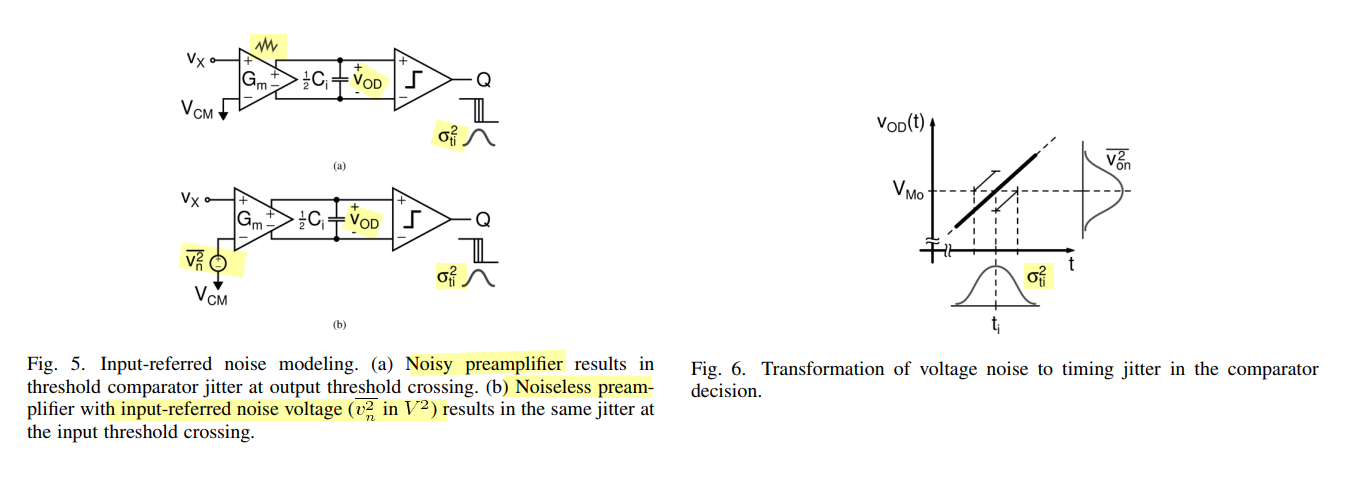
Noise Voltage to Timing Jitter Conversion & noise gain
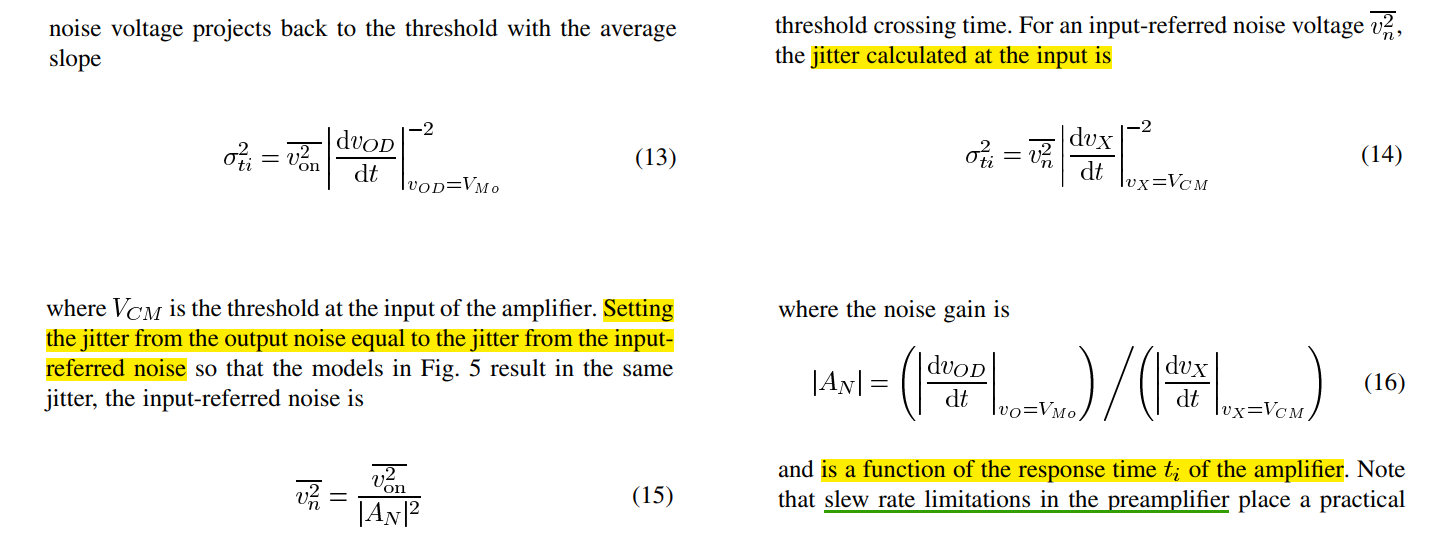
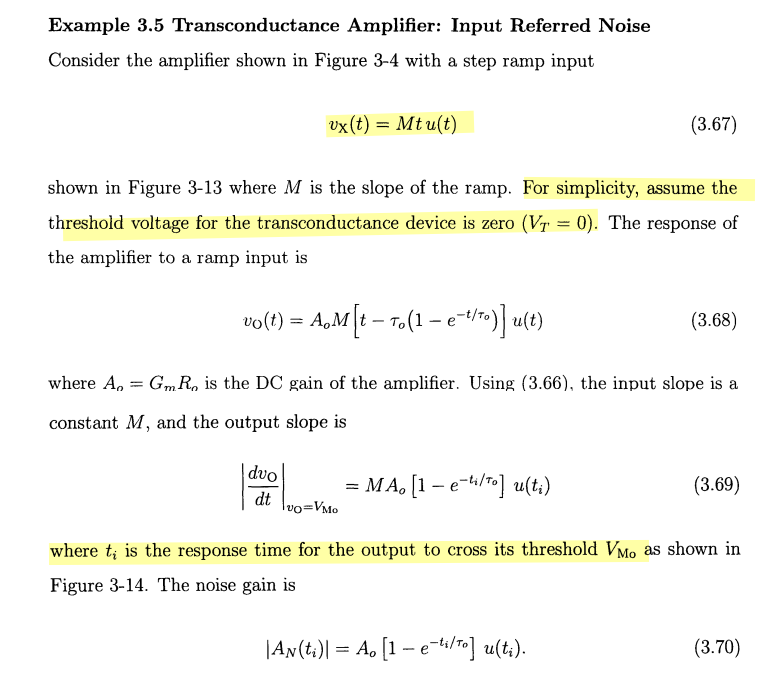
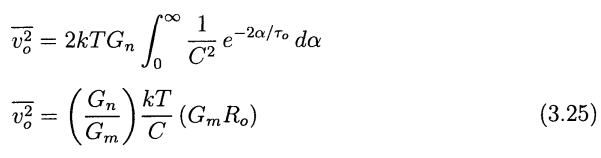
\[\begin{align} \overline{v_n^2}(t_i) &= \frac{\overline{v_{on}^2}}{|A_N|^2} \\ &= \frac{G_n}{G_m}\frac{kT}{C}\frac{1}{A_0}\frac{1+e^{-t_i/\tau_o}}{1-e^{-t_i/\tau_o}} \\ &=4kT\frac{G_n}{G_m^2}\frac{1}{4R_oC} \coth(\frac{t_i}{2\tau_o}) \\ &= 4kTR_n\frac{1}{4\tau_o} \coth(\frac{t_i}{2\tau_o}) \end{align}\]
where \(R_n = \frac{G_n}{G_m^2}\), the equivalent thermal noise resistance

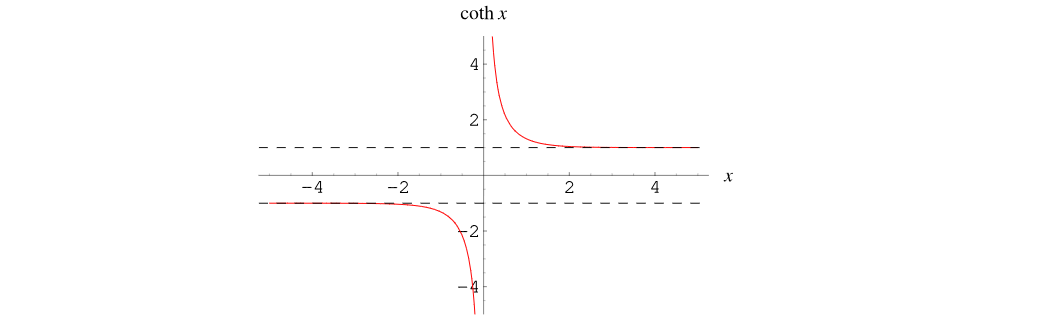
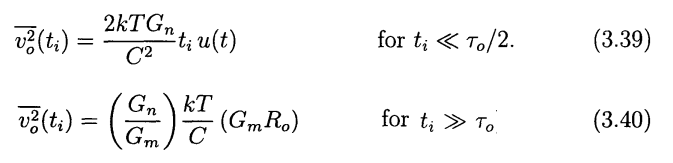
Suppose \(t_i \ll \tau_0\) \[ \overline{v_n^2}(t_i) = 4kTR_n\frac{1}{4\tau_o} \coth(\frac{t_i}{2\tau_o}) \approx 4kTR_n\frac{1}{4\tau_o} \frac{1 + (1-\frac{t_i}{\tau_0})}{1 - (1-\frac{t_i}{\tau_0})} =4kTR_n \cdot \frac{1}{2t_i} \]
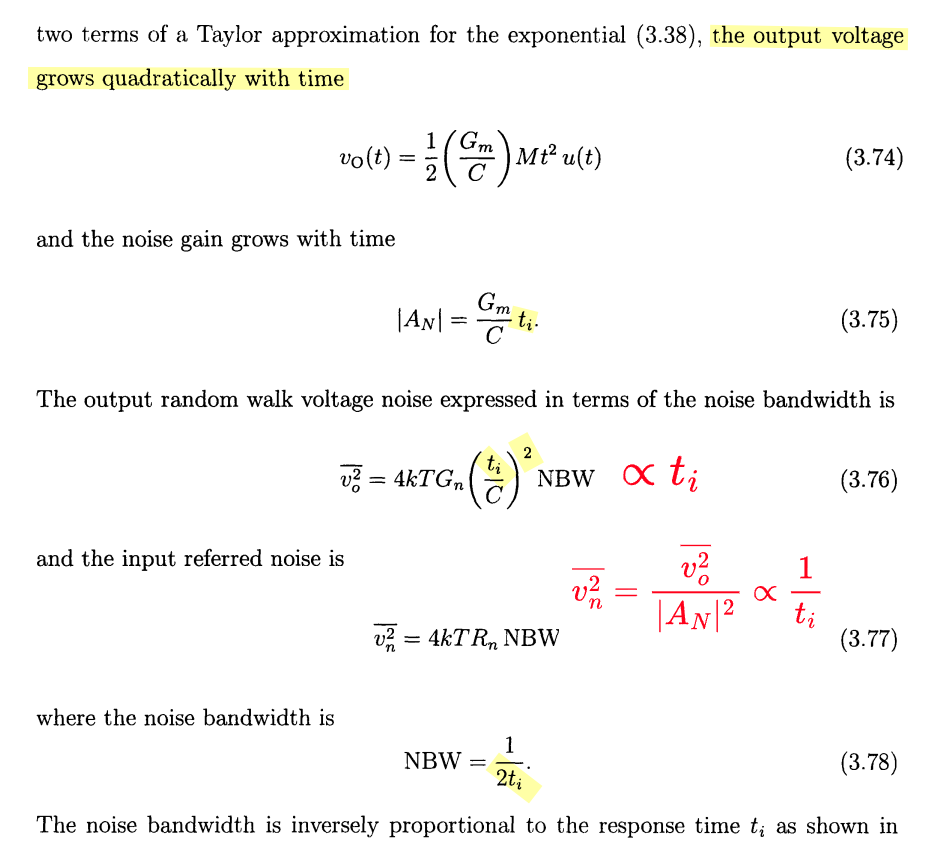
Suppose \(t_i \gg \tau_0\) \[ \overline{v_n^2}(t_i) = 4kTR_n\frac{1}{4\tau_o} \coth(\frac{t_i}{2\tau_o}) \approx 4kTR_n\frac{1}{4\tau_o} = \frac{G_n}{G_m}\frac{kT}{C}\frac{1}{A_0} \] As expected, the input referred noise voltage is \(kT/C\) noise
Windowed Integrals of Noise
A. A. Abidi, "Phase Noise and Jitter in CMOS Ring Oscillators," in IEEE Journal of Solid-State Circuits, vol. 41, no. 8, pp. 1803-1816, Aug. 2006 [pdf]
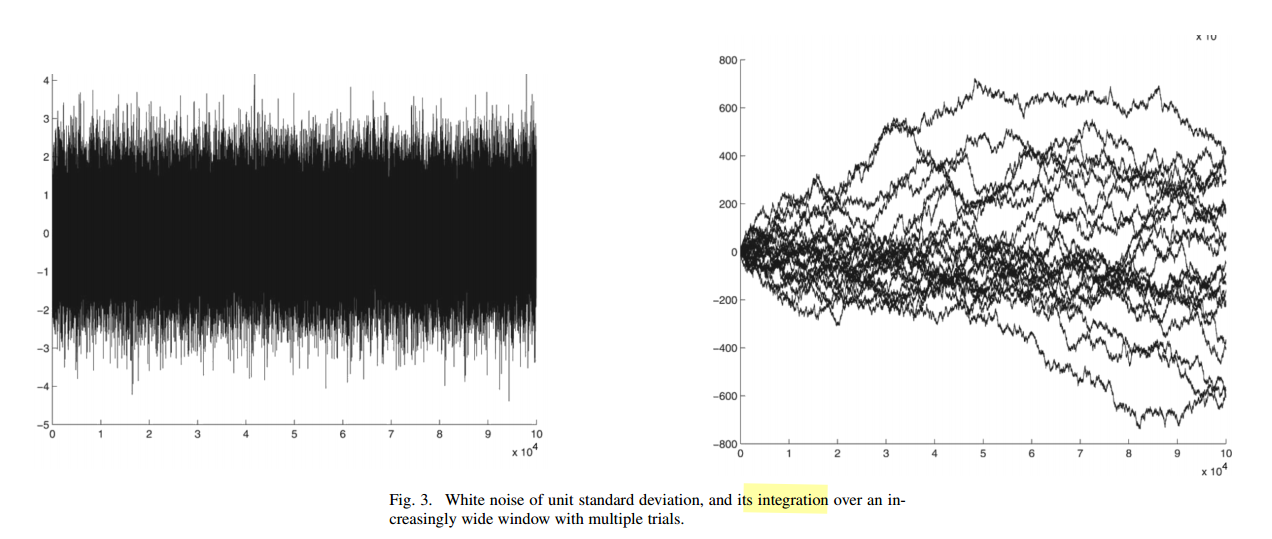
Lossless Integral
a noise current integrates onto a capacitor only
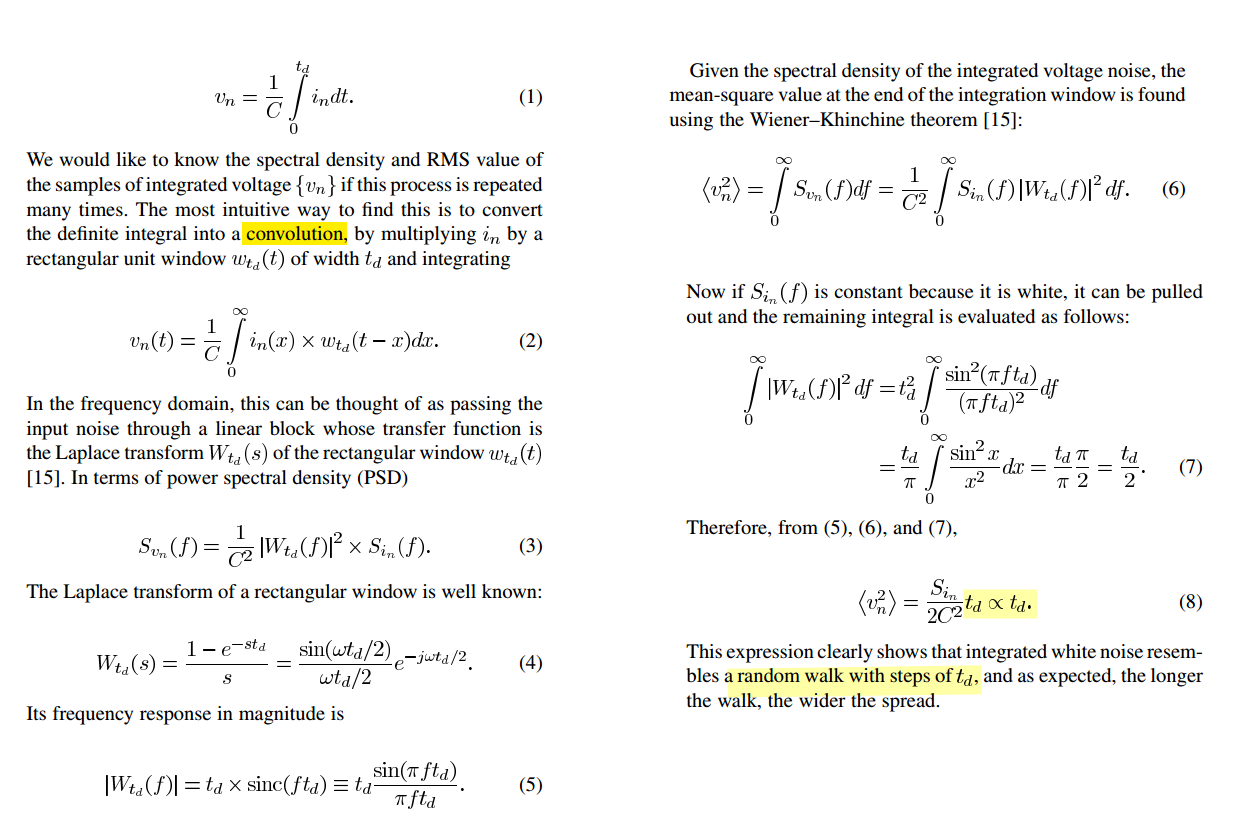
With white Gaussian noise at the input, the output spectrum is no longer white although its distribution remains Gaussian
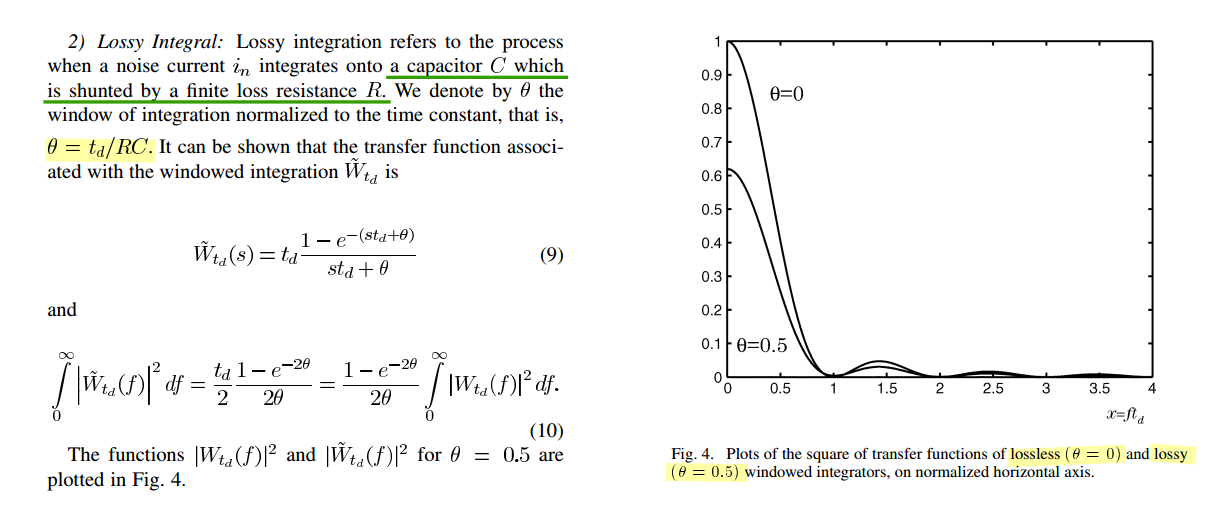
Lossy Integral
a noise current integrates onto a capacitor which is shunted by a finite loss resistance
\[ \frac{V}{I}(s) = \frac{1}{C}\frac{RC}{1+sRC} \overset{\mathcal{L}^{-1}}{\longrightarrow}\frac{1}{C}\cdot e^{-\frac{t}{RC}} \]
Laplace transform of Truncated Impulse Response \(0 \to t_d\) \[ \int_{0}^{t_d}\frac{1}{C}\cdot e^{-\frac{t}{RC}} \cdot e^{-st}dt = \frac{1}{C}\cdot \frac{1}{s+\frac{1}{RC}}\left(1-e^{-(st_d+\theta)}\right)=\frac{1}{C}\cdot \color{red}\frac{t_d}{st_d+\theta}\left(1-e^{-(st_d+\theta)}\right) \]
Google AI Mode [https://share.google/aimode/O6rjWM1YWel0NudI7]
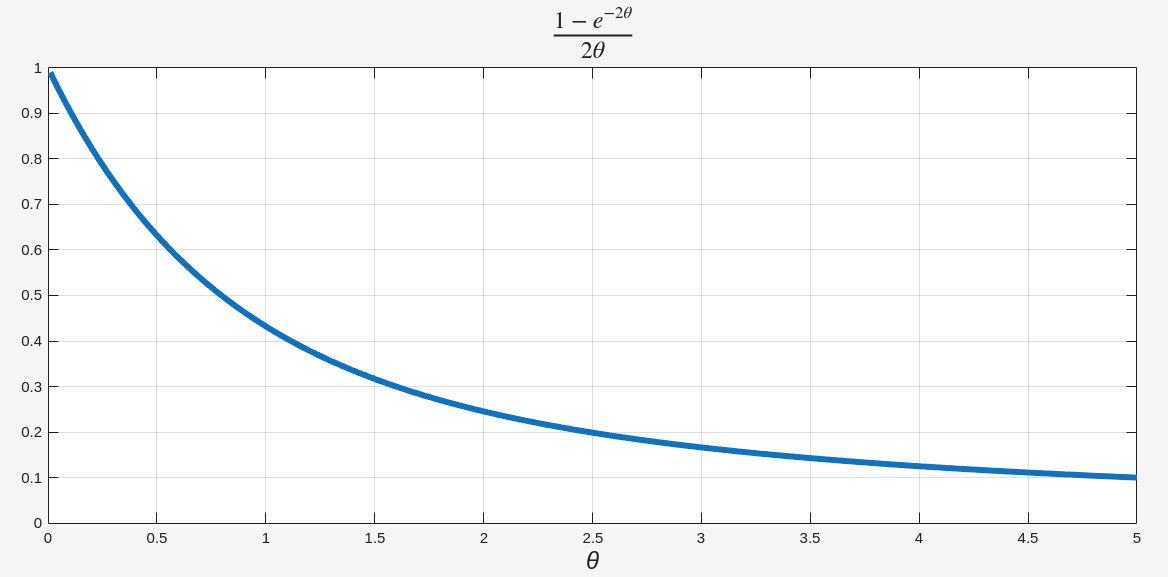
reference
David Herres, The difference between signal under-sampling, aliasing, and folding URL: https://www.testandmeasurementtips.com/the-difference-between-signal-under-sampling-aliasing-and-folding-faq/
Pharr, Matt; Humphreys, Greg. (28 June 2010). Physically Based Rendering: From Theory to Implementation. Morgan Kaufmann. ISBN 978-0-12-375079-2. Chapter 7 (Sampling and reconstruction)
Alan V Oppenheim, Ronald W. Schafer. Discrete-Time Signal Processing, 3rd edition
Mathuranathan Viswanathan. Digital Modulations using Matlab: Build Simulation Models from Scratch