Resynchronization & metastability
MTBF Calculation
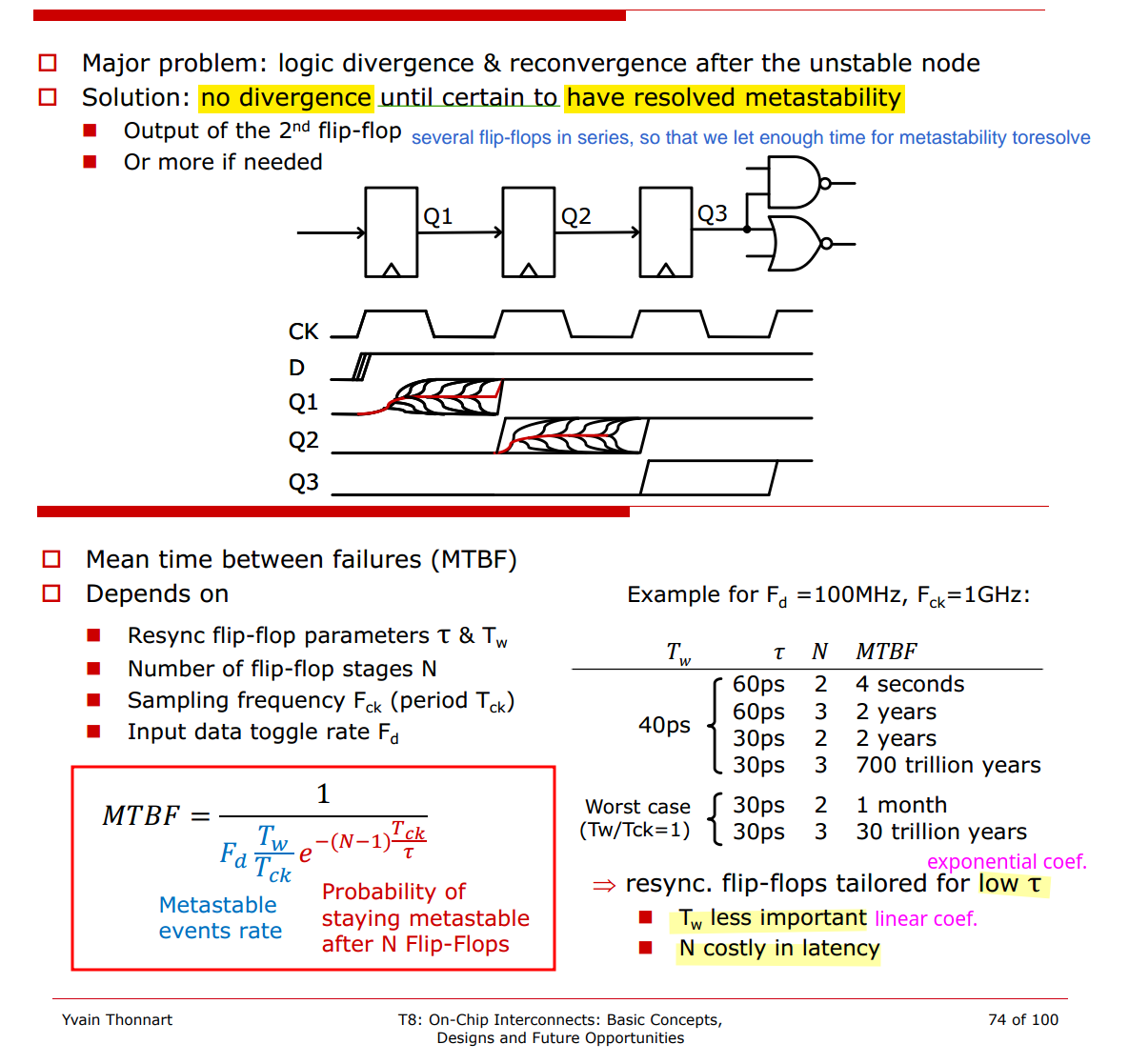

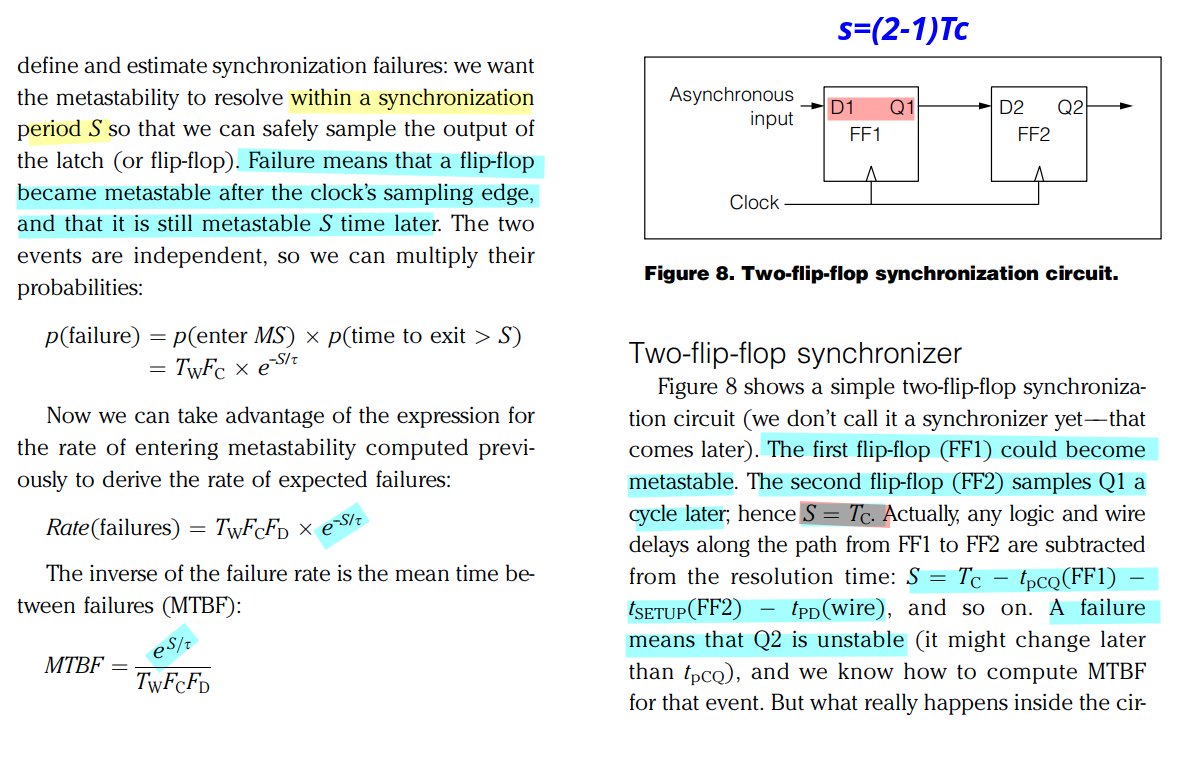
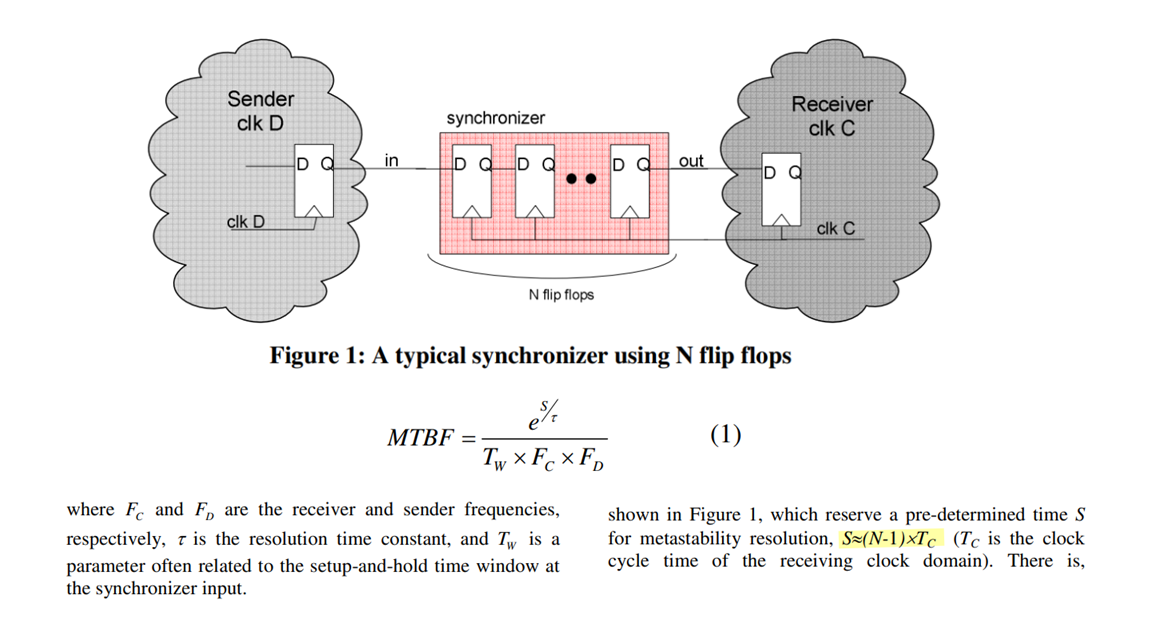
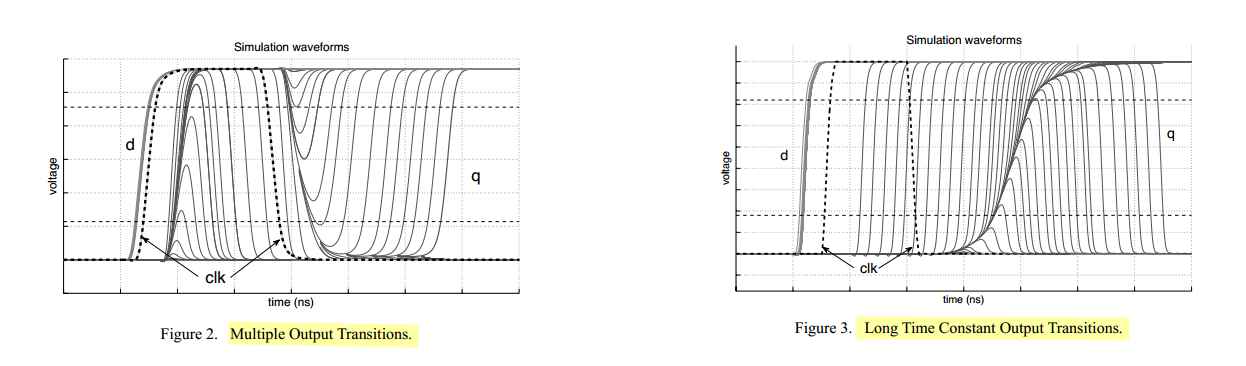
Beer, Salomon & Priel, Michael & Dobkin, Rostislav & Kolodny, Avinoam. (2010). The Devolution of Synchronizers. Proceedings - International Symposium on Asynchronous Circuits and Systems. [pdf]
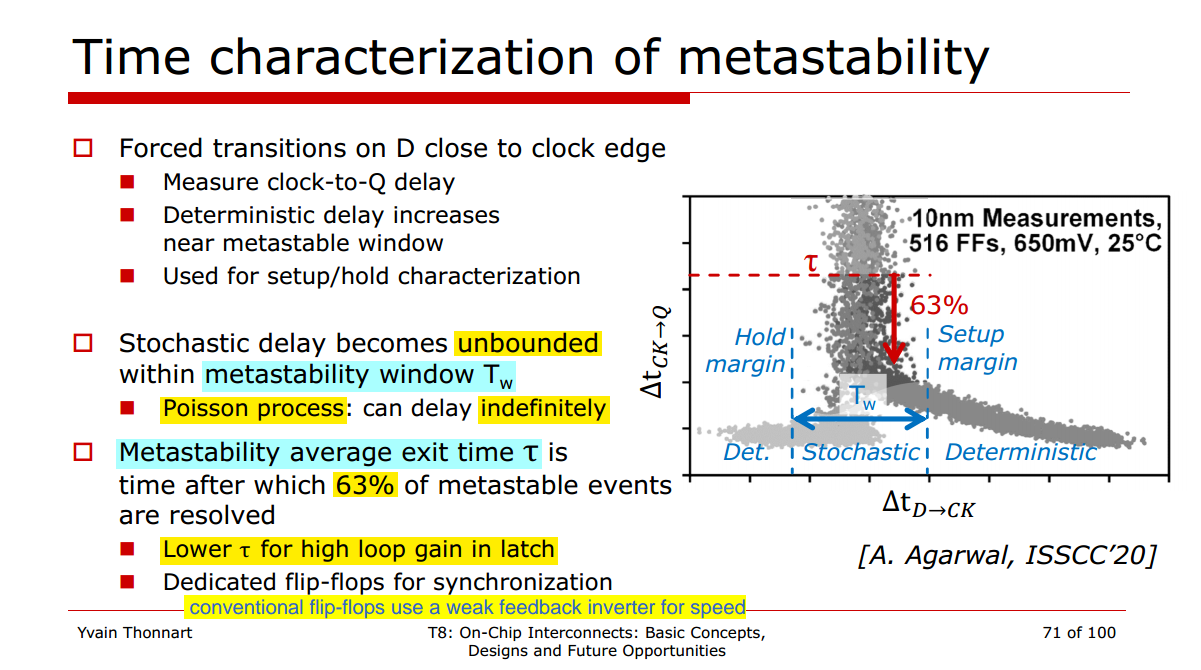
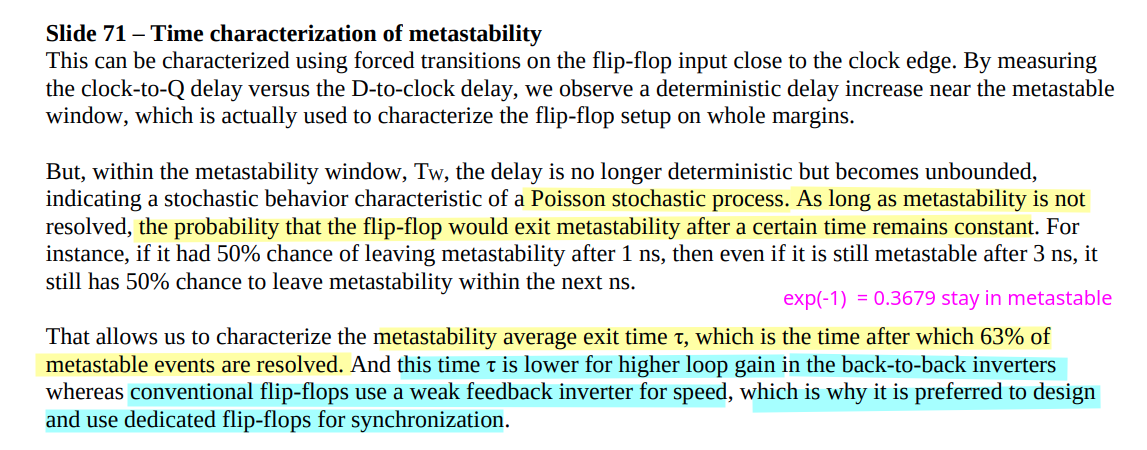
\(T_W\), metastability window is defined differently among published paper
Some PDK provide \(T_0\) and \(\tau\) for the corresponding cascaded flip flop synchronizer stdcells \[ \text{MTBF} = \frac{1}{T_W\times f_C\times f_D}\space \space \text{,where}\space\space T_W = T_0 e^{-T_r/\tau} \] and \(T_r = T_C - T_{DLY} - T_{SU}\)
Synchronizer Characterization
I. W. Jones, S. Yang and M. Greenstreet, "Synchronizer Behavior and Analysis," 2009 15th IEEE Symposium on Asynchronous Circuits and Systems, Chapel Hill, NC, USA, 2009 [https://sci-hub.ru/10.1109/ASYNC.2009.8]
Xprova. bisect-tau - EDA tool for characterizing the metastability resolution time constant (Tau) of bistable circuits [https://github.com/xprova/bisect-tau]
For GNU Octave, version 8.4.0, ngspice-42 : Circuit level simulation program @Ubuntu 24.04.3 LTS x86_64
TODO 📅
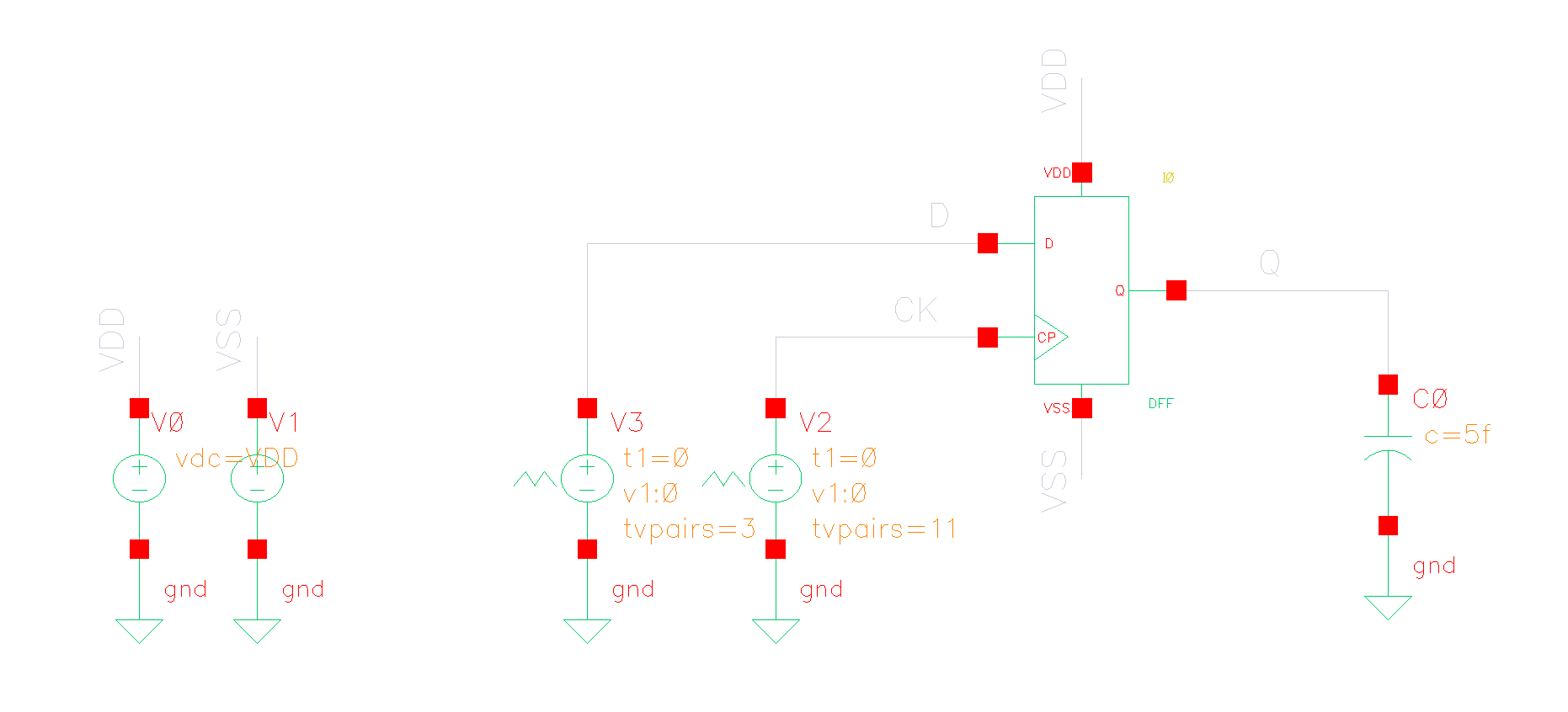
DFF Simulation
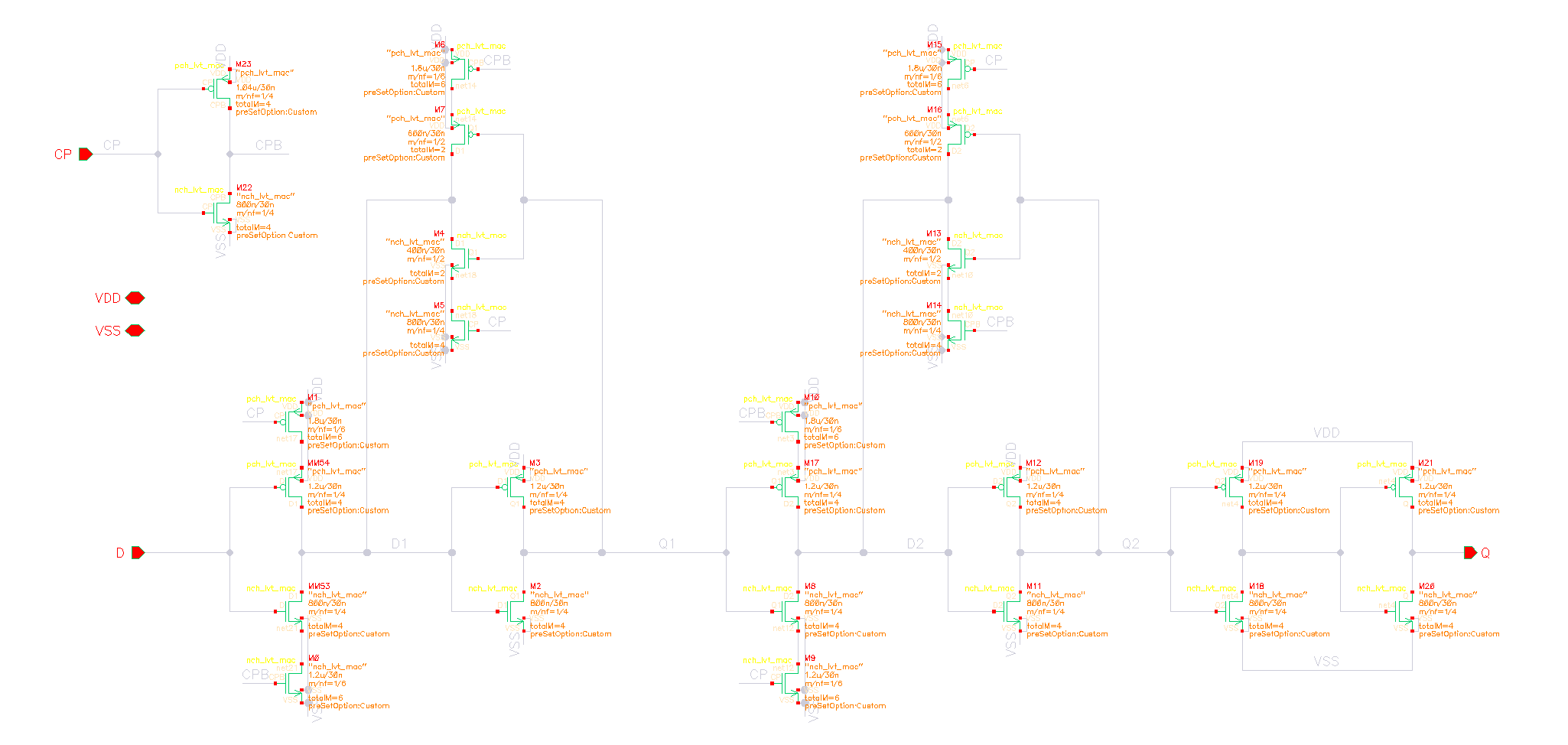
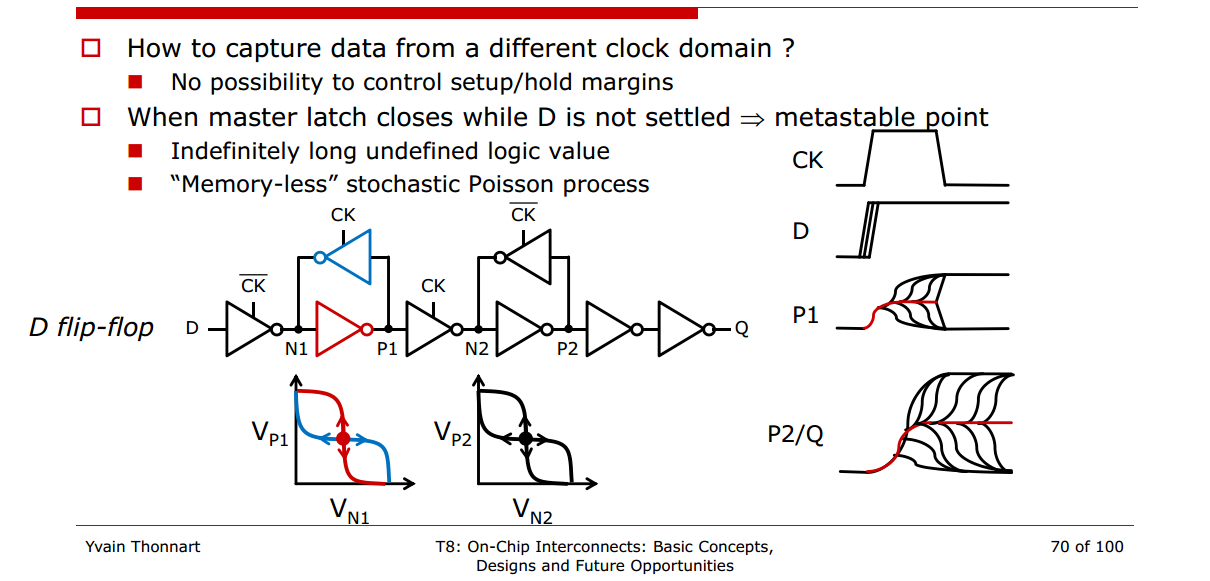
The typical flip-flops comprise master and slave latches and decoupling inverters.
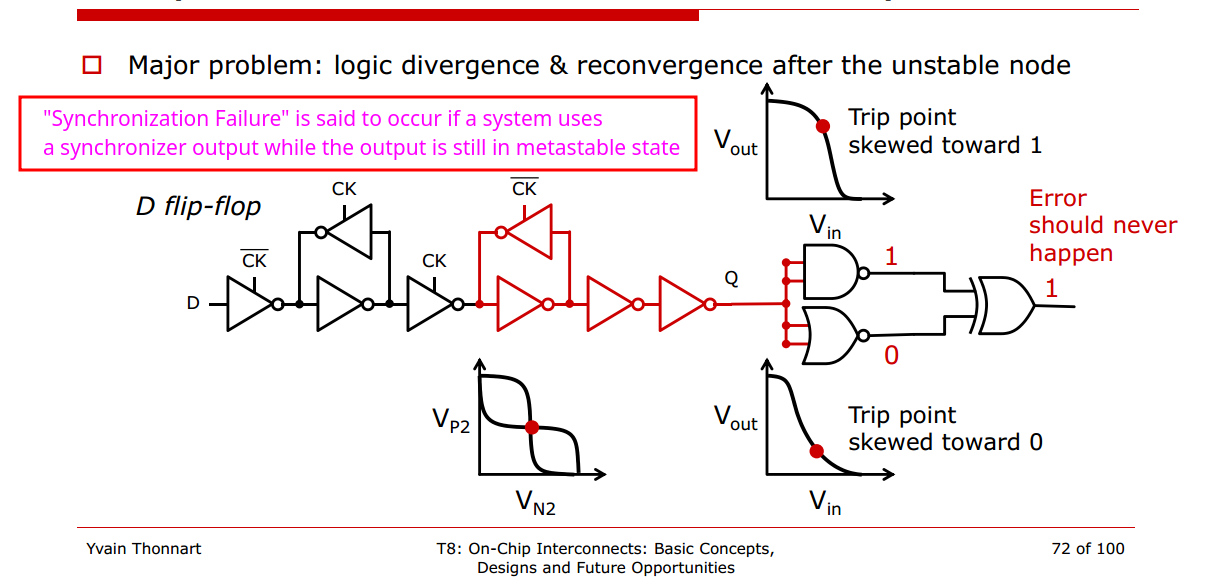
In metastability, the voltage levels of nodes A and B of the master latch are roughly midway between logic 1 (VDD) and 0 (GND)
master latch enter metastability
In fact, one popular definition says that if the output of a flip-flop changes later than the nominal clock-to-Q propagation delay, then the flip-flop must have been metastable
sweep \(\Delta t_{D \to \space \text{CK}}\)
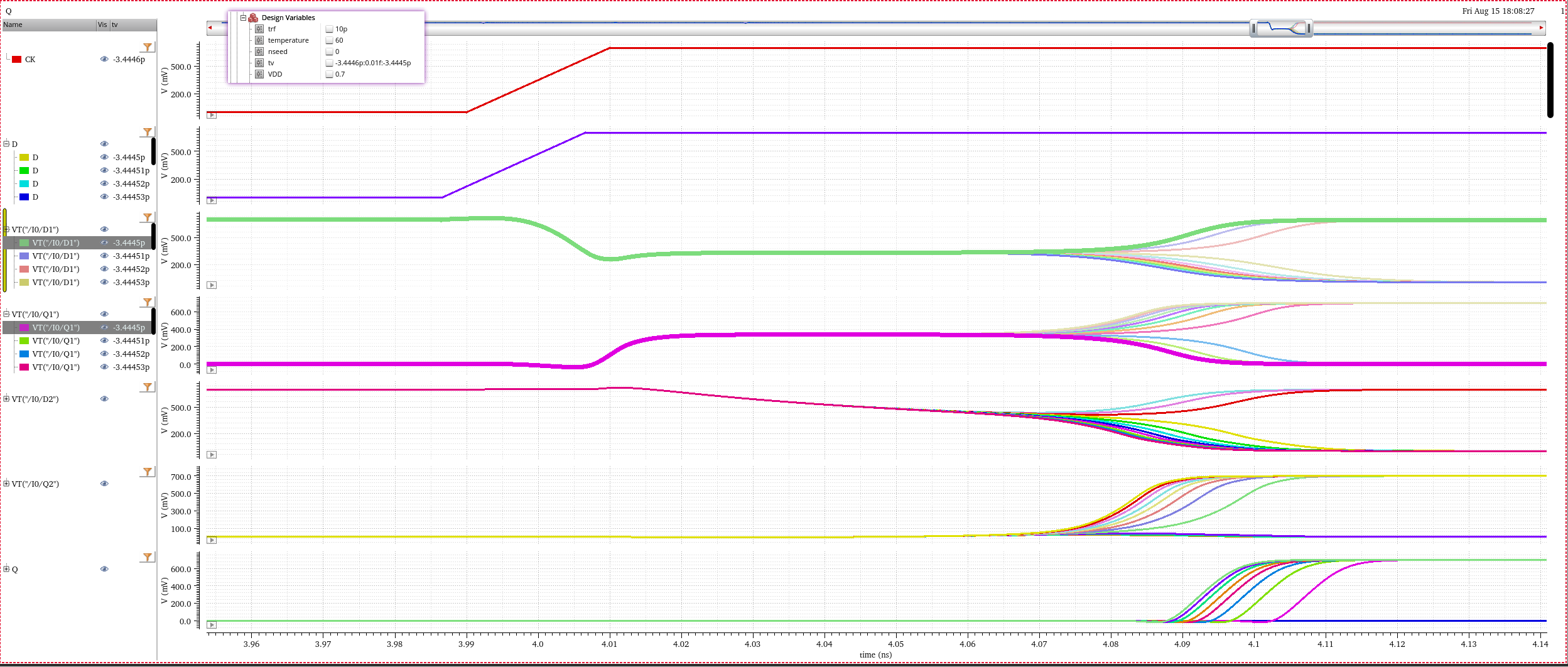
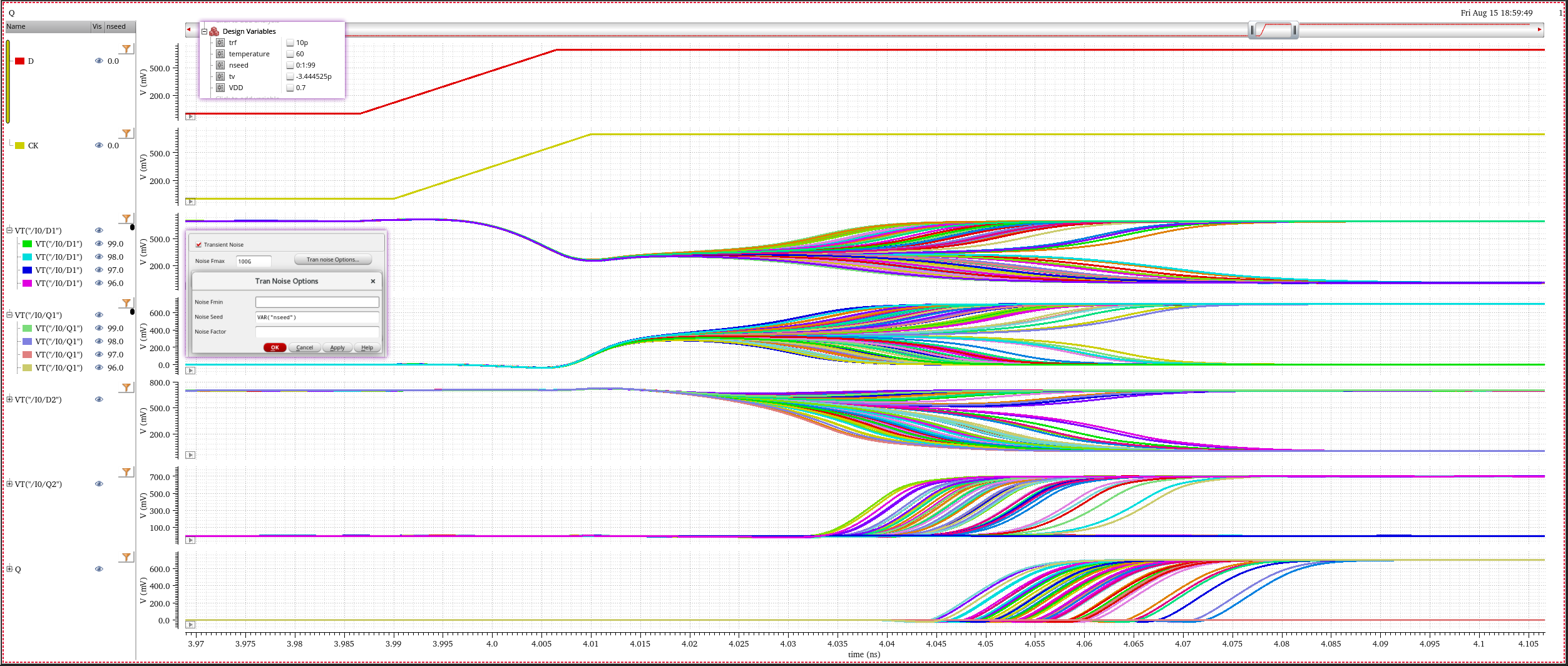
transient noise analysis @ \(\Delta t_{D \to \space \text{CK}} = -3.444525p\)
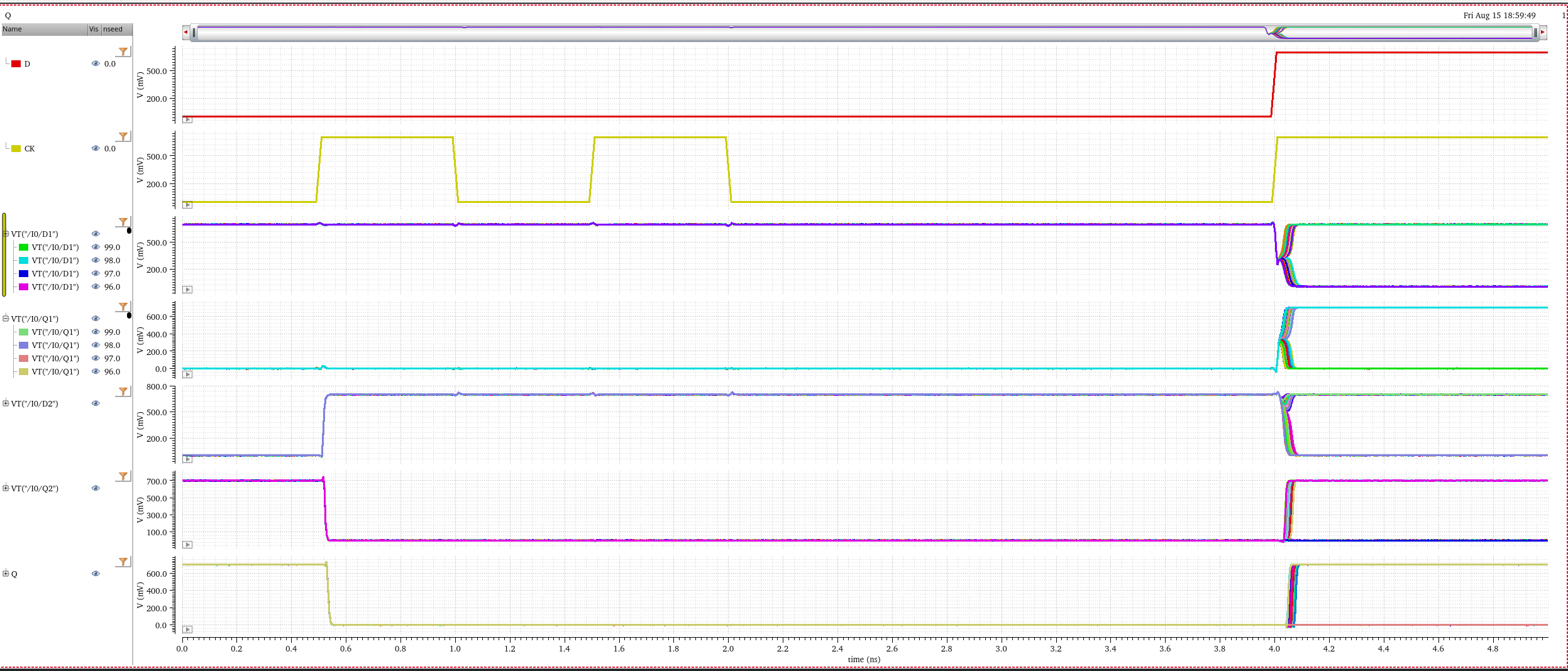
zoom out
Noise Seed—Seed for the random number generator (used by the simulator to vary the noise sources internally). Specifying the same seed allows you to reproduce a previous experiment. The default value is1.
Synchronizer effect – latency uncertainty
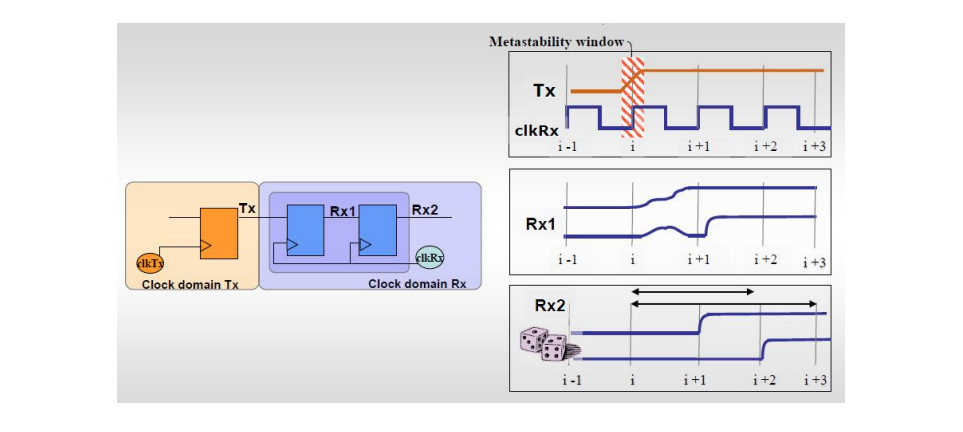
reference
Yvain Thonnart, CEA-LIST. ISSCC2021 T8: On-Chip Interconnects: Basic Concepts, Designs and Future Opportunities [https://www.nishanchettri.com/isscc-slides/2021%20ISSCC/TUTORIALS/ISSCC2021-T8.pdf]
R. Ginosar, "Metastability and Synchronizers: A Tutorial," in IEEE Design & Test of Computers, vol. 28, no. 5, pp. 23-35, Sept.-Oct. 2011 [https://webee.technion.ac.il/~ran/papers/Metastability-and-Synchronizers.IEEEDToct2011.pdf] [color]
Steve Golson. Synchronization and Metastability [https://trilobyte.com/pdf/golson_snug14.pdf]
Kinniment, D. J. Synchronization and arbitration in digital systems. John Wiley & Sons Ltd (2007).
Synchronizers And Data FlipFlops are Different [pdf]
S. Beer, R. Ginosar, M. Priel, R. Dobkin and A. Kolodny, "The Devolution of Synchronizers," 2010 IEEE Symposium on Asynchronous Circuits and Systems, Grenoble, France, 2010 [pdf]
赵启林 klin, Metastability [https://picture.iczhiku.com/resource/eetop/SHKSFADwZerLPBXN.pdf]
Asad Abidi. ISSCC 2023: Circuit Insights "The CMOS Latch" [https://youtu.be/sVe3VUTNb4Q&t=681]
Matt Venn. Interactive flip flop simulation [https://github.com/mattvenn/flipflop_demo]
Amr Adel Mohammady. Clock Domain Crossing [linkedin]