Statistical Signaling Analysis (SSA)
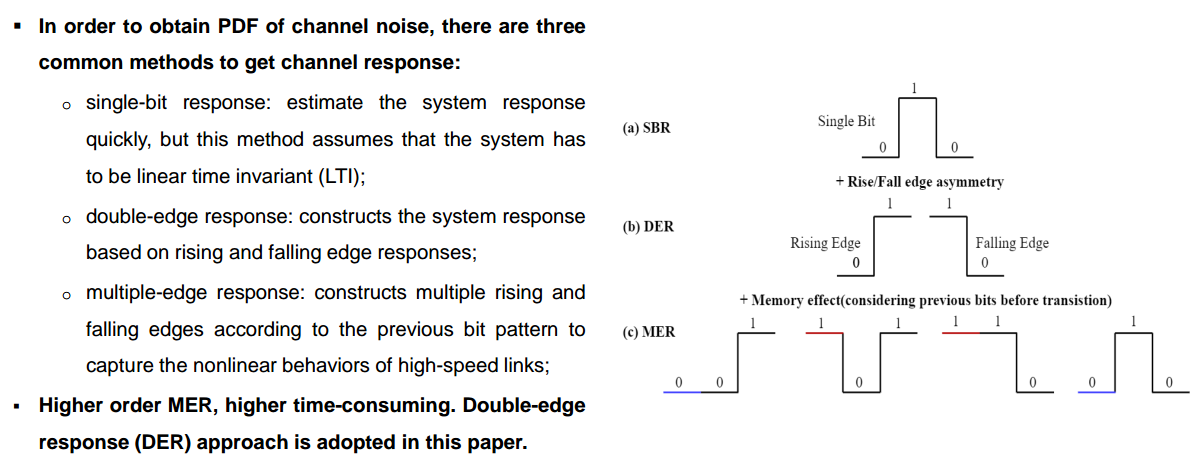
Three fast time-domain system simulation techniques:
- single-bit response method (SBR)
- double-edge response method (DER)
- multiple-edge response method (MER)
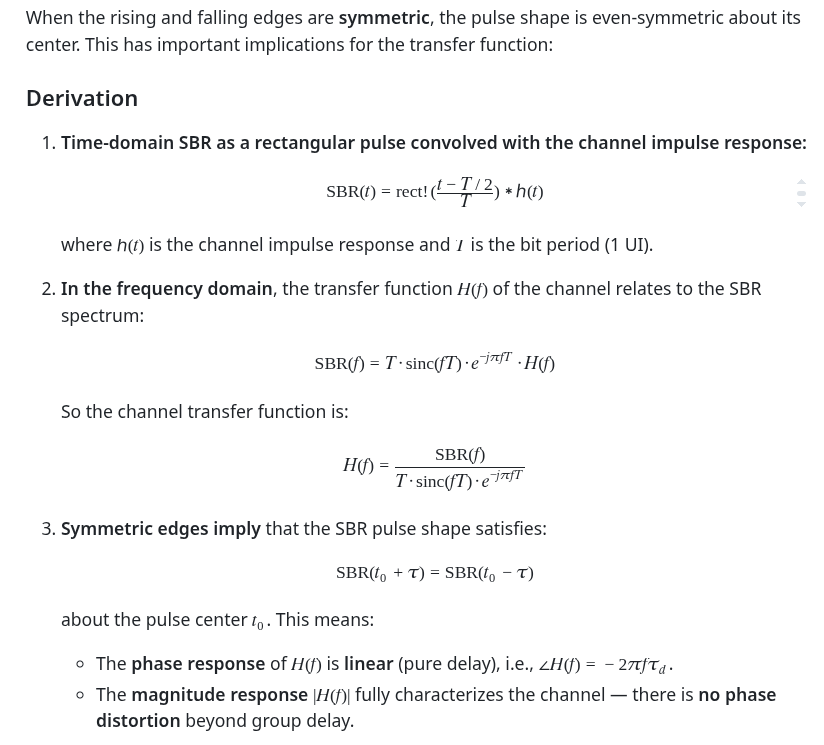
Symmetric Rising and Falling Edges
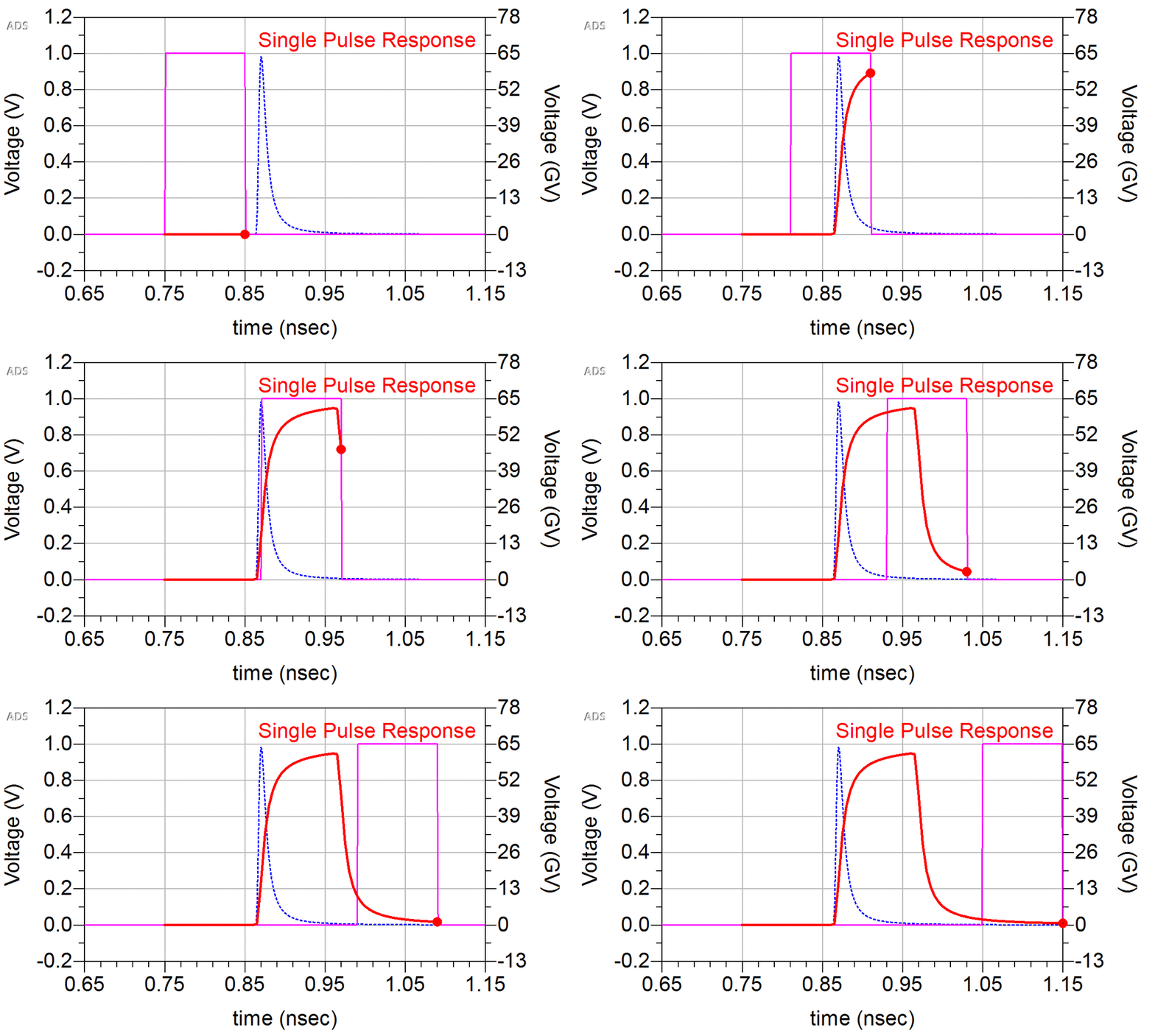
Single-Bit Response (SBR) Method
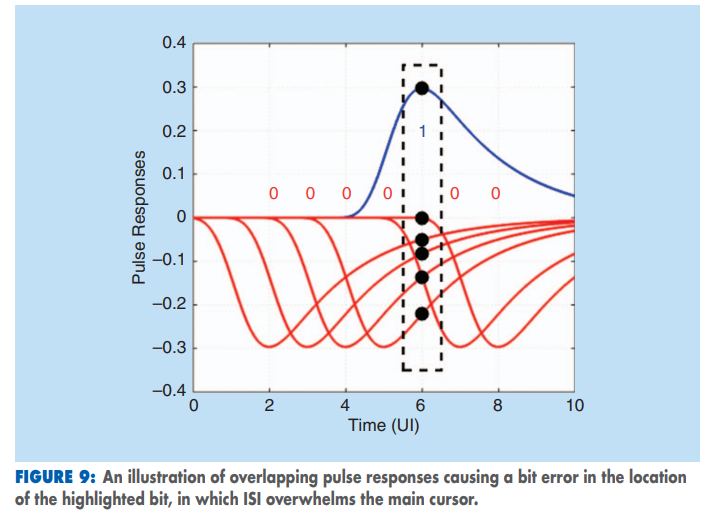
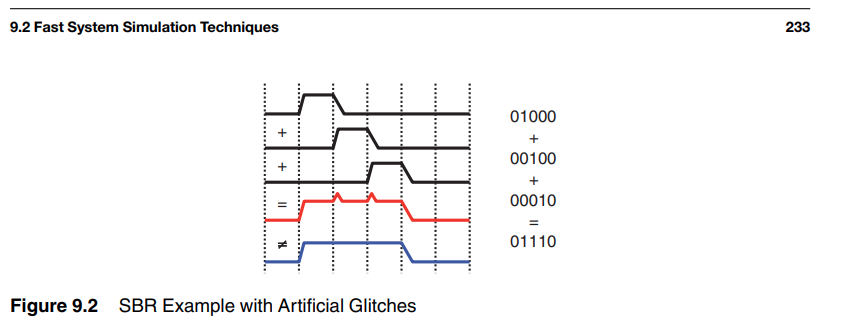
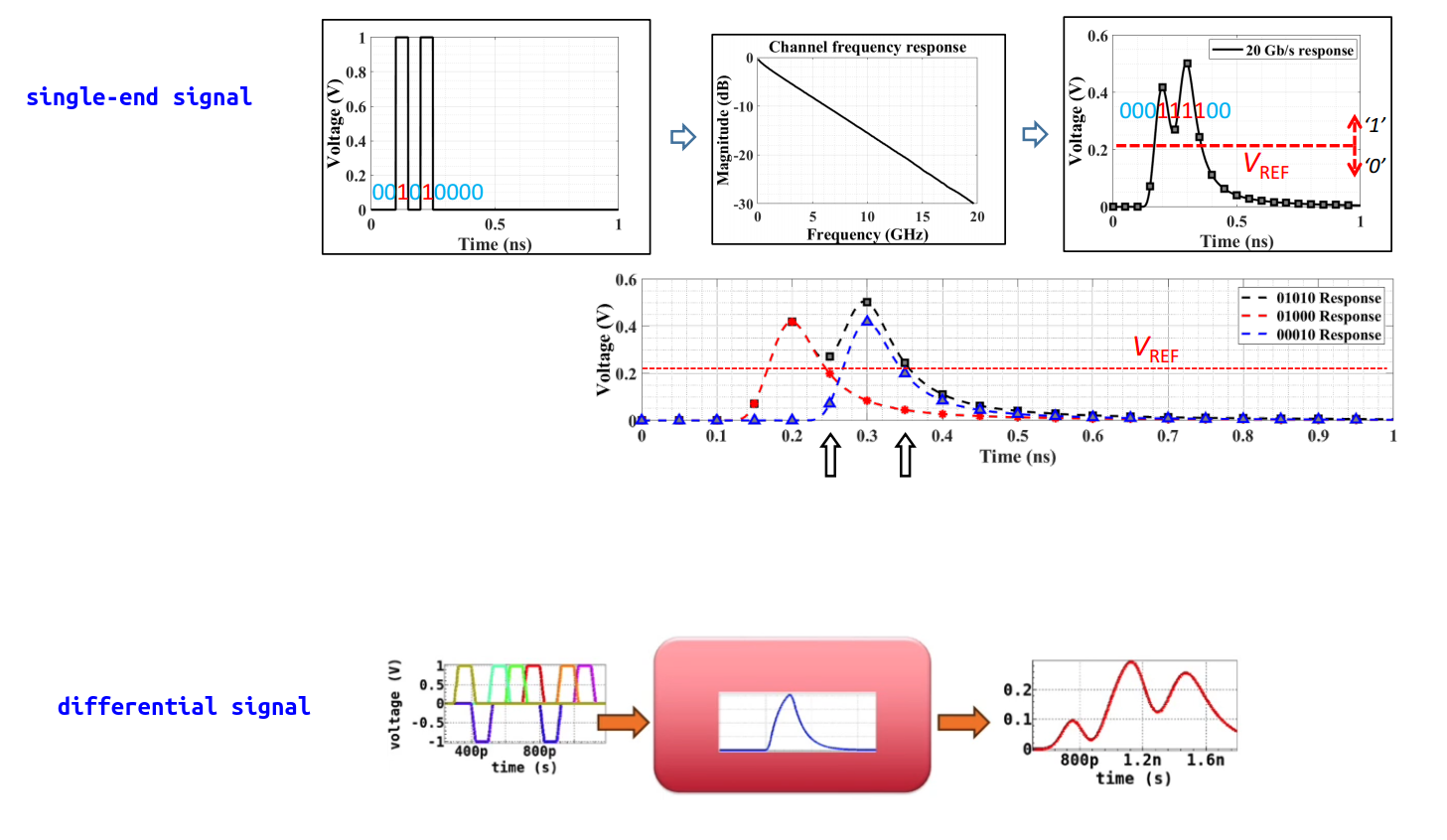
Overlapping portions of a pulse response from neighboring bits are referred to as intersymbol interference (ISI). A received waveform is formed by superimposing, in time, the pulse responses of each bit in the sequence, as illustrated in Figure 9, assuming symmetric positive and negative pulses are transmitted for 1s and 0s
To avoid spurious glitches between consecutive ones, rising and falling edge responses shall be symmetric. This is the limitation of SBR method.
Let \(p(t)\) be the SBR of the channel, \(t_s\) be the data sampling phase, \(T\) be the bit time, \(N_c\) is the number of UI in stored pulse response and \(b_m\) be the \(m\)th transmitted symbol. The voltage seen by the receiver's data sampler at the \(m\)th data sample is determined by \[ y_m = \sum_{k=m-N_c+1}^{m}b_kp(t_s+(m-k)T) \] where \(b_k \in [0, 1]\) and \(p(t) \ge 0\)
We always prepend \(Nc-1\) 0s in random bit stream for consistency.
For computation convenient, the pulse need to be positive. For differential signal and amplitude \(V_{peak}\), the peak to peak is \(-V_{peak}\) to \(+V_{peak}\). After pulse added by \(V_{peak}\), peak to peak is \(0\) to \(+2V_{peak}\).
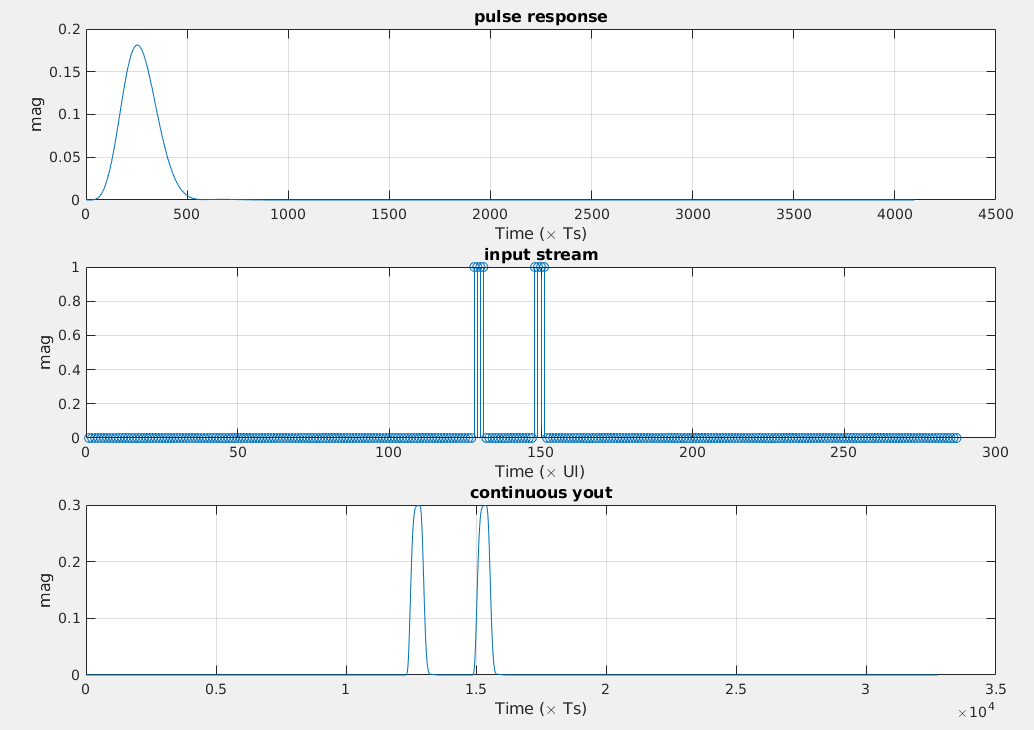
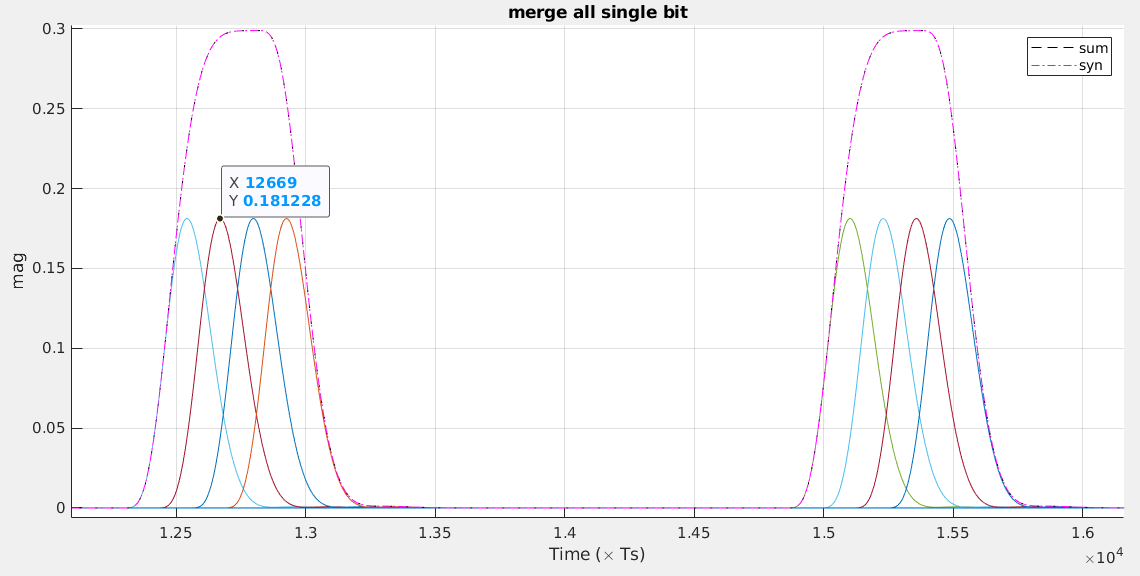
1 | hold on; |
The pulse response contain rising and falling edge. The 1 bit first rise from -1 to 1, then fall to -1; The 0 bit just do nothing for synthesized waveform with the help of falling edge of 1 bit.
The DC shift help deal with continuous 0 bits.
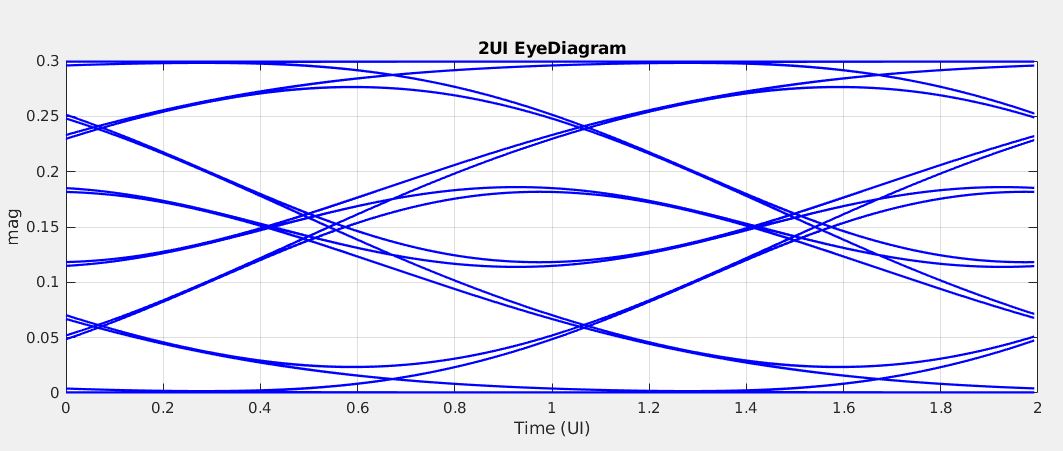
another SBR example
1 | A = zeros(10,21); |
Single Ended vs Differential Signaling
Sai Goutham Sunkara, create a precursor in a single-bit response using RC filter [linkdin]
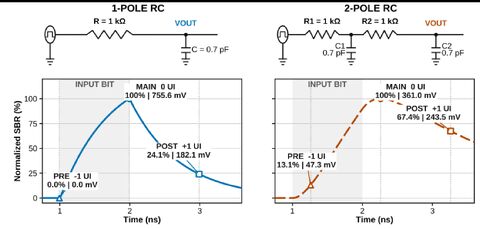
Two poles is the minimum RC-filter order needed to produce a nonzero −1-UI precursor
The cursors are defined relative to the response peak, not to when the input arrived. A causal system can't respond before its input, but it can easily respond before its own peak. Any extra delay or smoothing that moves the peak more than 1 UI after the response begins will put signal at the −1 UI sample.
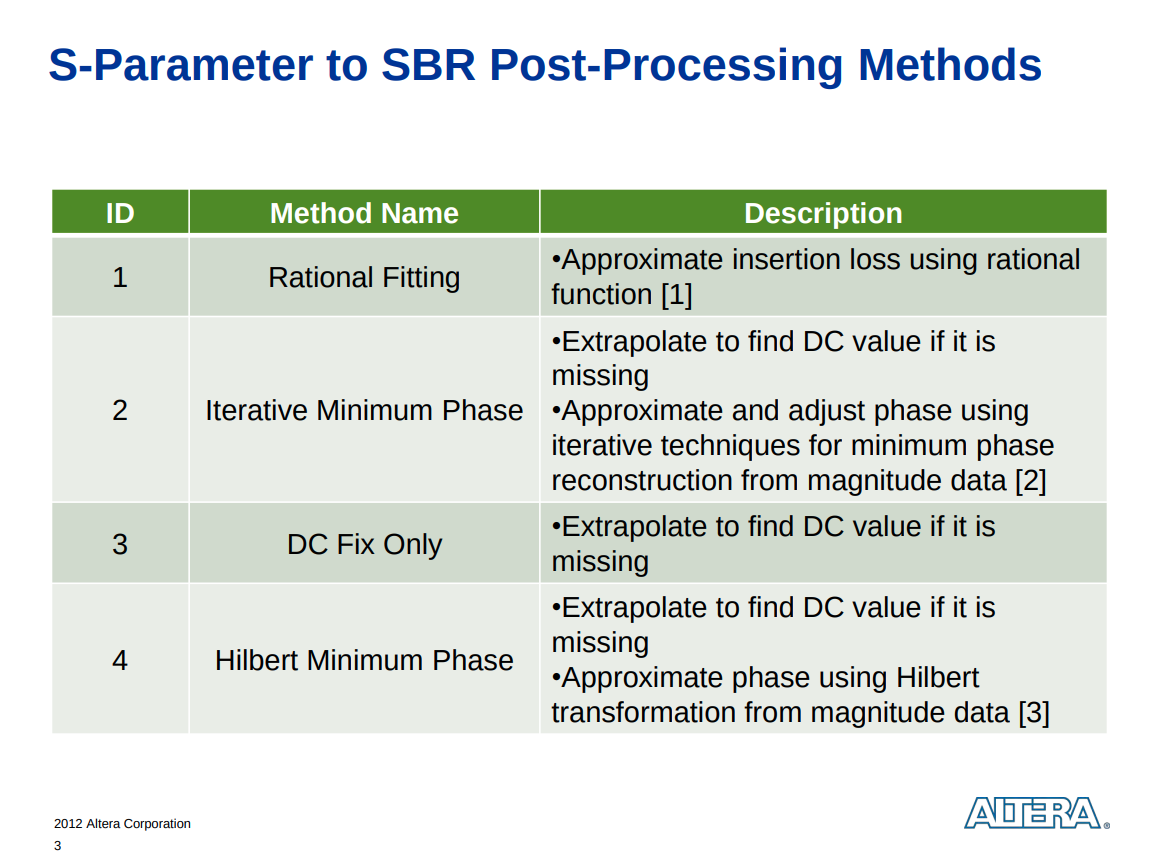
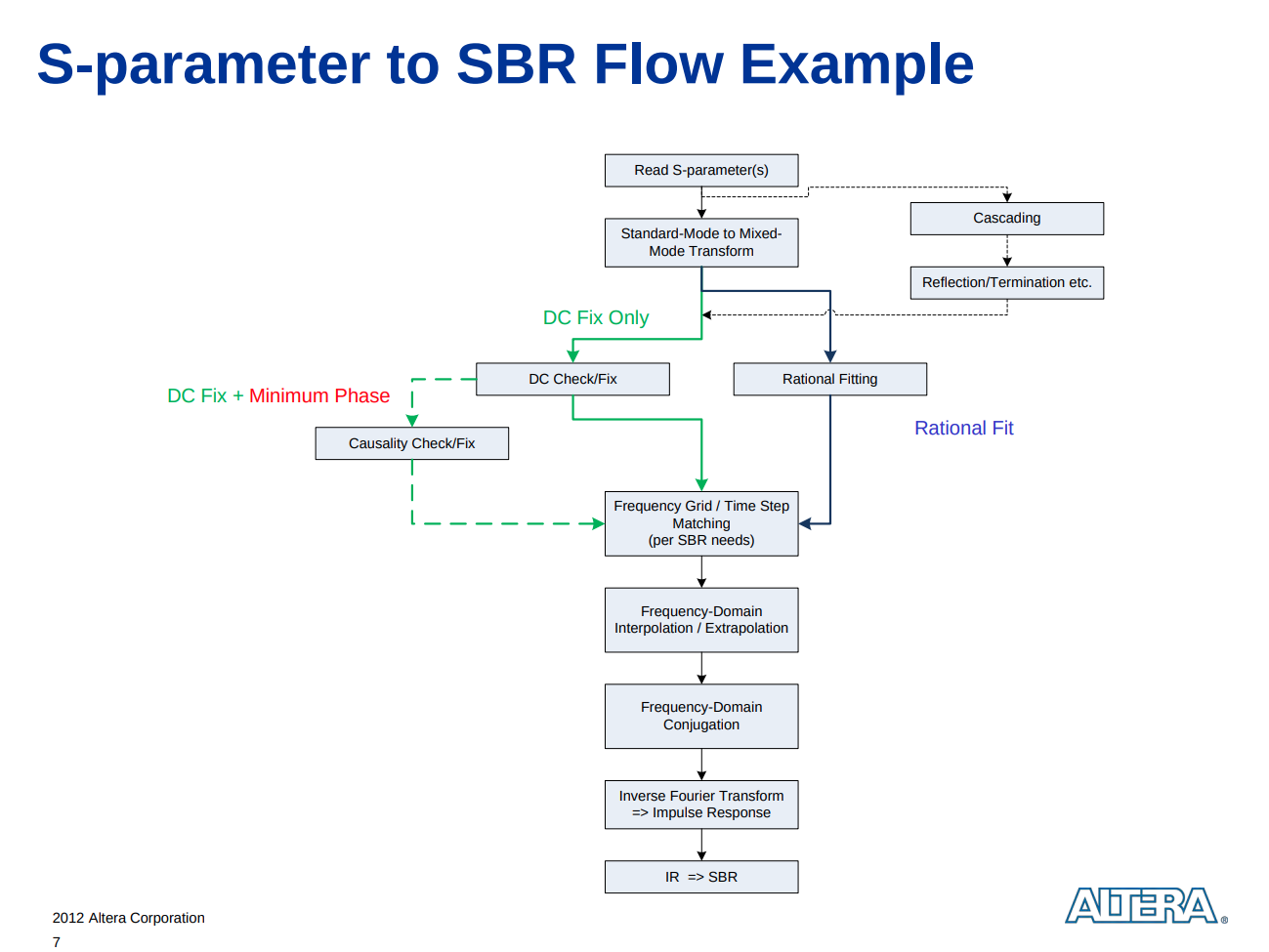
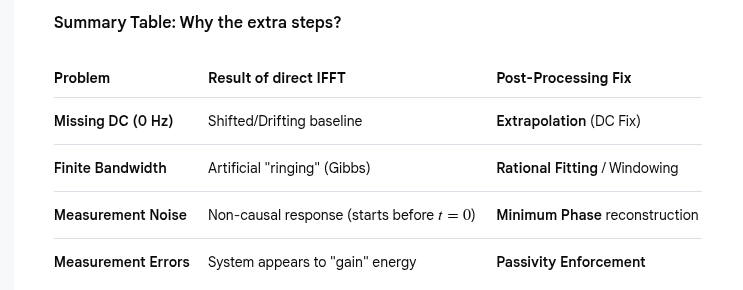
S-Parameter to Single Bit Response (SBR)
Mike Li, "S-Parameter to Single Bit Response (SBR) Transformation and Convergence Study" [https://ieee802.org/3/bj/public/may12/li_01_0512.pdf]
TODO 📅
Double-Edge Response (DER) Method
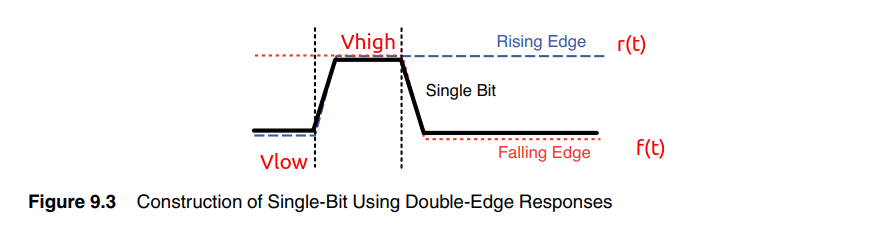
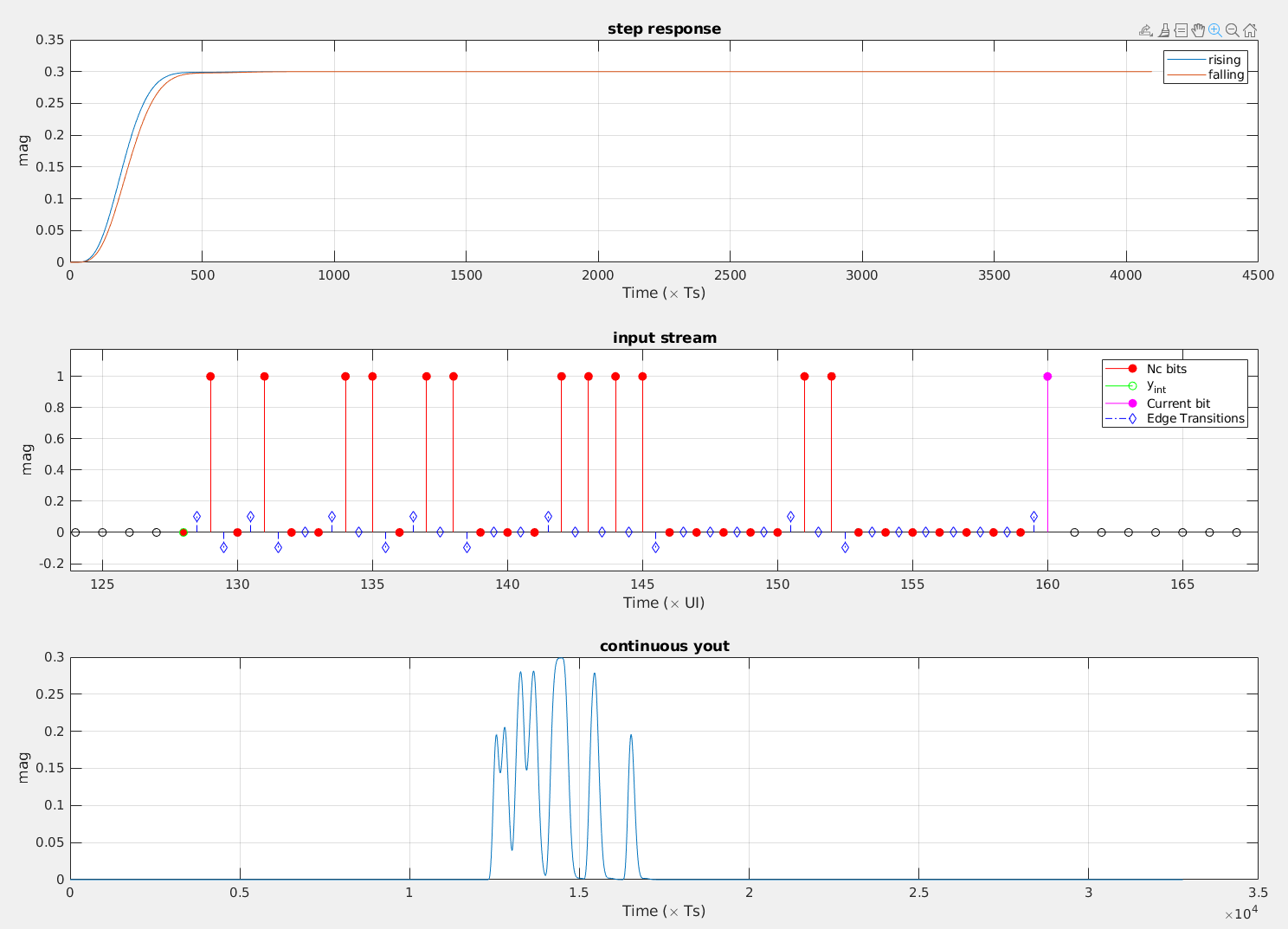
To handle the more general cases, with asymmetric rising and falling edges, the system response can be constructed in terms of edge transitions instead of bit responses.
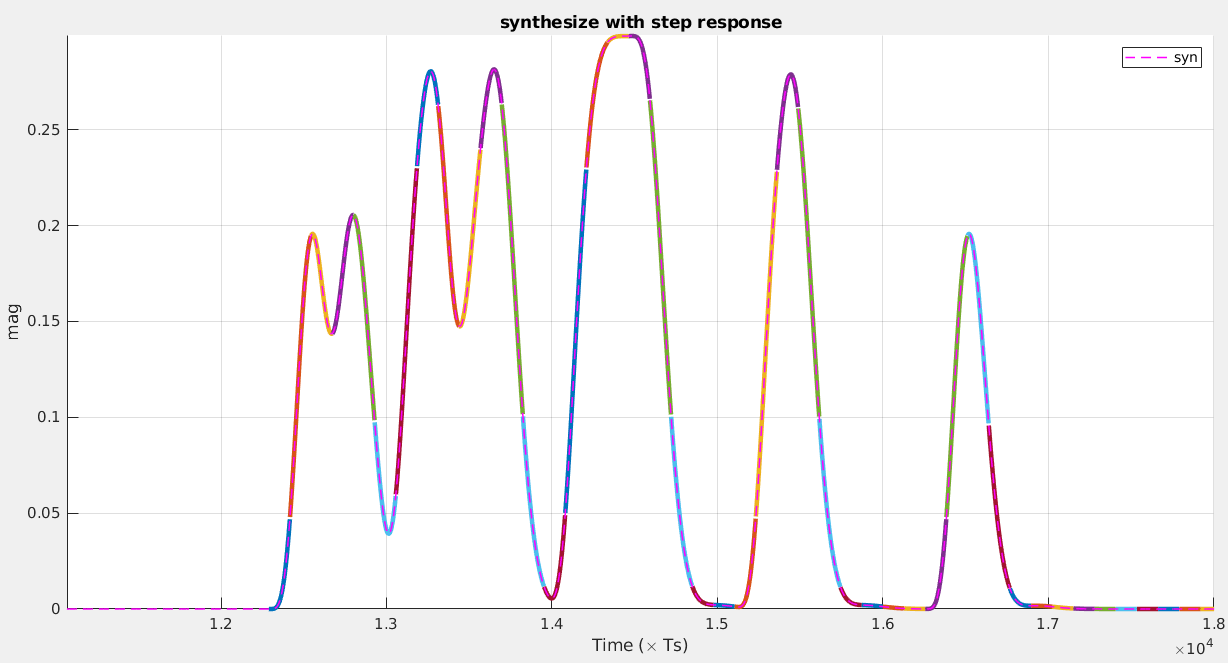
The DER method decomposes the input data pattern, in terms of rising and falling edge transitions. The system response can be calculated by superimposing the shifted versions of the rising and falling edge responses : \[ y_m = \sum_{k=m-N_c+1}^{m}(b_k-b_{k-1})s_k(t_s+(m-k)T) + y_{int} \] where
\[\begin{align} s_i(t) &= r(t) -V_{low} \quad \text{if} \: (b_i\gt b_{i-1}) \\ &= V_{high}-f(t) \quad \text{otherwise} \end{align}\]
\(r(t)\) and \(f(t)\) are the rising and falling edge responses,respectively. \(V_{high}\) and \(V_{low}\) are the steady state DC levels, in response to a constant stream of ones and zeros, respectively. \(y_{int}\) is the initial DC state (either \(V_{high}\) or \(V_{low}\) ).
We always prepend \(Nc\) 0s in random bit stream for consistency.

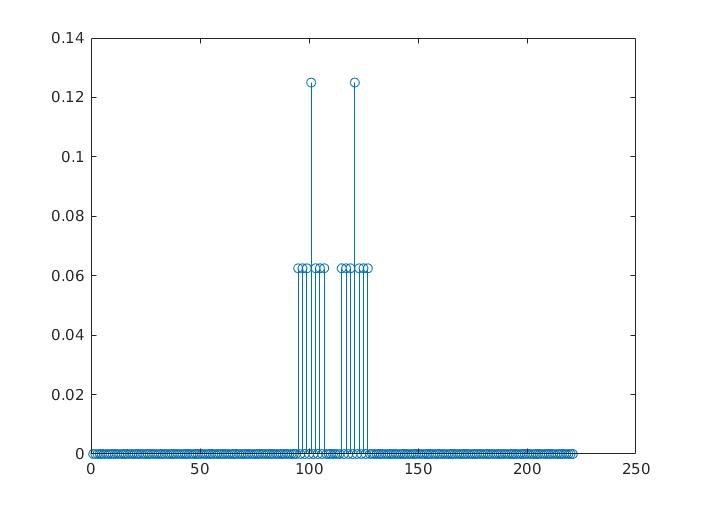
1 | figure(1) |
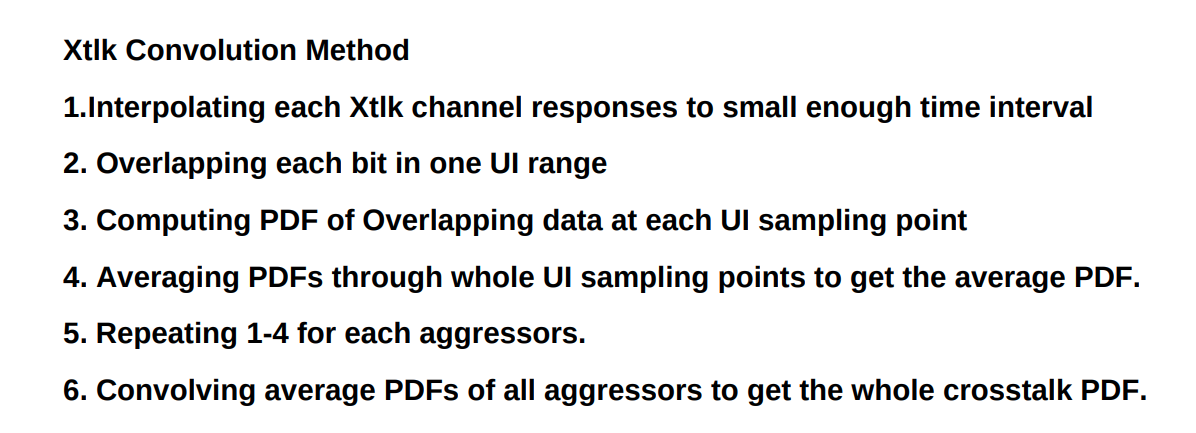
Cross Talk using Convolution
Charles Moore, Computing effect of cross talk using Convolution [https://grouper.ieee.org/groups/802/3/ap/public/channel_adhoc/moore_c1_0305.pdf]
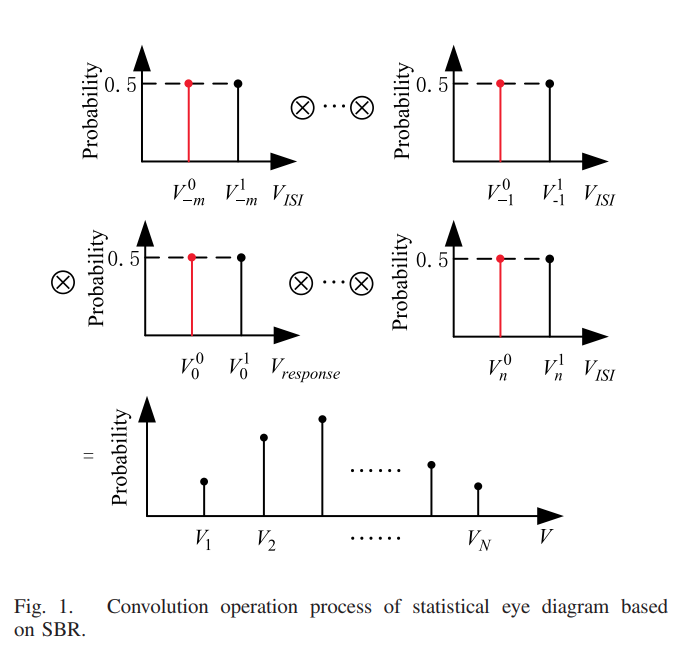
Huang Chunxing, Statistical Eye Simulation Requirements [https://ibis.org/summits/oct06a/huang.pdf]
Reference
T. C. Carusone, "Introduction to Digital I/O: Constraining I/O Power Consumption in High-Performance Systems," in IEEE Solid-State Circuits Magazine, vol. 7, no. 4, pp. 14-22, Fall 2015
—, ISSCC 2017 T6: Signal Integrity Analysis for Gb/s Links
Oh, Kyung Suk Dan, and Xing Chao Chuck Yuan. High-Speed Signaling: Jitter Modeling, Analysis, and Budgeting. Prentice Hall, 2011.
Ren, Jihong and Kyung Suk Oh. "Multiple Edge Responses for Fast and Accurate System Simulations." IEEE Transactions on Advanced Packaging 31 (2008) [https://sci-hub.jp/10.1109/TADVP.2008.2002201]
Shi, Rui. "Off-chip wire distribution and signal analysis." (2008). [pdf]
X. Chu, W. Guo, J. Wang, F. Wu, Y. Luo and Y. Li, "Fast and Accurate Estimation of Statistical Eye Diagram for Nonlinear High-Speed Links," in IEEE Transactions on Very Large Scale Integration (VLSI) Systems, vol. 29, no. 7, pp. 1370-1378, July 2021, [https://sci-hub.ru/10.1109/TVLSI.2021.3082208]
Tingting Pang, DesignCon 2025: Fast BER Analysis Technique for Next Generation Chiplet Simultaneous Bi-Directional Transceiver