AM & PM
Complex Signals & Mixer
K. W. Martin, "Complex signal processing is not complex," in IEEE Transactions on Circuits and Systems I: Regular Papers, vol. 51, no. 9, pp. 1823-1836, Sept. 2004, [[https://sci-hub.st/10.1109/TCSI.2004.834522](https://sci-hub.st/10.1109/TCSI.2004.834522])]
Mark Oude Alink, ESSERC 2026 Circuit Insights: Fundamentals of RF Mixer Design
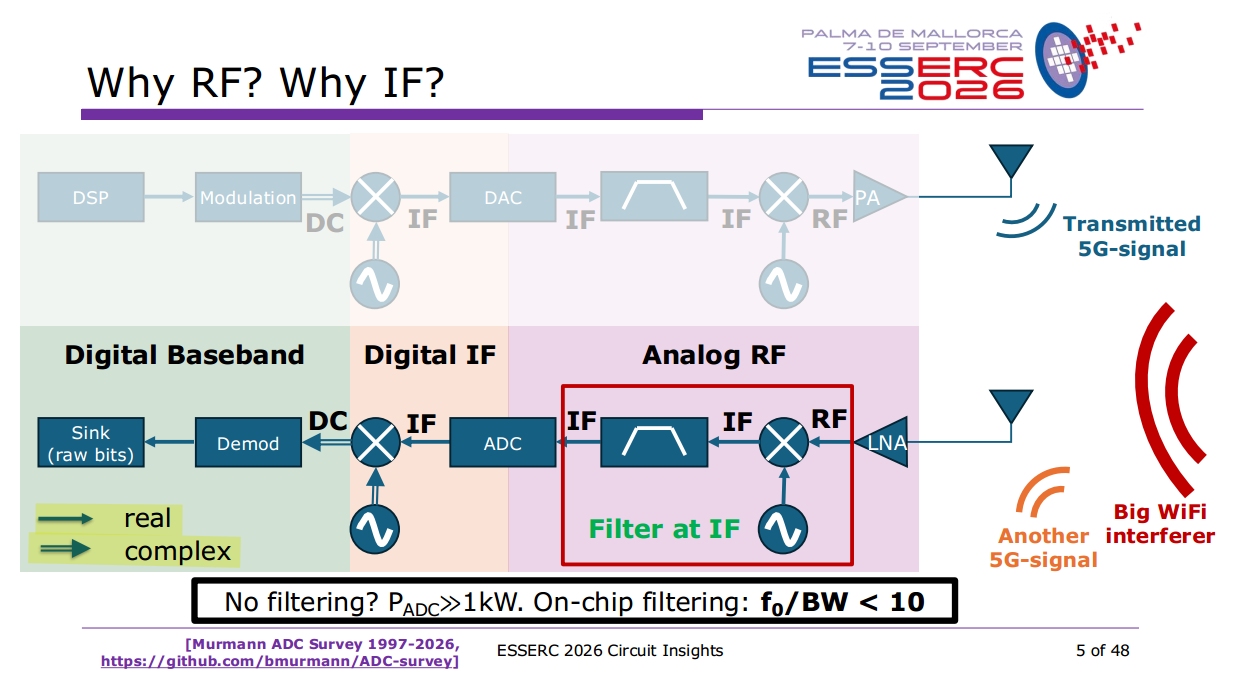
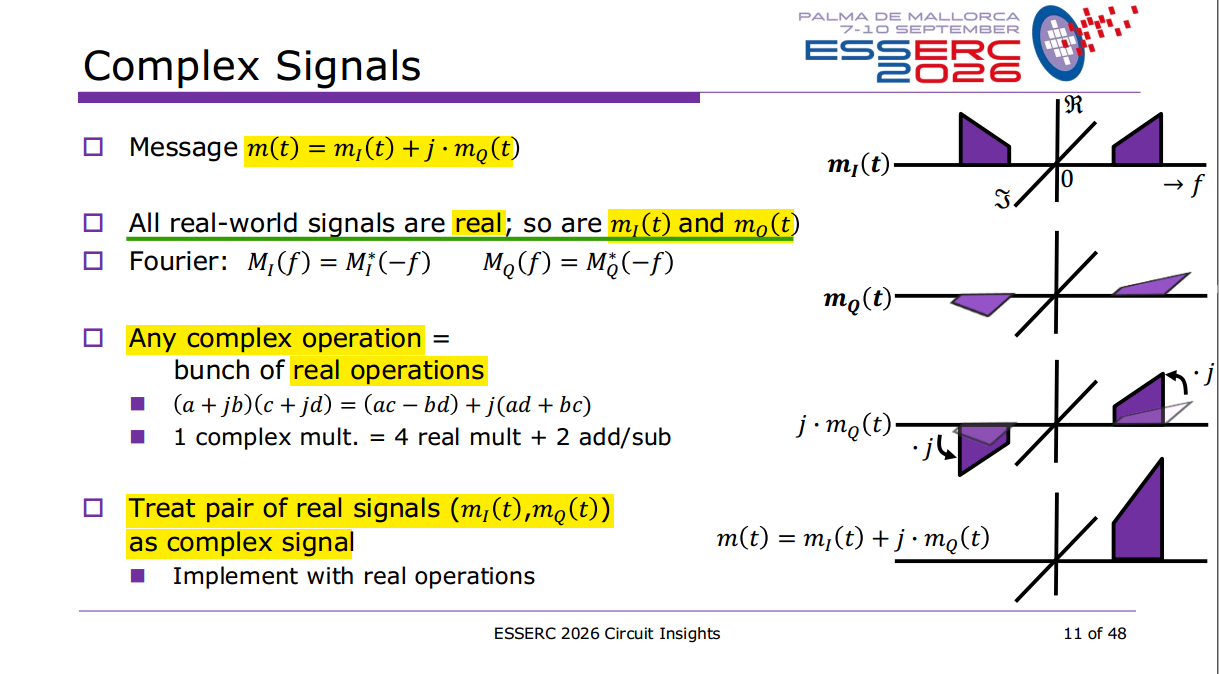
Transmitter: Complex to Real; Receiver: Real to Complex
Rotaing Phasor
phasor in time domain as time elapses

A. A. Abidi and D. Murphy, "How to Design a Differential CMOS LC Oscillator," in IEEE Open Journal of the Solid-State Circuits Society, vol. 5, pp. 45-59, 2025 [pdf]
—, 30 January, SSCS Technical Webinars, [https://resourcecenter.sscs.ieee.org/education/webinars/sscs_edu_web_abidi_013026]
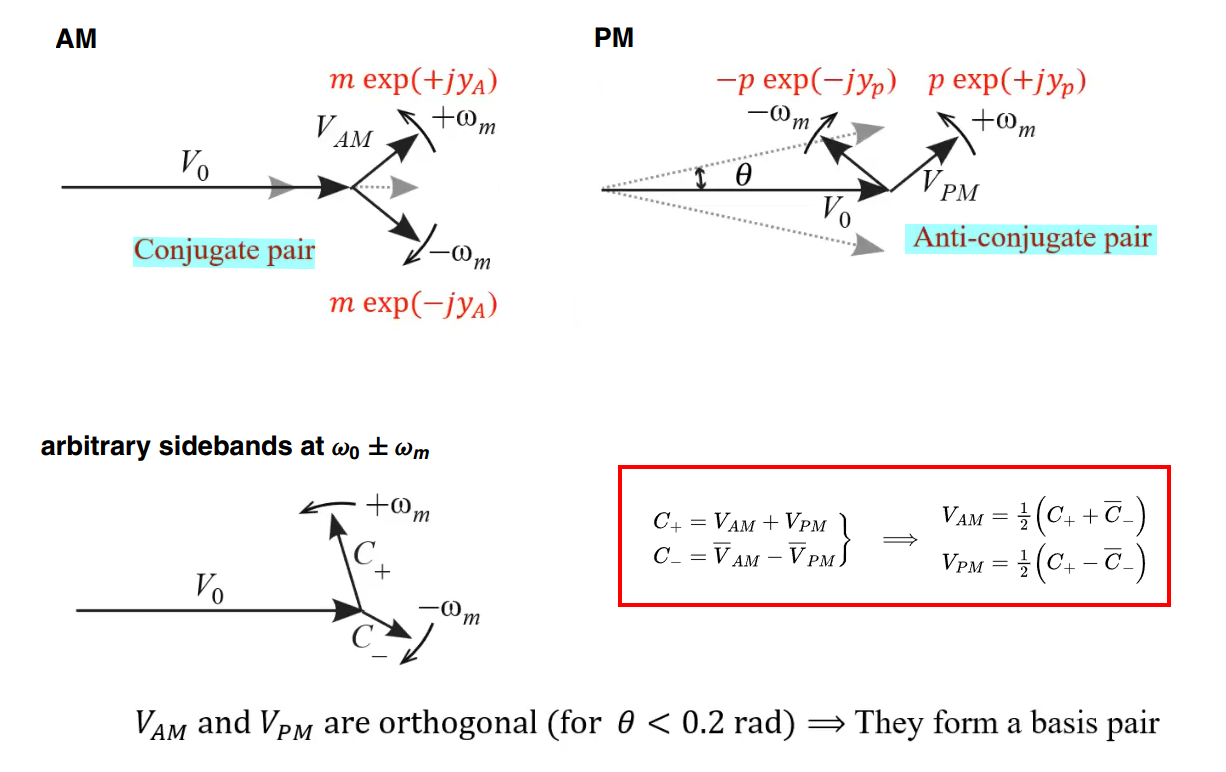
The oscillation \(\color{red}V_0\cos\omega_0 t\) is represented by the horizontal phasor of magnitude \(\color{red}V_0\)
 \[
\boxed{\color{blue}\begin{equation}
\left.
\begin{aligned}
C_{+} &= V_{AM} + V_{PM} \\
C_{-} &= \overline{V}_{AM} - \overline{V}_{PM}
\end{aligned}
\right\}
\quad\Longrightarrow\quad
\begin{aligned}
V_{AM} &= \tfrac{1}{2}\left(C_{+} + \overline{C}_{-}\right) \\
V_{PM} &= \tfrac{1}{2}\left(C_{+} - \overline{C}_{-}\right)
\end{aligned}
\end{equation}}
\]
\[
\boxed{\color{blue}\begin{equation}
\left.
\begin{aligned}
C_{+} &= V_{AM} + V_{PM} \\
C_{-} &= \overline{V}_{AM} - \overline{V}_{PM}
\end{aligned}
\right\}
\quad\Longrightarrow\quad
\begin{aligned}
V_{AM} &= \tfrac{1}{2}\left(C_{+} + \overline{C}_{-}\right) \\
V_{PM} &= \tfrac{1}{2}\left(C_{+} - \overline{C}_{-}\right)
\end{aligned}
\end{equation}}
\]
AM \[ e^{j\omega_0 t}(V_0 + V_{AM}e^{jy_A}+V_{AM}e^{-jy_A}) = V_0 e^{j\omega_0 t}\cdot \left(1+\frac{2V_{AM}}{V_0}\cos y_A\right) \] modulate amplitude of the oscillation sinusoidally with frequency \(\omega_m\) and depth \(m=\frac{2V_A}{V_0}\)
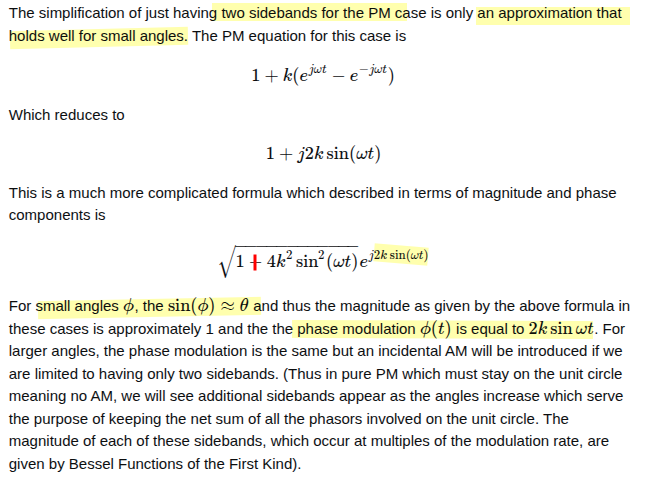
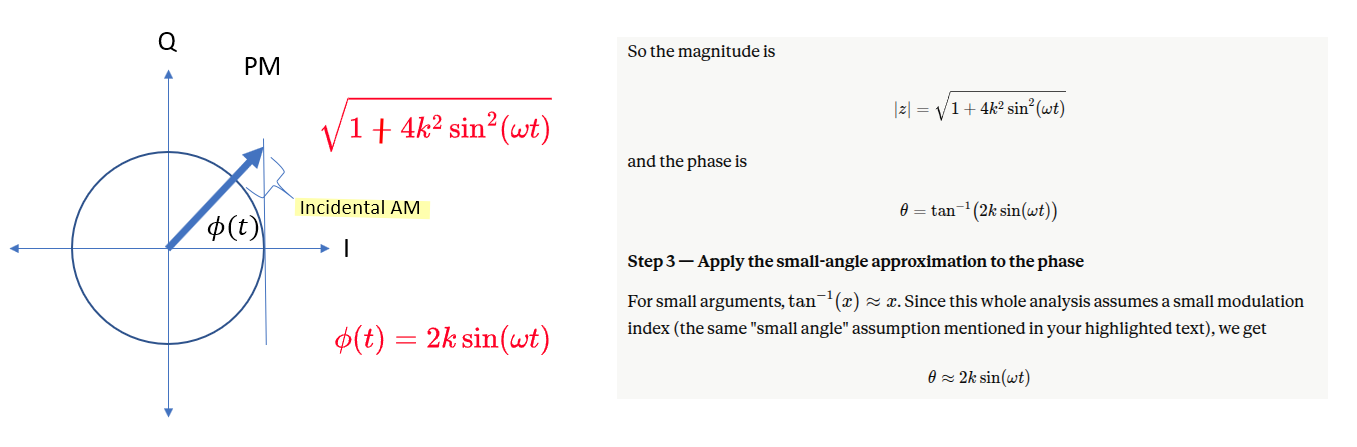
PM \[ e^{j\omega_0 t}(V_0 + V_{PM}e^{jy_P}-V_{PM}e^{-jy_P})=V_0e^{j\omega_0 t}\left(1 + j\frac{2V_{PM}}{V_0}\sin y_P\right) \approx V_0e^{j\omega_0 t}\cdot e^{j\frac{2V_{PM}}{V_0}\sin y_P} \] modulate the phase of the oscillation with an index of approximately \(\frac{2V_{PM}}{V_0}\) rad
Darabi H. Radio Frequency Integrated Circuits and Systems. 2nd ed. Cambridge University Press; 2020.
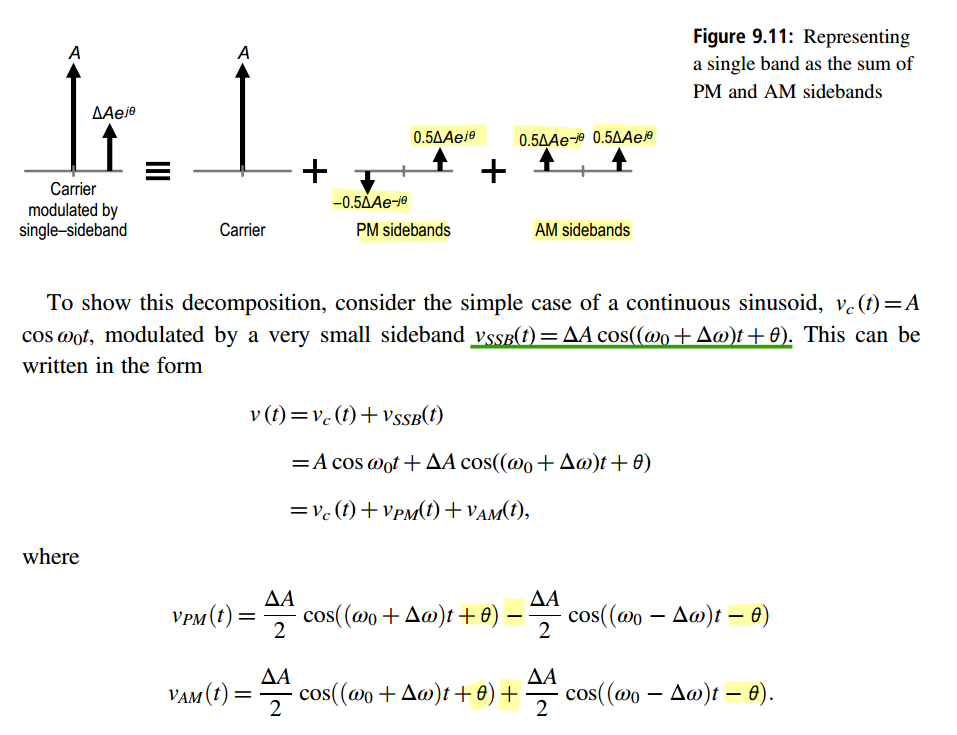
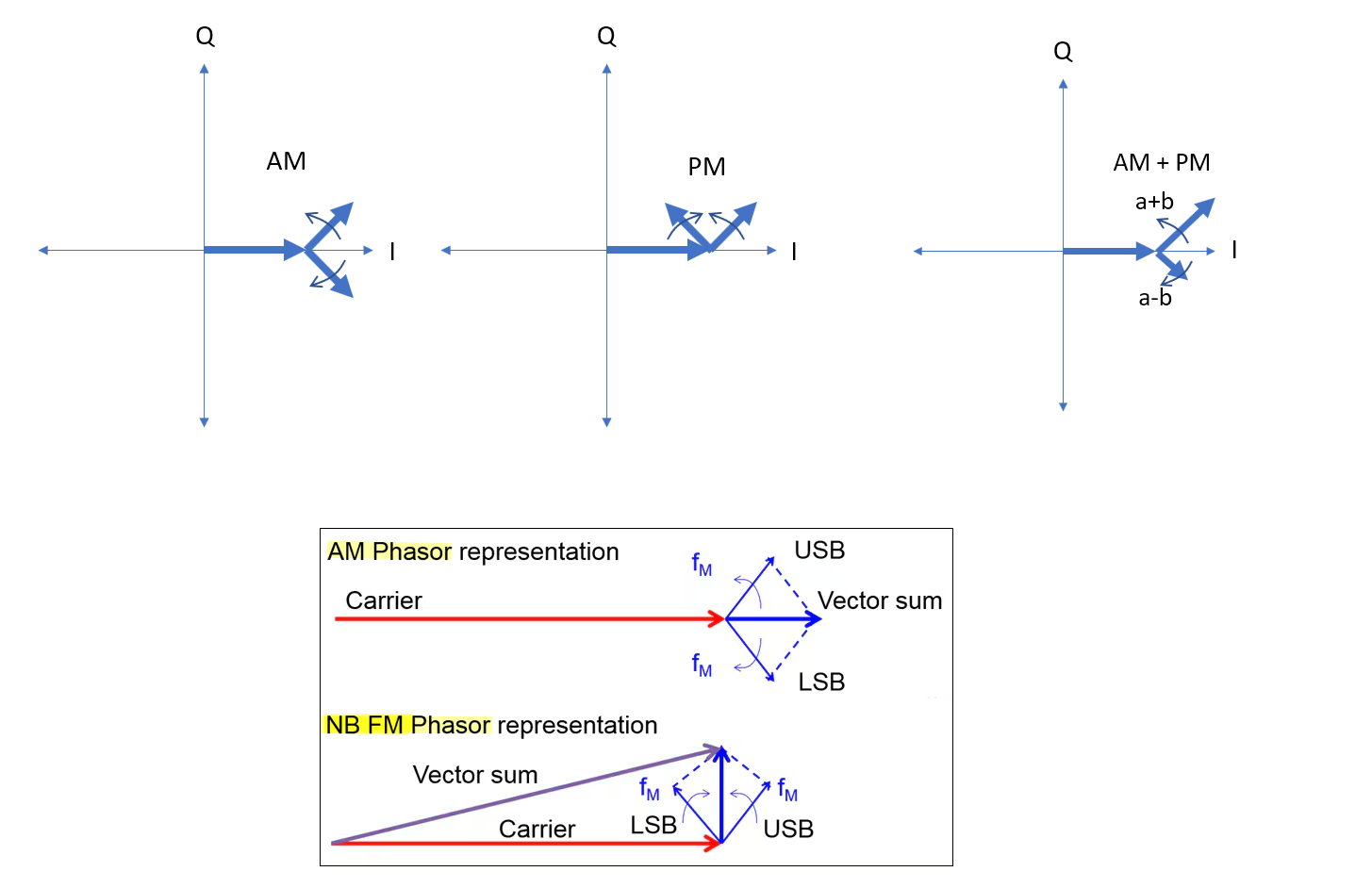
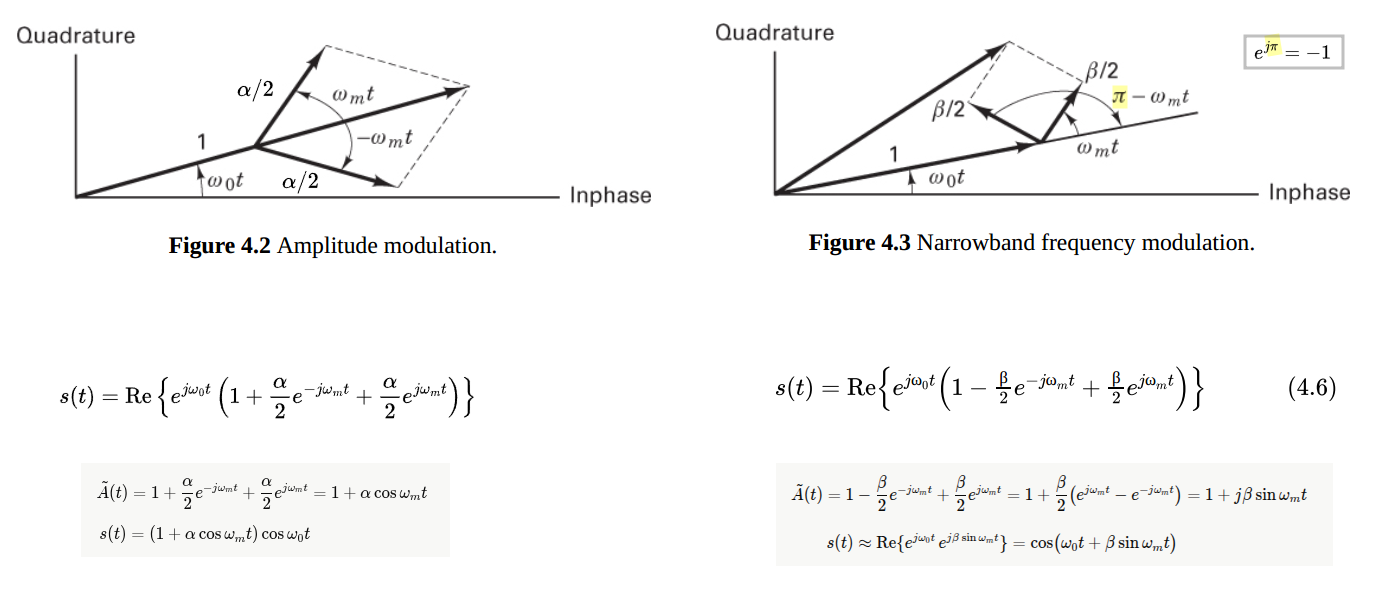
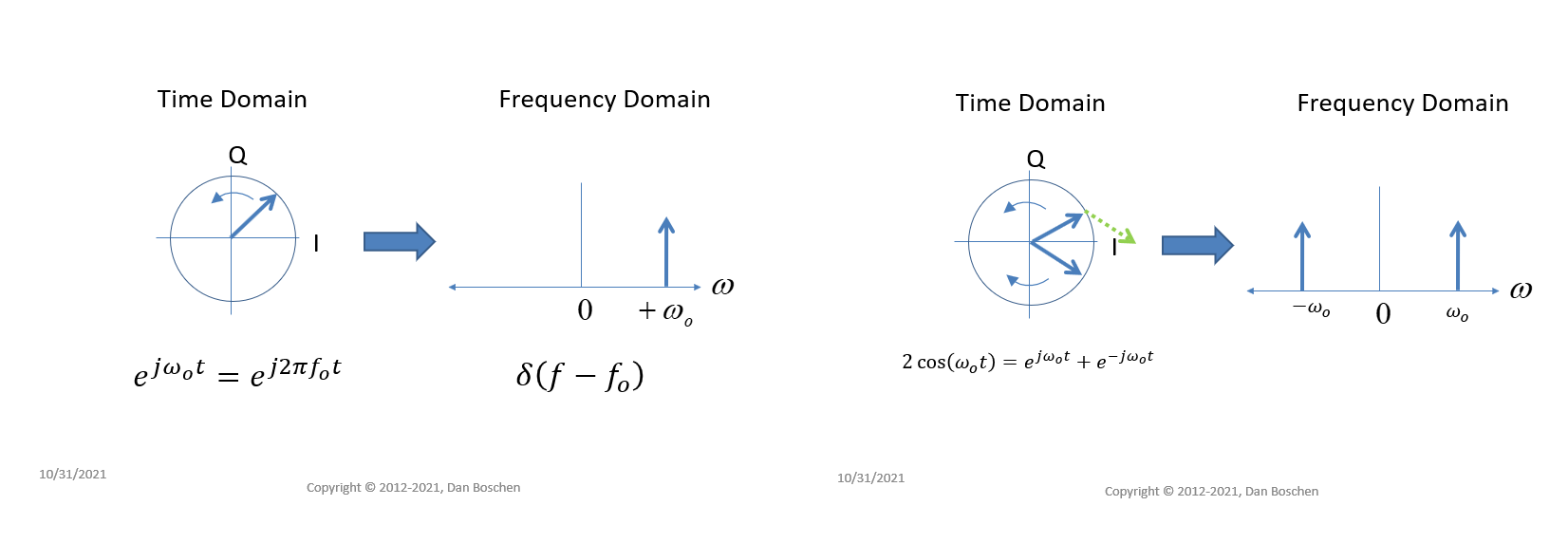
"I" is the in-phase or real axis and "Q" is the quadrature or imaginary axis
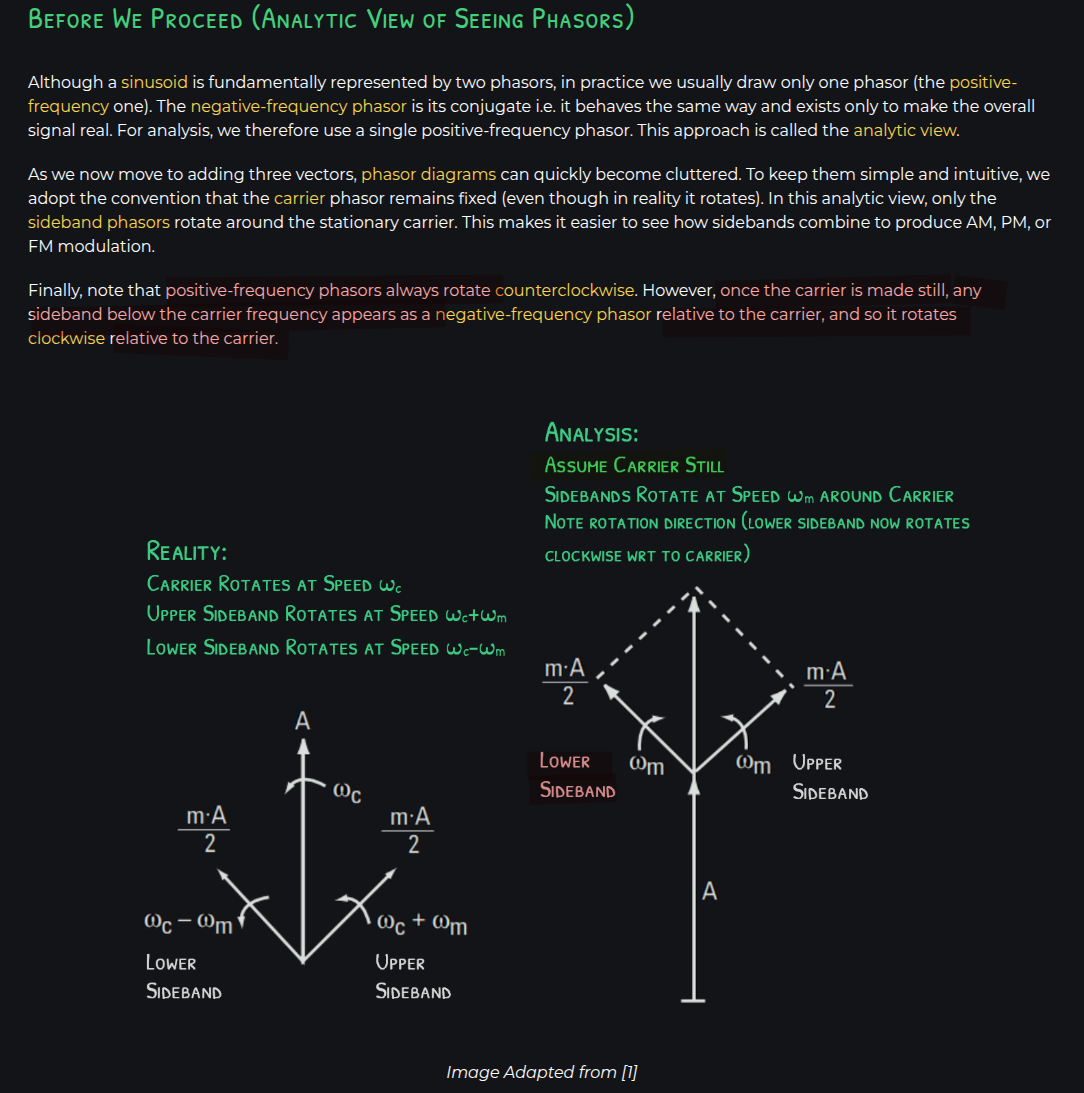
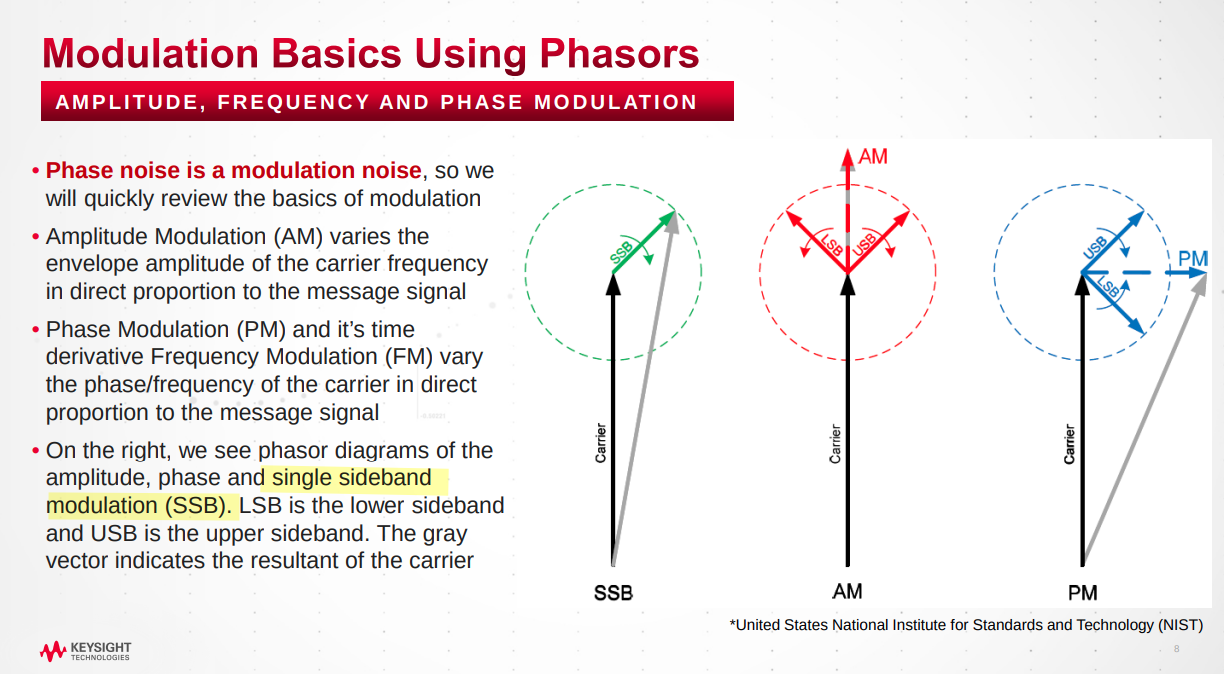
phasor rotating counter-clockwise represents the upper sideband (USB) \(e^{j(\omega_o+\omega_m )t} = e^{j\omega_o t}\color{red}e^{j\omega_m t}\)
phasor rotating clockwise represents the lower sideband (LSB) \(e^{j(\omega_o-\omega_m )t} = e^{j\omega_o t}\color{red}e^{-j\omega_m t}\)
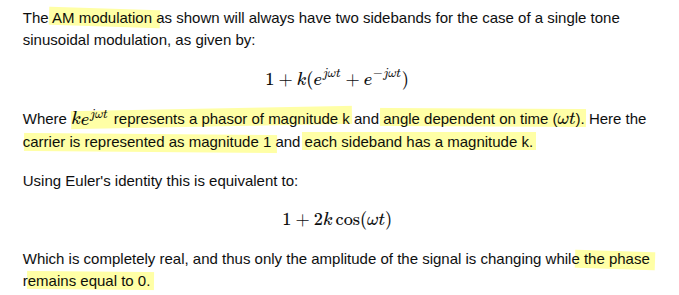
AM modulation
 \[\begin{align}
x(t)&= (1+2k\cos(\omega_m t)) \cos(\omega_0 t) = \cos(\omega_0 t) +
2k \cos(\omega_m t) \cos(\omega_0 t) \\
&=\mathcal{Re}\{e^{j\omega_0t}+k(e^{j\omega_0t}e^{j\omega_mt}+e^{j\omega_0t}e^{-j\omega_mt})\}
=\mathcal{Re}\{e^{j\omega_0t}(\color{red}1+k(e^{j\omega_mt}+e^{-j\omega_mt})\color{black})\}
\end{align}\]
\[\begin{align}
x(t)&= (1+2k\cos(\omega_m t)) \cos(\omega_0 t) = \cos(\omega_0 t) +
2k \cos(\omega_m t) \cos(\omega_0 t) \\
&=\mathcal{Re}\{e^{j\omega_0t}+k(e^{j\omega_0t}e^{j\omega_mt}+e^{j\omega_0t}e^{-j\omega_mt})\}
=\mathcal{Re}\{e^{j\omega_0t}(\color{red}1+k(e^{j\omega_mt}+e^{-j\omega_mt})\color{black})\}
\end{align}\]
PM modulation with incidental AM
Phasors, Modulation & Sidebands [https://www.rfinsights.com/concepts/modulation-and-sidebands/]
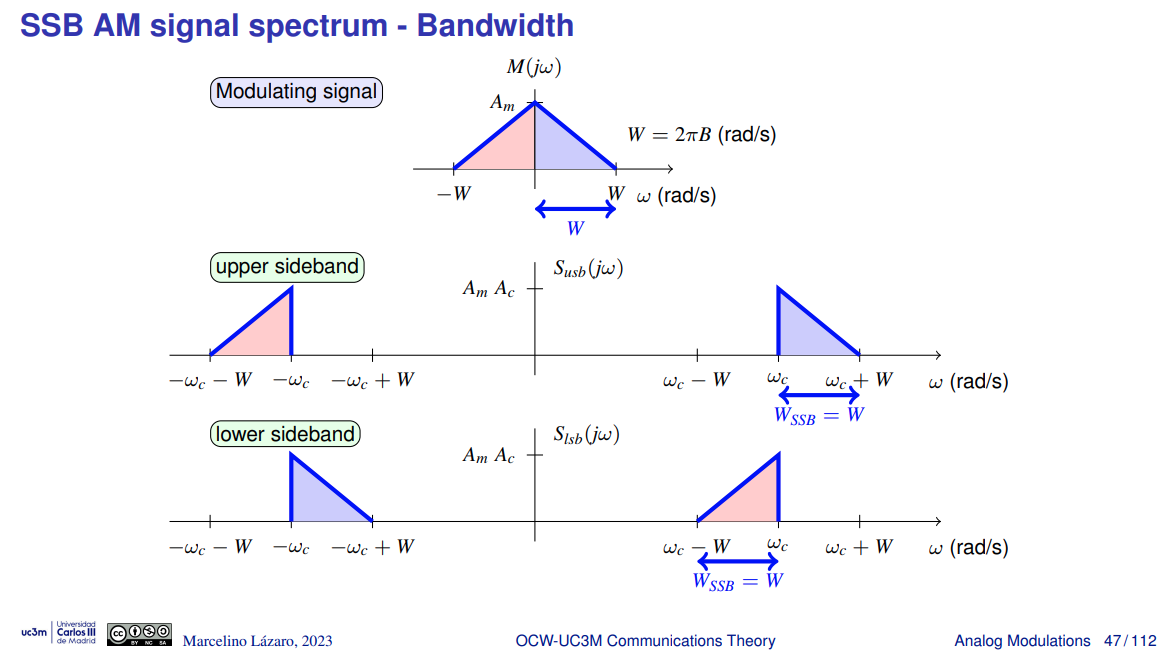
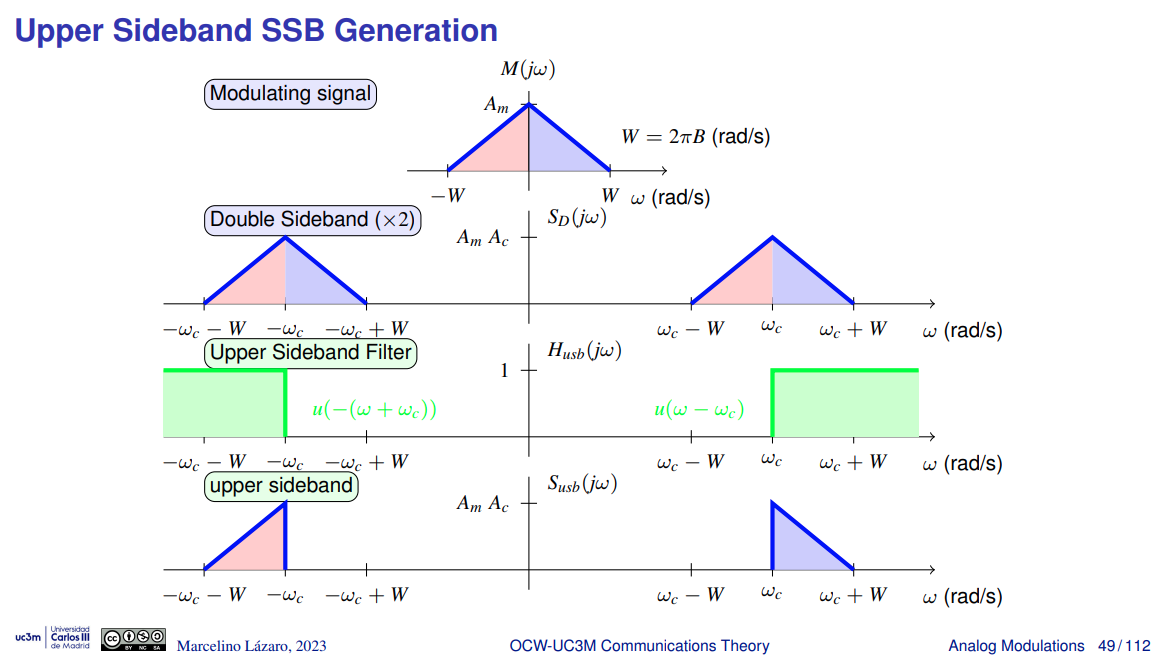
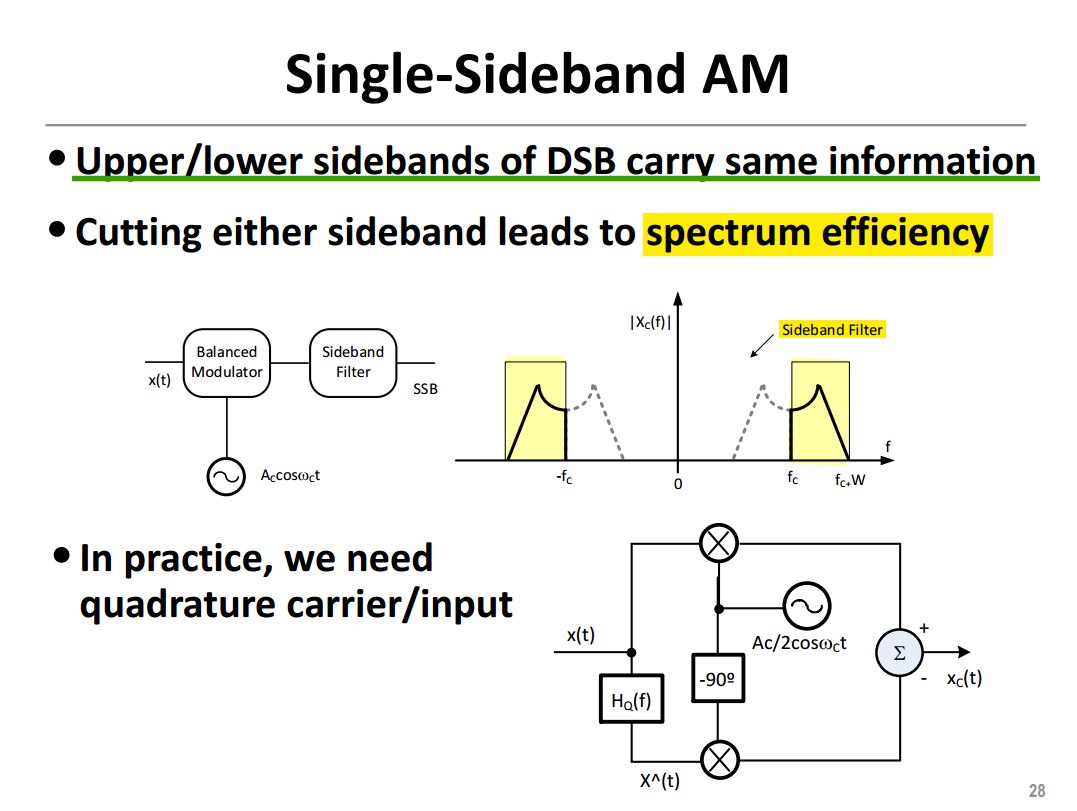
Single Sideband Modulation (SSB)
Phase Noise 101: Basics, Applications and Measurements [https://www.qsl.net/ab4oj/test/docs/20180720_KEE7_PhaseNoise.pdf]
Marcelino Lazaro, Communication Theory, Chapter 2 Analog Modulations [https://ocw.uc3m.es/pluginfile.php/7097/mod_page/content/15/OCW-CT-C2.pdf] [video]
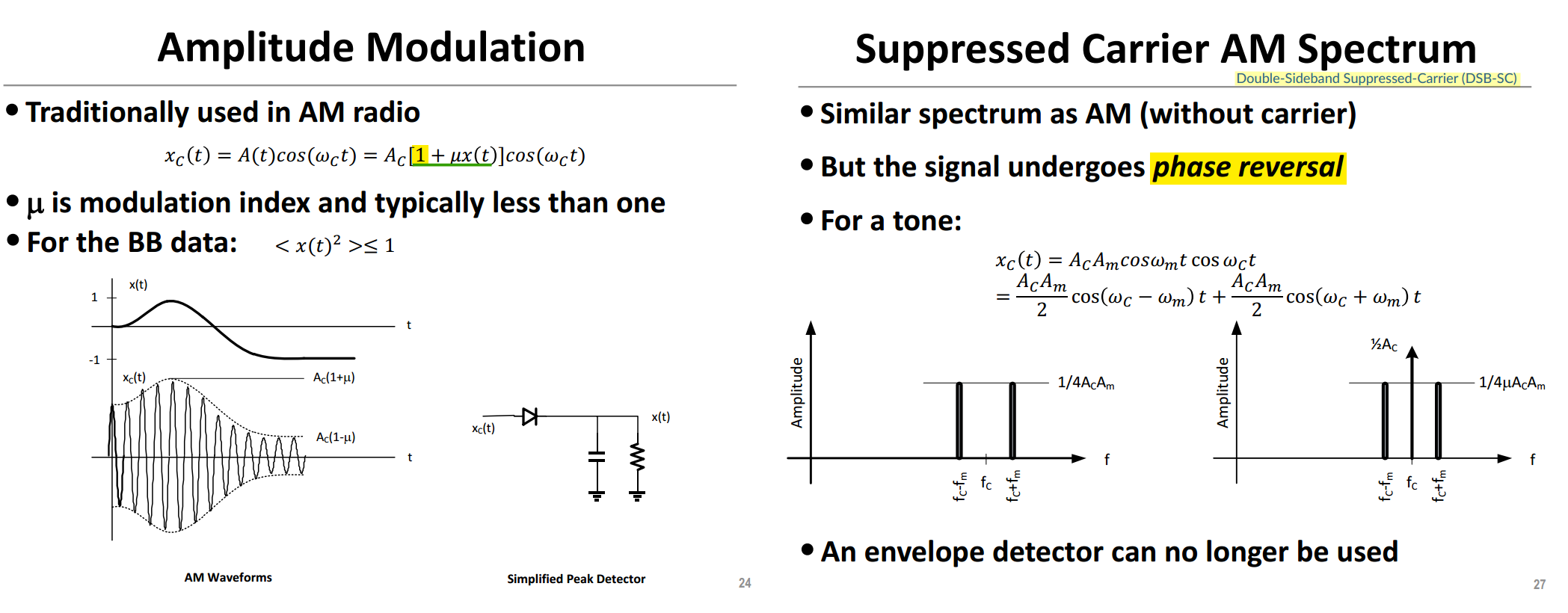
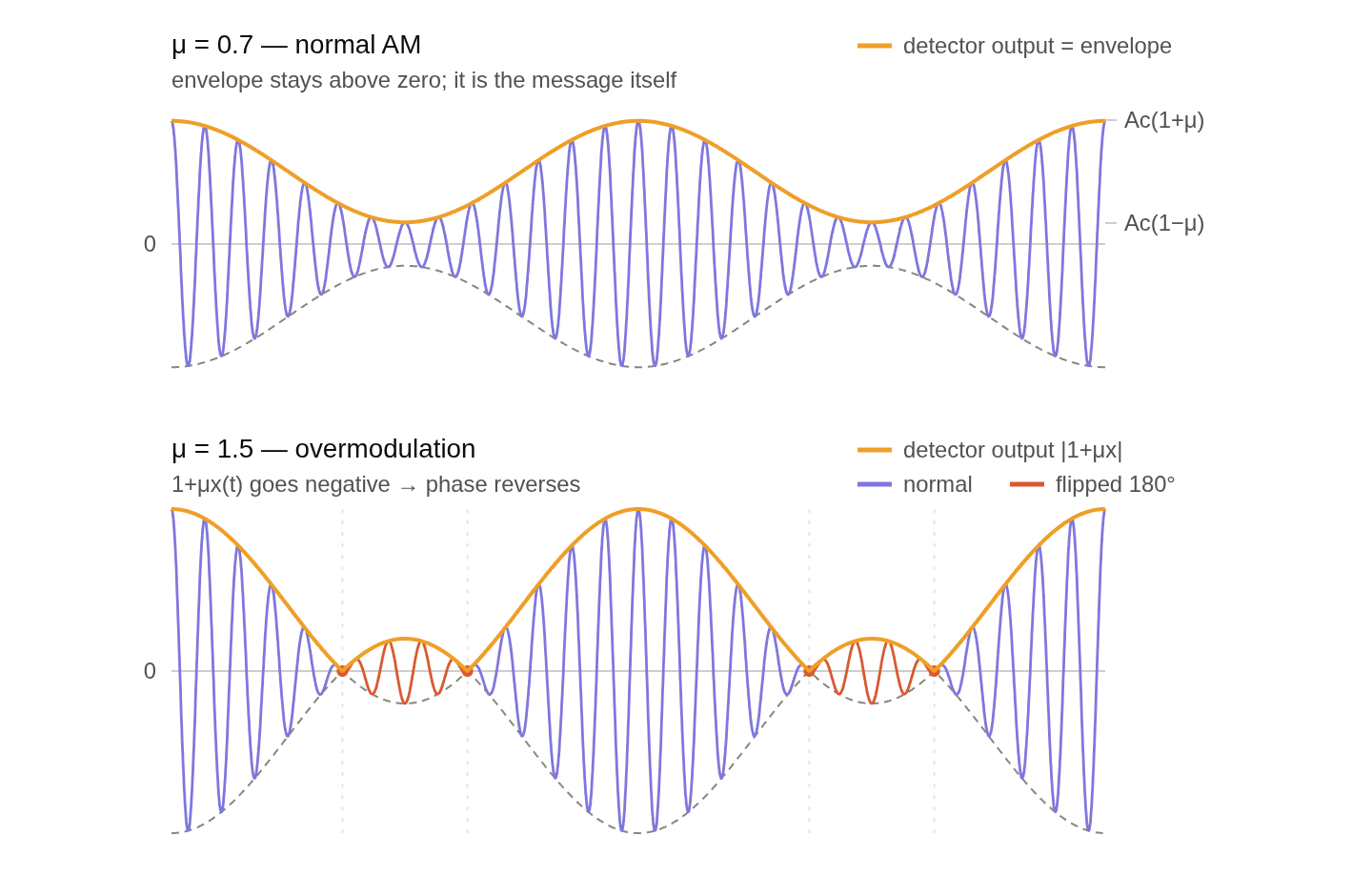
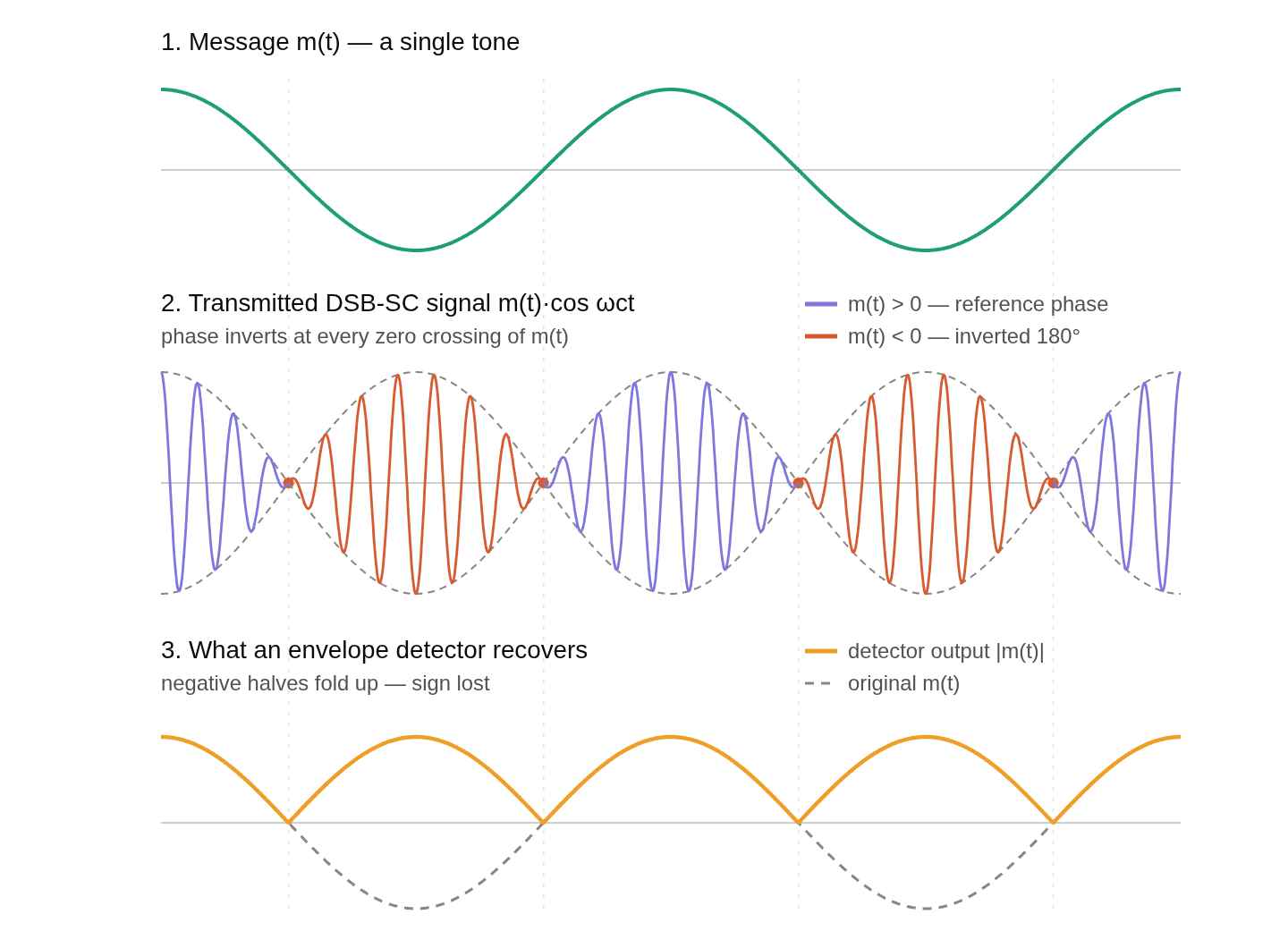
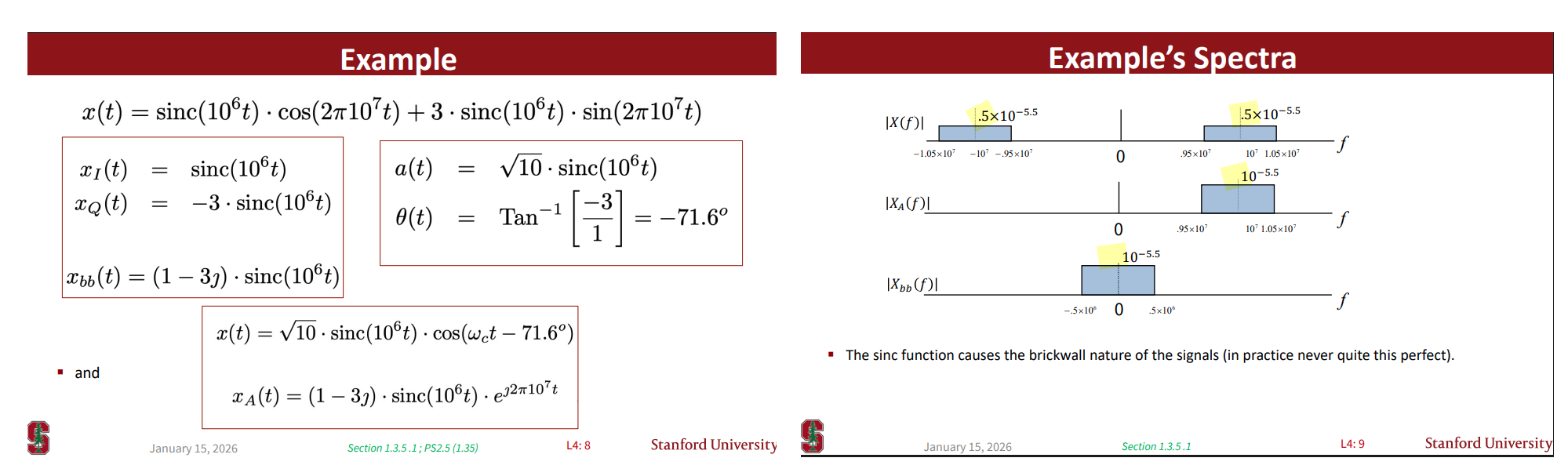
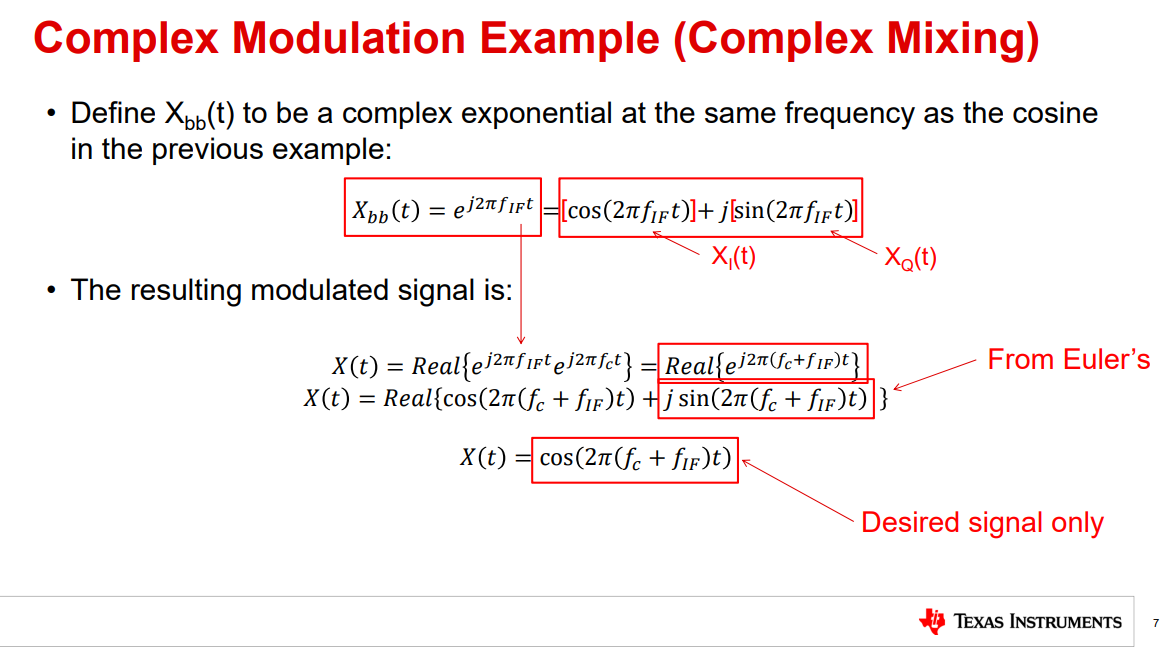
Real & Complex Modulation
J OHN M. C IOFFI. Complex AWGN and Other Channels [https://cioffi-group.stanford.edu/ee379a/Lectures/L4.pdf]
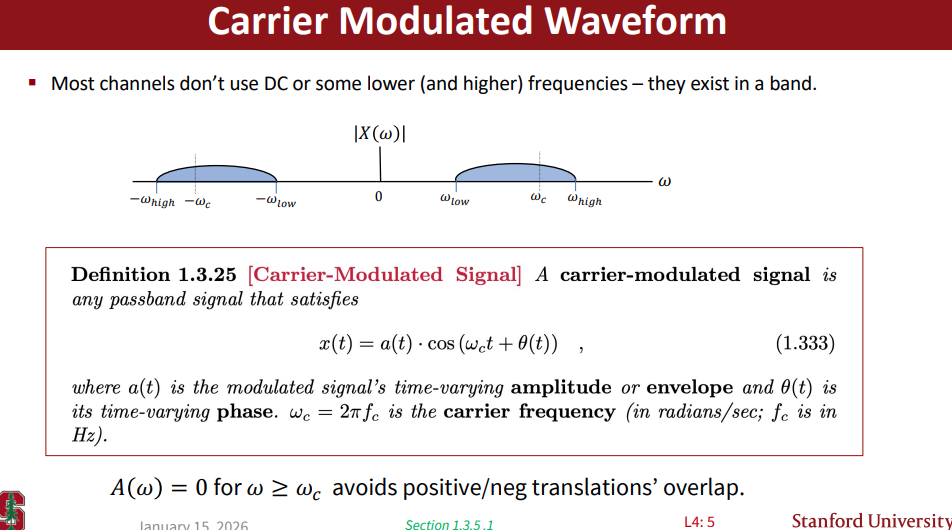
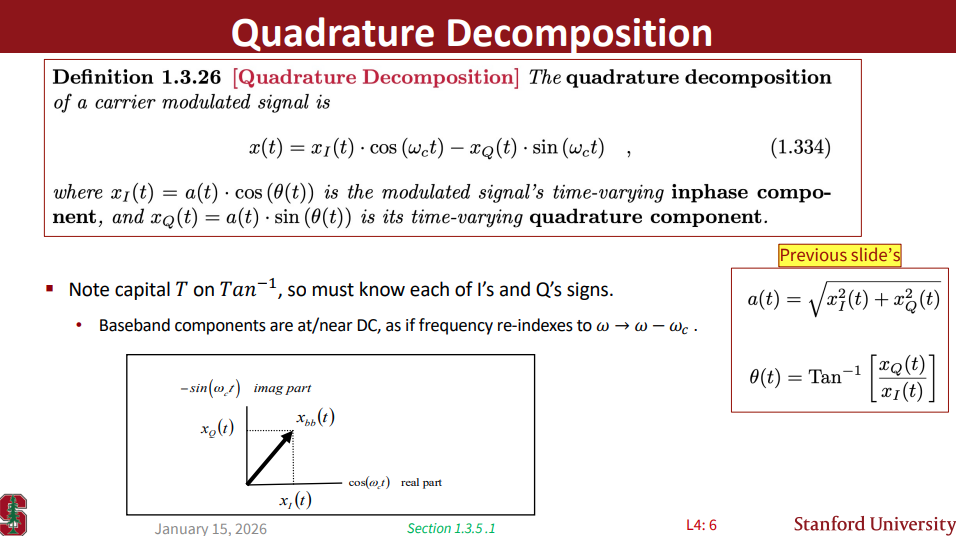
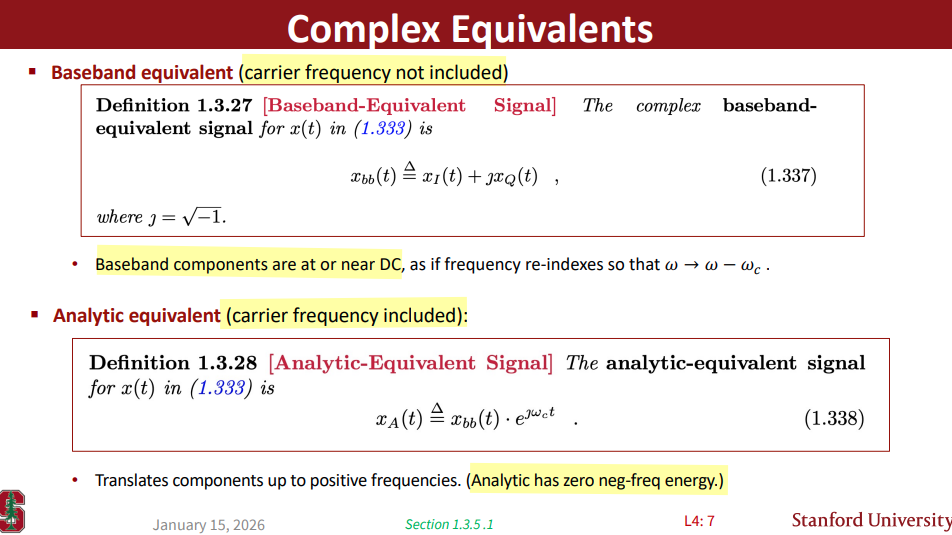
| signal | Spectra |
|---|---|
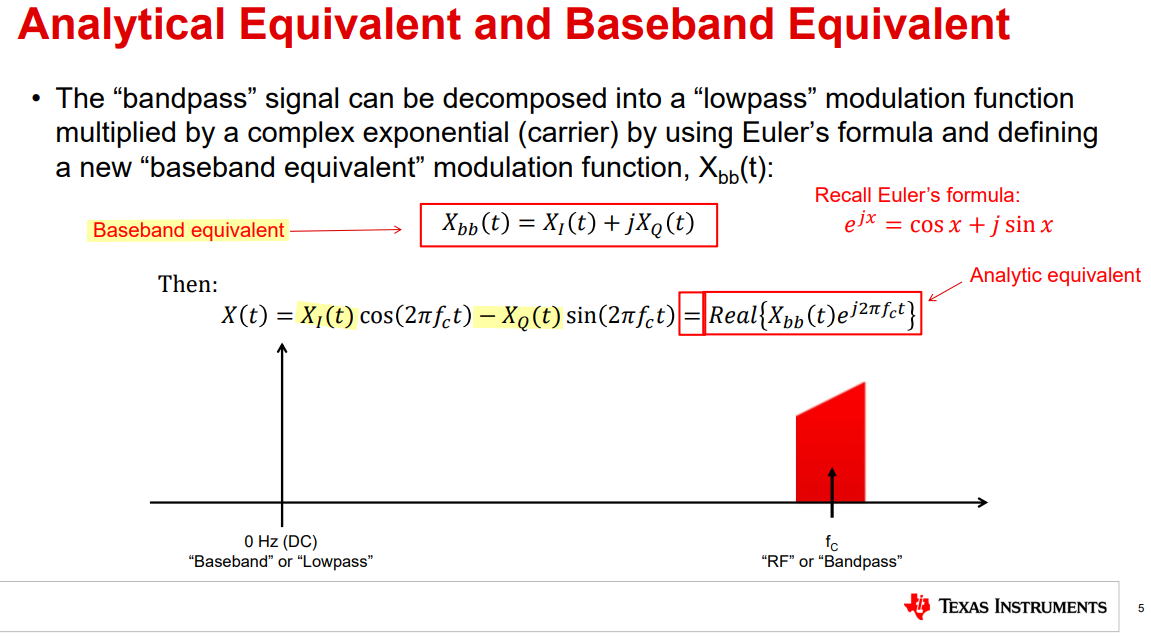
| \(x_{bb}(t) = x_I(t)+jx_Q(t)\) | \(X_{I}(\omega)+jX_Q(\omega)\) |
| \(x(t)=\color{red}x_I(t)\cdot\cos(\omega_c t)\color{blue}-x_Q(t)\cdot\sin(\omega_c t)\) | \(\color{red}\frac{1}{2}X_{I}(\omega+\omega_c)+\color{blue}\frac{1}{2}jX_{Q}(\omega+\omega_c)+\color{red}\frac{1}{2}X_{I}(\omega-\omega_c)+\color{blue}\frac{1}{2}jX_{Q}(\omega-\omega_c)\) |
| \(x_A=x_{bb}(t)\cdot e^{j\omega_c t}\) | \(X_{I}(\omega-\omega_c)+jX_Q(\omega-\omega_c)\) |
Matt Guibord. TIPL 4: Real and Complex Modulation [https://www.ti.com/content/dam/videos/external-videos/en-us/2/3816841626001/5576277660001.mp4/subassets/TIPL4708-Real-and-Complex-Modulation.pdf]
 \[\begin{align}
X_{bb,AM,USB}(t) &= e^{j\omega_m t} = \cos(\omega_m t) +
j\sin(\omega_m t)\\
X_{bb,AM,LSB}(t) &= e^{-j\omega_m t} = \cos(\omega_m t) -
j\sin(\omega_m t)
\end{align}\]
\[\begin{align}
X_{bb,AM,USB}(t) &= e^{j\omega_m t} = \cos(\omega_m t) +
j\sin(\omega_m t)\\
X_{bb,AM,LSB}(t) &= e^{-j\omega_m t} = \cos(\omega_m t) -
j\sin(\omega_m t)
\end{align}\]
where \(X_{I,AM,USB}(t)=\cos(\omega_m t)\) and \(X_{Q,AM,USB}(t)=\sin(\omega_m t)\); \(X_{I,AM,USB}(t)=\cos(\omega_m t)\) and \(X_{Q,AM,USB}(t)=-\sin(\omega_m t)\);
\(X_{I,AM,USB} = X_{I,AM,LSB}\) and \(X_{Q,AM,USB} = -X_{Q,AM,LSB}\)
\[\begin{align} X_{bb,PM,USB}(t) &= e^{j\omega_m t} = \cos(\omega_m t) + j\sin(\omega_m t)\\ X_{bb,PM,LSB}(t) &= -e^{-j\omega_m t} = -\cos(\omega_m t) + j\sin(\omega_m t) \end{align}\]
where \(X_{I,PM,USB}(t)=\cos(\omega_m t)\) and \(X_{Q,PM,USB}(t)=\sin(\omega_m t)\); \(X_{I,PM,USB}(t)=-\cos(\omega_m t)\) and \(X_{Q,PM,USB}(t)=\sin(\omega_m t)\);
\(X_{I,PM,USB} = -X_{I,PM,LSB}\) and \(X_{Q,PM,USB} = X_{Q,PM,LSB}\)
Amplitude Noise
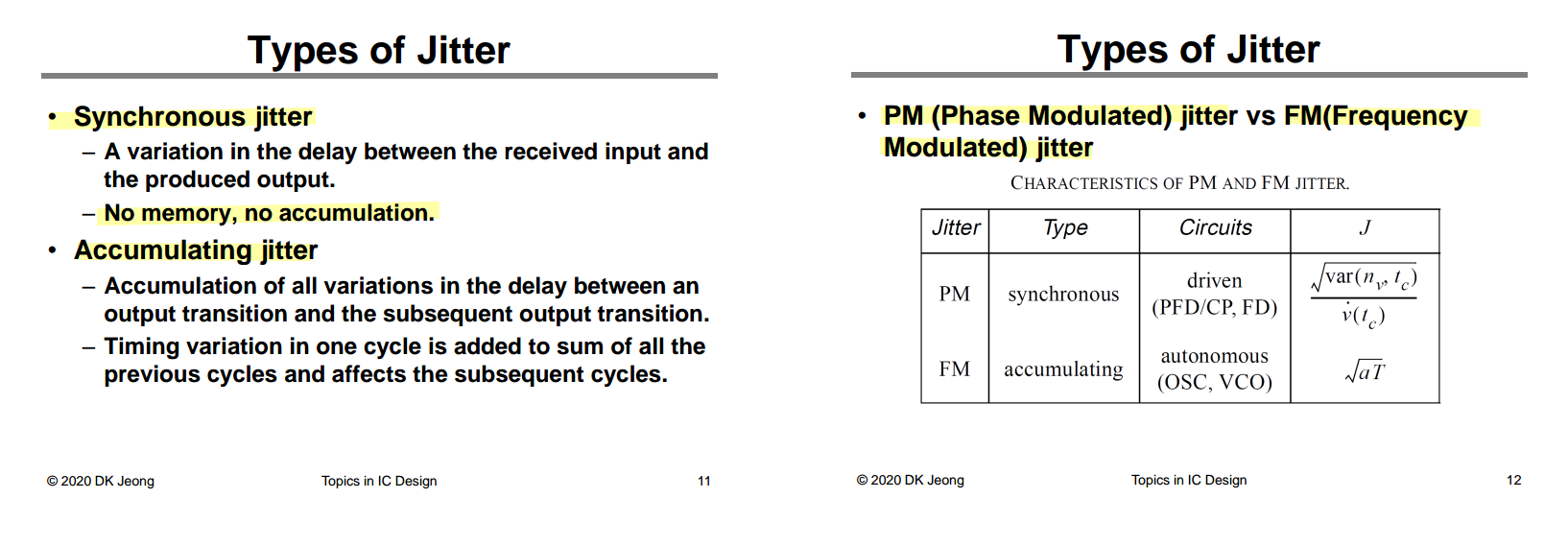
Deog-Kyoon Jeong. Topics in IC Design: 1.1 Introduction to Jitter [https://ocw.snu.ac.kr/sites/default/files/NOTE/Lec%201%20-%20Jitter%20and%20Phase%20Noise.pdf]
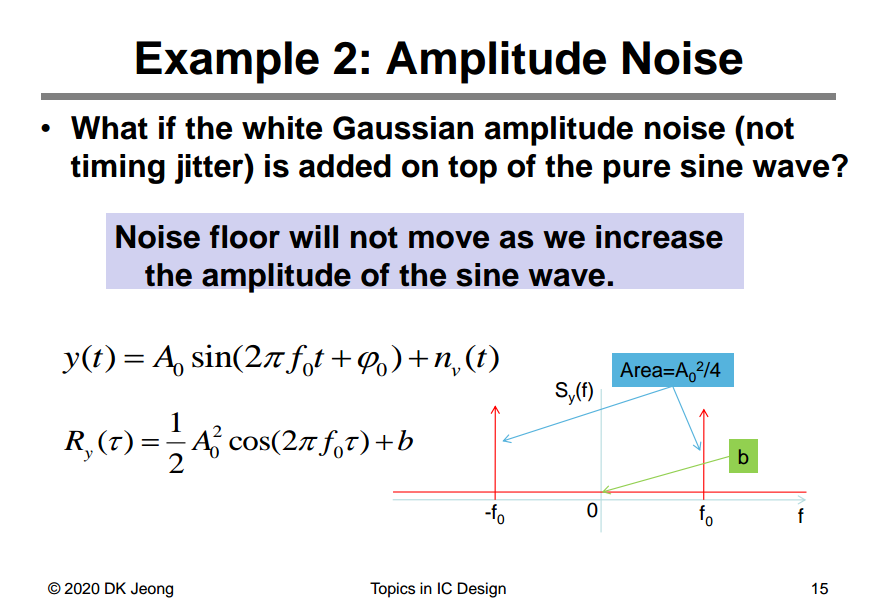
with \(x(t) = A_0\sin (2\pi f_0 t +\phi _0)\), then \(y(t) = x(t) + n_v(t)\)
\[\begin{align} R_y(\tau) &= \mathrm{E}[y(t)y(t+\tau)] \\ &= \mathrm{E}[x(t)x(t+\tau)] + \mathrm{E}[x(t)]\mathrm{E}[n_v(t+\tau)] + \mathrm{E}[x(t+\tau)]\mathrm{E}[n_v(t)] + \mathrm{E}[n_v(t)n_v(t+\tau)]\\ &= \mathrm{E}[x(t)x(t+\tau)] + \mathrm{E}[n_v(t)n_v(t+\tau)] = R_x(\tau) + R_{n_v}(\tau) \end{align}\]
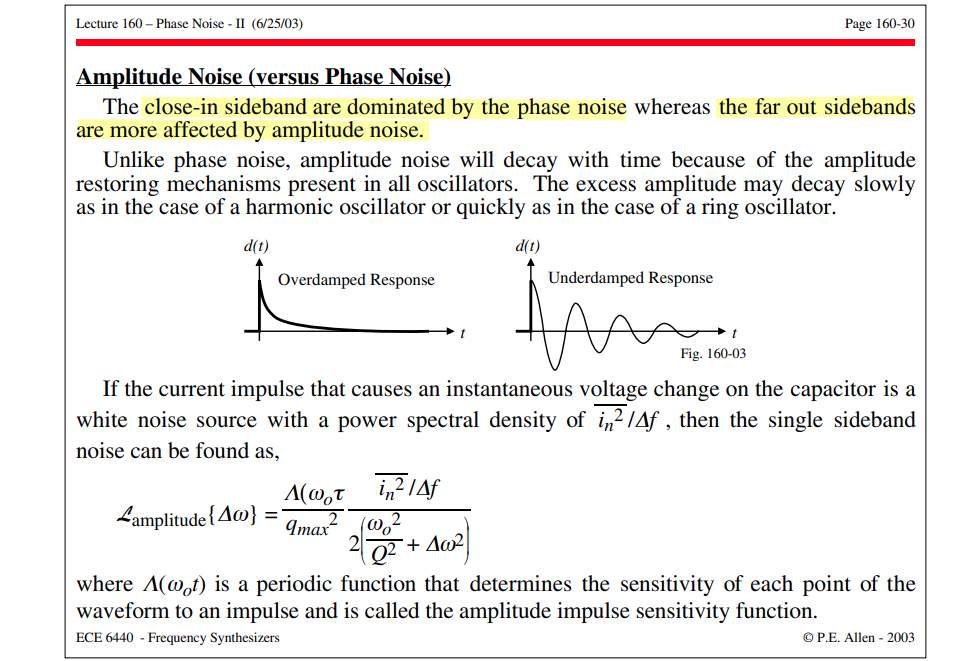
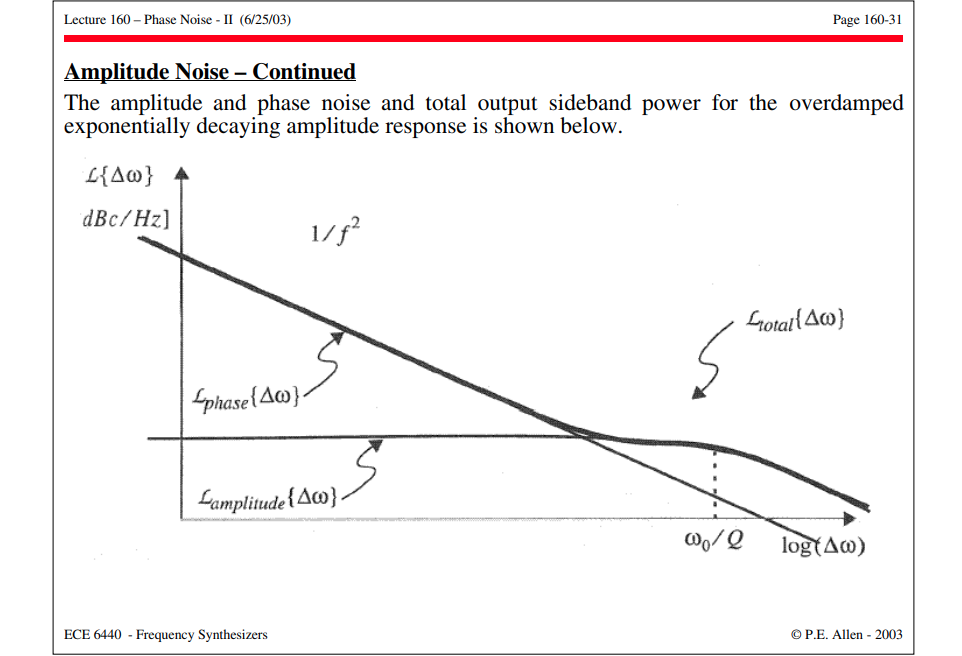
P.E. Allen - 2003. ECE 6440 - Frequency Synthesizers: Lecture 160 – Phase Noise - II [https://pallen.ece.gatech.edu/Academic/ECE_6440/Summer_2003/L160-PhNoII(2UP).pdf]
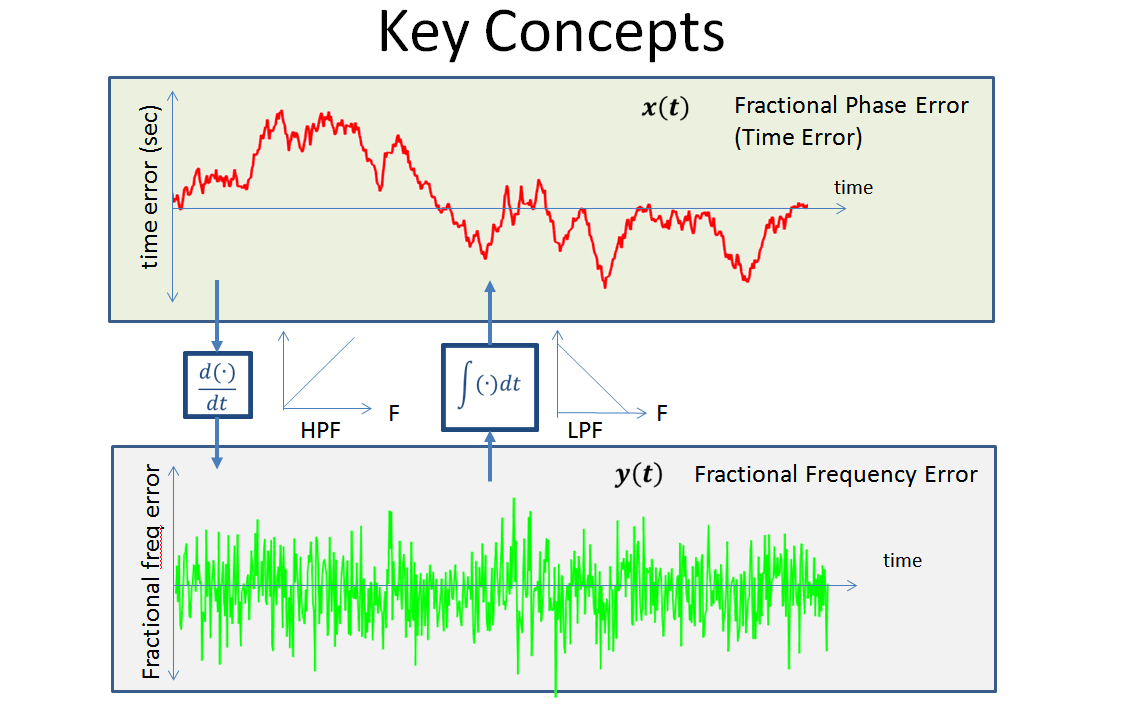
PM & FM
Dan Boschen What is the difference between phase noise and frequency noise? [https://dsp.stackexchange.com/a/38230/59253]
Phase Noise and Frequency Noise are not two different noise sources, they are artifacts of the same noise, it is just a matter of what units you want to use
AM & PM Sidebands
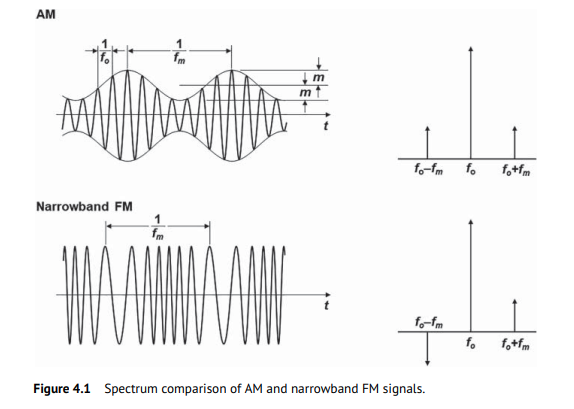
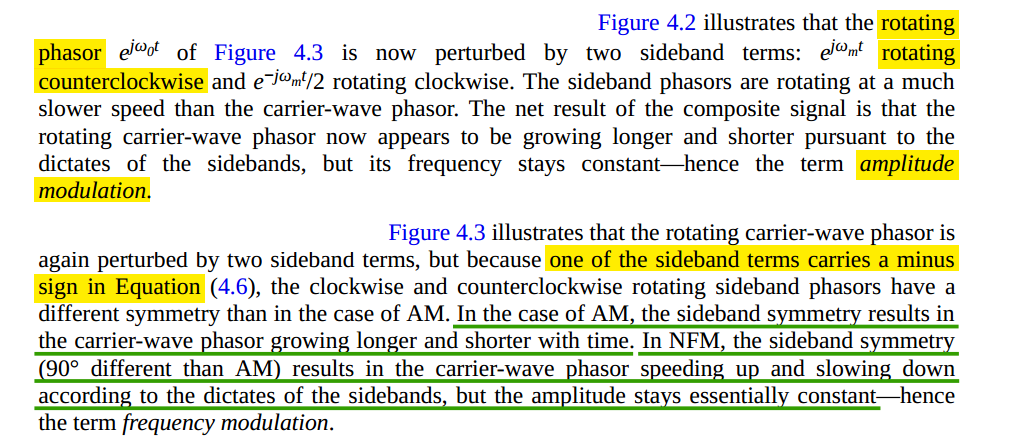
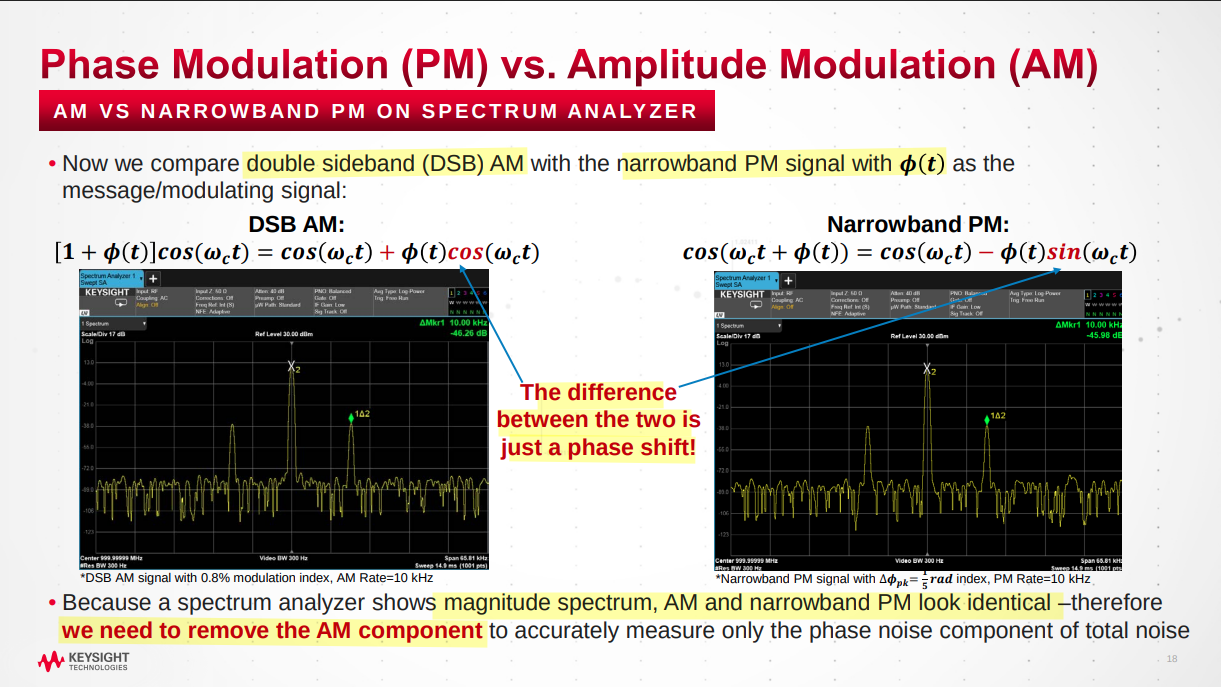
The spectrum of the narrowband FM signal is very similar to that of an amplitude modulation (AM) signal but has the phase reversal for the other sideband component
Assume the modulation frequency of PM and AM are same, \(\omega_m\)
\[\begin{align} x(t) &= (1+A_m\cos{\omega_m t})\cos(\omega_0 t + P_m \sin\omega_m t) \\ &= \cos(\omega_0 t + P_m \sin\omega_m t) + A_m\cos{\omega_m t}\cos(\omega_0 t + P_m \sin\omega_m t) \\ &= X_{pm}(t) + X_{apm}(t) \end{align}\]
\(X_{pm}(t)\), PM Only \[ X_{pm}(t) = \cos\omega_0 t - \frac{P_m}{2}\cos(\omega_0 - \omega_m)t + \frac{P_m}{2}\cos(\omega_0 + \omega_m)t \] \(X_{apm}(t)\), AM & PM \[\begin{align} X_{apm}(t) &= A_m \cos{\omega_m t} (\cos\omega_0 t-P_m\sin\omega_m t\sin\omega_0 t) \\ &= \frac{A_m}{2}[\cos(\omega_0 + \omega_m)t + \cos(\omega_0 -\omega_m)t] - \frac{A_mP_m}{2}\sin(2\omega_m t)\sin(\omega_0 t) \\ &= \frac{A_m}{2}\cos(\omega_0 + \omega_m)t + \frac{A_m}{2}\cos(\omega_0 -\omega_m)t - \frac{A_mP_m}{4}\cos(\omega_0 - 2\omega_m)t + \frac{A_mP_m}{4}\cos(\omega_0 + 2\omega_m)t \end{align}\]
That is \[\begin{align} x(t) &= \cos\omega_0 t + \frac{A_m-P_m}{2}\cos(\omega_0 - \omega_m)t + \frac{A_m+P_m}{2}\cos(\omega_0 + \omega_m)t \\ &\space\space\space\space\space\space\space\space\space\space\space\space\space\space\space\space\space\space - \frac{A_mP_m}{4}\cos(\omega_0 - 2\omega_m)t + \frac{A_mP_m}{4}\cos(\omega_0 + 2\omega_m)t \end{align}\]
For general case, \(x(t) = (1+A_m\cos{\omega_{am} t})\cos(\omega_0 t + P_m \sin\omega_{pm} t)\), i.e., PM is \(\omega_{pm}\), AM is \(\omega_{am}\)
\[\begin{align} x(t) &= \cos\omega_0 t - \frac{P_m}{2}\cos(\omega_0 - \omega_{pm})t + \frac{P_m}{2}\cos(\omega_0 + \omega_{pm})t \\ &\space\space\space\space\space\space\space\space\space\space\space\space\space\space\space\space\space\space + \frac{A_m}{2}\cos(\omega_0 - \omega_{am})t + \frac{A_m}{2}\cos(\omega_0 + \omega_{am})t \\ &\space\space\space\space\space\space\space\space\space\space\space\space\space\space\space\space\space\space - \frac{A_mP_m}{4}\cos(\omega_0 - \omega_{pm}-\omega_{am})t + \frac{A_mP_m}{4}\cos(\omega_0 + \omega_{pm}+\omega_{am})t \\ &\space\space\space\space\space\space\space\space\space\space\space\space\space\space\space\space\space\space + \frac{A_mP_m}{4}\cos(\omega_0 + \omega_{pm}-\omega_{am})t - \frac{A_mP_m}{4}\cos(\omega_0 - \omega_{pm}+\omega_{am})t \end{align}\]
Therefore, sideband is asymmetric if \(\omega_{pm} = \omega_{am}\) same
Asymmetrical Linear System
Golara, S. (2015). Identifying Mechanisms of AM-PM Distortion in Large Signal Amplifiers. UCLA [https://escholarship.org/uc/item/4jp786z8]
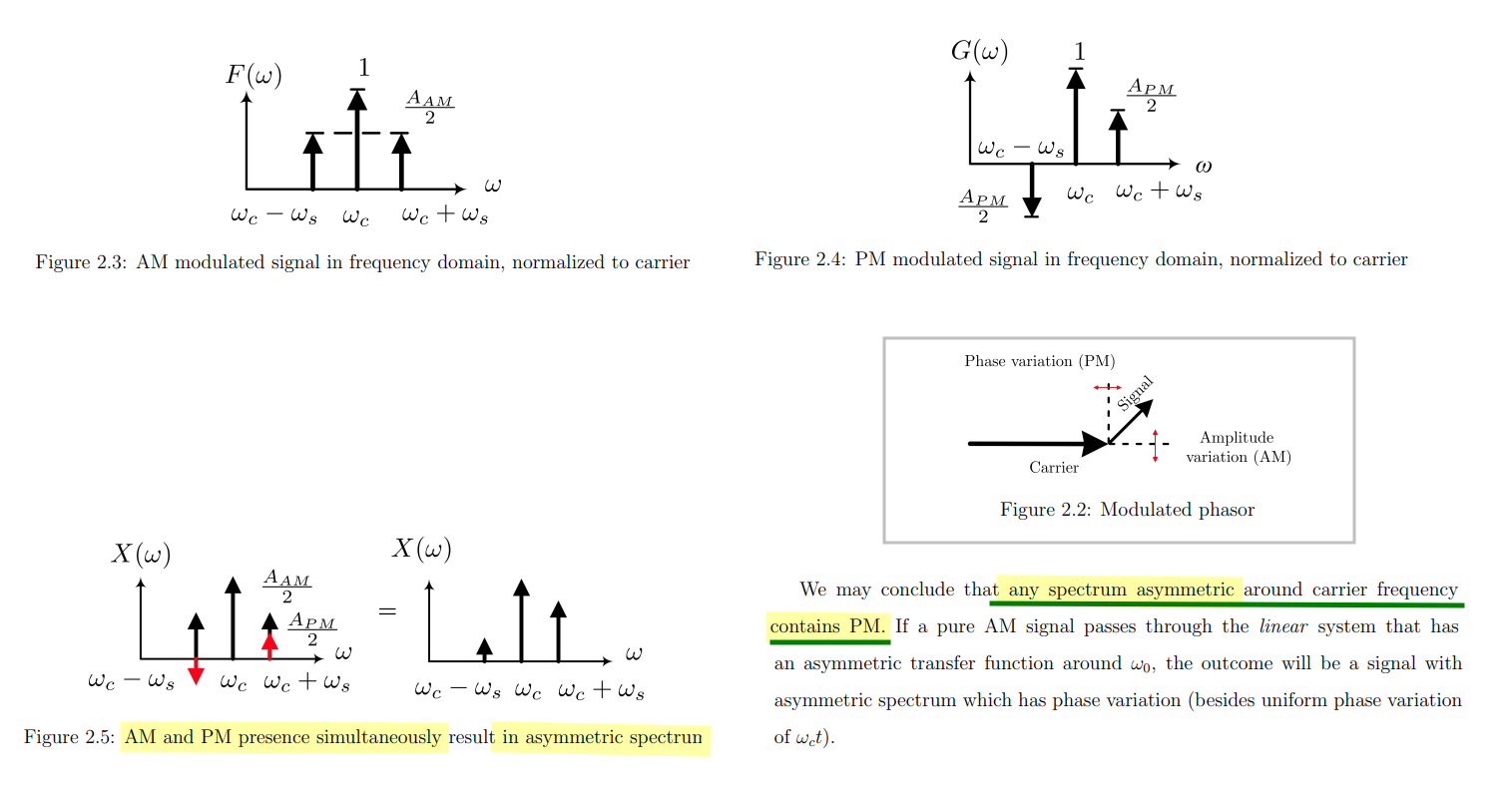
Bob Nelson. Phase Noise 101: Basics, Applications and Measurements [[https://www.qsl.net/ab4oj/test/docs/20180720_KEE7_PhaseNoise.pdf])https://www.qsl.net/ab4oj/test/docs/20180720_KEE7_PhaseNoise.pdf]
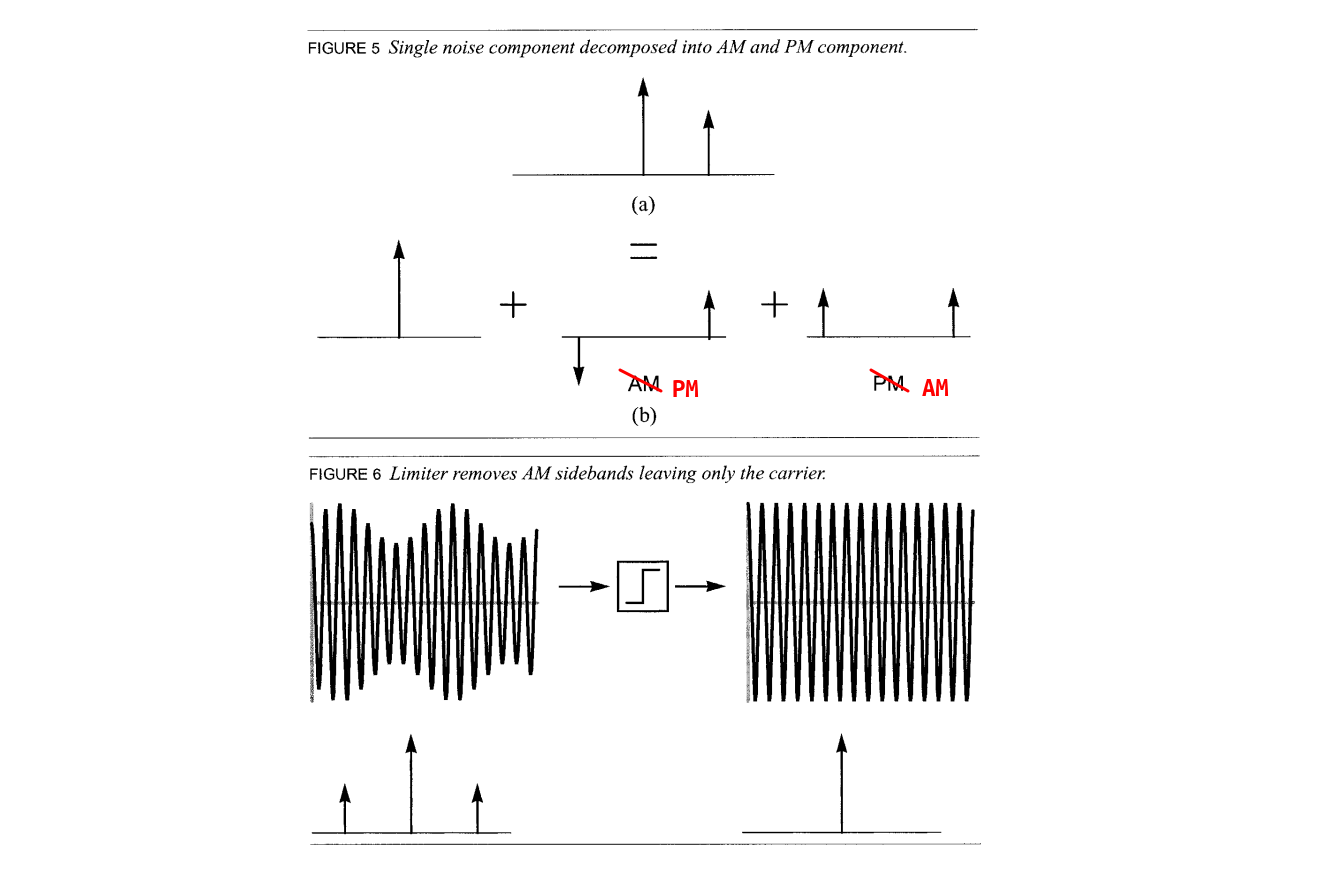
Hegazi, Emad, Asad Abidi, and Jacob Rael. The Designer's Guide to High-purity Oscillators. [New York]: Kluwer Academic Publishers, 2005. [pdf]
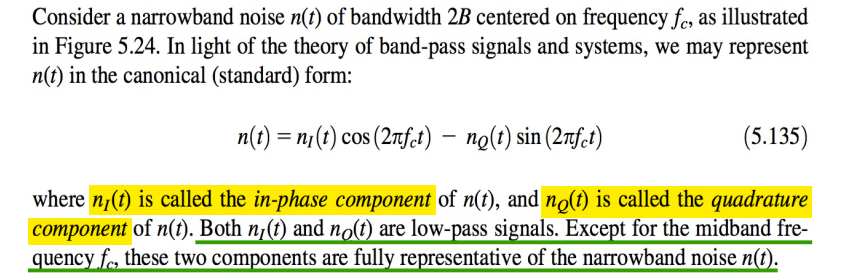
Narrowband Noise

in-phase & quadrature component
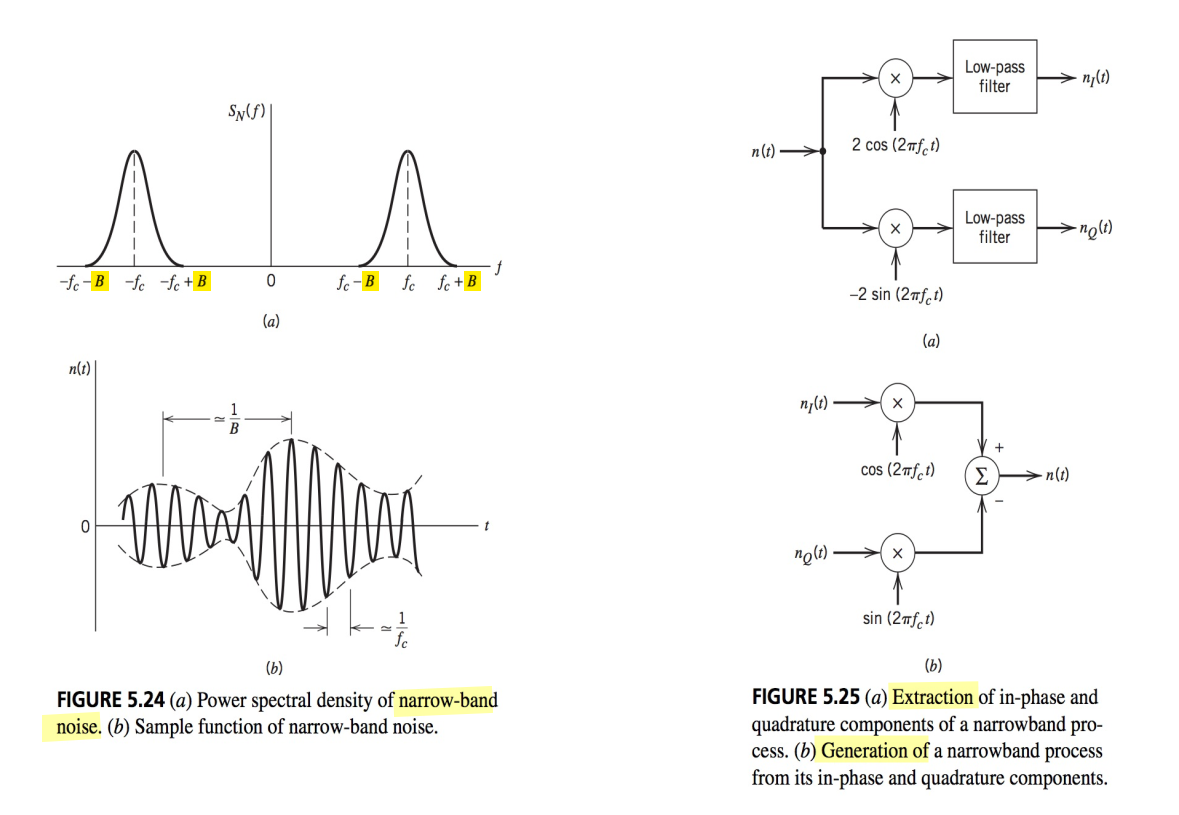
\[\begin{align} n(t)\cdot 2\cos(\omega_c t) &= n_I(t) + n_I(t)\cos(2\omega_c t) - n_Q(t)\sin(2\omega_c t) \\ n(t)\cdot -2\sin(\omega_c t) &= n_Q(t) - n_I(t)\sin(2\omega_c t) - n_Q(t)\cos(2\omega_c t) \end{align}\]
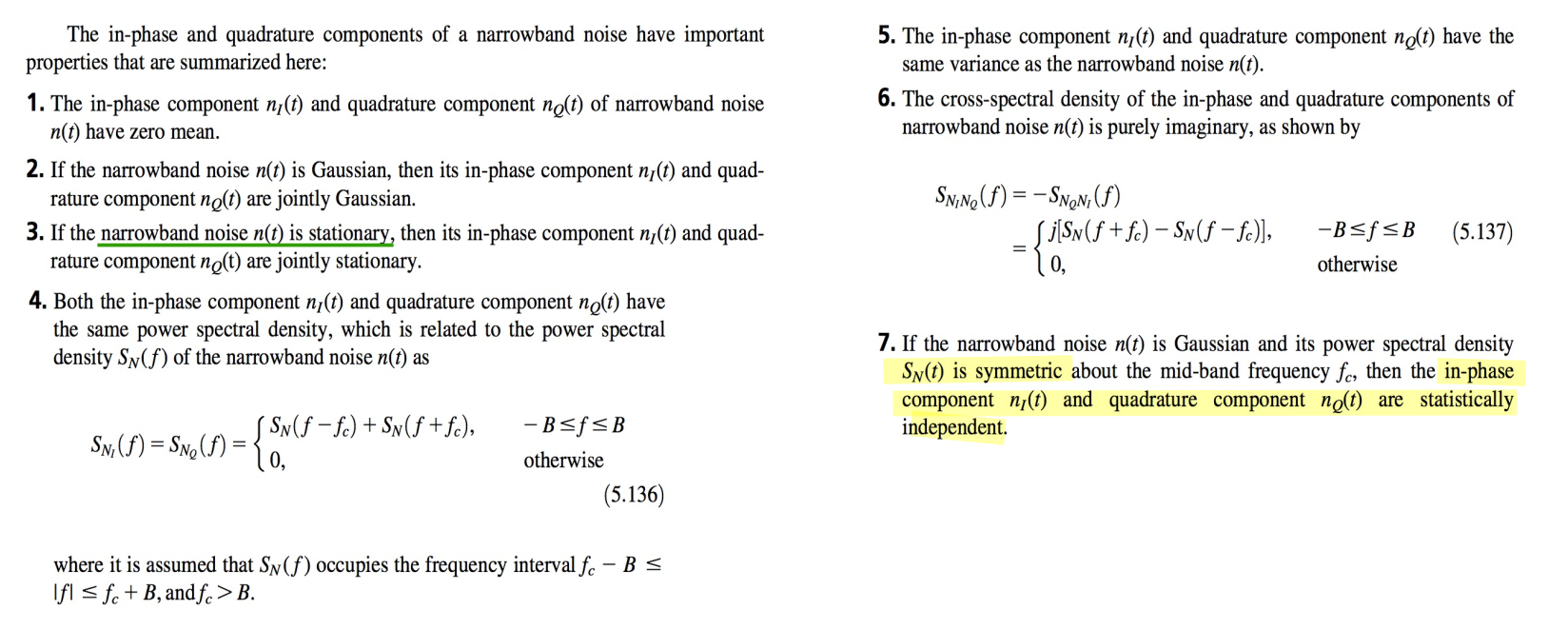

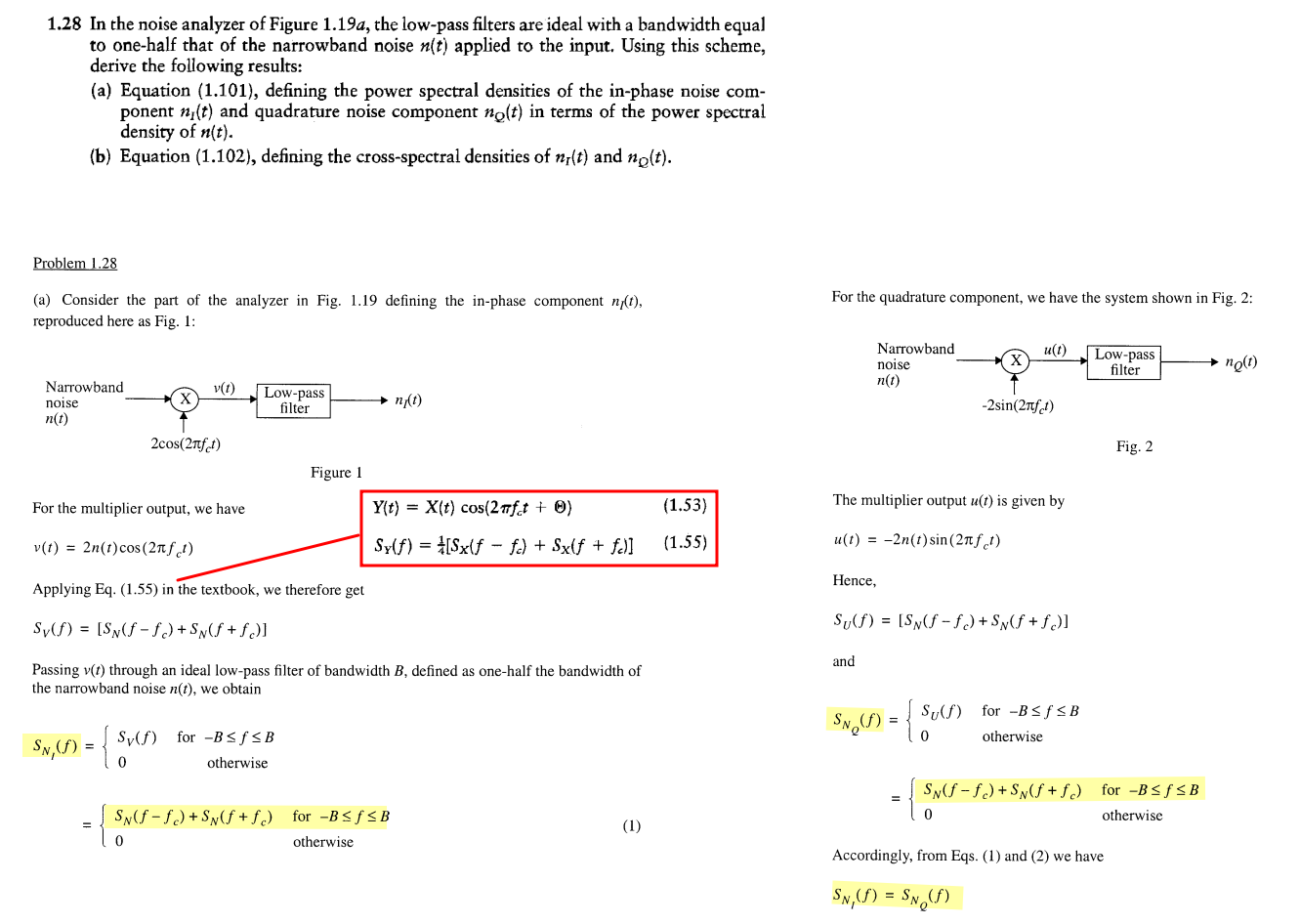
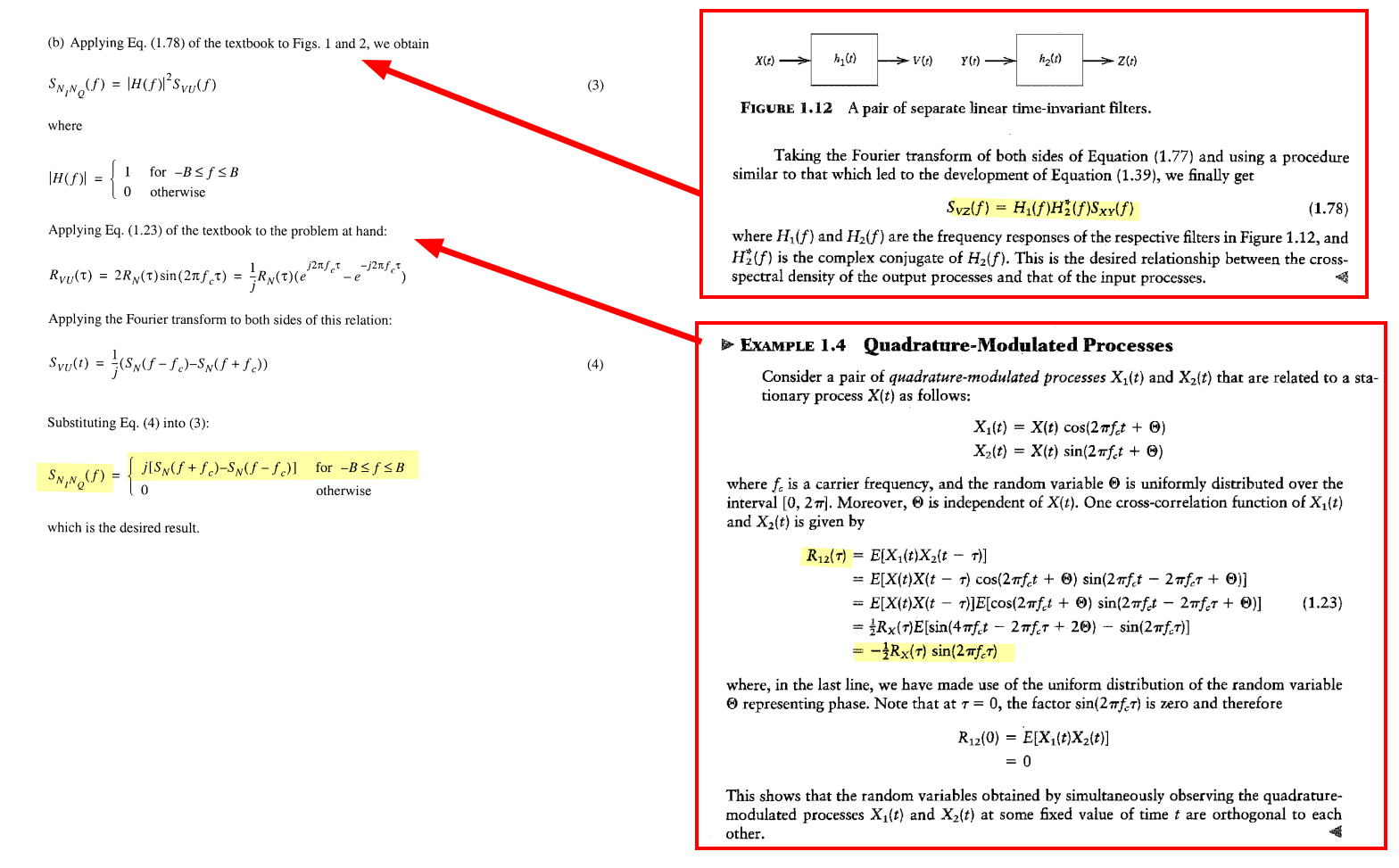
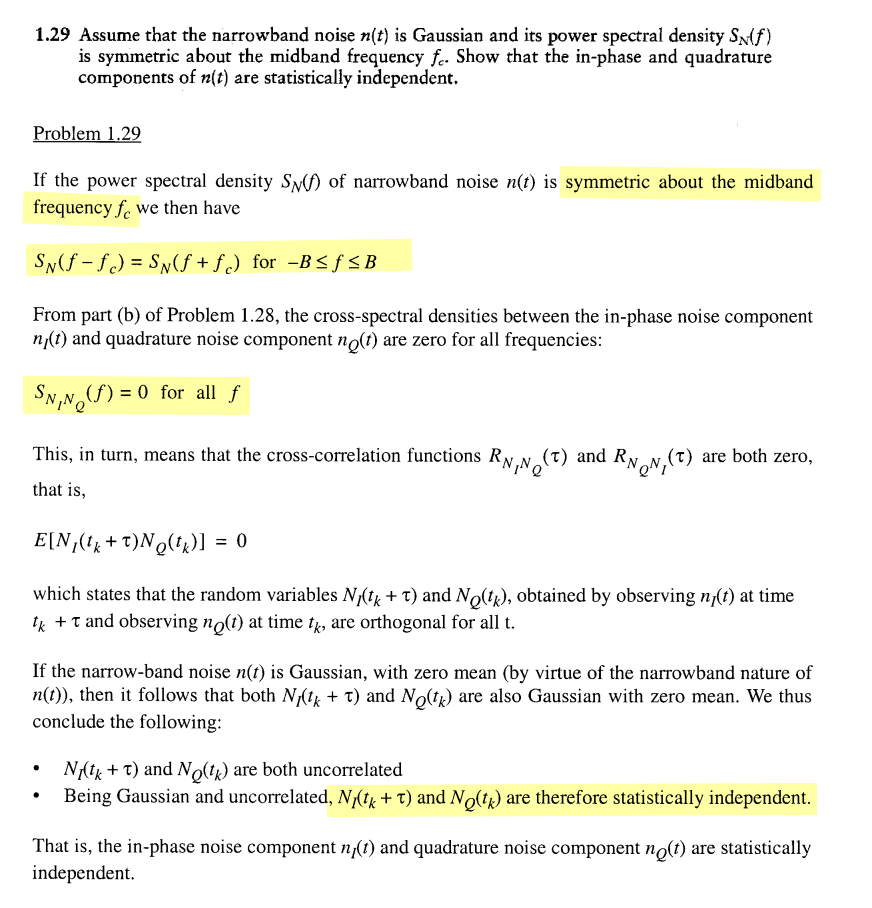
If the narrowband noise \(n(t)\) is Gaussian and its power spectral density \(S_N (t )\) is symmetric about the mid-band frequency \(f_c\), then the in-phase component \(n_I(t)\) and quadrature component \(n_Q(t)\) are statistically independent
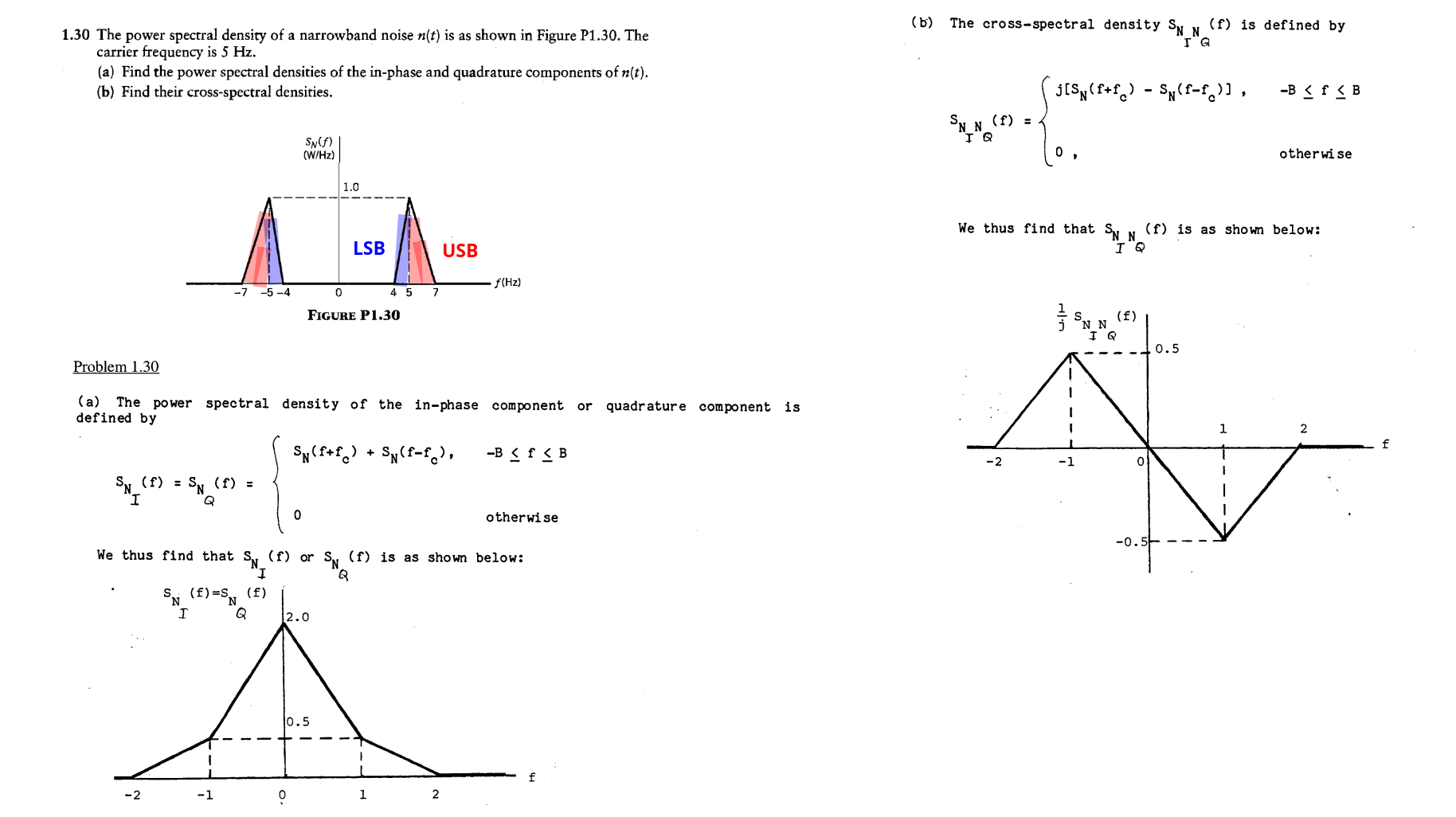
envelope and phase components
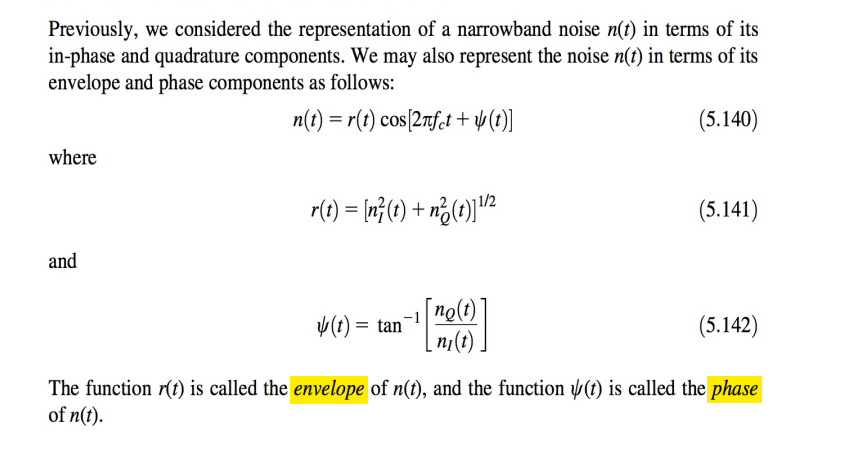
AN-PN Conversion
G. Giust, Influence of Noise Processes on Jitter and Phase Noise Measurements [https://www.signalintegrityjournal.com/articles/800-influence-of-noise-processes-on-jitter-and-phase-noise-measurements]
—. "Methodologies for PCIe5 Refclk Jitter Analysis,", PCI-SIG Electrical Workgroup Meeting (Jan. 19, 2018)
—. How to Identify the Source of Phase Jitter through Phase Noise Plots [https://www.sitime.com/company/newsroom/blog/how-identify-source-phase-jitter-through-phase-noise-plots]
AN10072 Determine the Dominant Source of Phase Noise, by Inspection [https://www.sitime.com/support/resource-library/application-notes/an10072-determine-dominant-source-phase-noise-inspection]
AM alone doesn't introduce jitter (e.g., doesn't change zero-crossings) nor impact phase
AM changes slew rate, and so influences the conversion of amplitude noise to jitter when amplitude noise (BB) is present
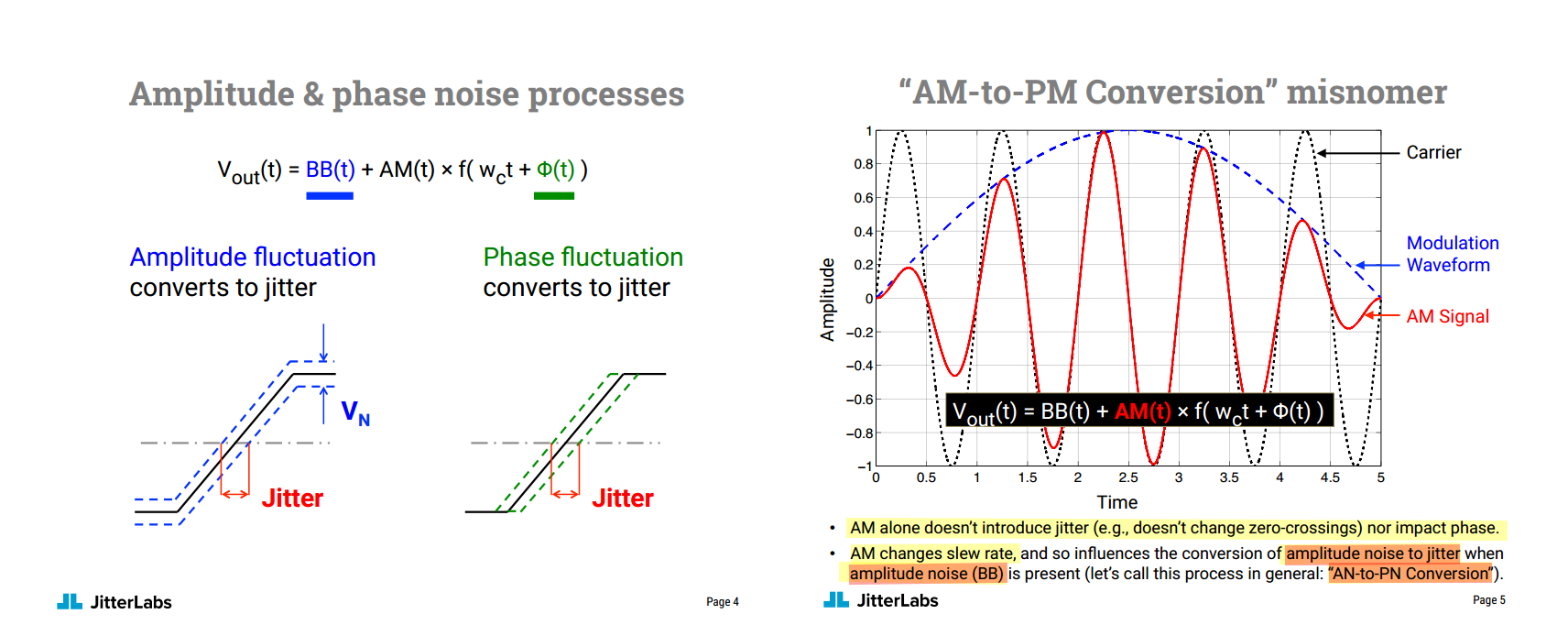
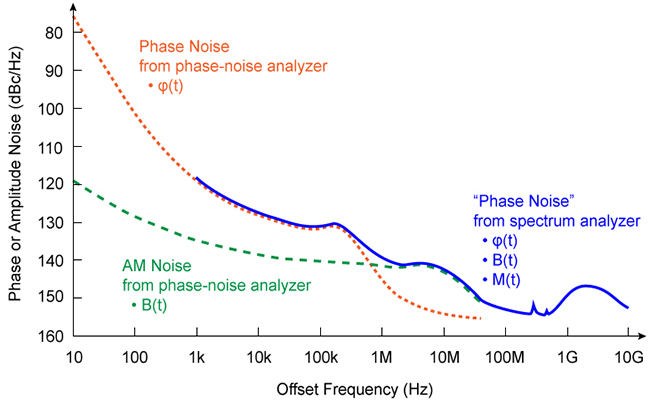
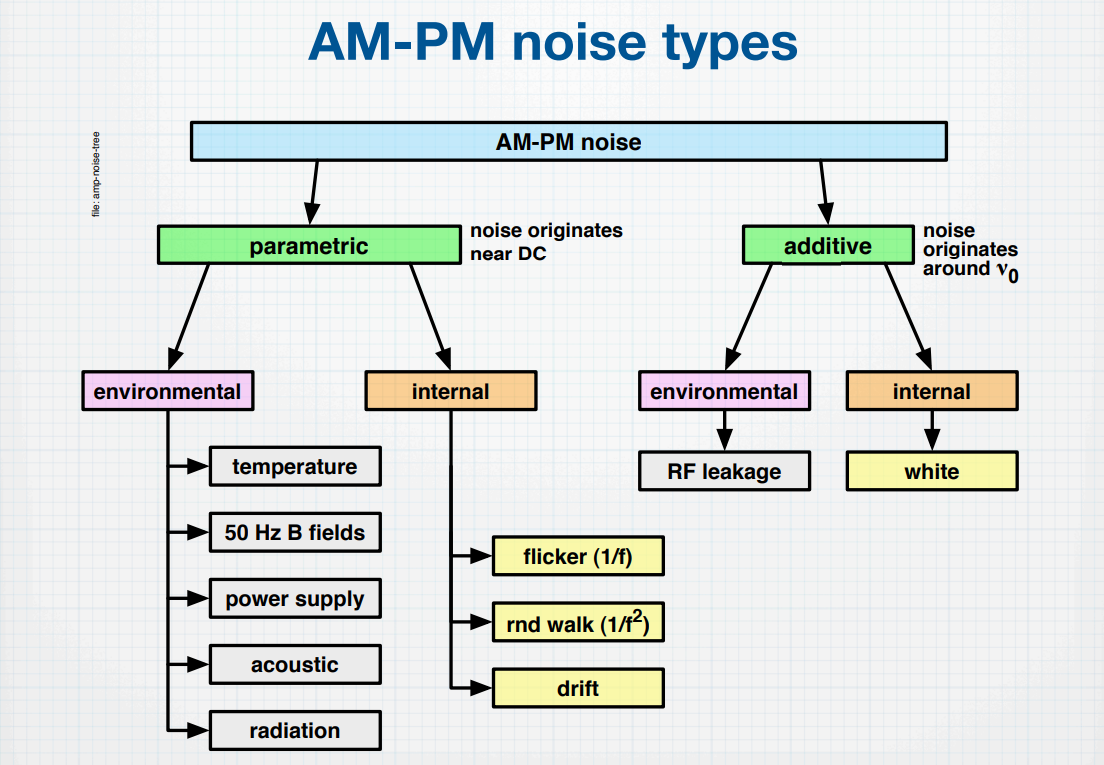
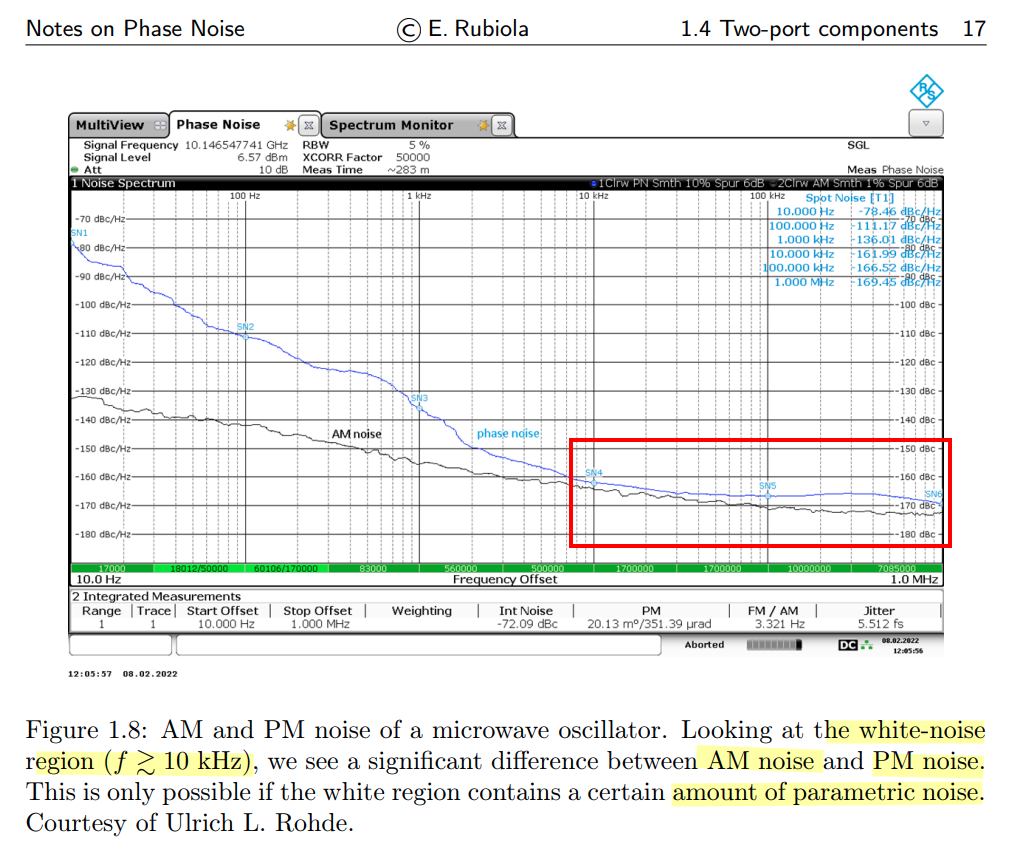
additive & parametric noise
Enrico Rubiola. The Measurement of AM-PM Noise, and the Origin of Noise in Oscillators [https://rubiola.org/pdf-slides/2010T-ANL-Noise-and-oscillators.pdf]
—, February 7, 2025. Phase Noise - Art, Science and Experimental Methods [https://rubiola.org/pdf-lectures/Scient-Instrum-Files/!-Phase-noise.pdf]
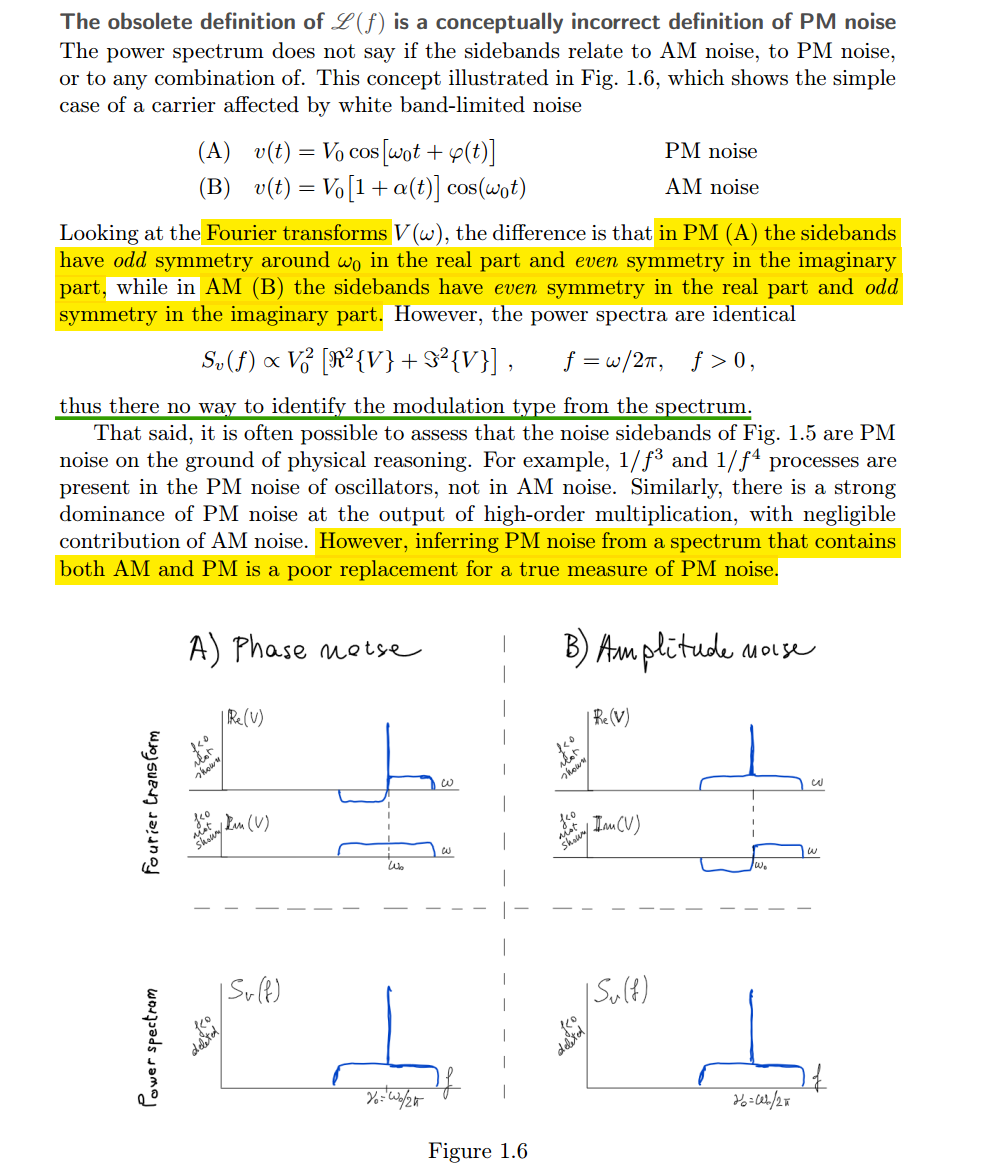
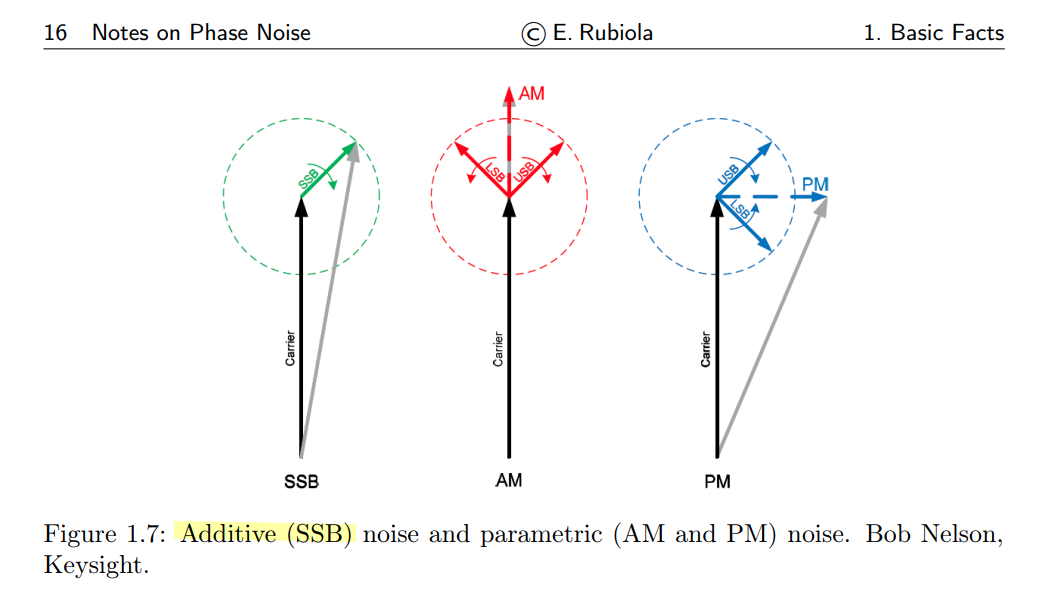
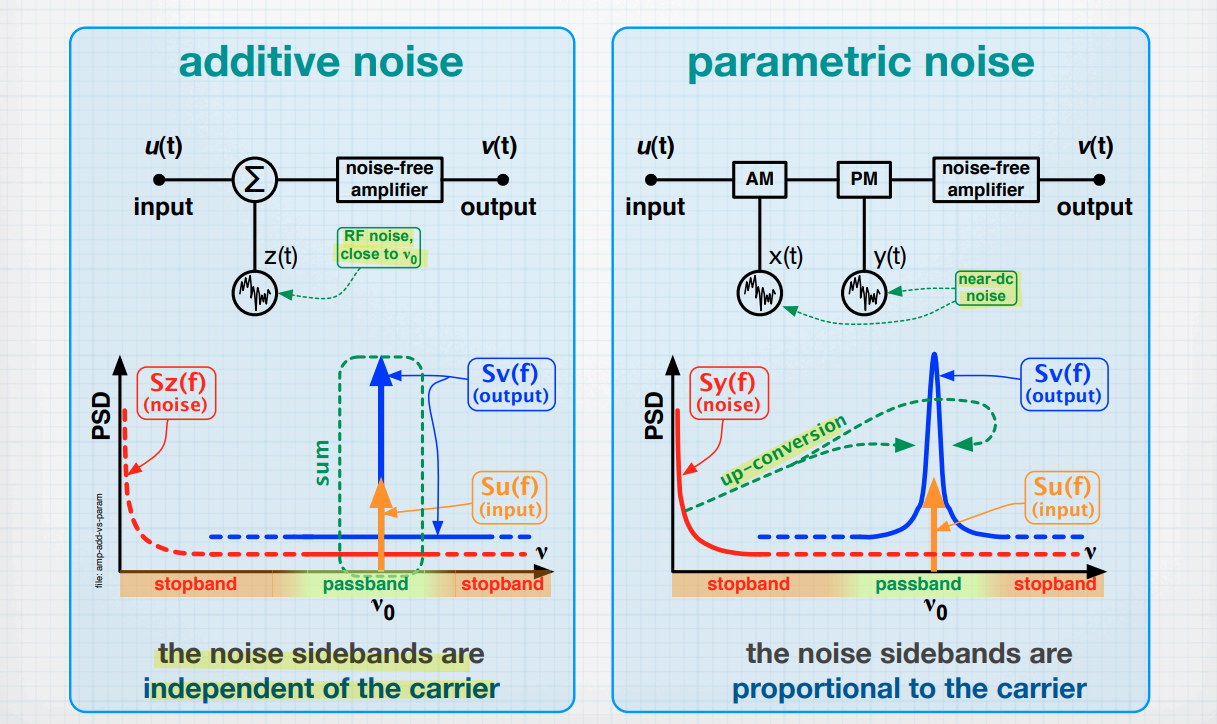
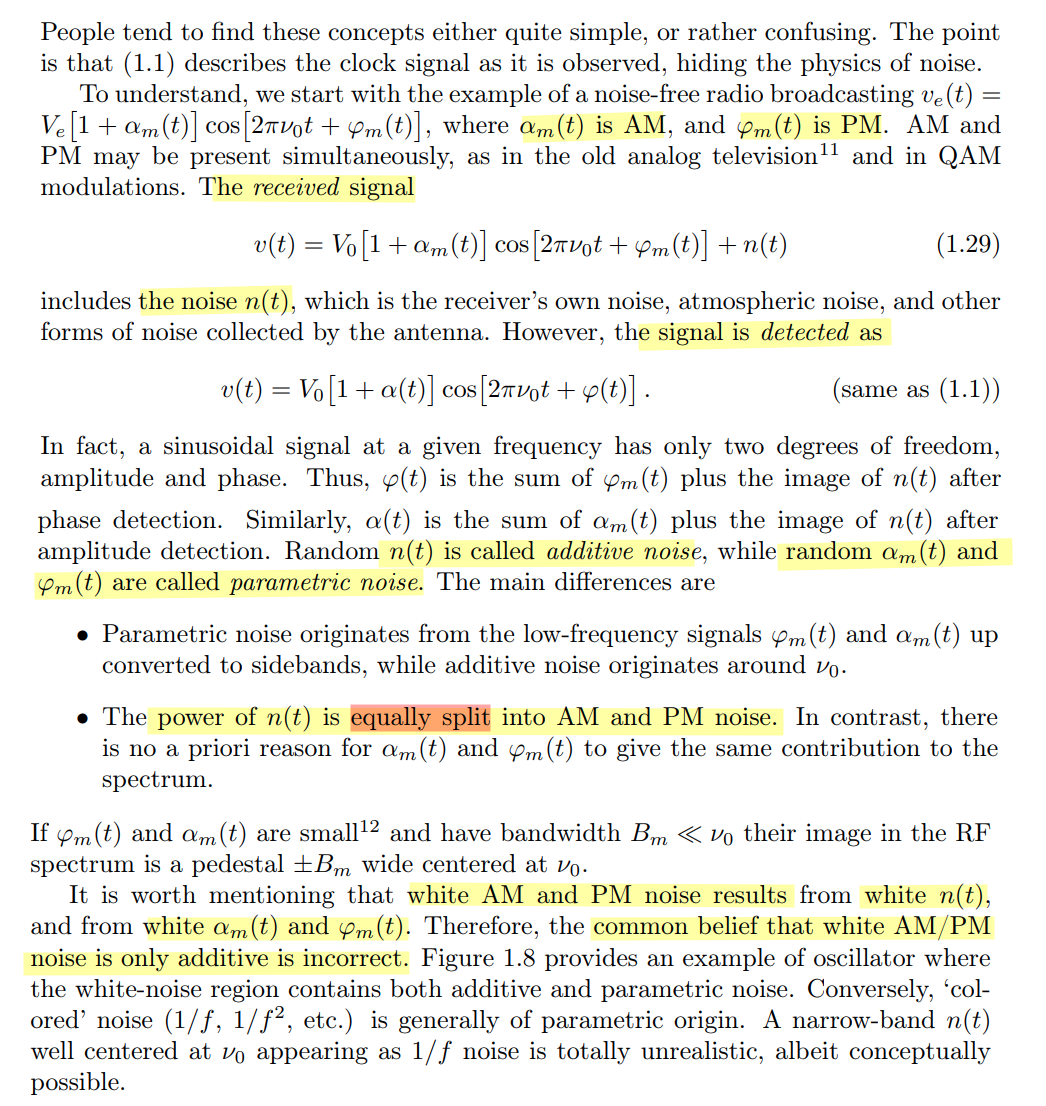
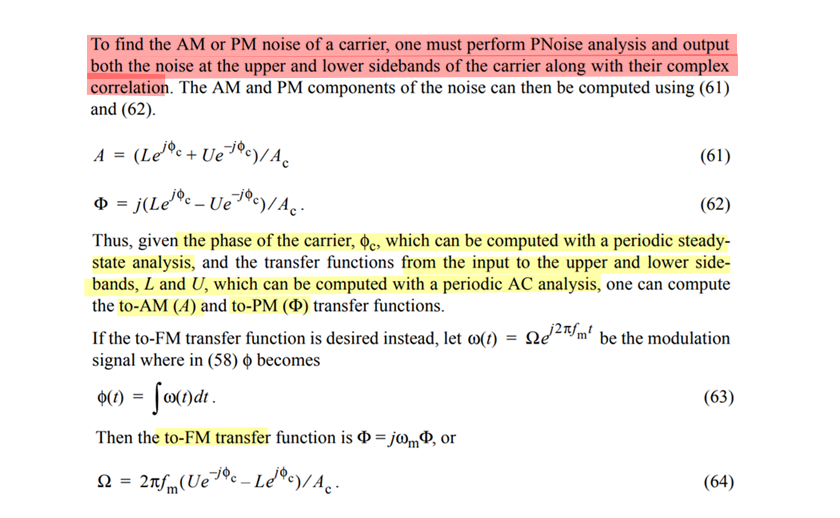
AM & PM Noise Separation
Ken Kundert. Introduction to RF Simulation and its Application [https://designers-guide.org/analysis/rf-sim.pdf]
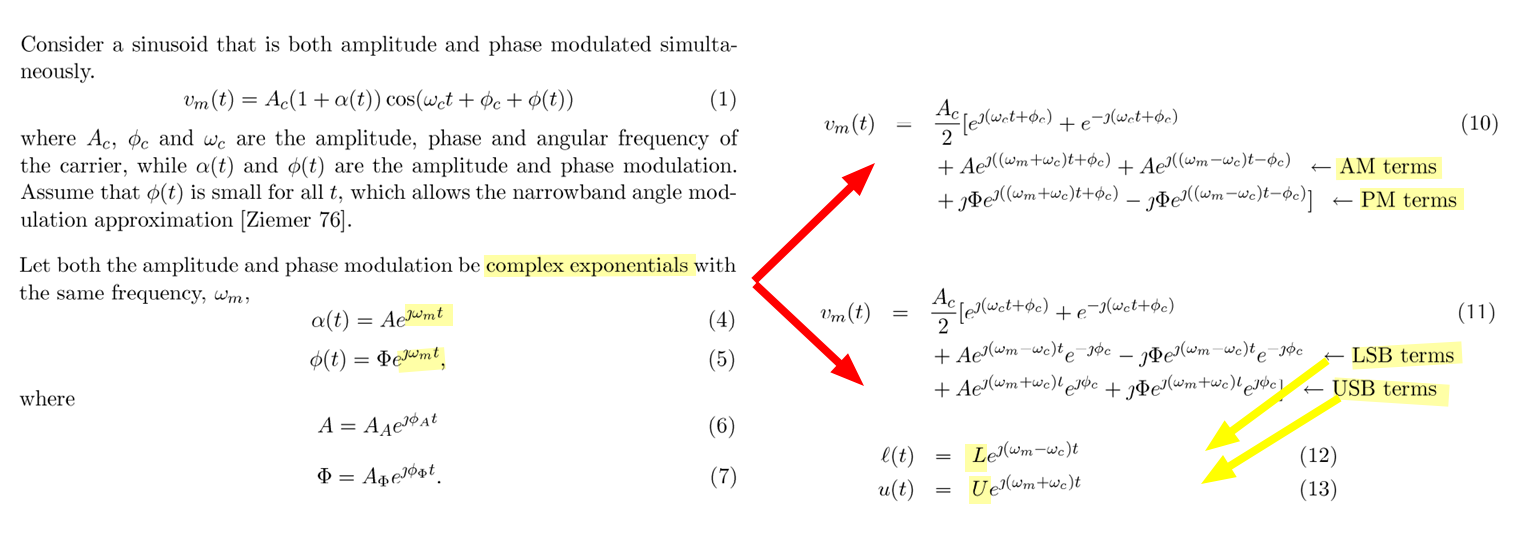

For AM & pacphase=90deg, complex exponentials with frequency \(\omega_m\) \[ \alpha_+(t) = je^{j\omega_m t} = e^{j(\omega_mt+\pi/2)} \] where \(A_+=j\)
Then, the complex exponentials with frequency \(-\omega_m\) shall be \[ \alpha_-(t) = [\alpha_+(t)]^* = -je^{-j\omega_m t} = e^{-j(\omega_mt+\pi/2)} \] where \(A_-=A_+^* =-j\)
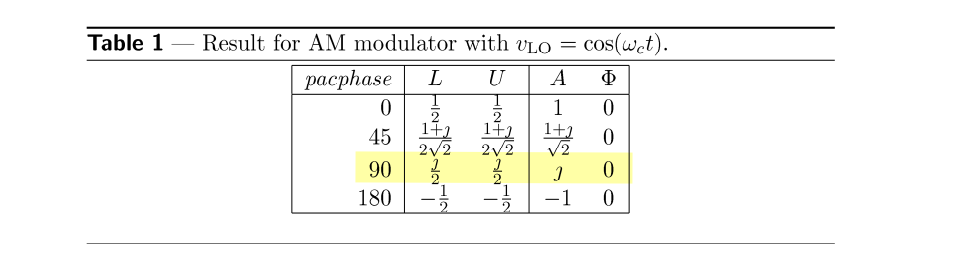
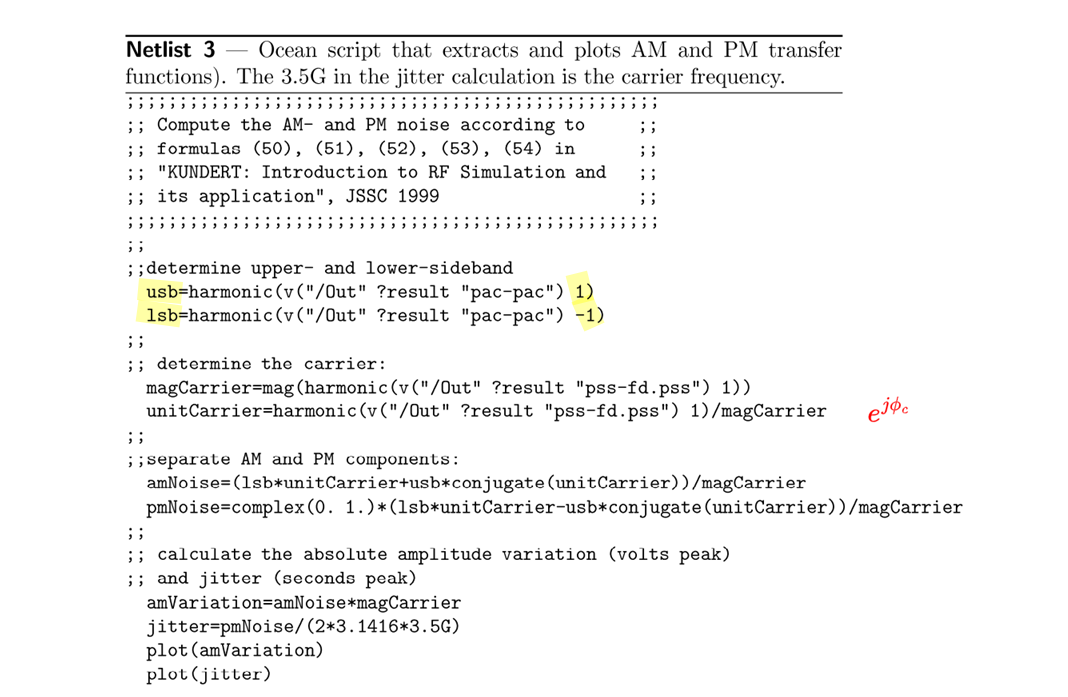
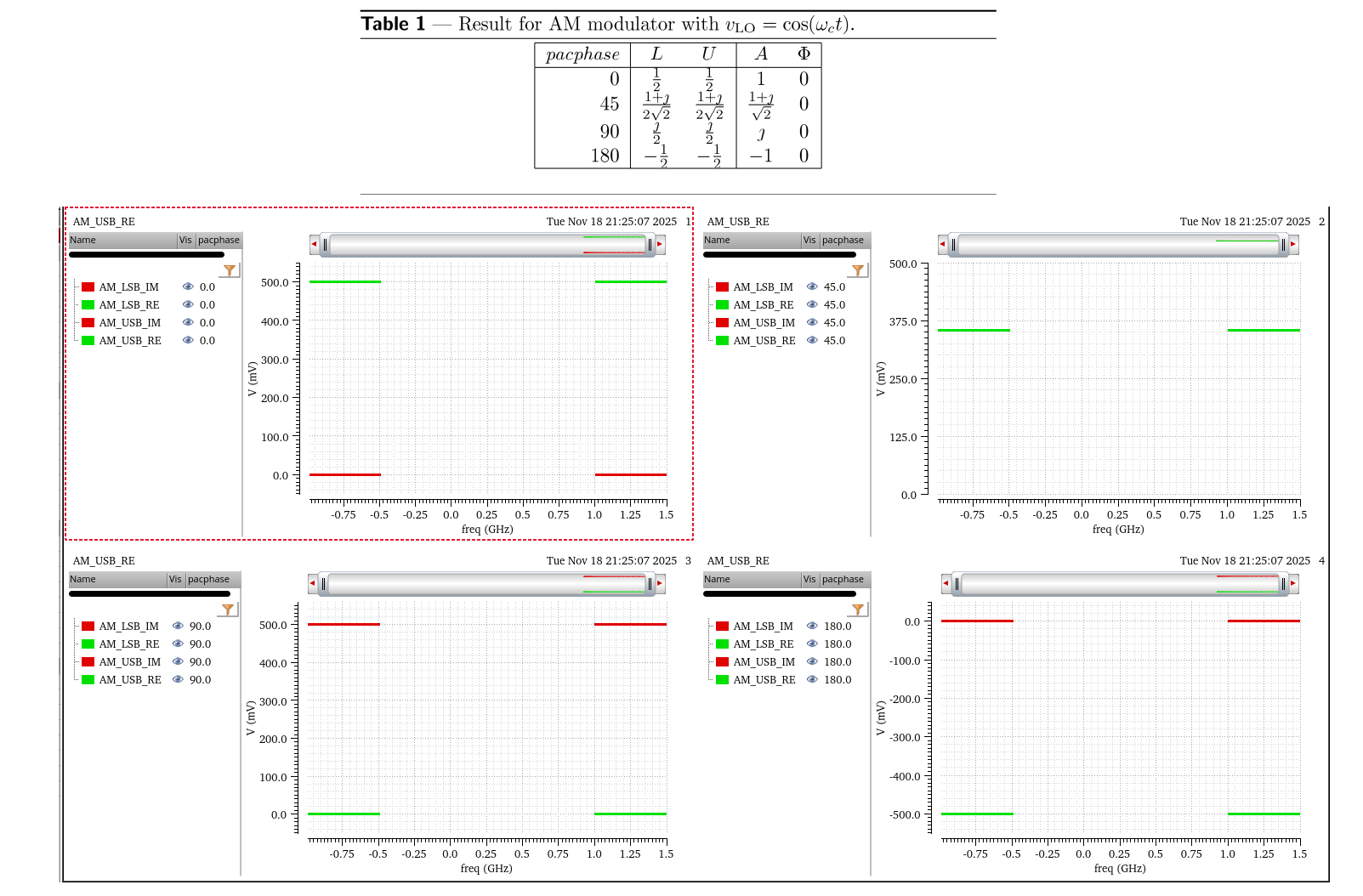
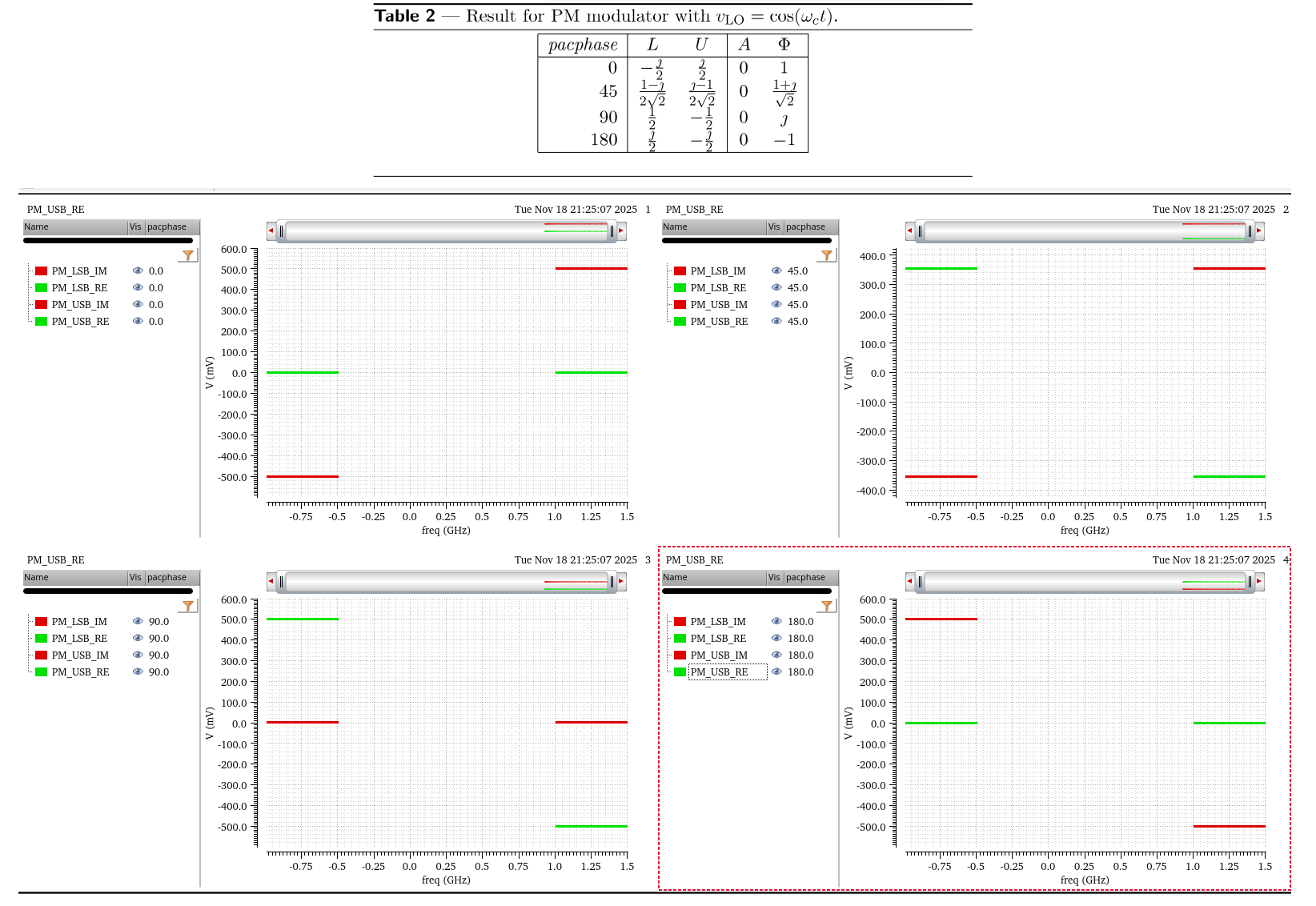
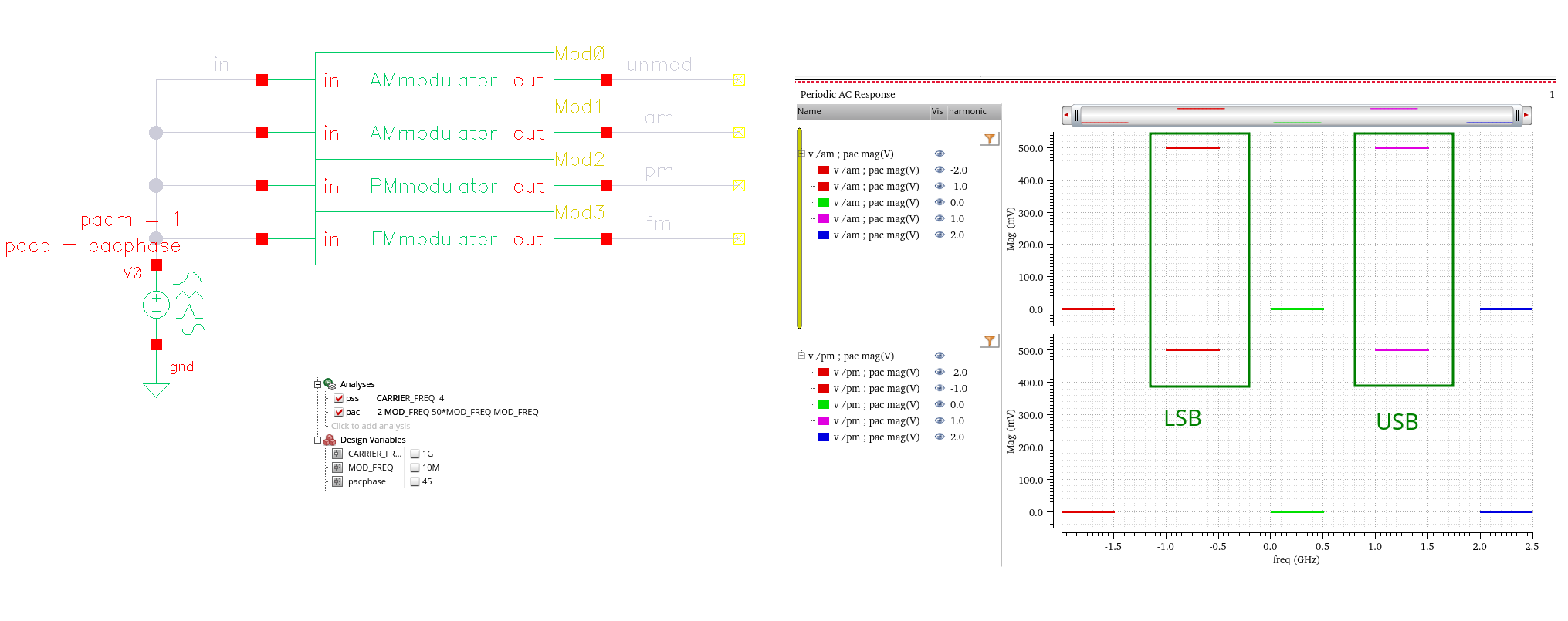
\(\phi_c=0\) in above simulation
Ken Kundert. Re: Question about phase noise simulation result [https://designers-guide.org/forum/YaBB.pl?num=1309258199/15#15]
Spectre Circuit Simulator RF Analysis Theory — Measuring AM, PM and FM Conversion

| noise profile | sidebands | contribution |
|---|---|---|
| stationary | uncorrelated | \(S_{AM} = S_{PM}\) |
| cyclostationary | correlated | \(S_{AM} \gt S_{PM}\) or \(S_{AM} \lt S_{PM}\) |
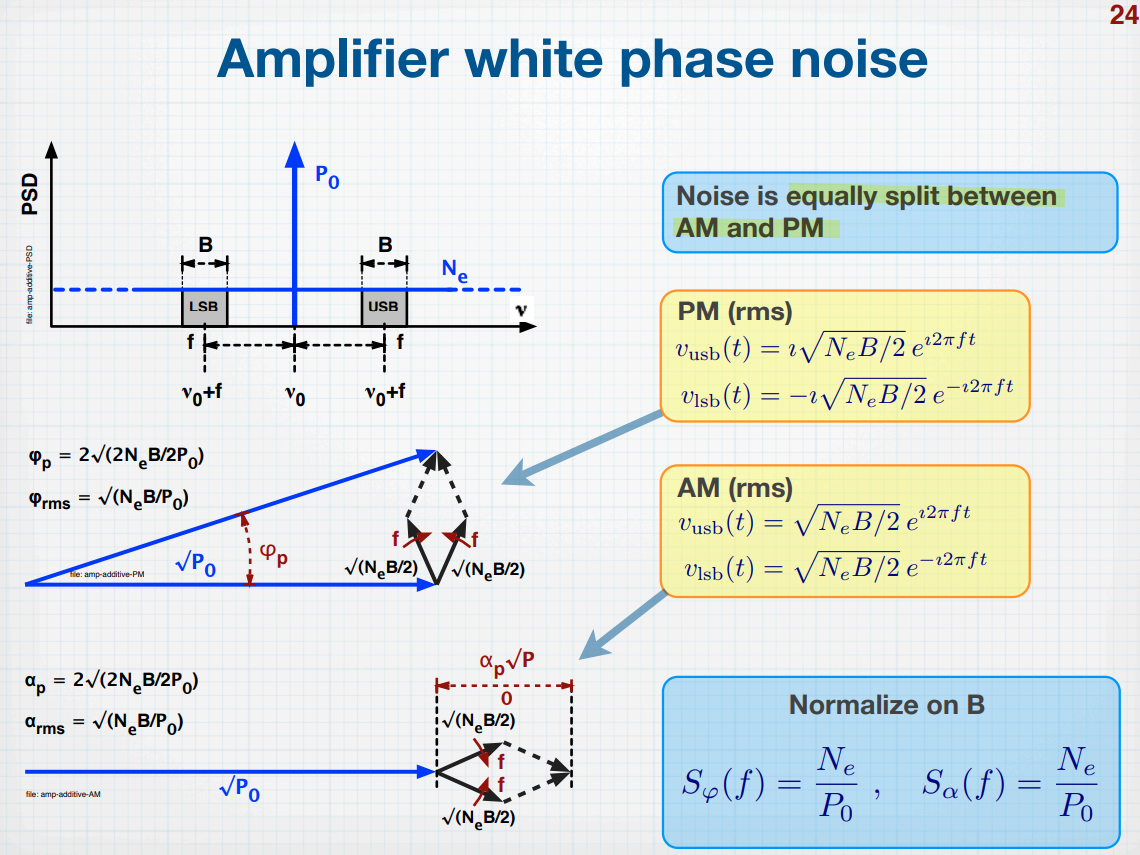
sine wave + white noise
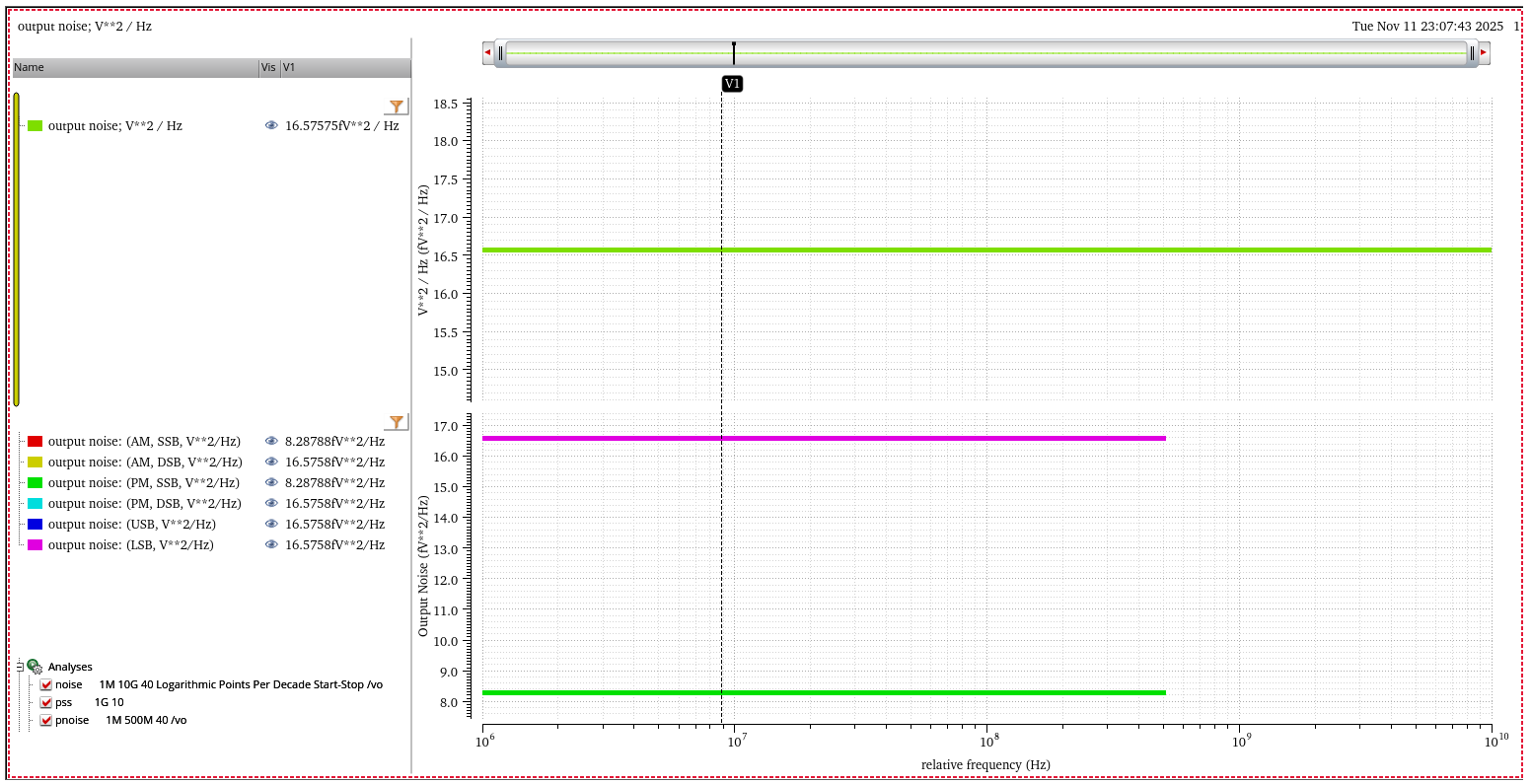
equal amounts of AM and PM noise in both USB and LSB
sine wave + AM
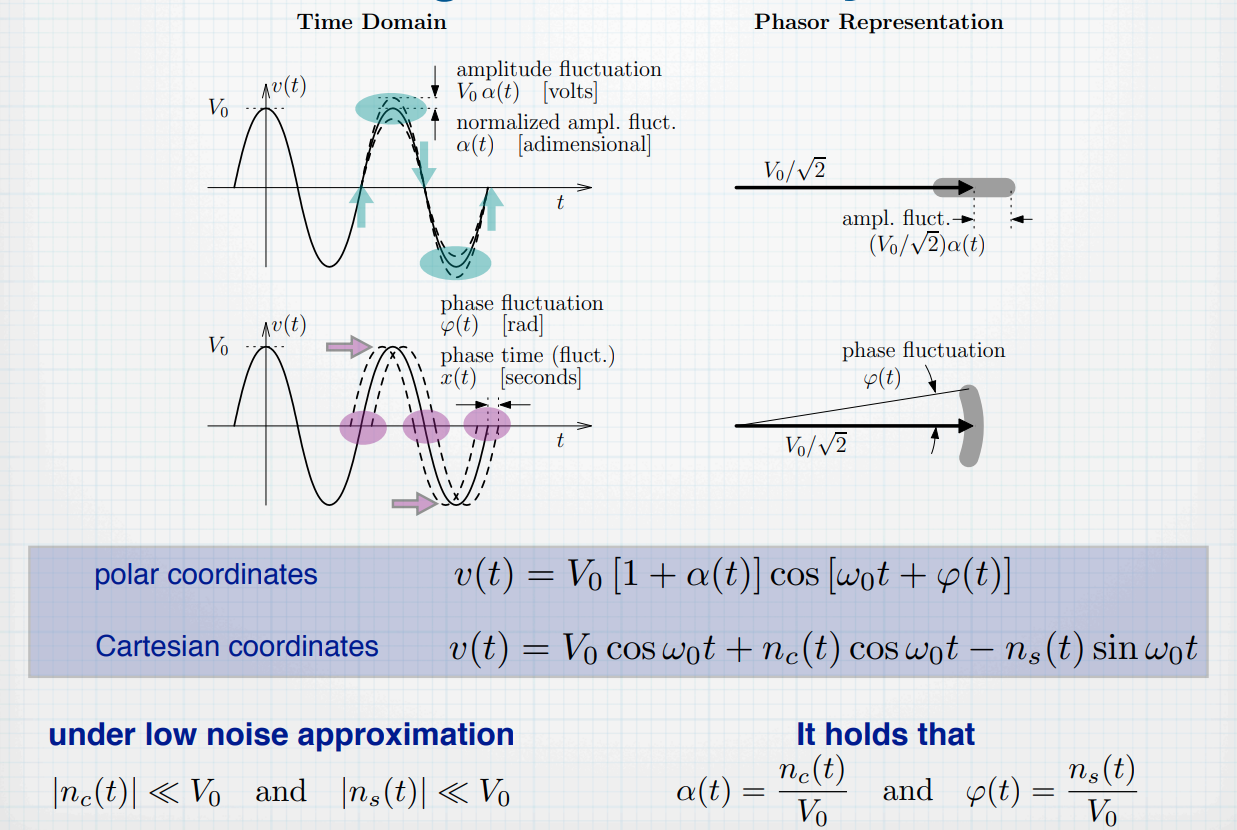
肥肥牛是只虎. PSS+Pnoise仿真:基本设置 [https://mp.weixin.qq.com/s/etyQ2UkfisPkvbc44XFw4w]
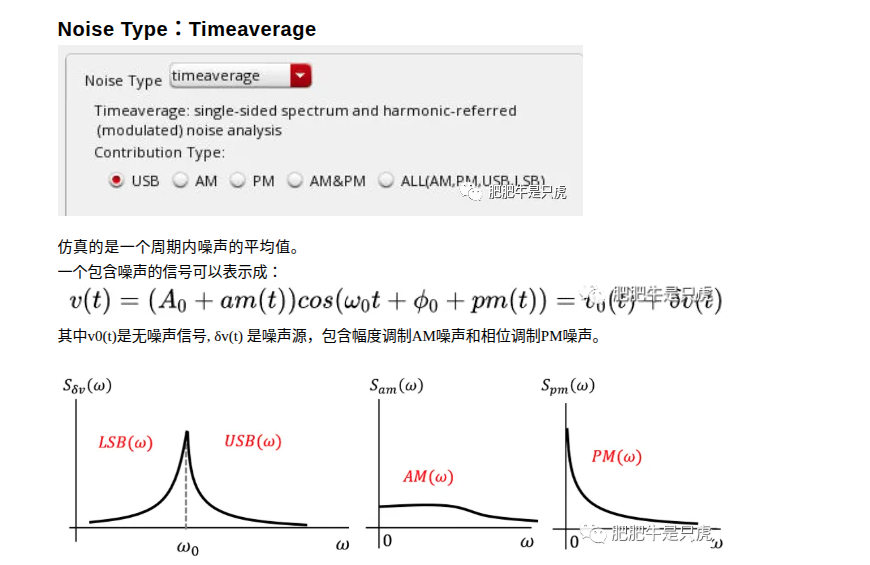
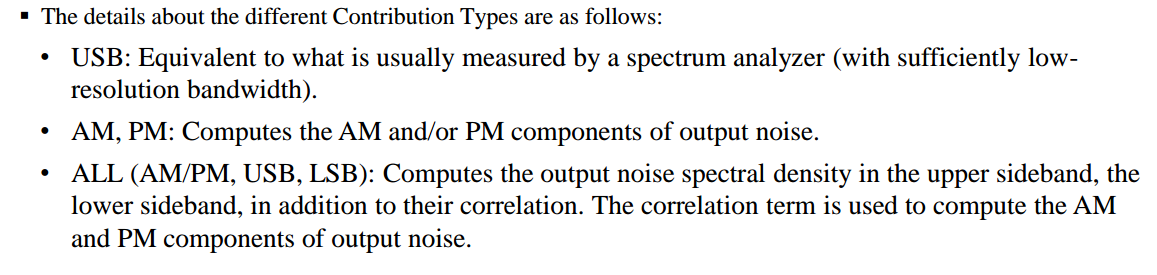
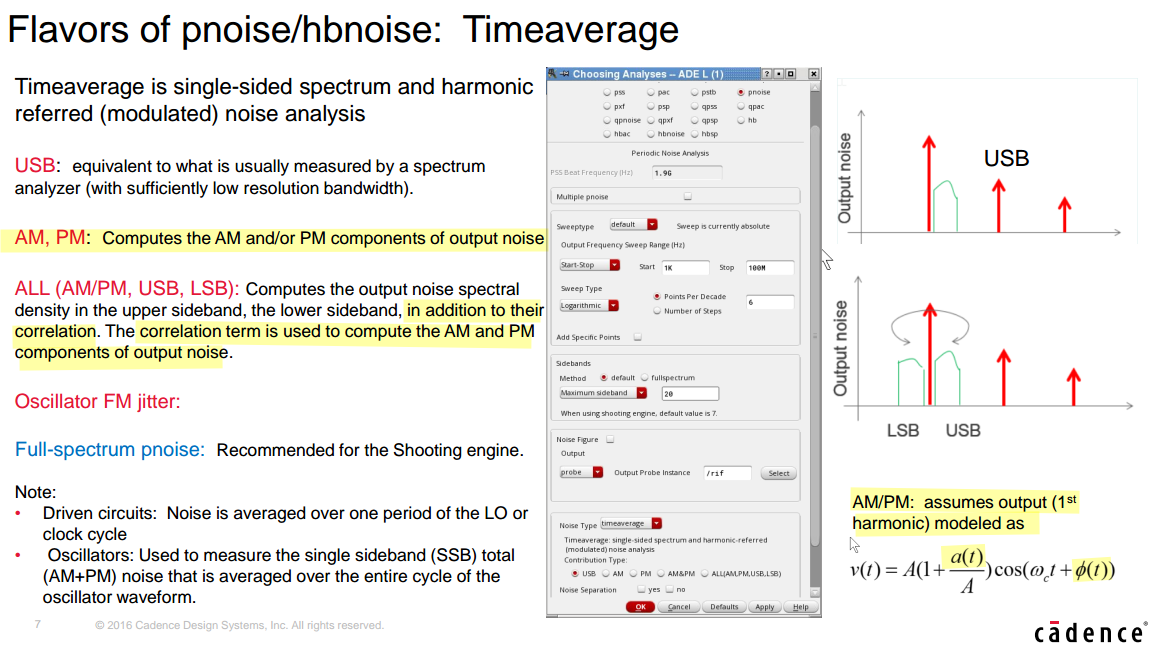
Phase Noise Measurement
Phase Noise Measurement Solutions [https://www.keysight.com/vn/en/assets/7018-02528/technical-overviews/5990-5729.pdf]
Greg Bonaguide. Advances in Phase Noise Measurement Techniques [https://ieee.li/pdf/viewgraphs/advances_in_phase_noise_measurement_techniques.pdf]
U. L. Rohde, A. K. Poddar and A. M. Apte, "Getting Its Measure: Oscillator Phase Noise Measurement Techniques and Limitations," in IEEE Microwave Magazine, vol. 14, no. 6, pp. 73-86, Sept.-Oct. 2013 [https://sci-hub.jp/10.1109/MMM.2013.2269860]
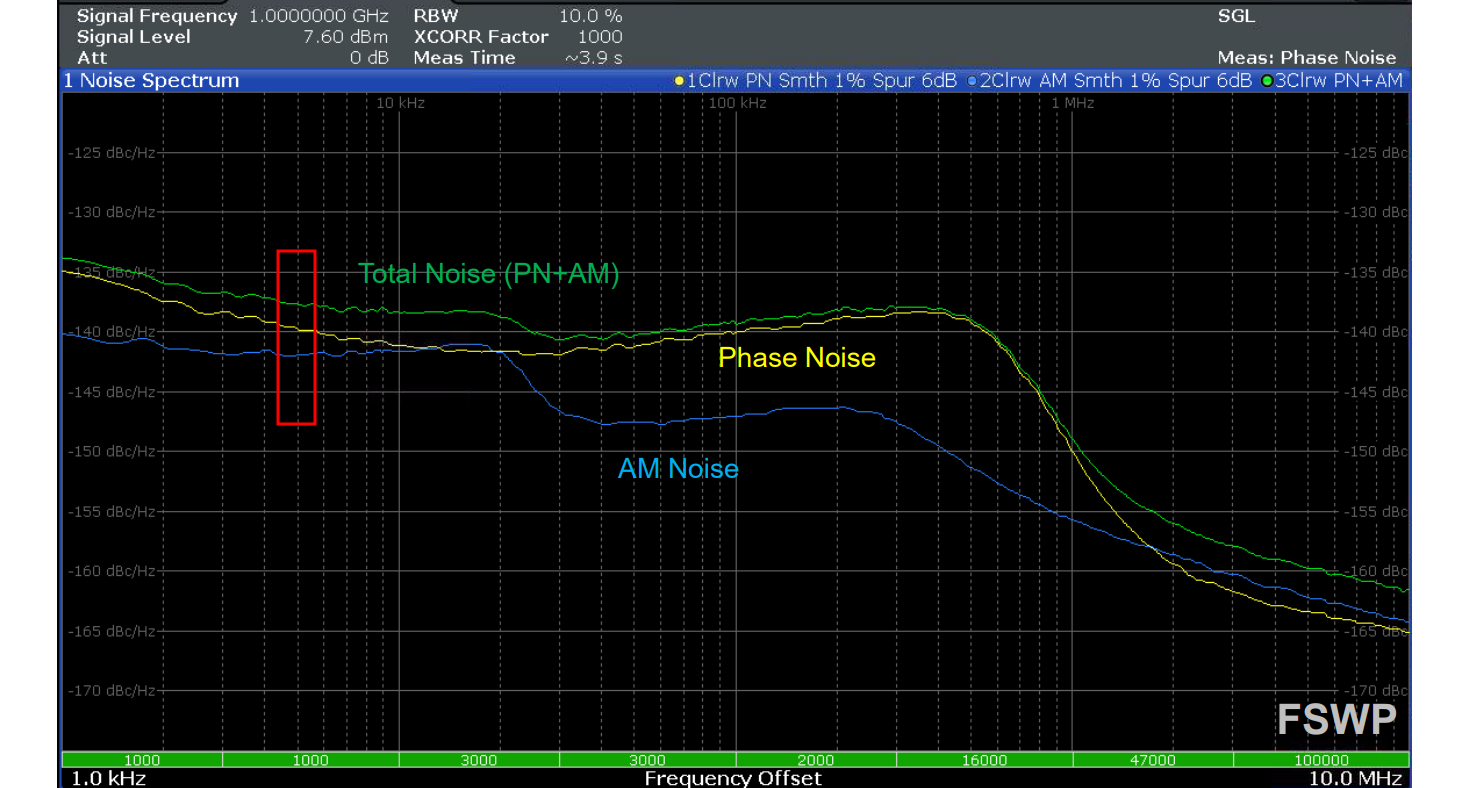
The three most widely adopted techniques are direct spectrum, phase detector, and two-channel cross-correlation.
While the direct spectrum technique measures phase noise with the existence of the carrier signal, the other two remove the carrier (demodulation) before phase noise is measured.
Though direct spectrum technique method may not be useful for measuring very close-in phase noise to a drifting carrier, it is convenient for qualitative quick evaluation on sources with relatively high noise
1 | import numpy as np |

Direct-spectrum method
Paul Denisowski, Test & measurement expert, Phase noise and spectrum analyzer resolution bandwidth [https://www.rohde-schwarz.com/us/products/test-and-measurement/analyzers/signal-and-spectrum-analyzers/spectrum-analysis-method-for-measuring-phase-noise_258374.html]
two measurements are made: the power of the carrier and the power spectral density (PSD) of the oscillator noise at a specified offset frequency and referenced to the carrier power
A swept spectrum analyzer never displays the true PSD; it displays the input spectrum convolved with the RBW filter
- The carrier is measured once with a comfortably wide RBW — a CW peak level is independent of RBW as long as the line fits inside the filter
- then each offset region is measured in segments with its own narrow, offset-scaled RBW, normalized to 1 Hz
The classical definition is convenient when measuring phase noise with a spectrum analyzer, but it combines both amplitude and phase noise effects. It also has limitations for signals that have high phase noise.
reference
Ken Kundert, Measuring AM, PM & FM Conversion with SpectreRF [https://designers-guide.org/analysis/am-pm-conv.pdf]
Noise in mixers, oscillators, samplers, and logic: an introduction to cyclostationary noise [https://designers-guide.org/theory/cyclo-preso.pdf], [https://designers-guide.org/theory/cyclo-paper.pdf]
Dan Boschen. Creating uneven sidebands with AM + PM modulation? [https://dsp.stackexchange.com/a/61670/59253]
—. Creating uneven sidebands with AM + PM modulation? [https://dsp.stackexchange.com/a/61670/59253]
—. Qualitative Explanation of Fourier Transform [https://dsp.stackexchange.com/a/78911/59253]
Timing 201 #1: The Case of the Phase Noise That Wasn't - Part 1 [https://community.silabs.com/s/share/a5U1M000000knpiUAA/timing-201-1-the-case-of-the-phase-noise-that-wasnt-part-1?]
Application Notes: Spectrum Analysis Amplitude and Frequency Modulation [https://www.keysight.com/us/en/assets/7018-06742/application-notes/5954-9130.pdf]
Haykin, Simon S., and Michael Moher. Communication Systems. 5th ed. John Wiley & Sons, 2009.
Marcelino Lazaro, Communication Theory: Bachelor in Telecommunication Technologies Engineering [https://ocw.uc3m.es/file.php/326/Bibliography/OCW-CT-Book.pdf]
L.W. Couch, Digital and Analog Communication Systems, 8th Edition, Pearson, 2013. [pdf]
Sklar, Bernard, and Fredric J. Harris. 2021. Digital Communications: Fundamentals and Applications. 3rd ed. New York: Pearson