Filter Design
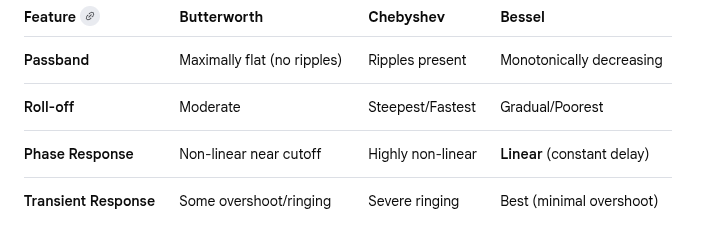
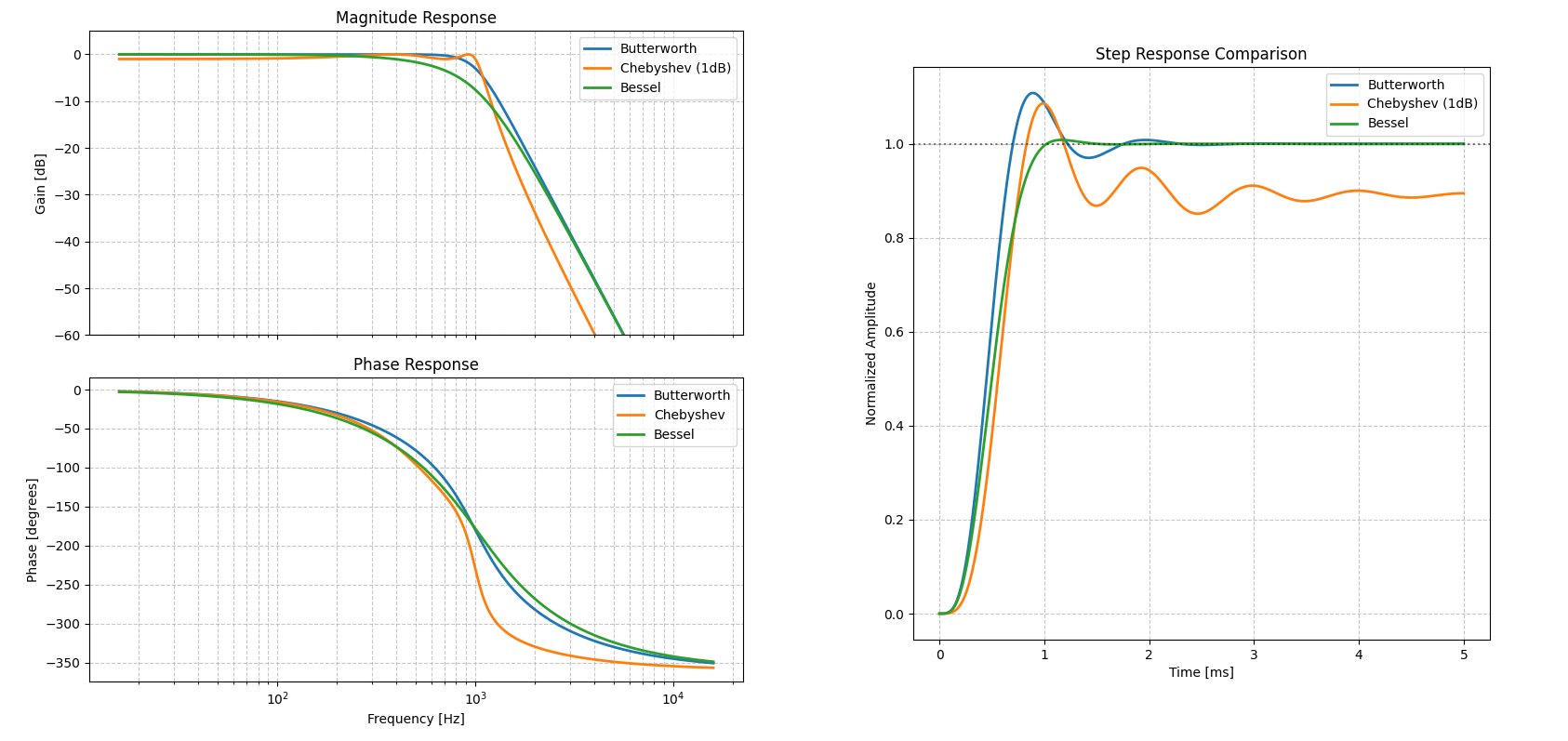
1 | import numpy as np |
Butterworth Filters
Butterworth Filters [https://people.eecs.ku.edu/~demarest/212/Butterworth%20Filters.pdf]
Stephen Roberts, Signal Processing & Filter Design B3 option: Lecture 2 - Frequency Selective Filters [https://www.robots.ox.ac.uk/~sjrob/Teaching/SP/l2.pdf]
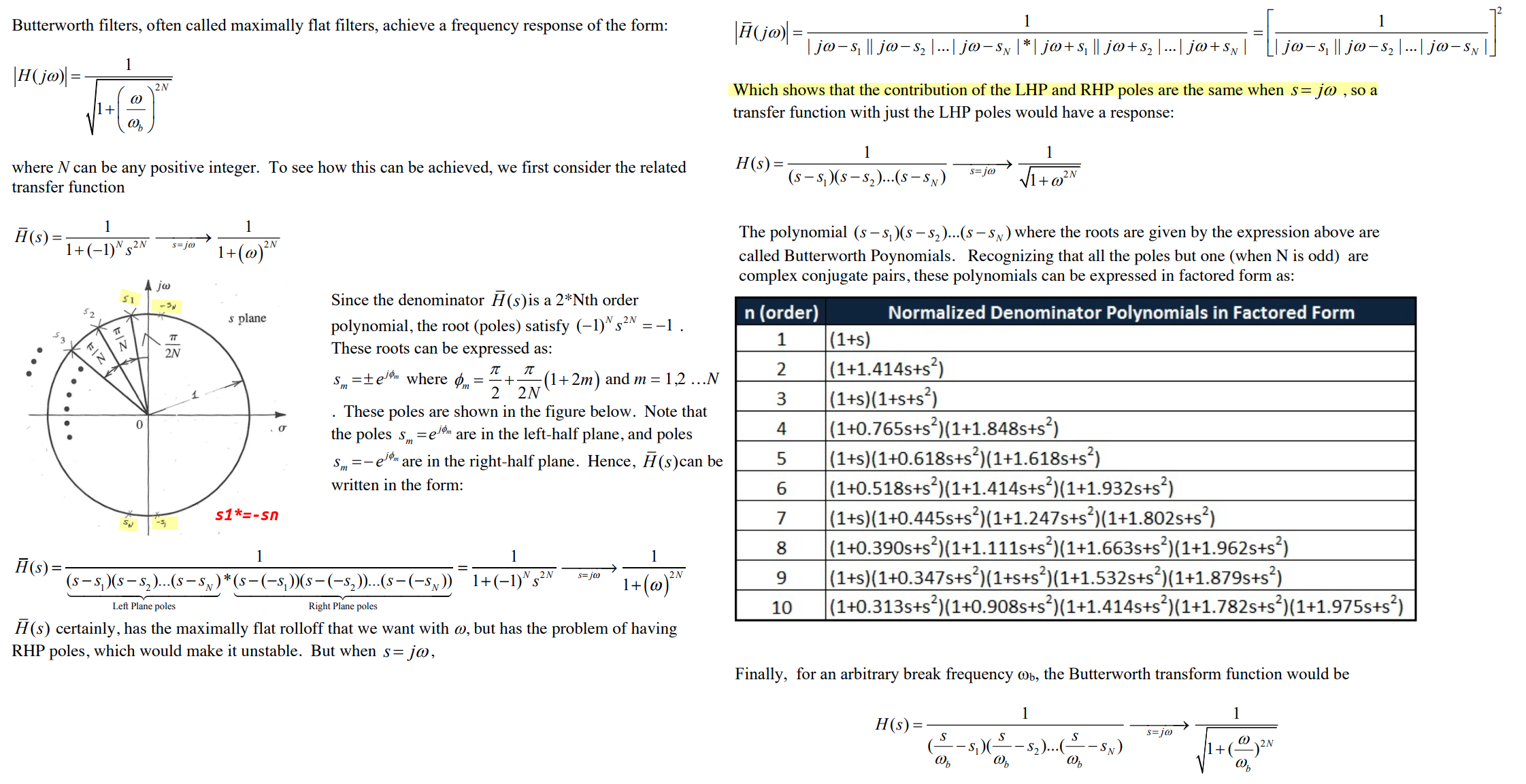
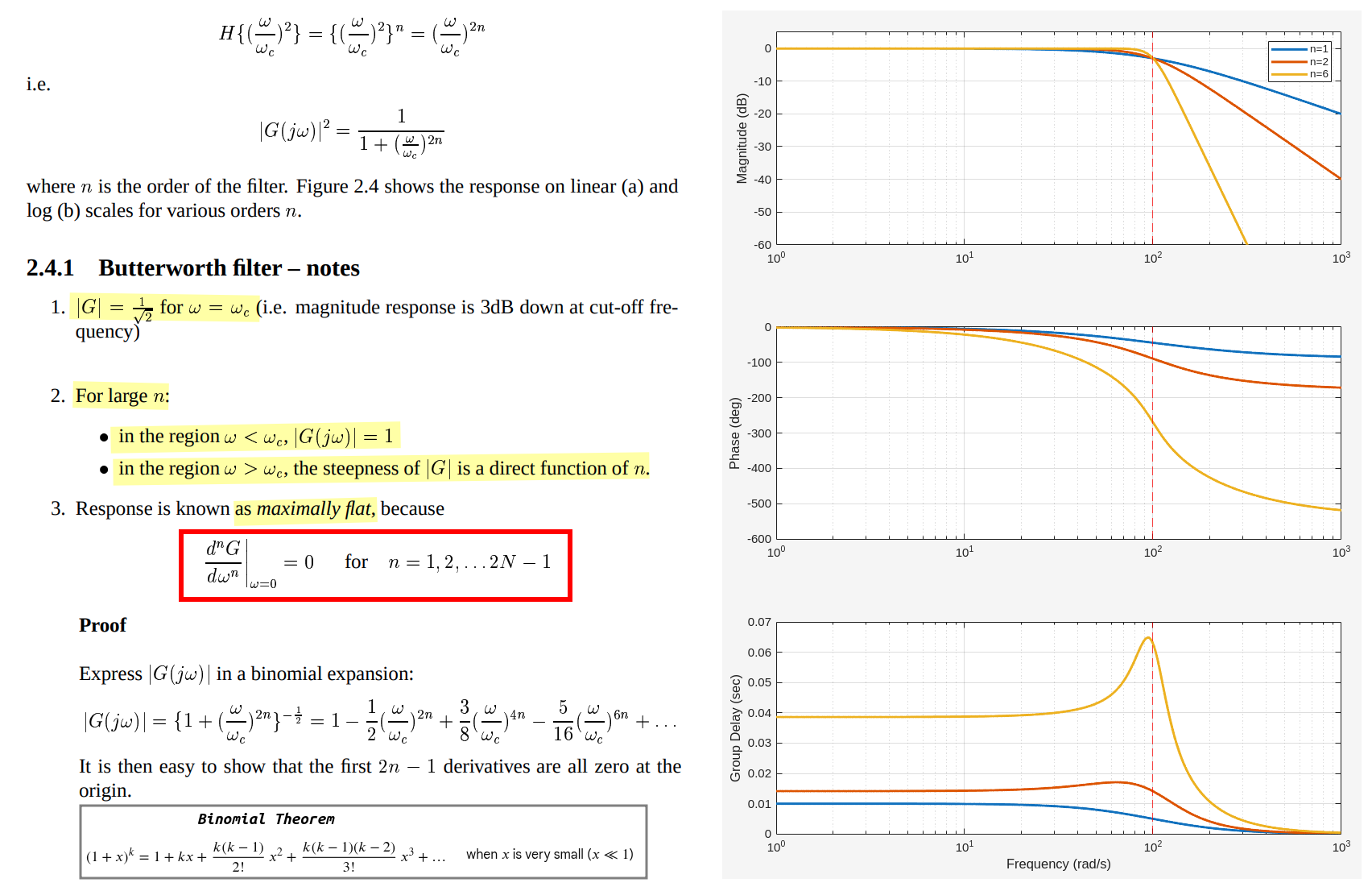
1 | % Parameters |
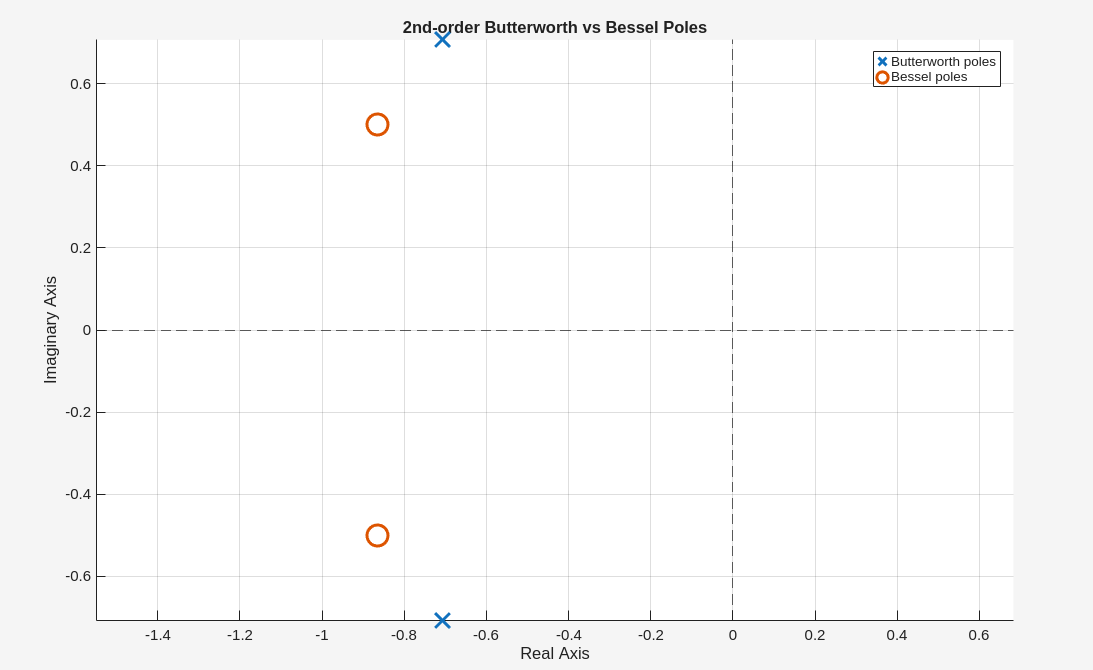
Bessel Filters
Stephen Roberts, Signal Processing & Filter Design B3 option: Lecture 3 - Transient Response and Transforms [https://www.robots.ox.ac.uk/~sjrob/Teaching/SP/l3.pdf]
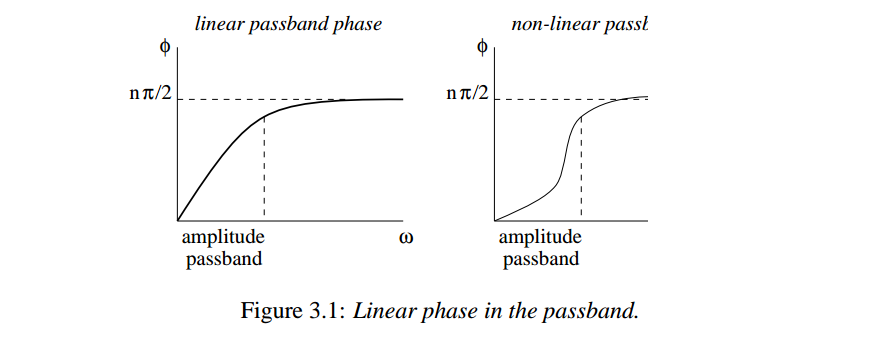
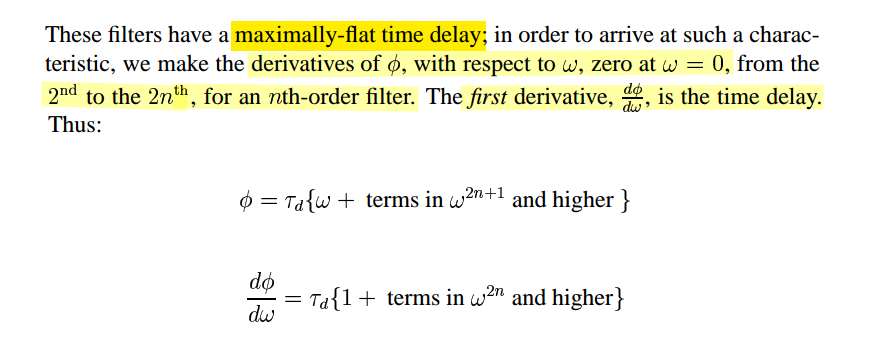
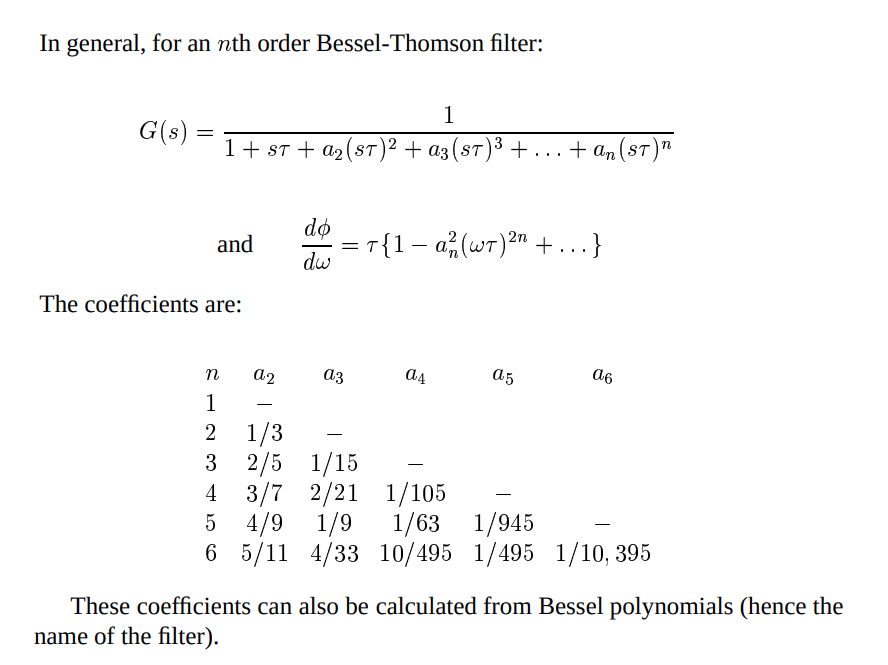
Bessel filter is often called Bessel–Thomson filter or simply Thomson filter
besself: Bessel analog filter design
[b,a] = besself(n, Wo)
the transfer function coefficients of an \(n\)th-order lowpass analog Bessel filter, where
Wois the angular frequency up to which the filter's group delay is approximately constant. Larger values ofnproduce a group delay that better approximates a constant up toWo.
scipy.signal.bessel(N, Wn, btype='low', analog=True, output='ba', norm='phase')
norm='phase'— The filter is normalized such that the phase response reaches its midpoint at angular (e.g. rad/s) frequencyWnThis is the default, and matches MATLAB's implementation.
1 | octave:8> [b,a] = besself(5,1) |
1 | b_bess, a_bess = signal.bessel(5, 1, btype='low', analog=True, norm='phase') |
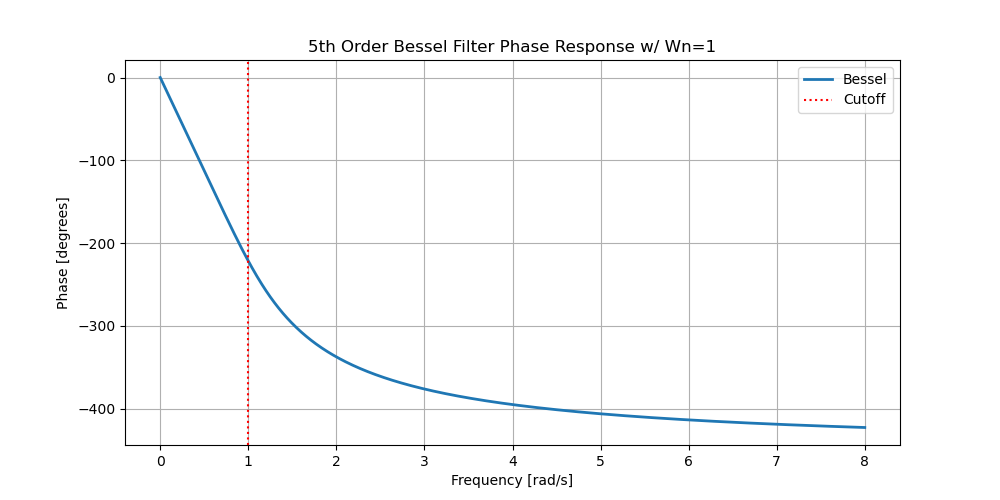
1 | import numpy as np |
1 | Wn = 1; |
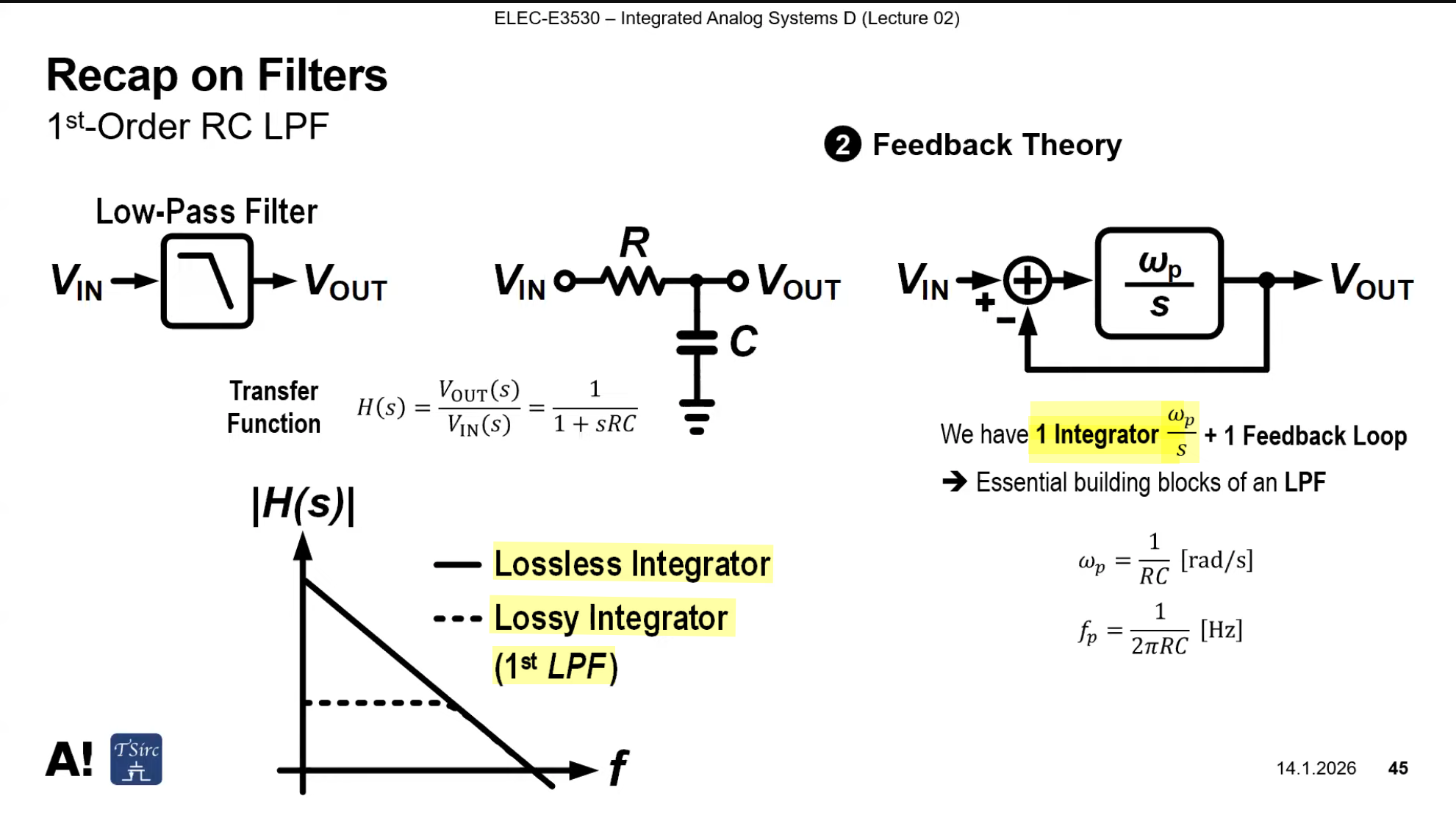
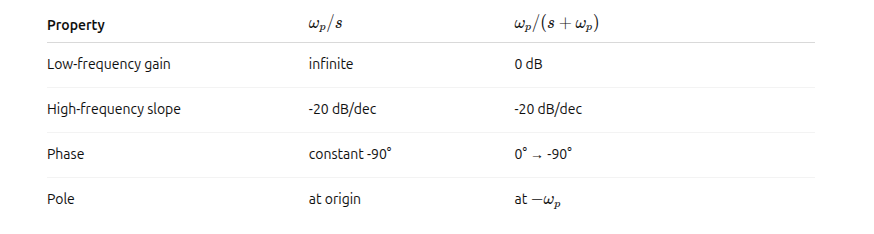
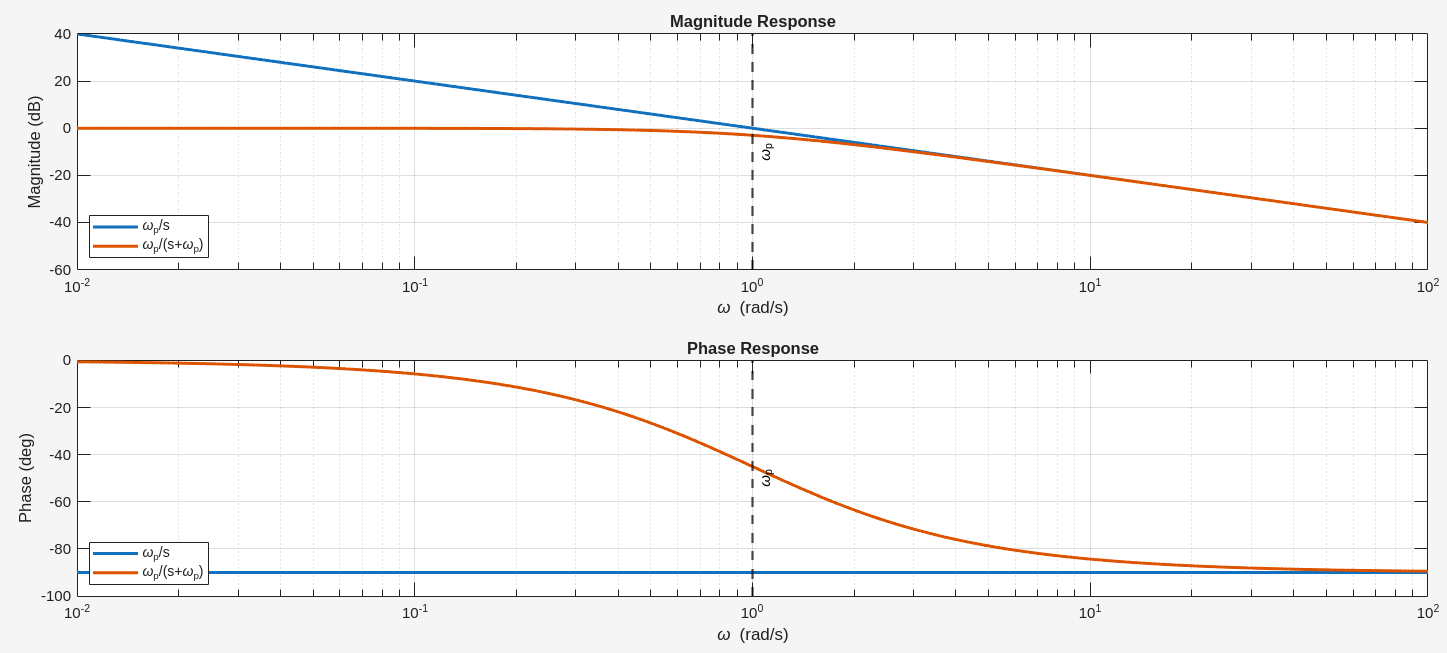
RC LPF
Kwantae Kim, Integrated Analog Systems D - Lecture 02 (Continuous-Time Filters) [https://youtu.be/B7-kr5zV3NA]
—, Integrated Analog Systems D - Lecture 03 (Continuous-Time Filters) [https://youtu.be/6GdDiwaKDZw]
—, Integrated Analog Systems D - Lecture 05 (Continuous-Time Filters) [https://youtu.be/LHhEK1RlC6w]
C. K. Singh and G. C. Temes, "R-C Ladder Design: A Tutorial [CAS Education]," in IEEE Circuits and Systems Magazine, vol. 24, no. 4, pp. 65-69, Fourthquarter 2024 [https://sci-net.xyz/10.1109/MCAS.2024.3462661]
2nd-Order RC LPF
Loading effect & limitation
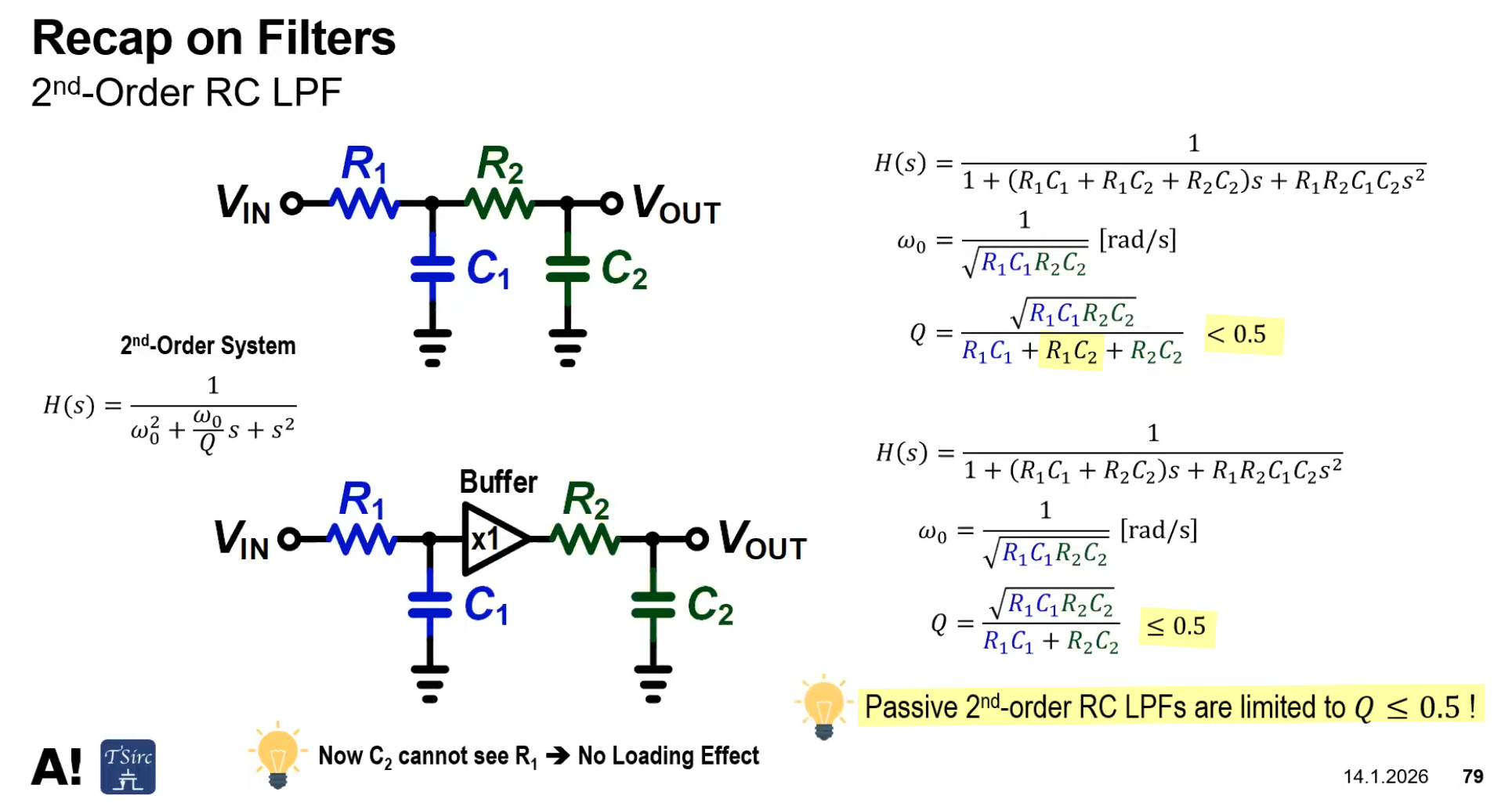

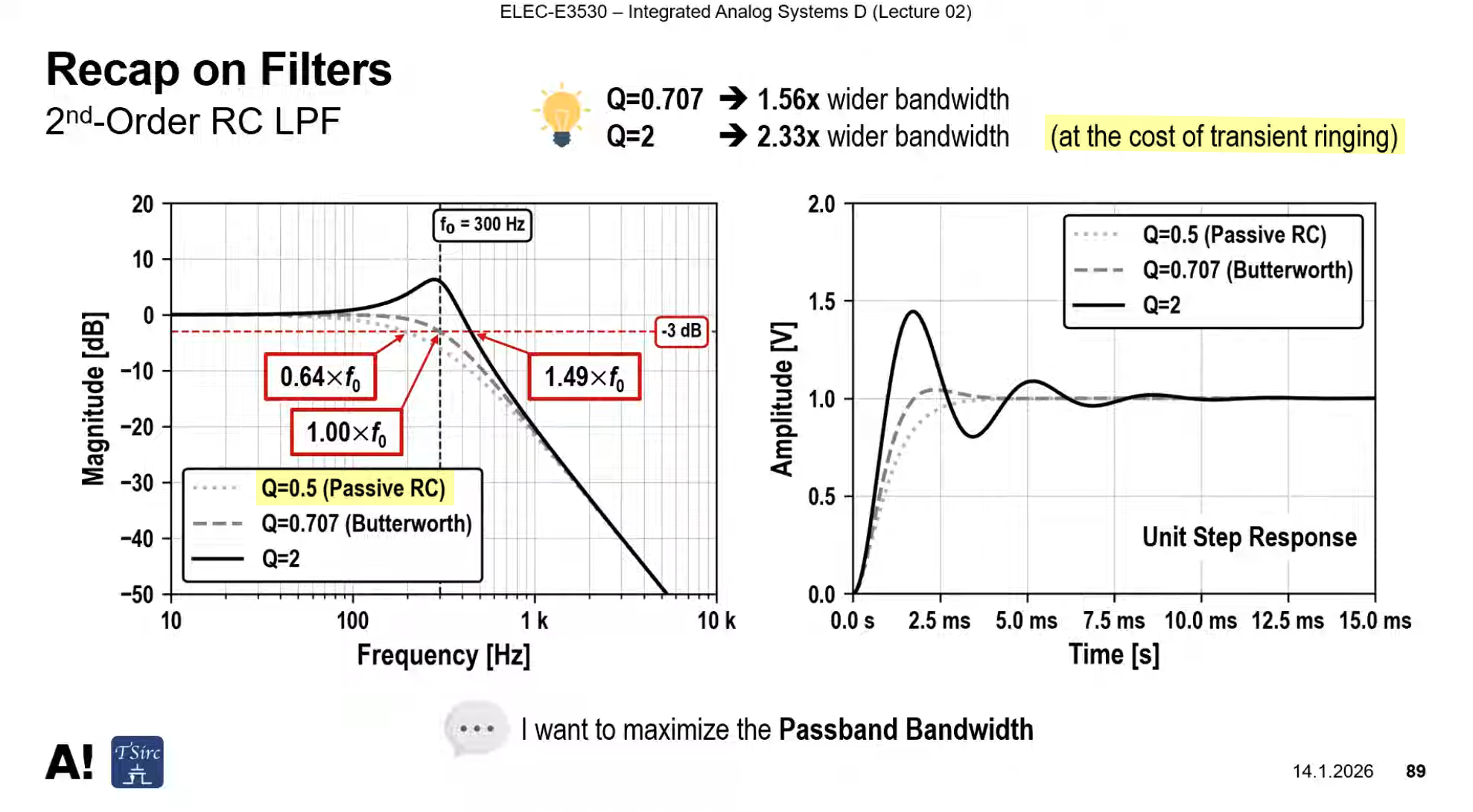
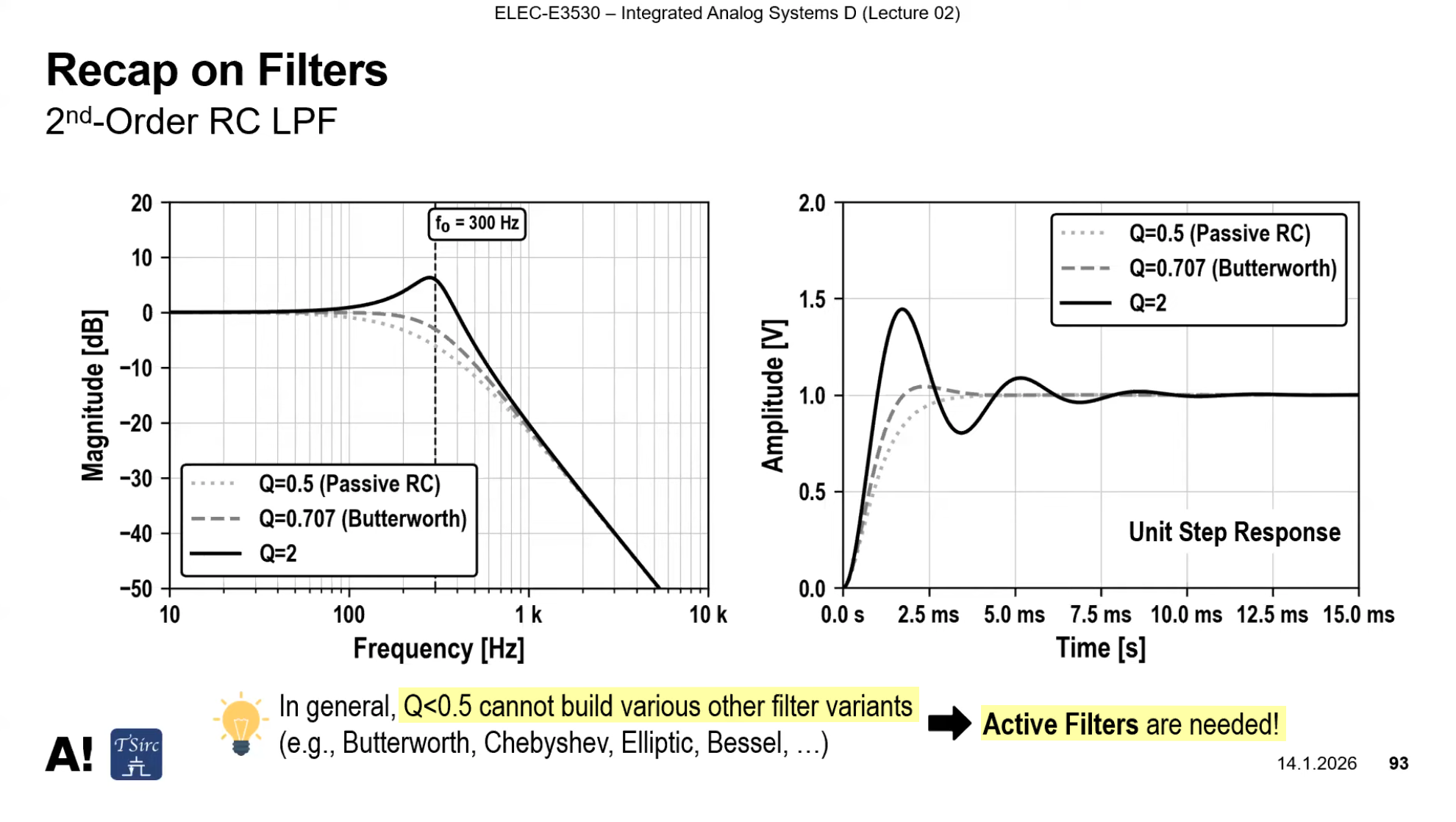
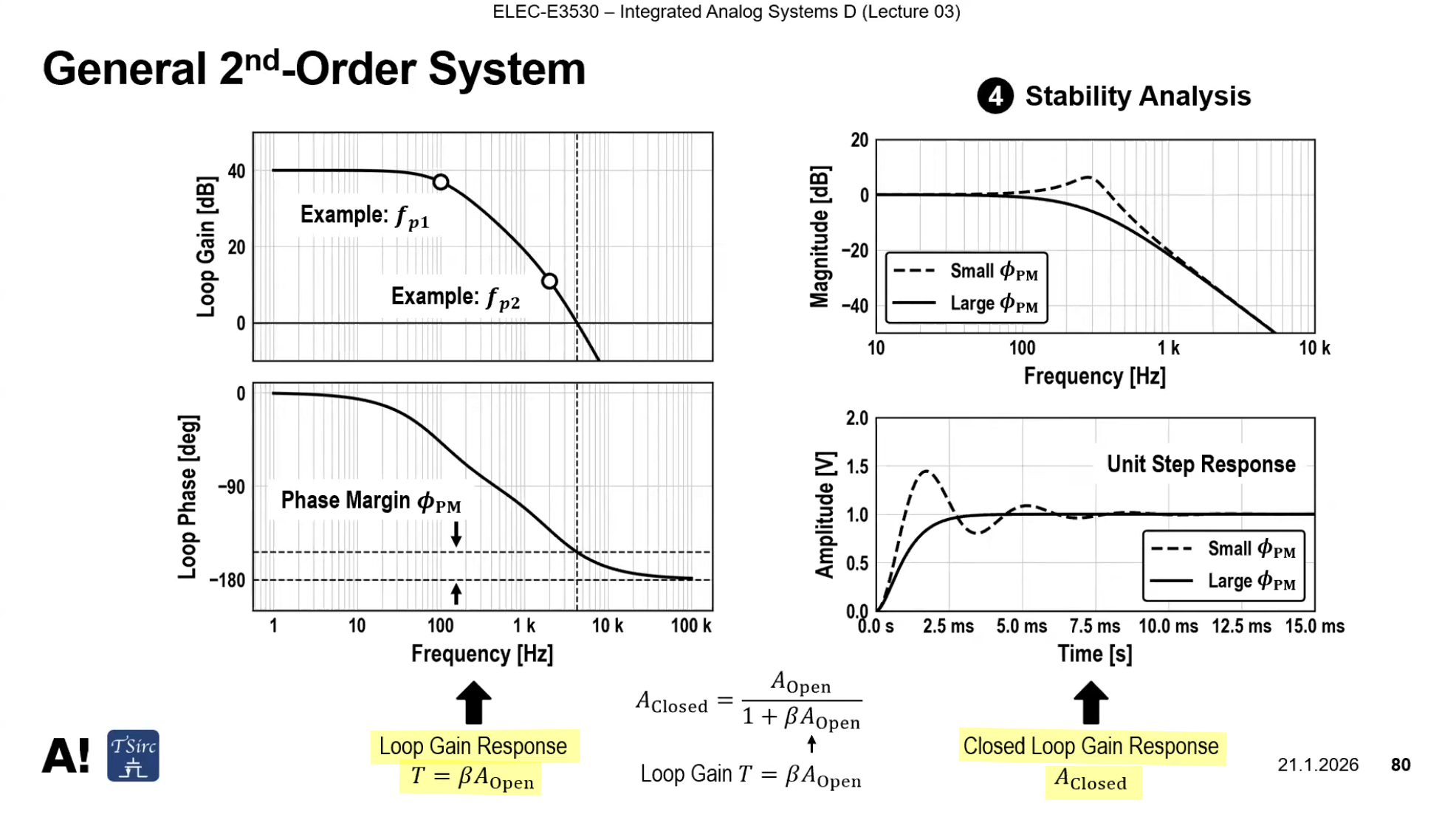
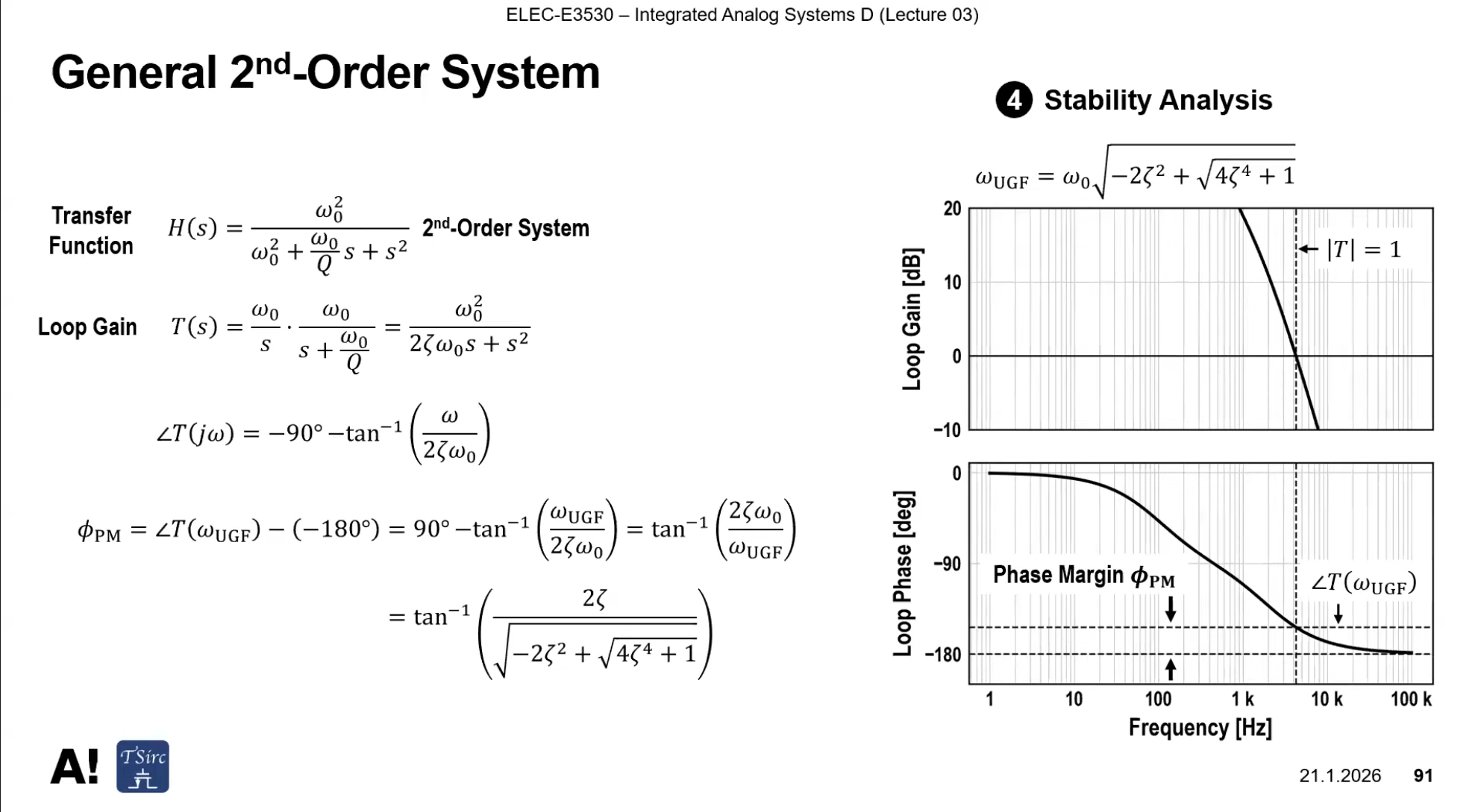
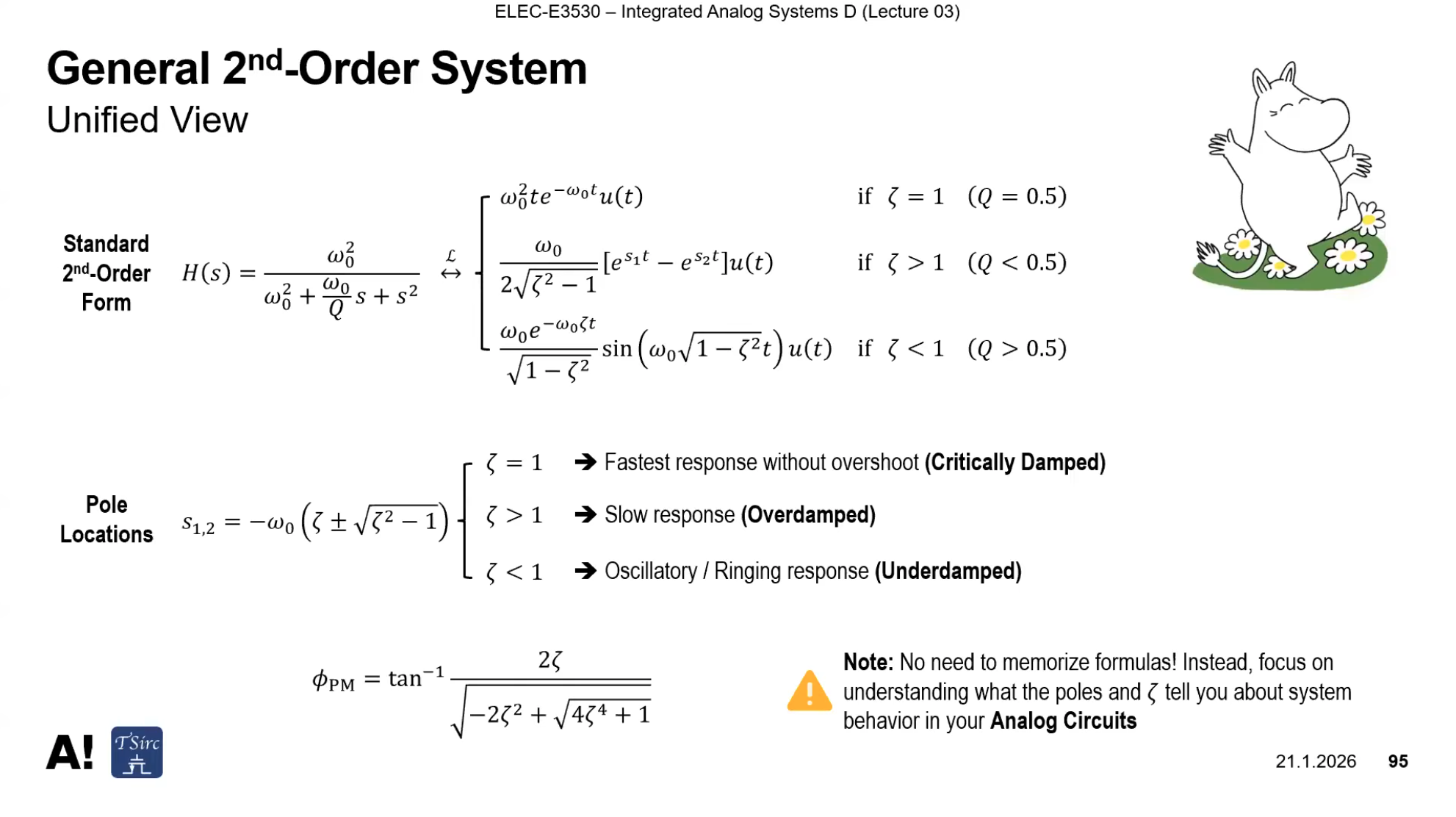
Phase Magin with damping Factor \(\zeta\)
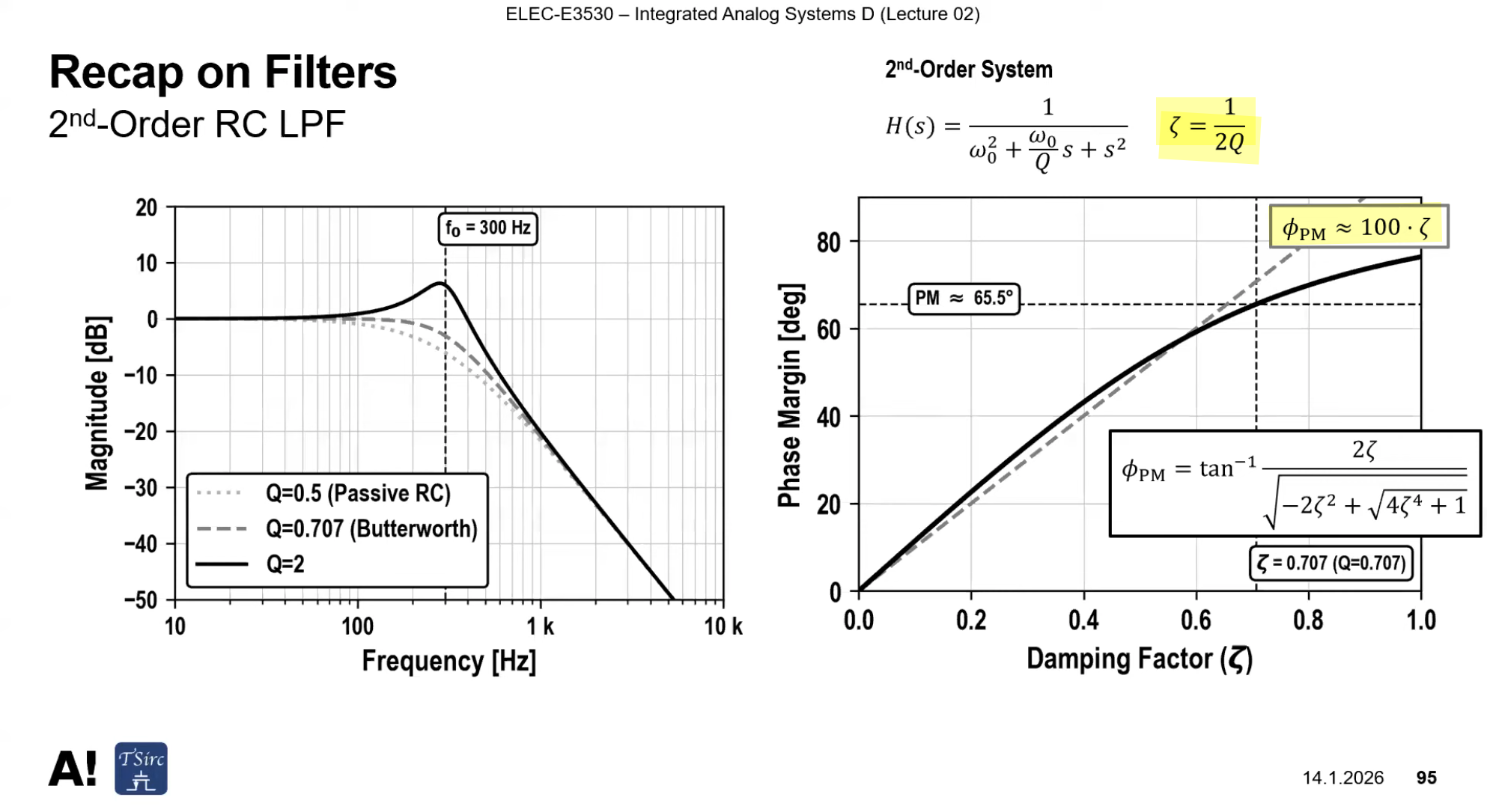 \[
\boxed{\phi_\text{PM}\approx 100\cdot \zeta}
\]
\[
\boxed{\phi_\text{PM}\approx 100\cdot \zeta}
\]
General 2nd-Order RC LPF
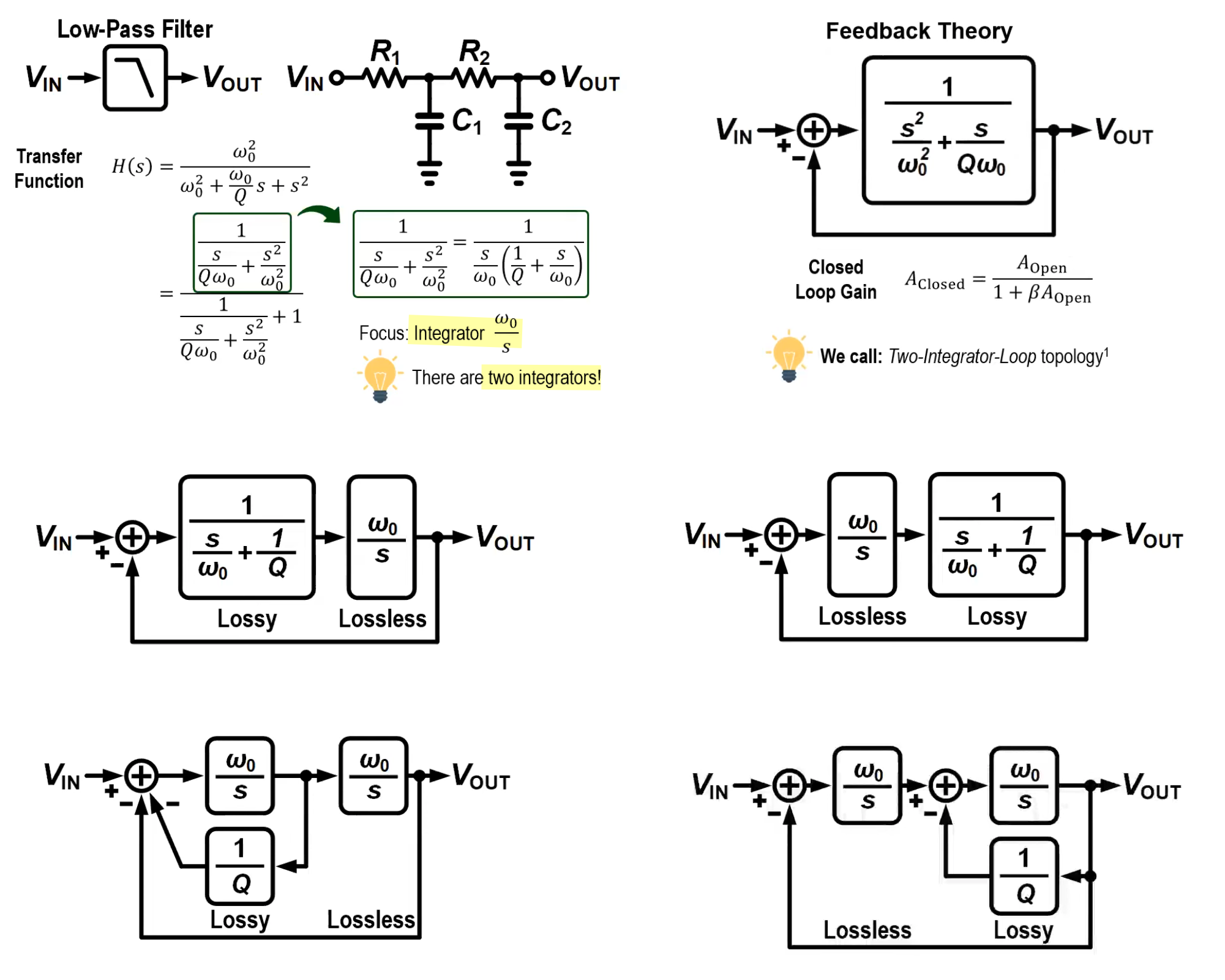
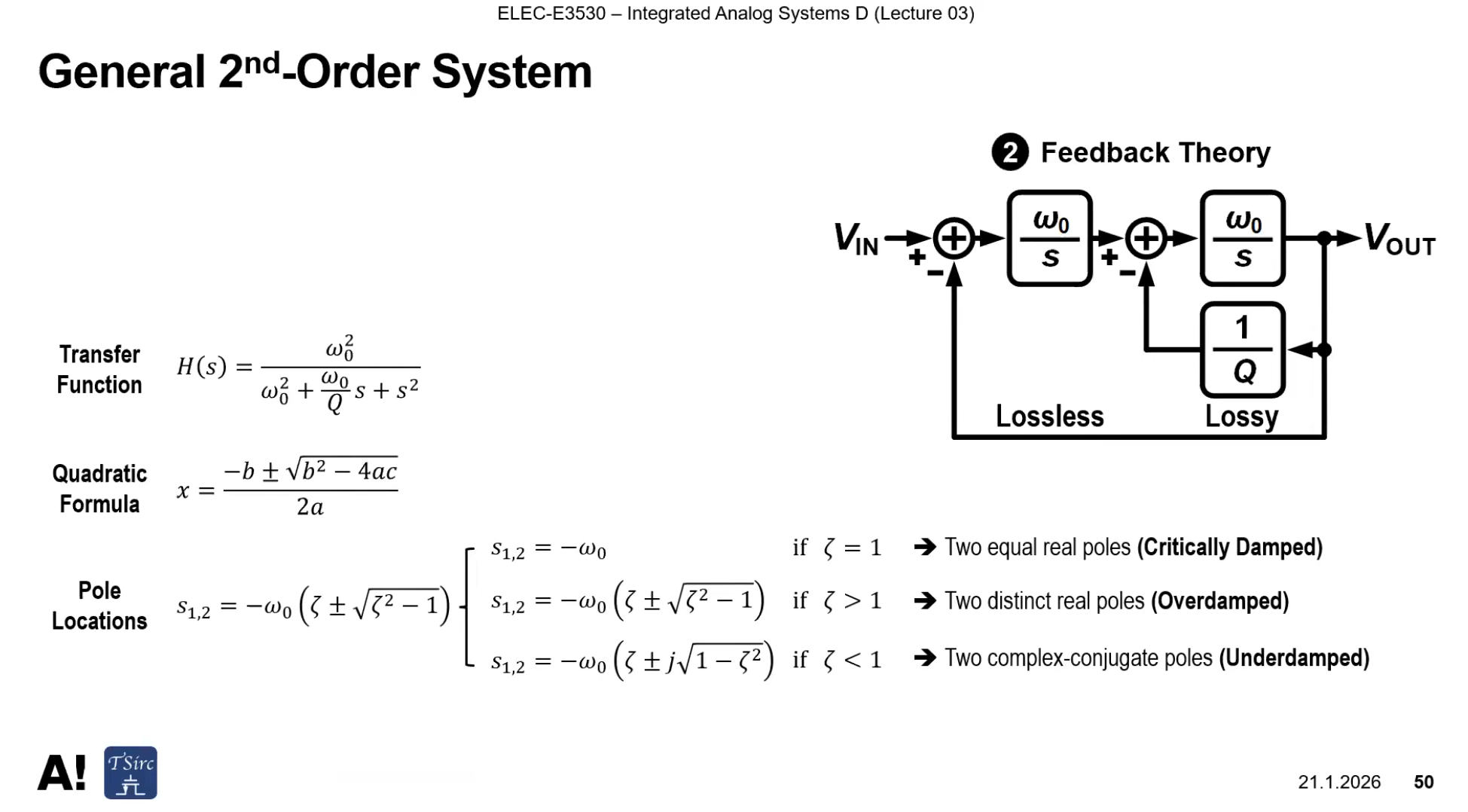
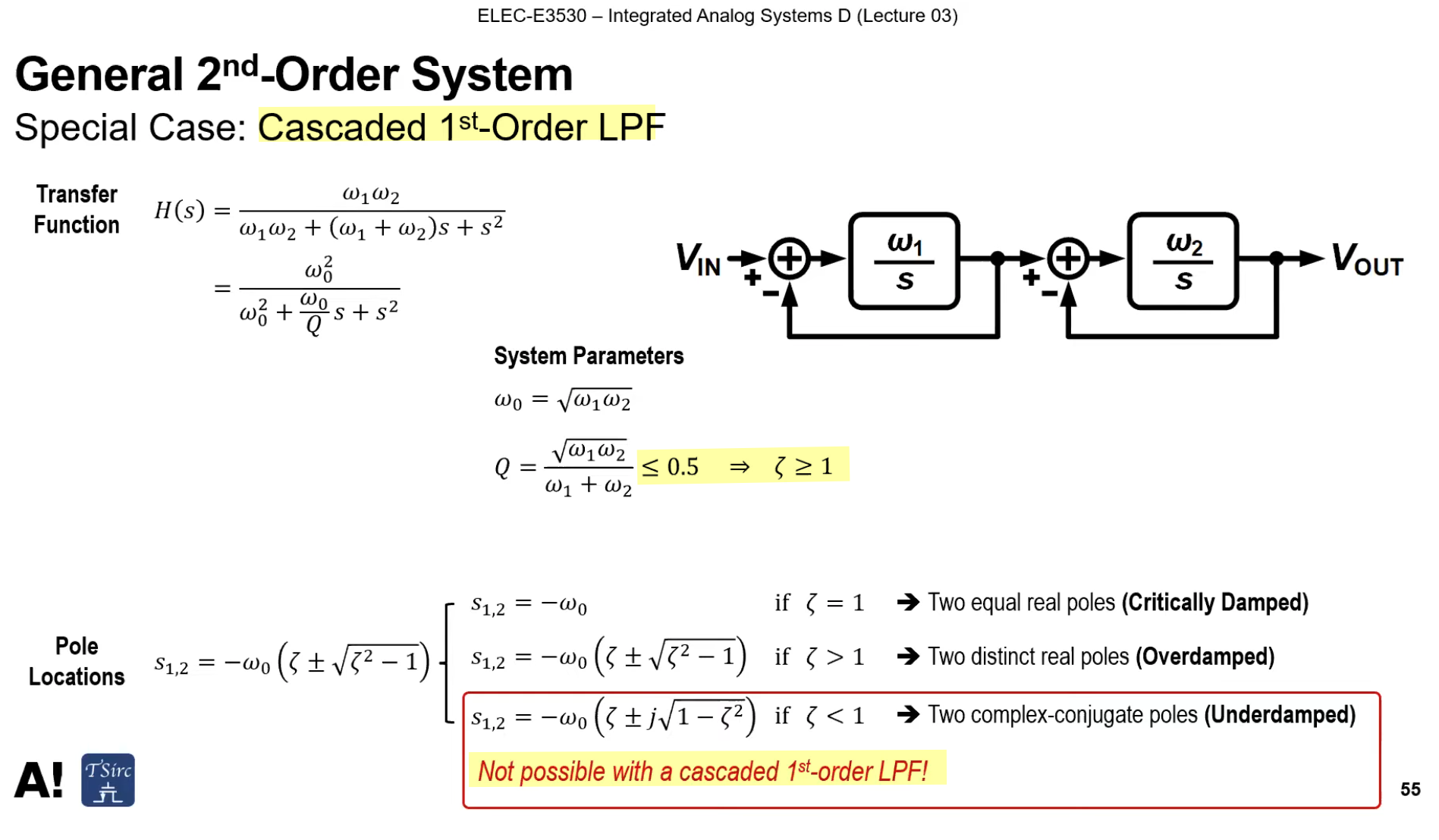
Laplace Transform
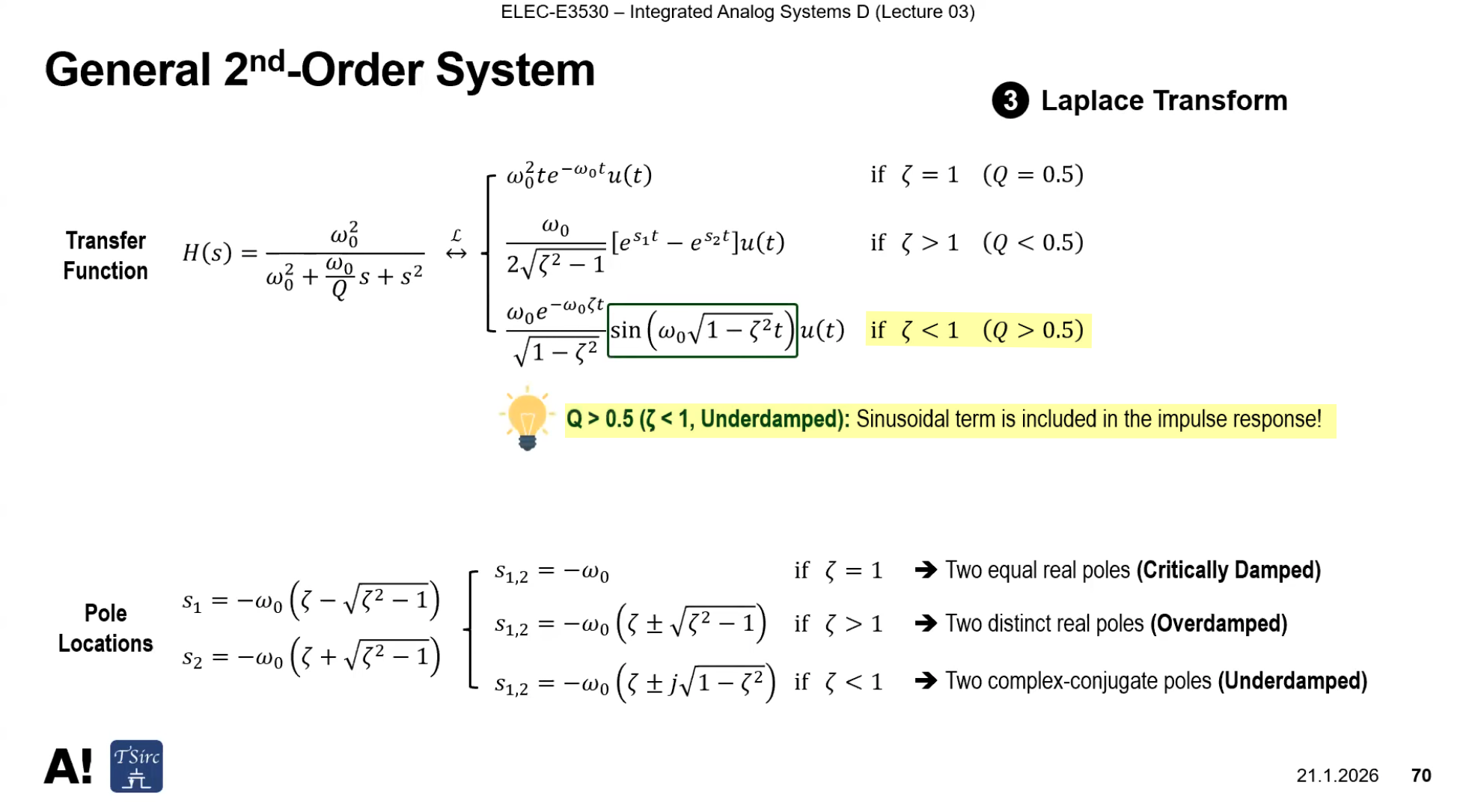
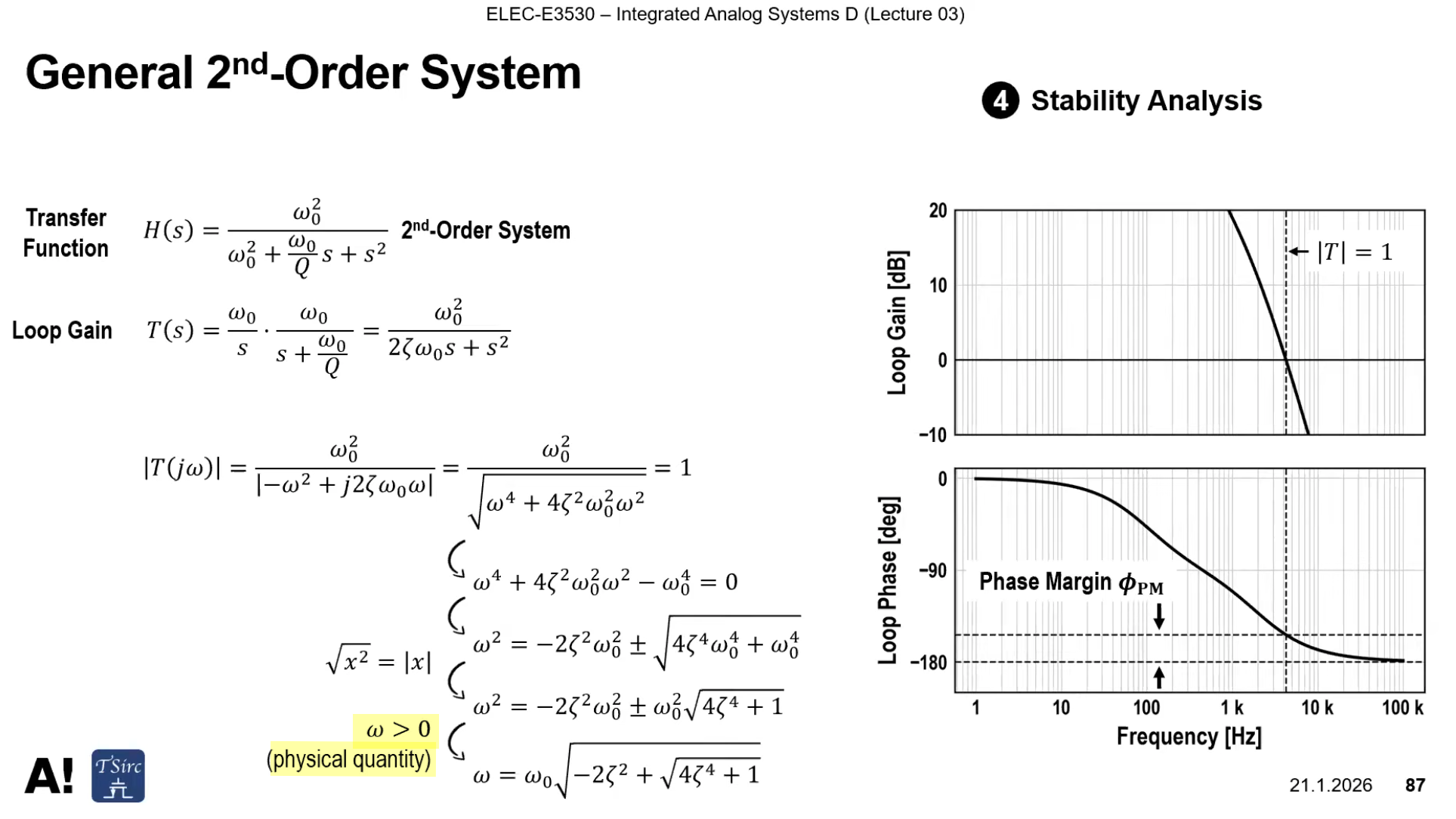
Stability Analysis
Bode's noise theorem
Bode's noise theorem holds only for linear, passive networks in thermal equilibrium, meaning every lossy element is at the same temperature T and the only noise is the thermal noise of that loss.
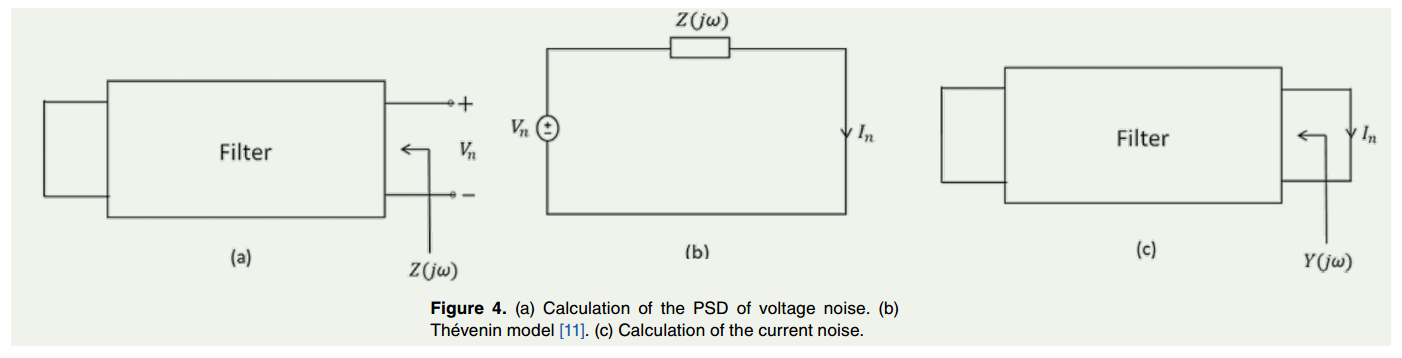
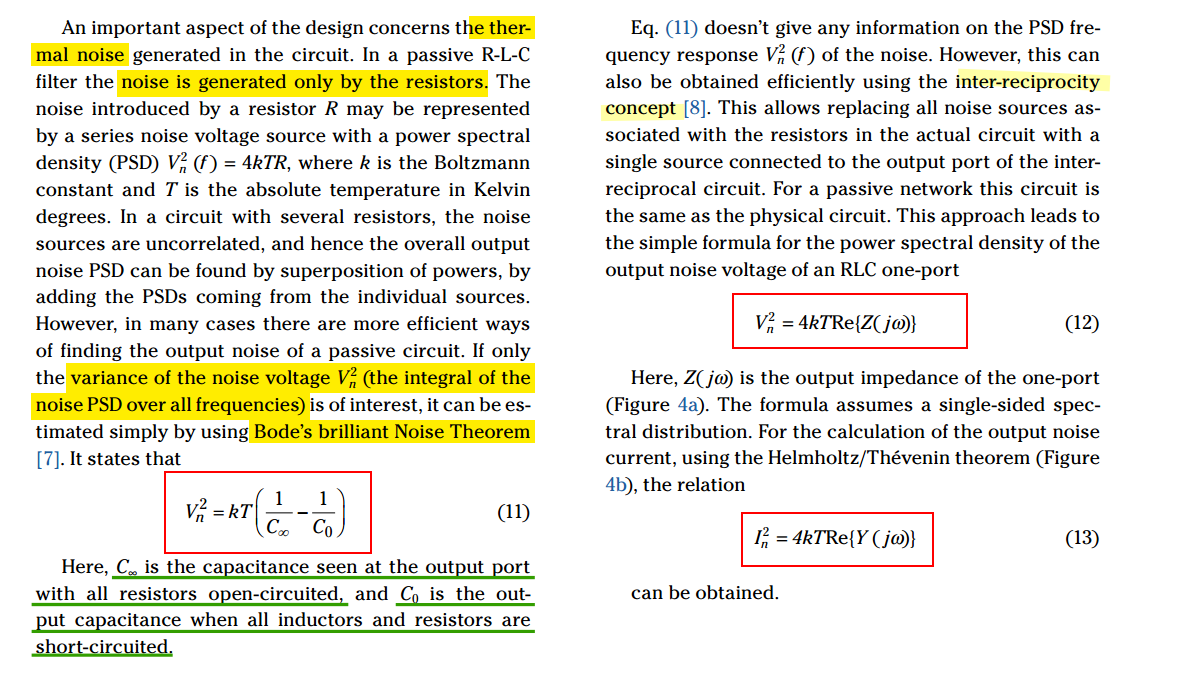
A short circuit is the limit of a capacitor with infinite capacitance, since its impedance go to 0 only when capacitance go to infinity.
For 1st RC filter, \(C_\infty=C\), and \(C_0\) (the capacitance "seen" at the output) is \(C\) in parallel with a short, which is infinite, i.e. \(C_0=C+\infty=\infty\) \[ V_n^2=kT(\frac{1}{C} - \frac{1}{\infty})=\frac{kT}{C} \]
Active Filters
Kwantae Kim, Integrated Analog Systems D - Lecture 05 (Continuous-Time Filters) [https://youtu.be/LHhEK1RlC6w]
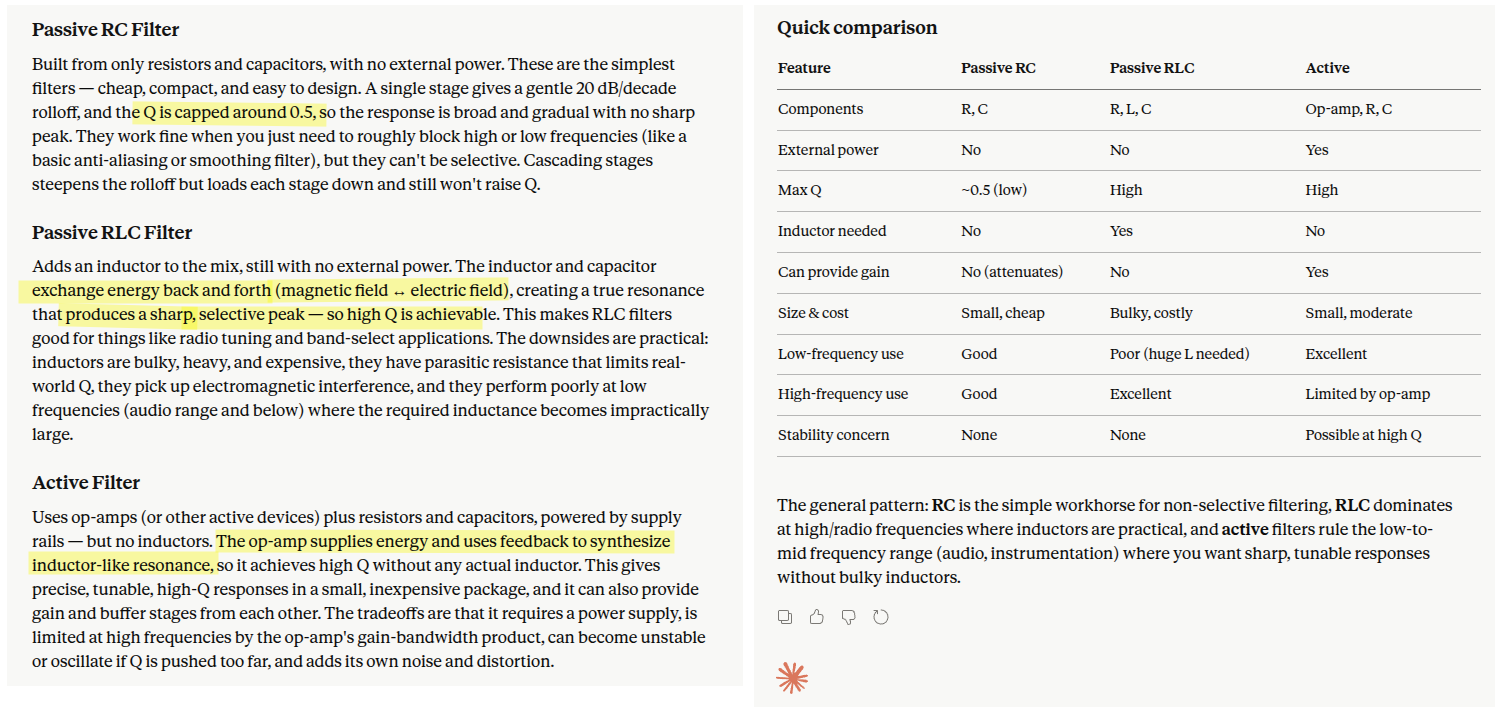
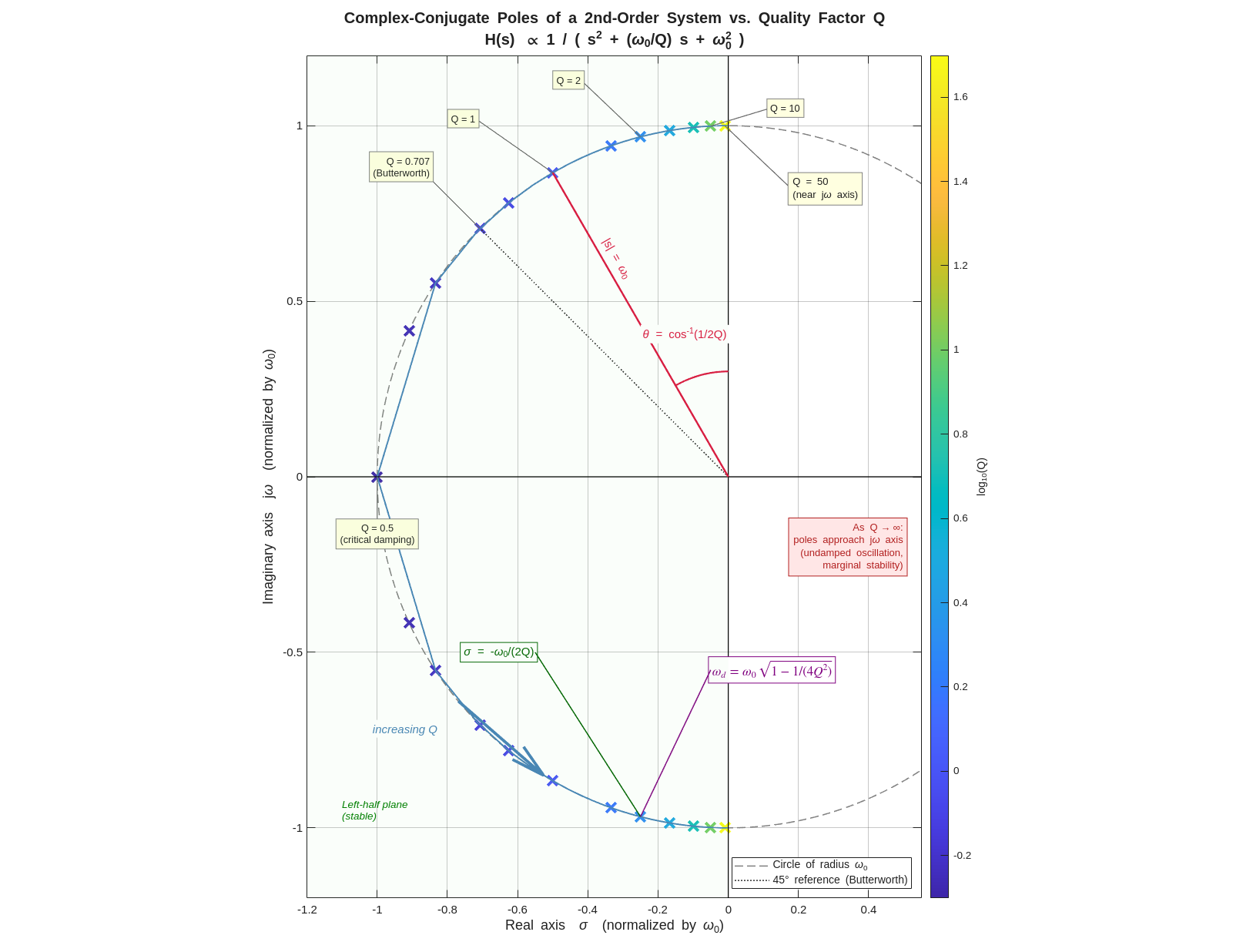
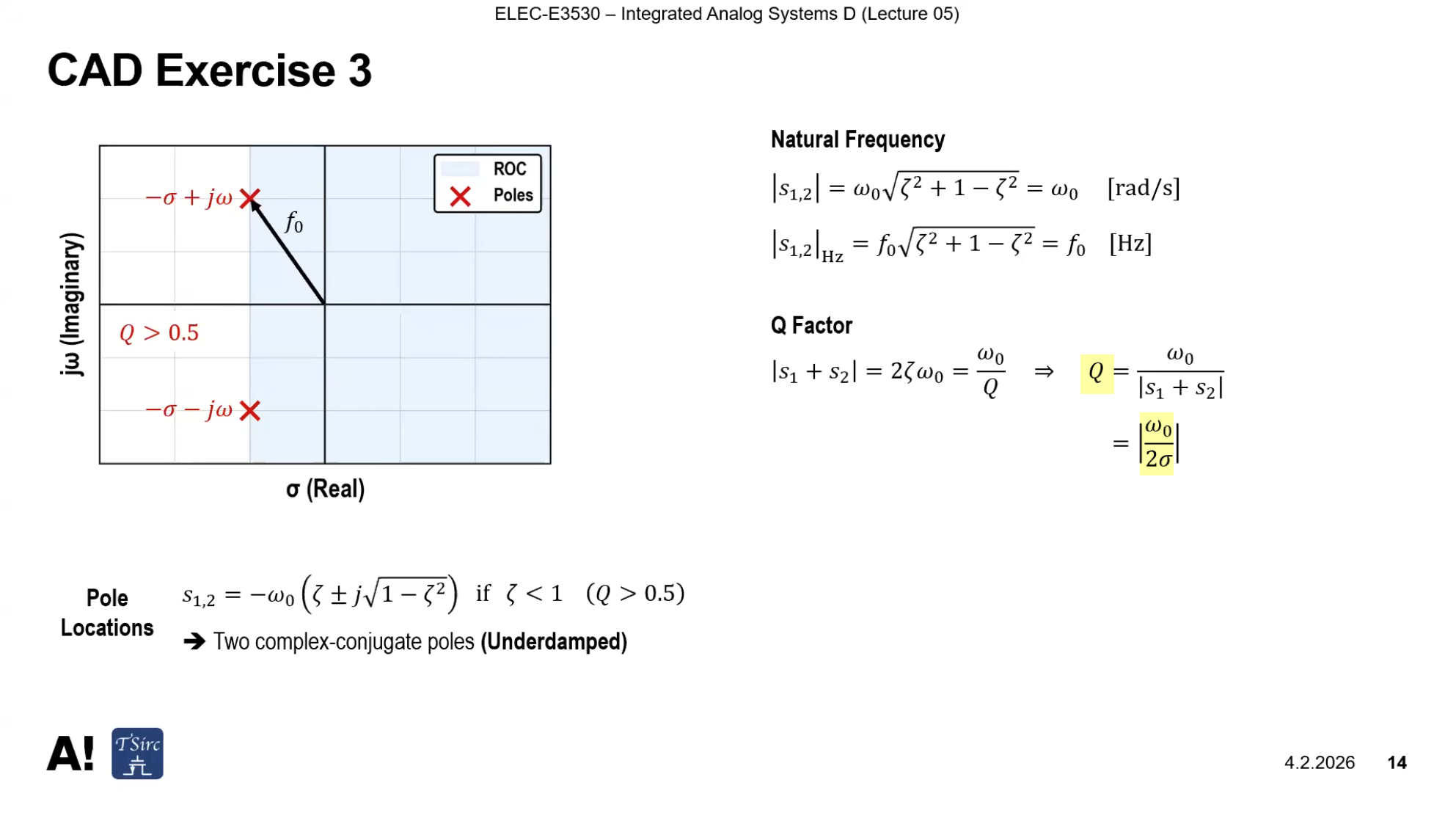
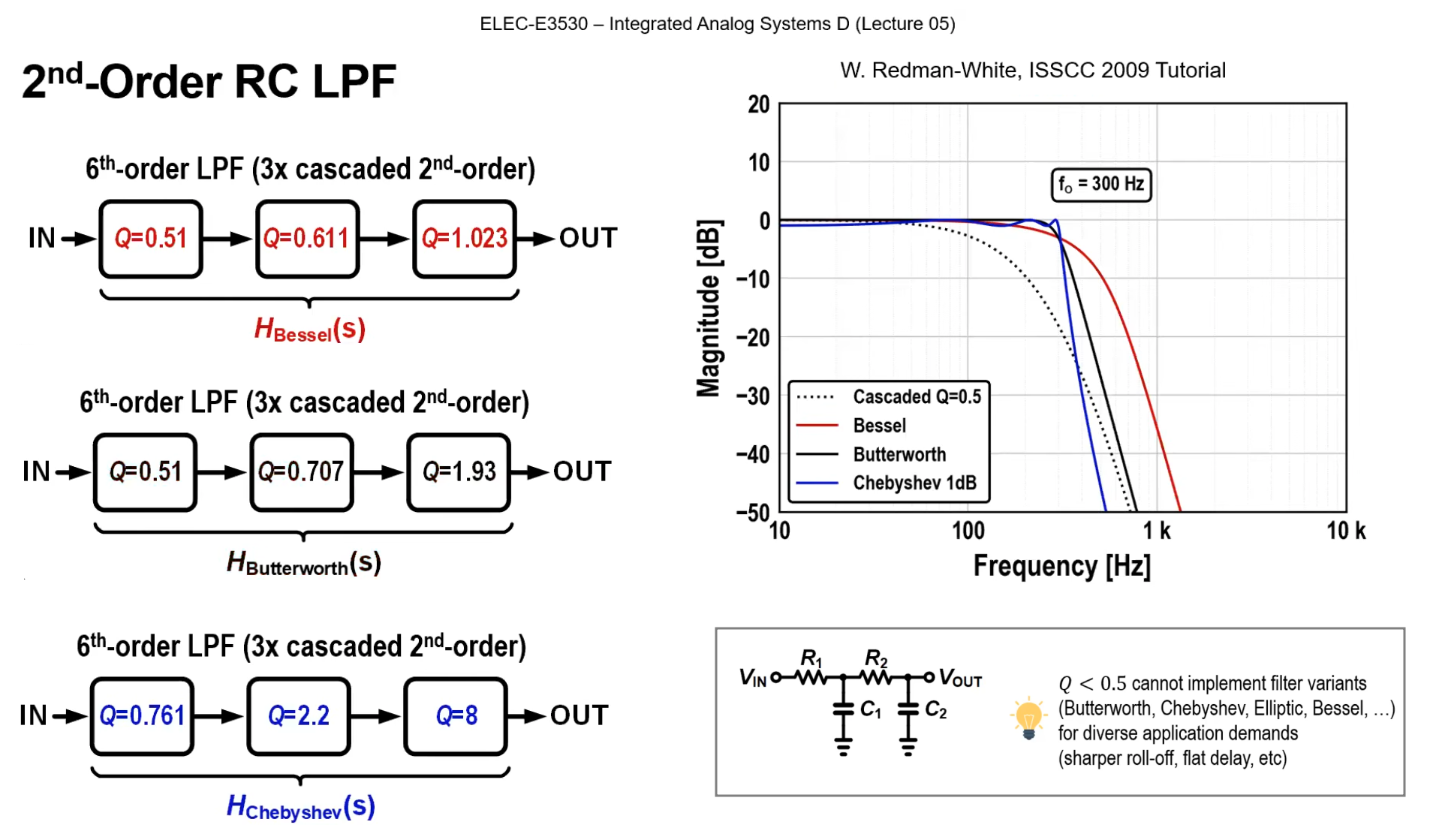
TODO 📅
Single-Pole LPF Algorithms
Neil Robertson, Model a Sigma-Delta DAC Plus RC Filter [https://www.dsprelated.com/showarticle/1642.php]
Jason Sachs, Ten Little Algorithms, Part 2: The Single-Pole Low-Pass Filter [https://www.embeddedrelated.com/showarticle/779.php]
—. Return of the Delta-Sigma Modulators, Part 1: Modulation [https://www.dsprelated.com/showarticle/1517/return-of-the-delta-sigma-modulators-part-1-modulation]
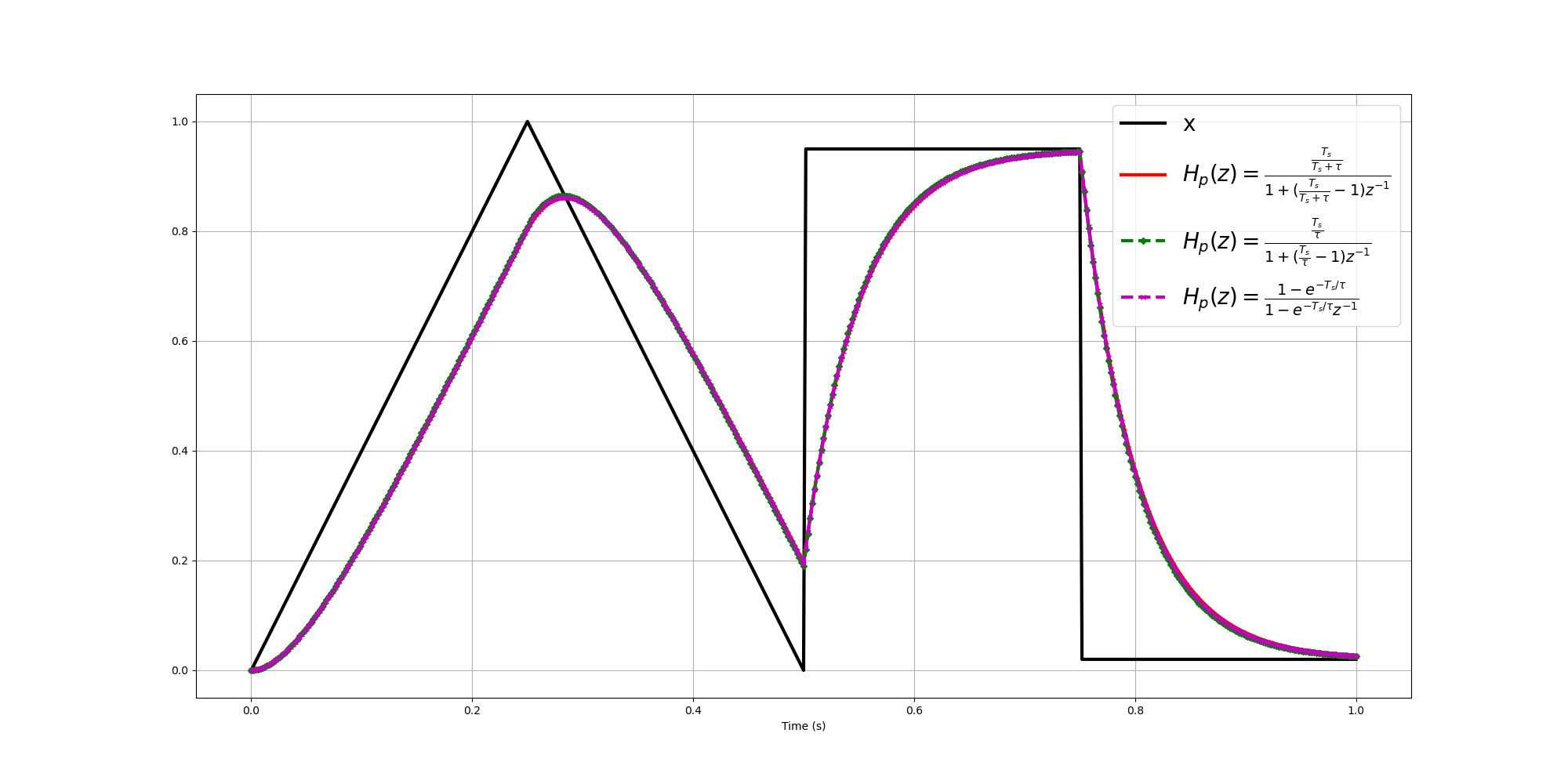
Derivatives Approximation (\(H_p(s)=\frac{1}{s\tau +1}\))
\[\begin{align} H_p(z)&=\frac{\frac{T_s}{T_s+\tau}}{1+(\frac{T_s}{T_s+\tau}-1)z^{-1}}\tag{EQ-0}\\ H_p(z)&=\frac{\frac{T_s}{\tau}}{1+(\frac{T_s}{\tau}-1)z^{-1}}\tag{EQ-1} \end{align}\]
Matched z-Transform (Root Matching) \[ H_p(z)=\frac{1-e^{-T_s/\tau}}{1-e^{-T_s/\tau}z^{-1}}\tag{EQ-2} \] EQ-2 is connected with EQ-1 by \(1 - e^{-\Delta t/\tau} \approx \frac{\Delta t}{\tau}\)
1 | import numpy as np |
1 | x(t) ──┬── R ──┬── y(t) |
Three discretizations of the same continuous prototype, all valid first-order LPFs but with different sample-domain behavior \(\alpha = \frac{T}{T+\tau}\):
| Form | Difference equation | Transfer function | Notes |
|---|---|---|---|
| Backward Euler (above) | \(y_n = (1-\alpha) y_{n-1} + \alpha\, x_n\) | \(\dfrac{\alpha}{1 - (1-\alpha) z^{-1}}\) | Implicit; needs \(x_n\) before computing \(y_n\) |
| Delayed leaky integrator | \(y_n = (1-\alpha) y_{n-1} + \alpha\, x_{n-1}\) | \(\dfrac{\alpha z^{-1}}{1 - (1-\alpha) z^{-1}}\) | One extra sample of delay; same magnitude response |
| Bilinear (Tustin) | \(y_n = (1-\alpha)y_{n-1} + \tfrac{\alpha}{2}(x_n + x_{n-1})\) | \(\dfrac{(\alpha/2)(1 + z^{-1})}{1 - (1-\alpha) z^{-1}}\) | Adds zero at \(z = -1\); better frequency-response match |
| Forward Euler | \(y_n = (1 - T/\tau)y_{n-1} + (T/\tau)\,x_{n-1}\) | \(\dfrac{(T/\tau) z^{-1}}{1 - (1 - T/\tau) z^{-1}}\) | Unstable when \(T > 2\tau\) |
Pole magnitude \(|1-\alpha| < 1\) always — backward Euler is unconditionally stable, unlike forward Euler (\(\alpha = T/\tau\)), which goes unstable when \(T > 2\tau\)
All four collapse to the same continuous-time filter as \(T \to 0\), but they're not interchangeable at finite \(T\) — the delayed leaky integrator in particular adds one sample of group delay that the others don't.
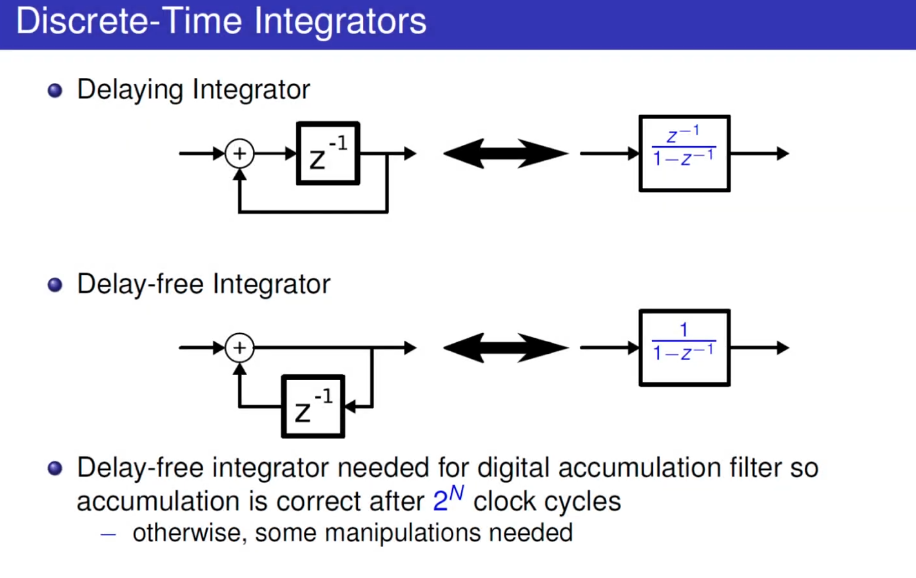
Discrete-Time Integrators
Qasim Chaudhari. Discrete-Time Integrators [https://wirelesspi.com/discrete-time-integrators/]
David Johns (University of Toronto) "Oversampled Data Converters" Course (2019) [https://youtu.be/qIJ2LORYmyA]
Delaying Integrator
Delay-free Integrator
Discrete-Time Differentiator
Qasim Chaudhari. Design of a Discrete-Time Differentiator [https://wirelesspi.com/design-of-a-discrete-time-differentiator/]
TODO 📅
reference
Boris Murmann. EE315A VLSI Signal Conditioning Circuits
Bill Redman-White, ISSCC 2009 Tutorial: T1 : Continuous-Time Filters
B. Nikolic, "Tutorial: Filtering in RF Transceivers," 2014 IEEE International Solid-State Circuits Conference Digest of Technical Papers (ISSCC), San Francisco, CA, USA, 2014
W. Sansen, "Short Course: Power Limits for Amplifiers and Filters," 2012 IEEE International Solid-State Circuits Conference, San Francisco, CA, USA, 2012
Antonio Liscidini, 2018 New Trends in Analog Filters
M. Babaie, "Tutorial: Role of Current-Mode Passive Mixers and N-Path Filters in RF Receivers," 2023 IEEE International Solid-State Circuits Conference (ISSCC), San Francisco, CA, USA, 2023
Stephen Roberts, Signal Processing & Filter Design B3 option [https://www.robots.ox.ac.uk/~sjrob/Teaching/sp_course.html]
Butterworth, Chebyshev & Bessel filters [https://analogcircuitdesign.com/butterworth-and-chebyshev-filters/]
Qasim Chaudhari. FIR vs IIR Filters – A Practical Comparison [https://wirelesspi.com/fir-vs-iir-filters-a-practical-comparison/]
—. Finite Impulse Response (FIR) Filters [https://wirelesspi.com/finite-impulse-response-fir-filters/]
—. Why FIR Filters have Linear Phase [https://wirelesspi.com/why-fir-filters-have-linear-phase/]
—. Moving Average Filter [https://wirelesspi.com/moving-average-filter/]
—. Cascaded Integrator Comb (CIC) Filters – A Staircase of DSP. [https://wirelesspi.com/cascaded-integrator-comb-cic-filters-a-staircase-of-dsp/]
Hideo Okawara's Mixed Signal Lecture Series [https://tomverbeure.github.io/2024/01/06/Hideo-Okawara-Mixed-Signal-Lecture-Series.html]
How to generate complex poles without inductor? [https://a2d2ic.wordpress.com/2020/02/19/basics-on-active-rc-low-pass-filters/]