Basis of Inductance

Eric Bogatin. What Really Is Inductance? [https://speedingedge.com/wp-content/uploads/BTS006_What_Is_Inductance-2.pdf]

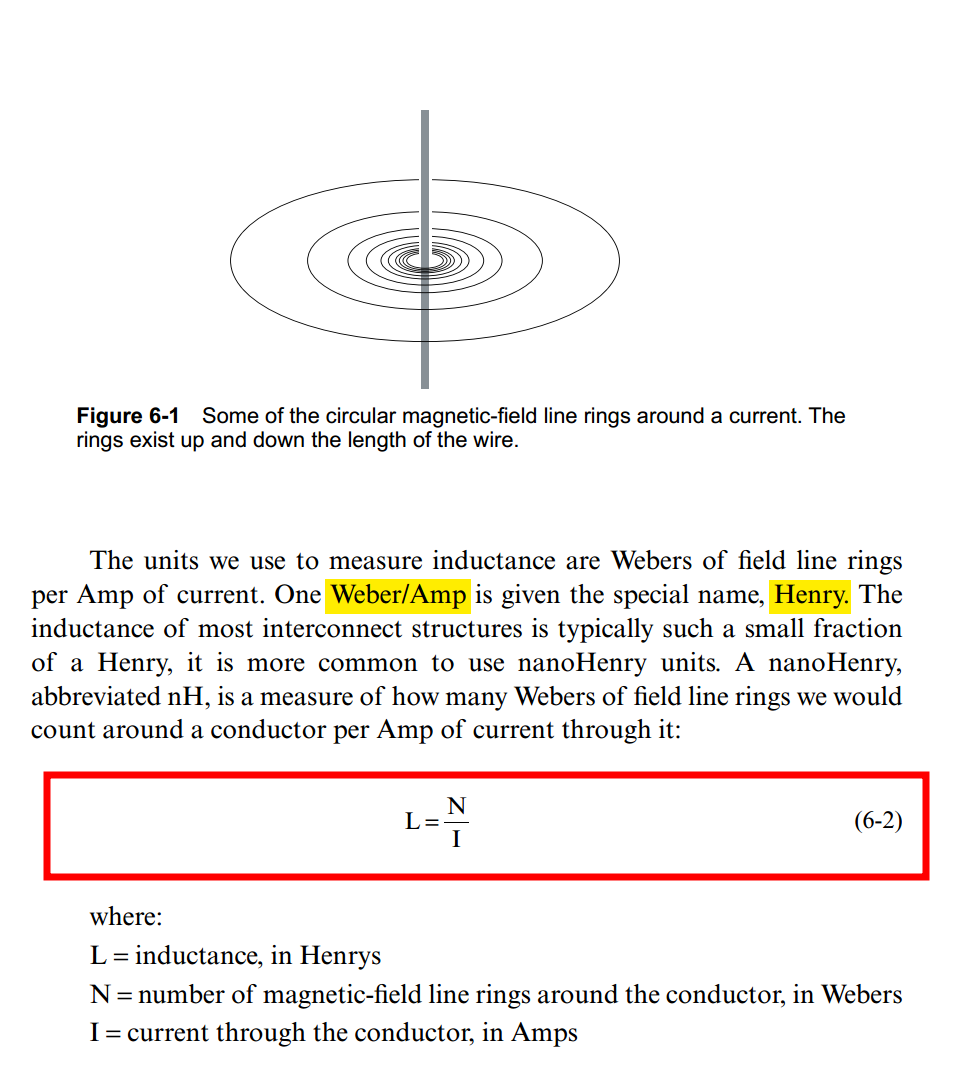
image-20260124152308248

image-20260124210314577

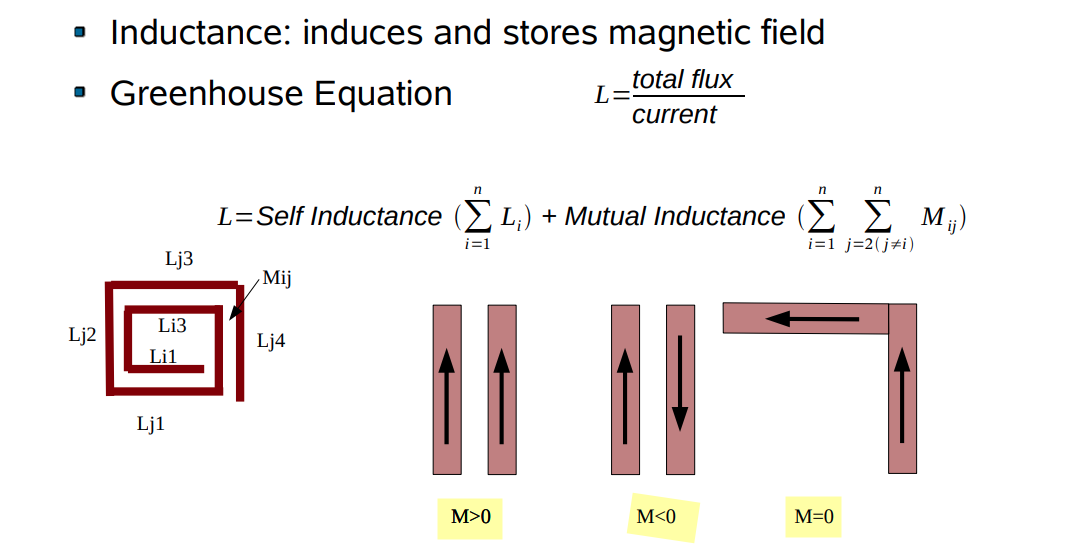
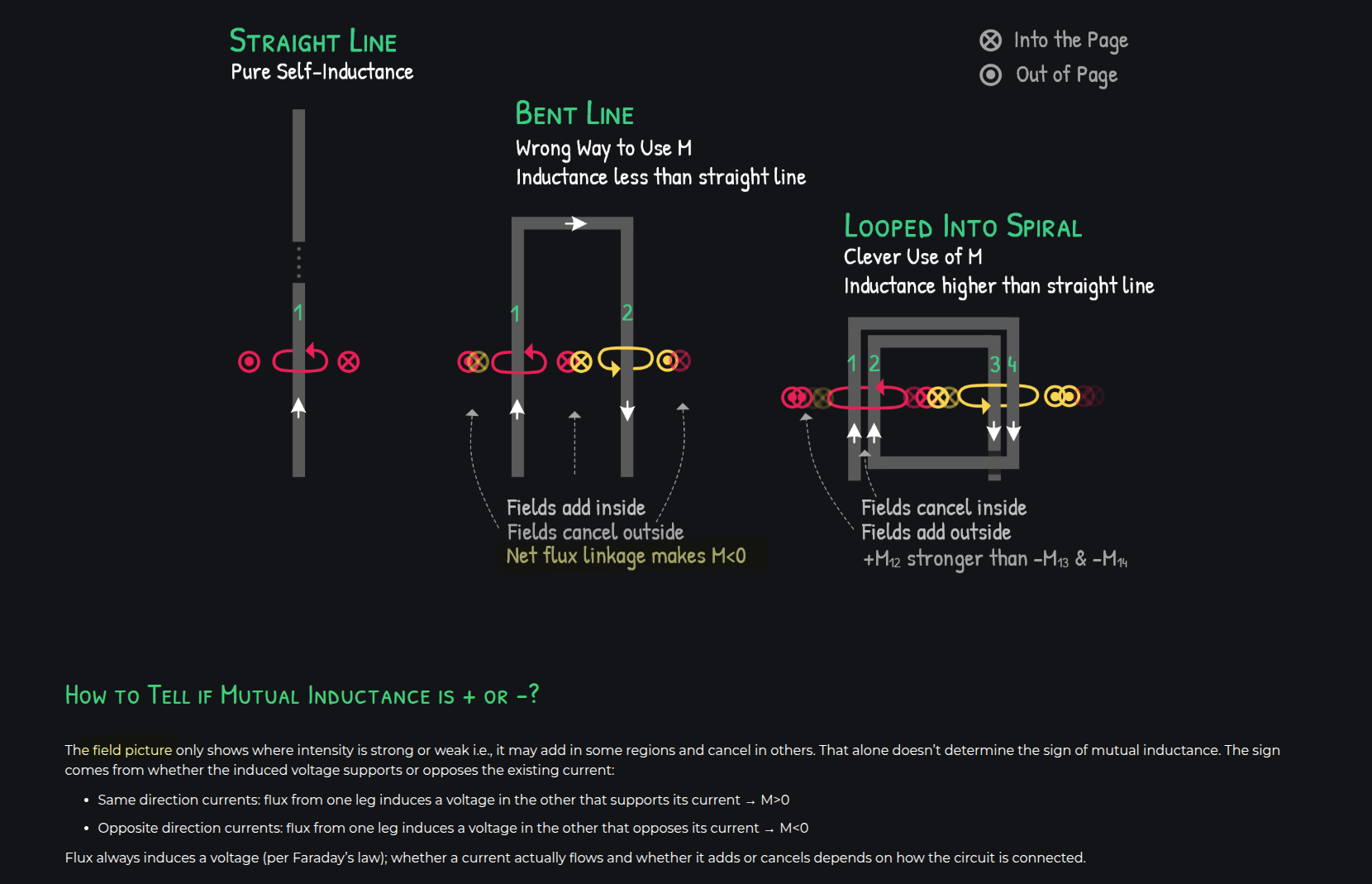
Self-Inductance & Mutual Inductance

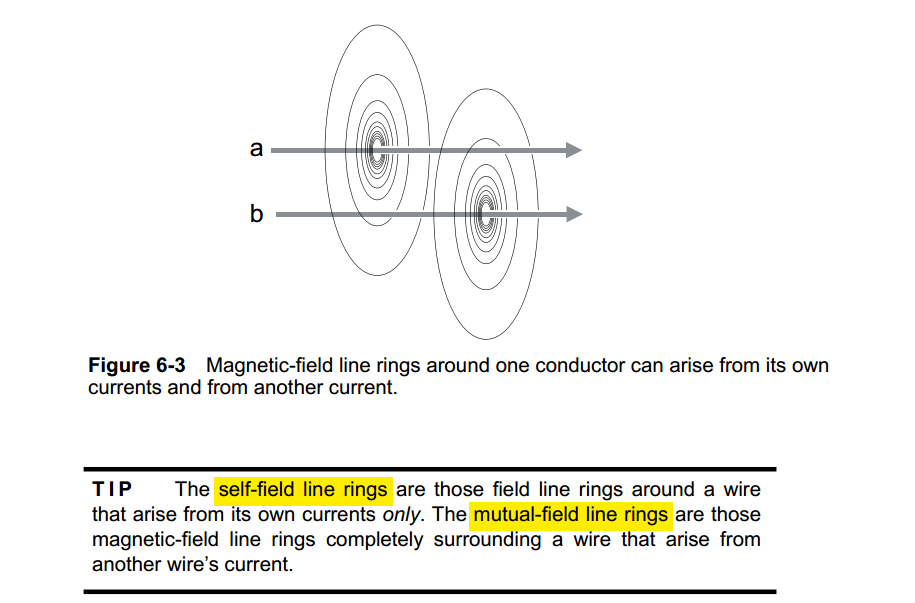
image-20260124200404275

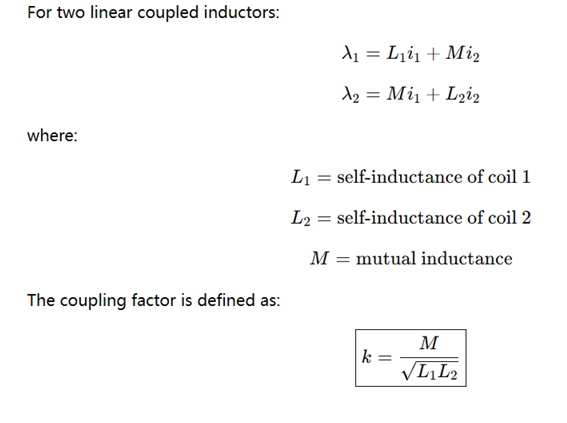
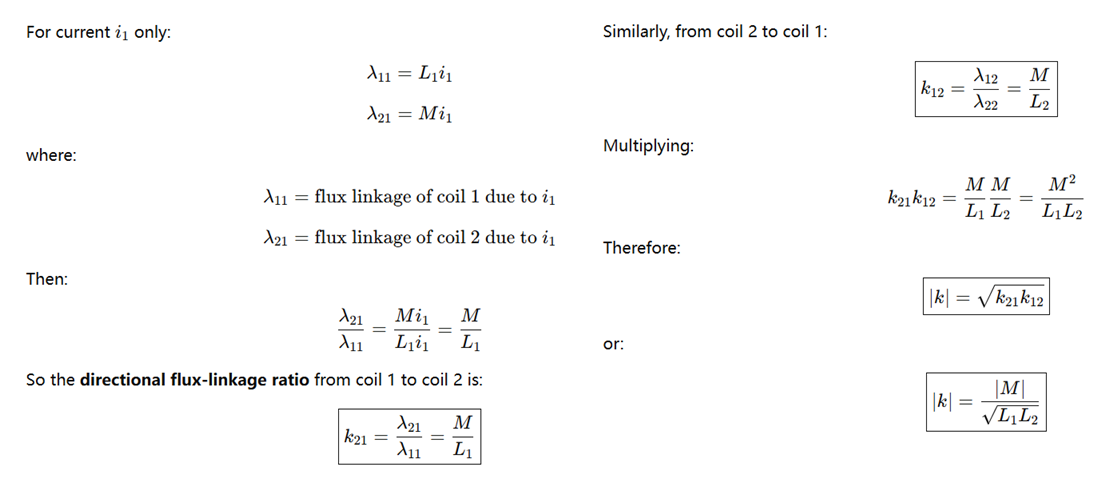
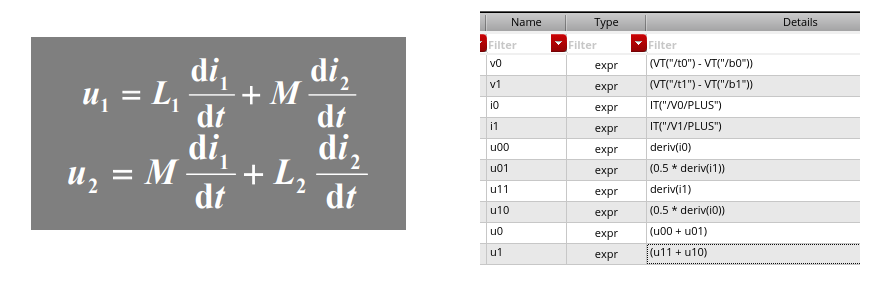
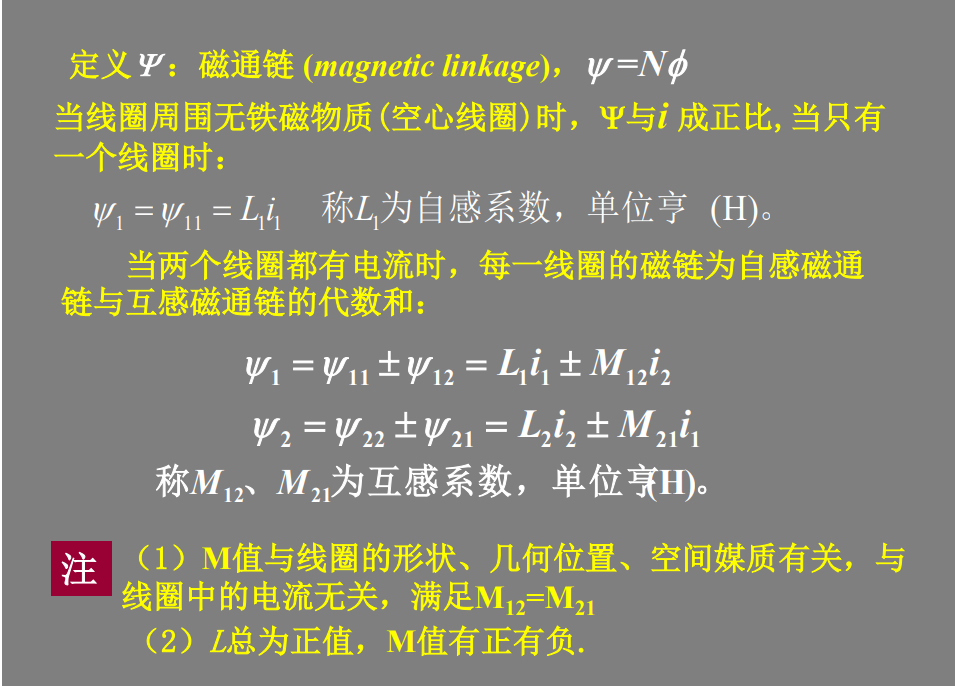
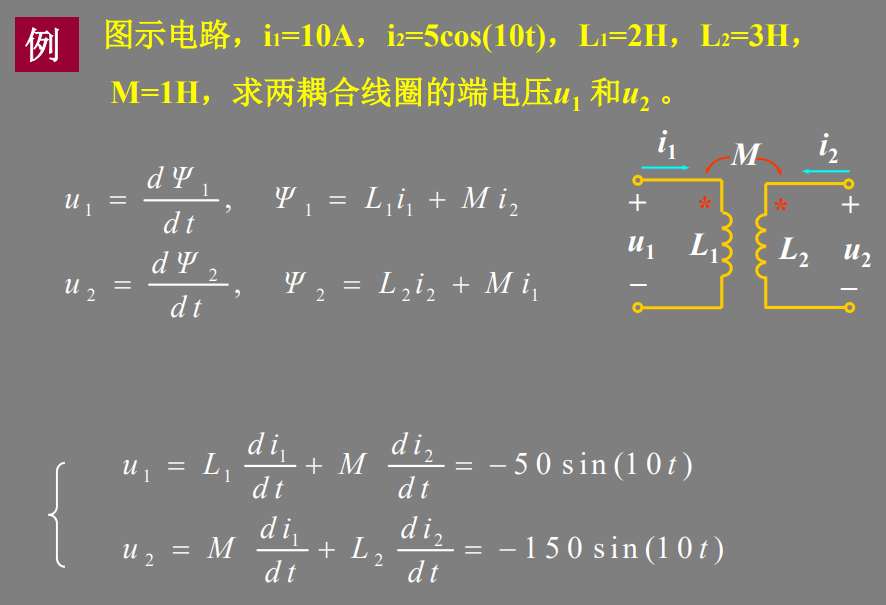
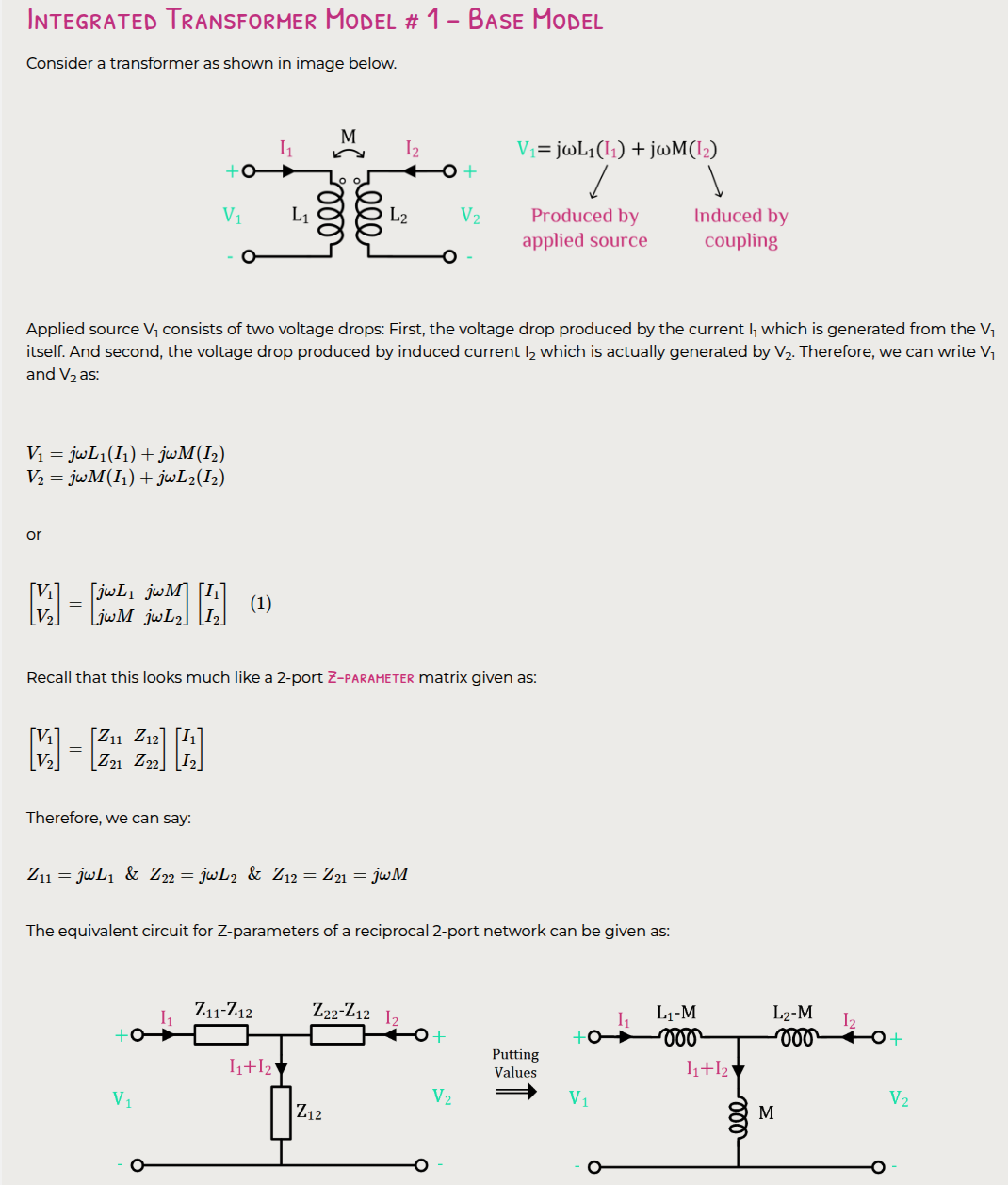
image-20260124210821758\[\begin{align} N_a &= L_a I_a + \color{red}M_{ab}I_b \\ N_b &= L_b I_b + \color{red}M_{ab}I_a \end{align}\]

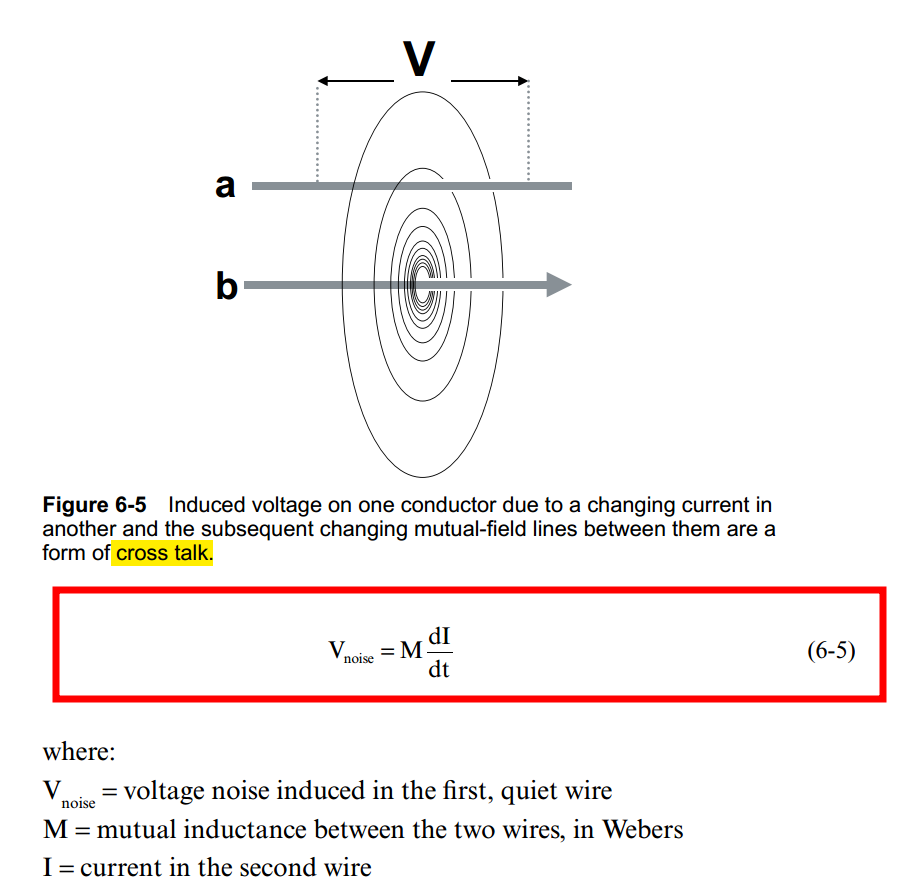
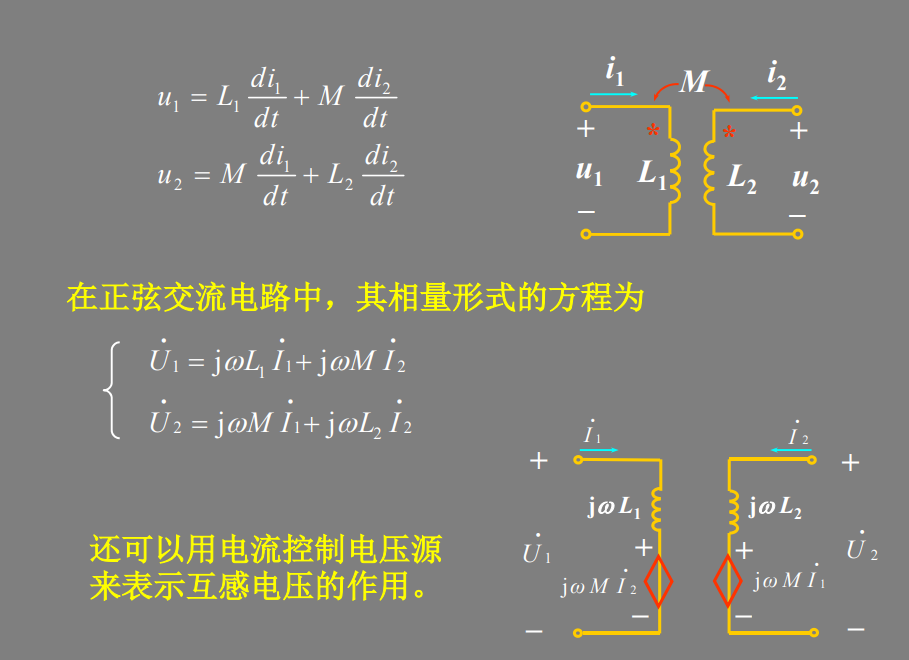
Induced voltage

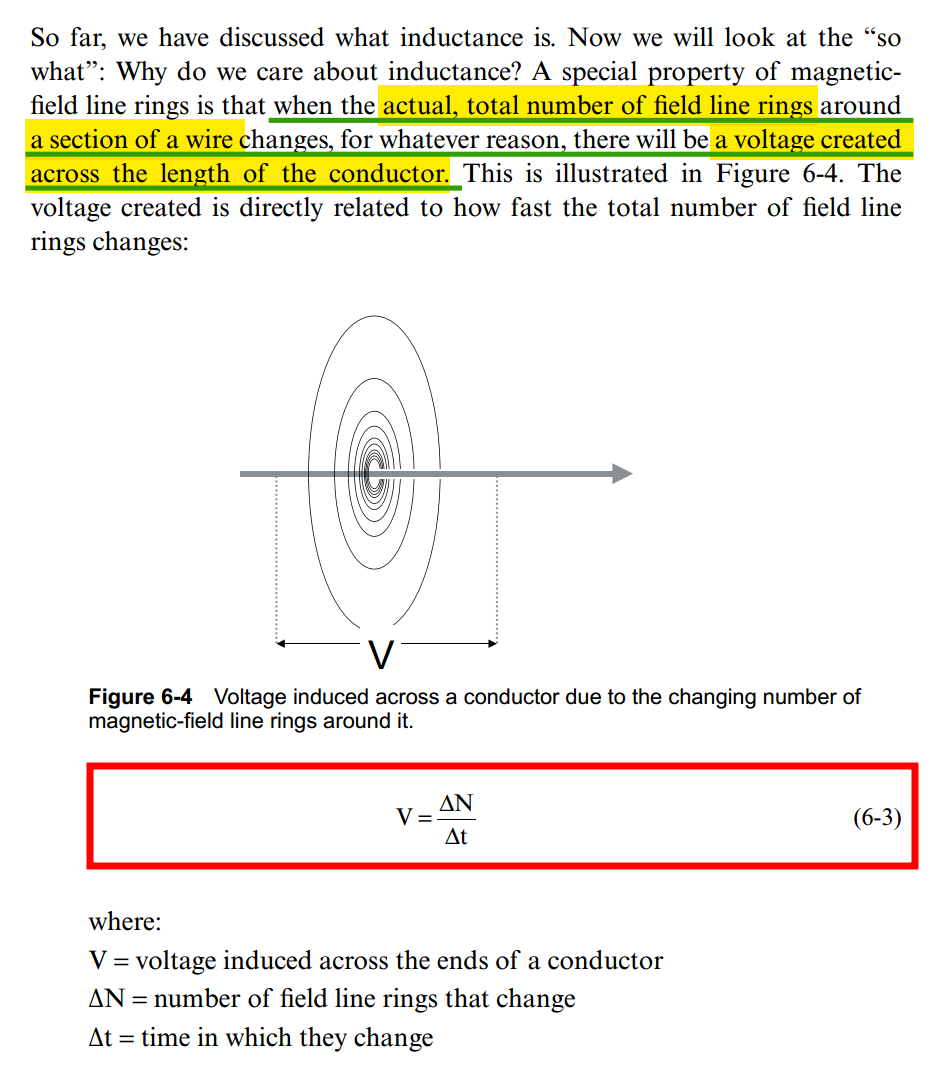
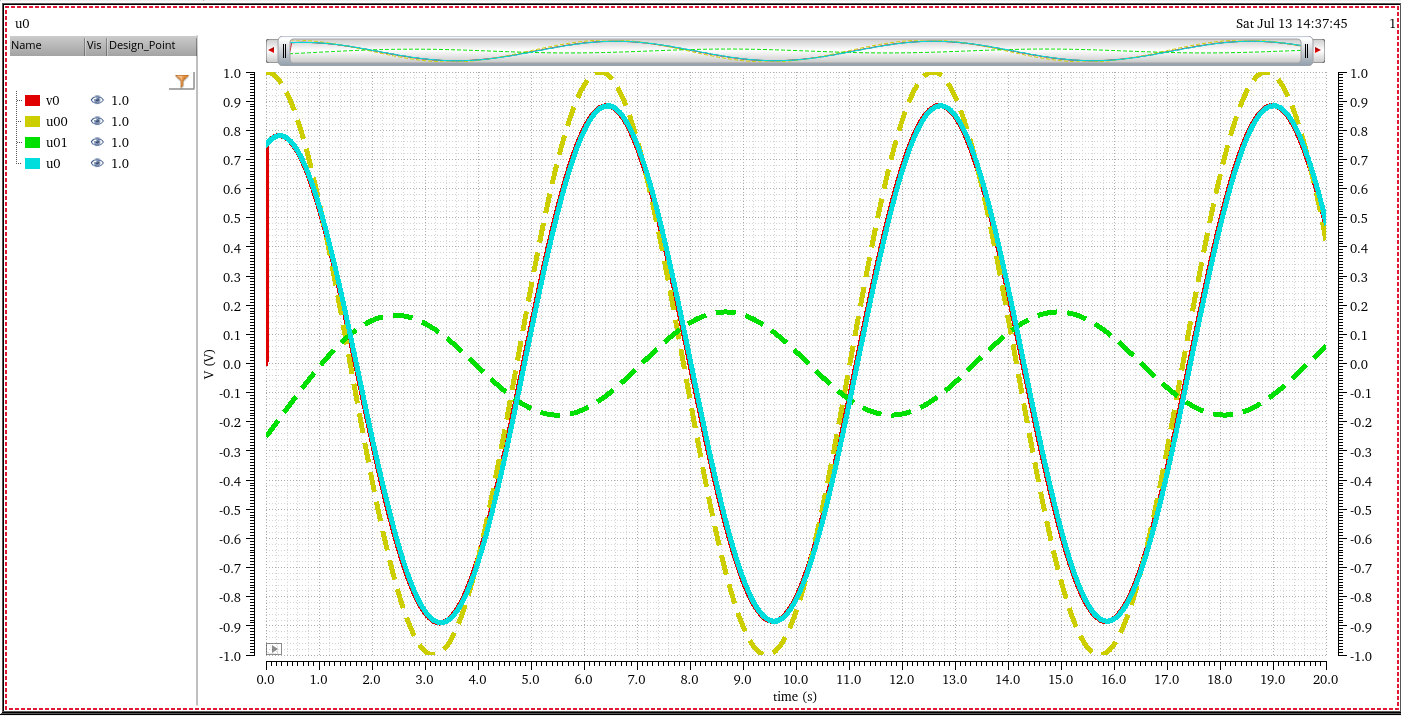
image-20260124210346852

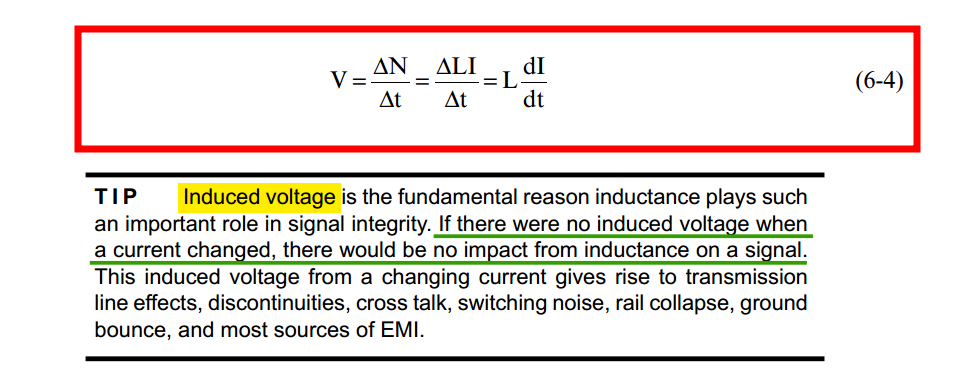
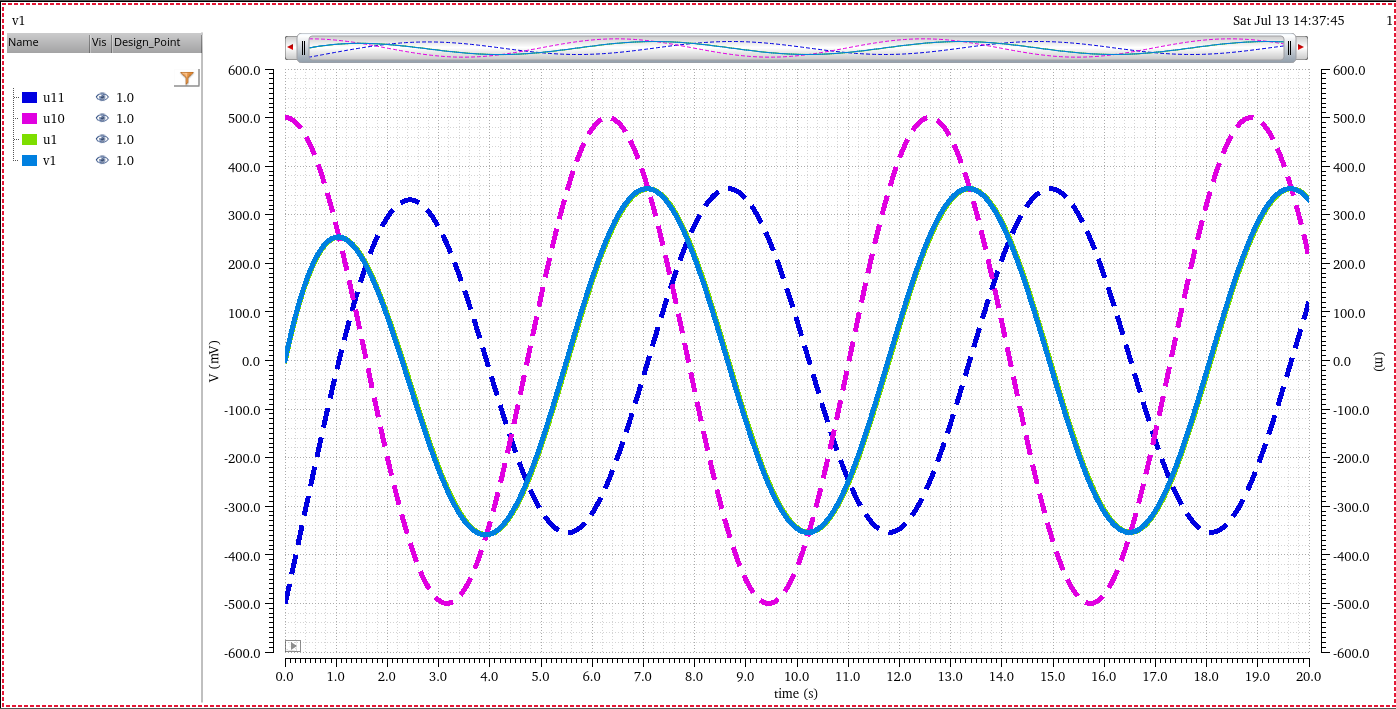
image-20260125120847806

image-20260125120937298

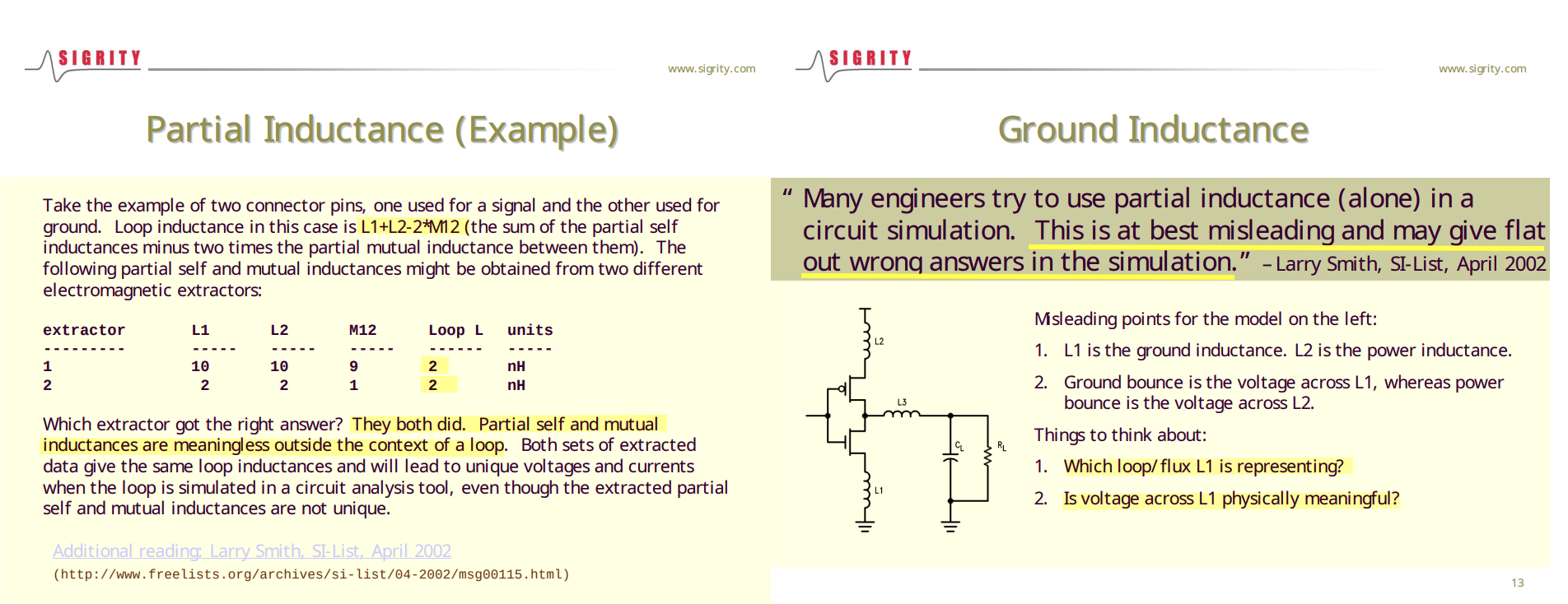
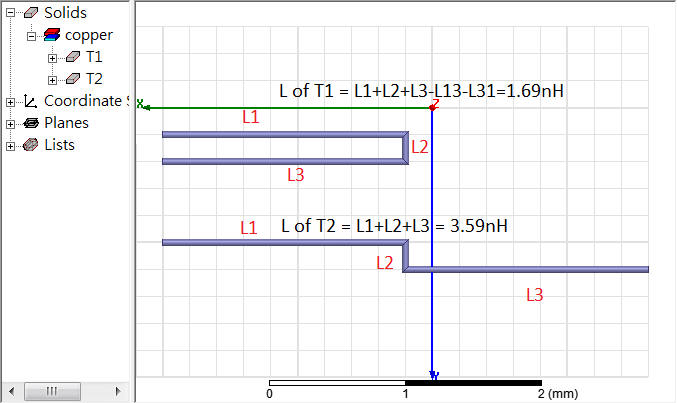
Partial Inductance

image-20260125183617687

image-20260125183709820

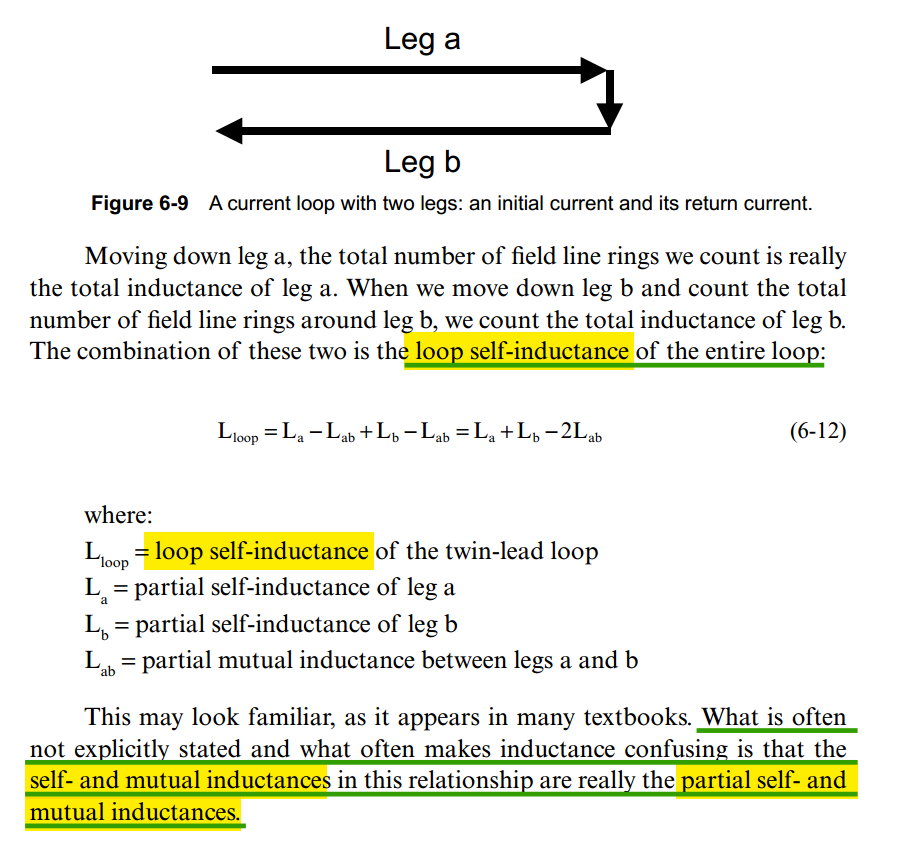
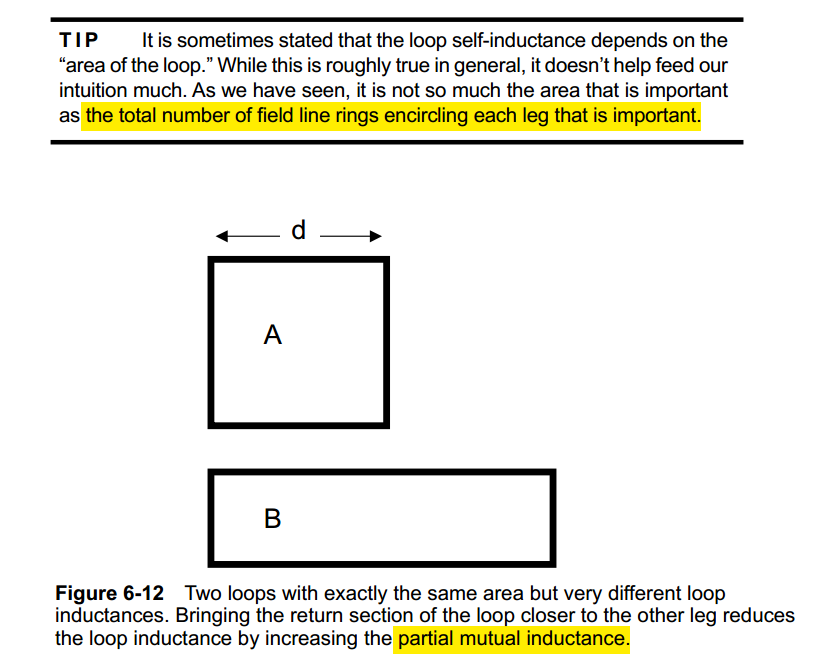
Loop Self & Mutual Inductance

image-20260125195819018

image-20260125202151186

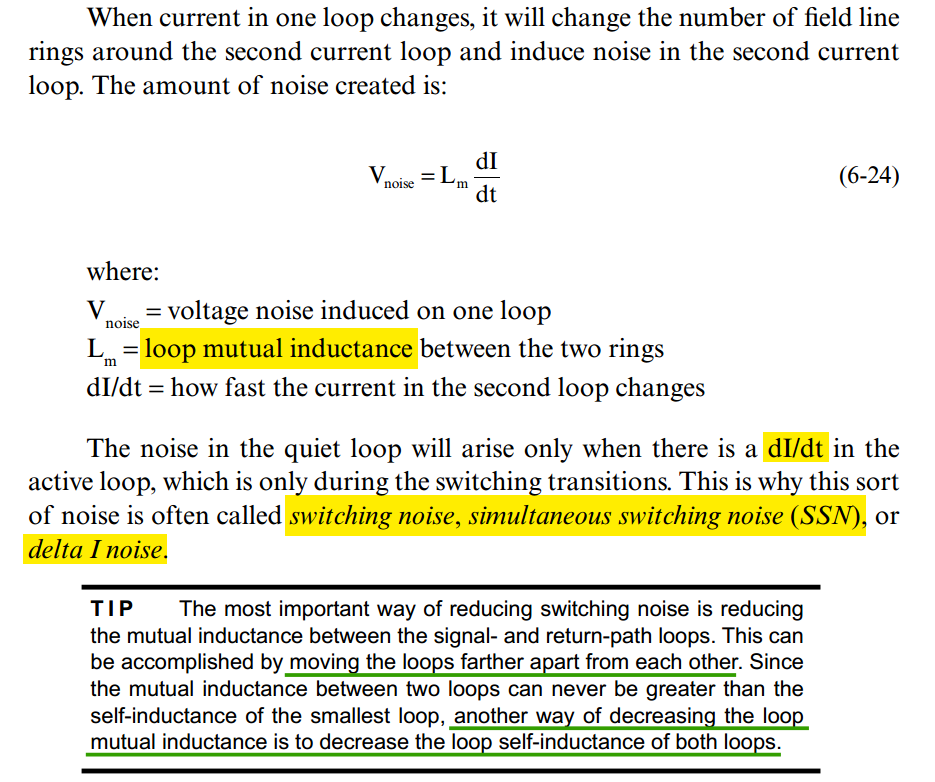
Loop Mutual Inductance

image-20260125211932743

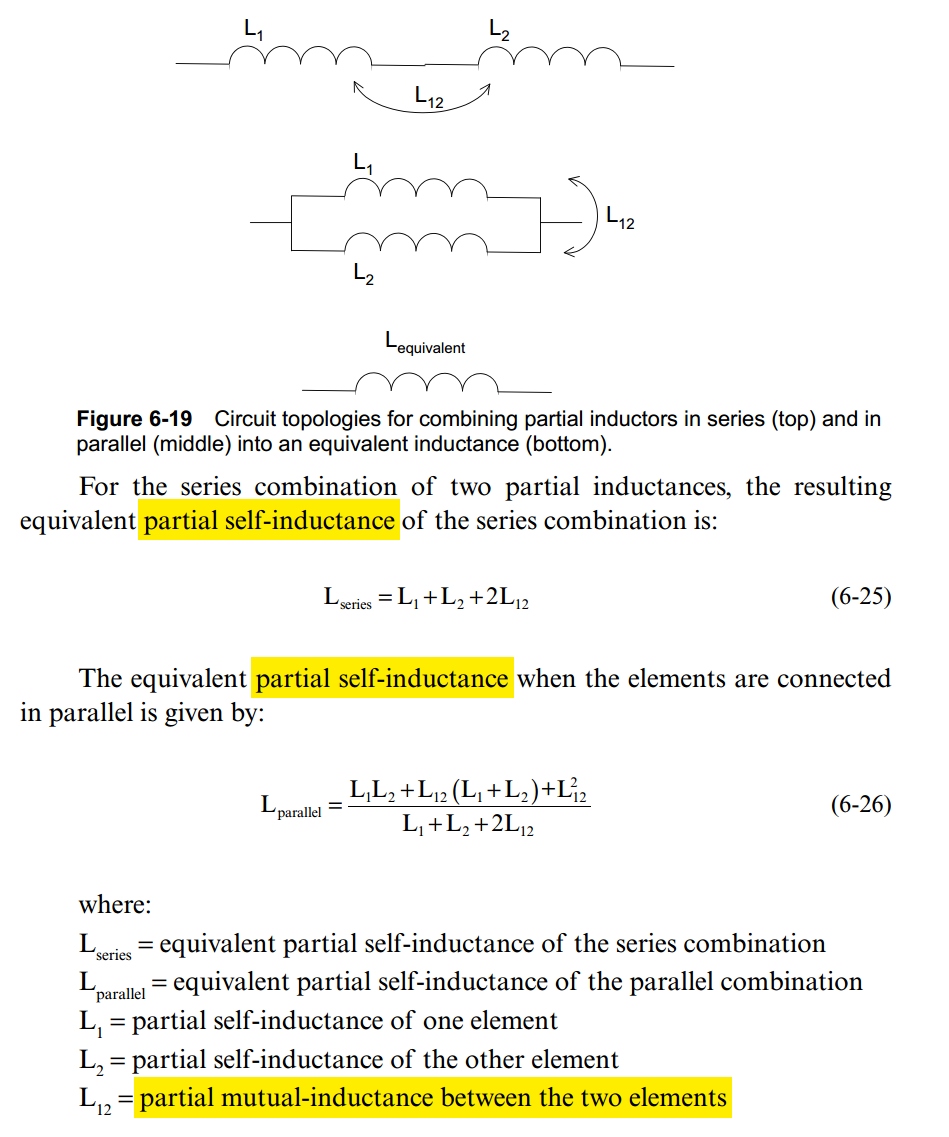
Equivalent Inductance of Multiple Inductors

image-20260125212328197 \[ L_\text{series} = L_1 + L_{12} + L_2 +L_{12} = L_1 + L_2 + 2L_{12} \]

\[ L_\text{parallel} = (L_1 + L_{12})\parallel (L_2 + L_{12}) = \frac{L_1L_2 +L_{12}(L_1+L_2)+L_{12}^2}{L_1+L_2+2L_{12}} \]

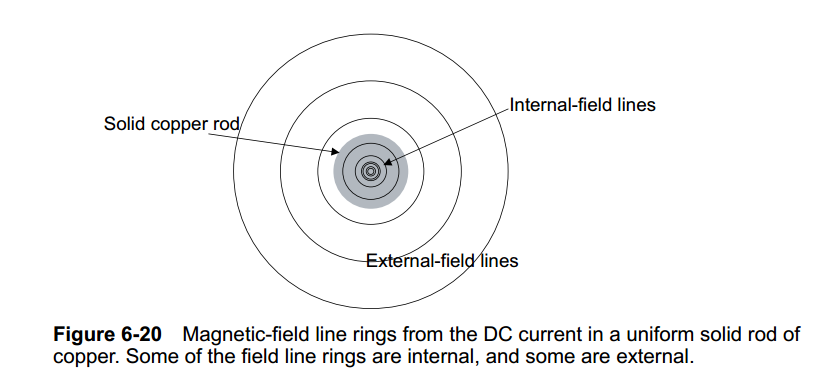
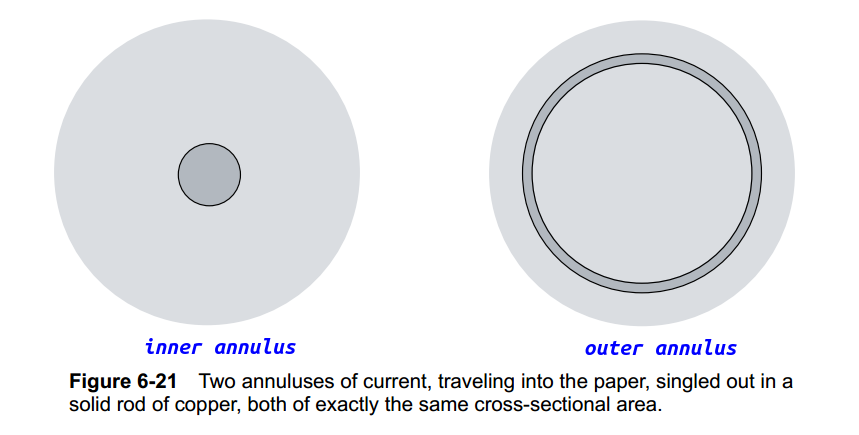
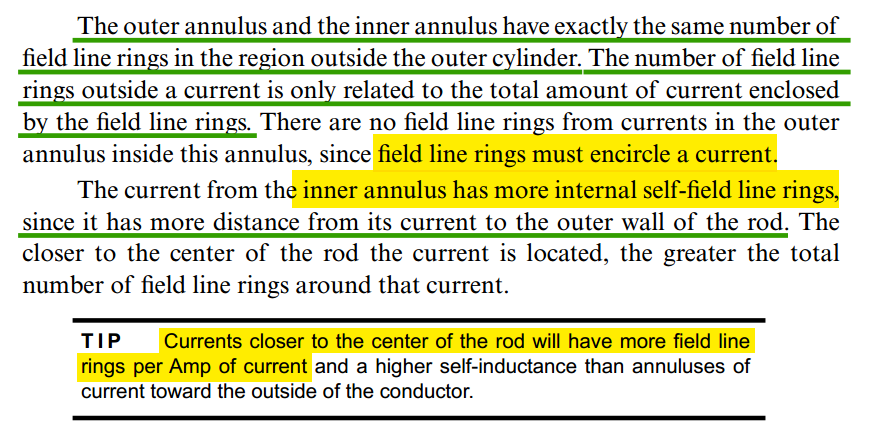
internal self-inductance

image-20260226234546294

self-inductance magnetic-field line
internal self-inductance inside the conductor
external self-inductance outside the conductor

image-20260226235112730

image-20260226235308288


image-20260226233648052

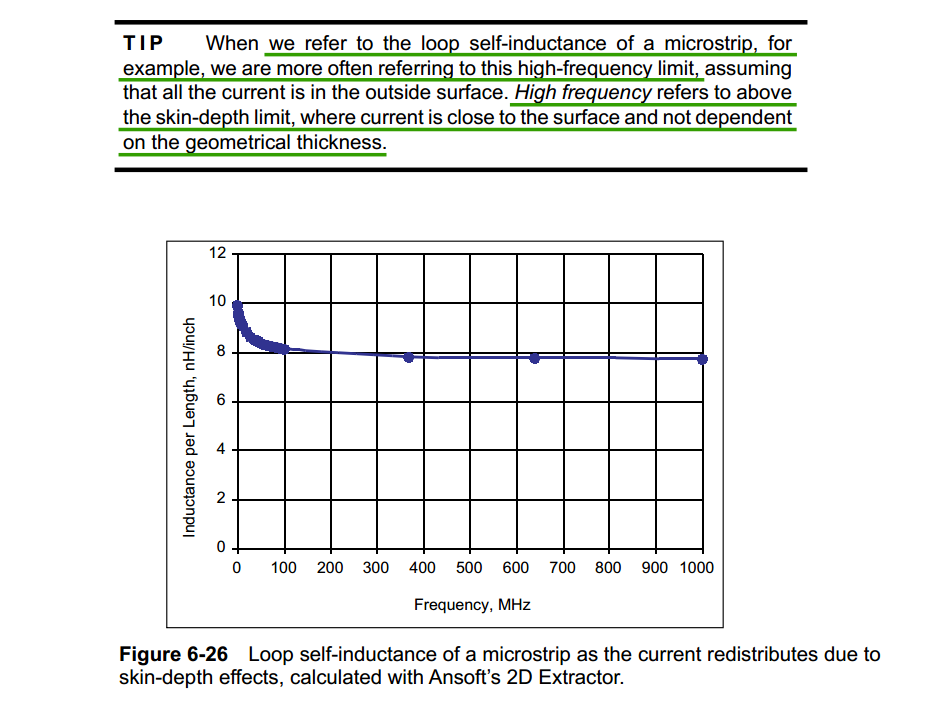
Frequency self-inductance
low frequency \(L_\text{internal} + L_\text{external}\)
high frequency \(L_\text{external}\)

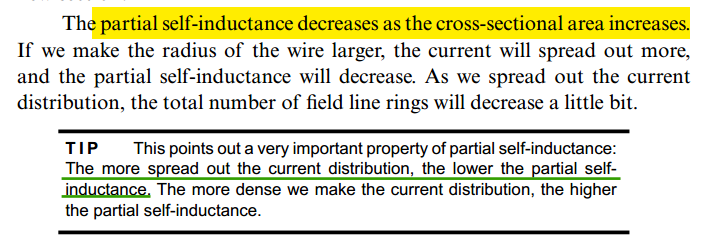
cross-sectional area

image-20260227002304758

at low frequency

Partial Inductance

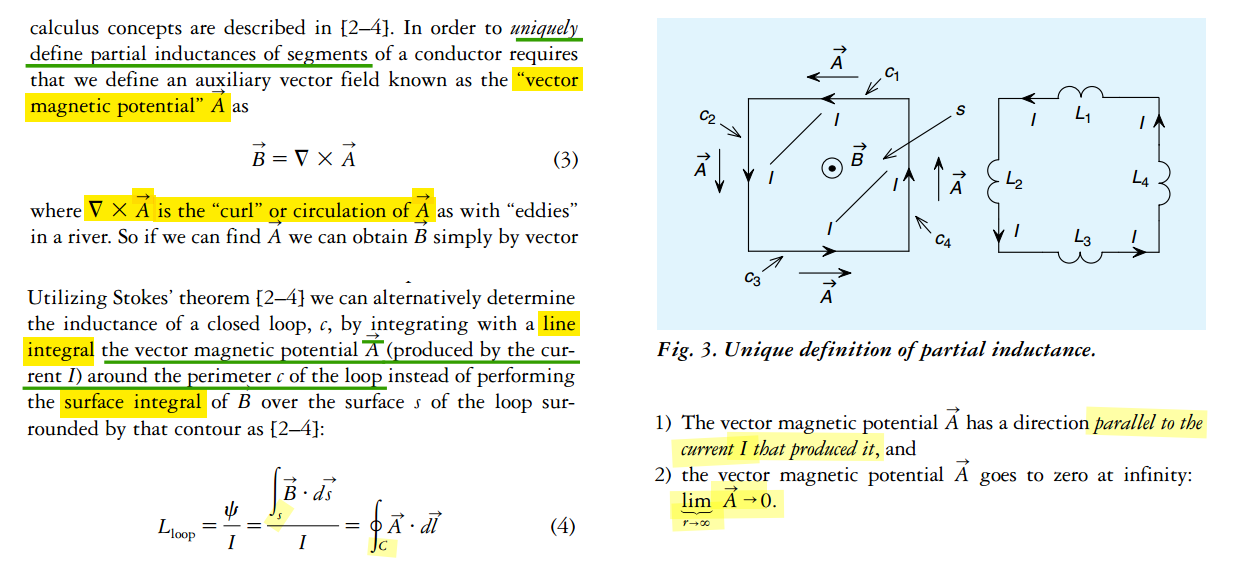
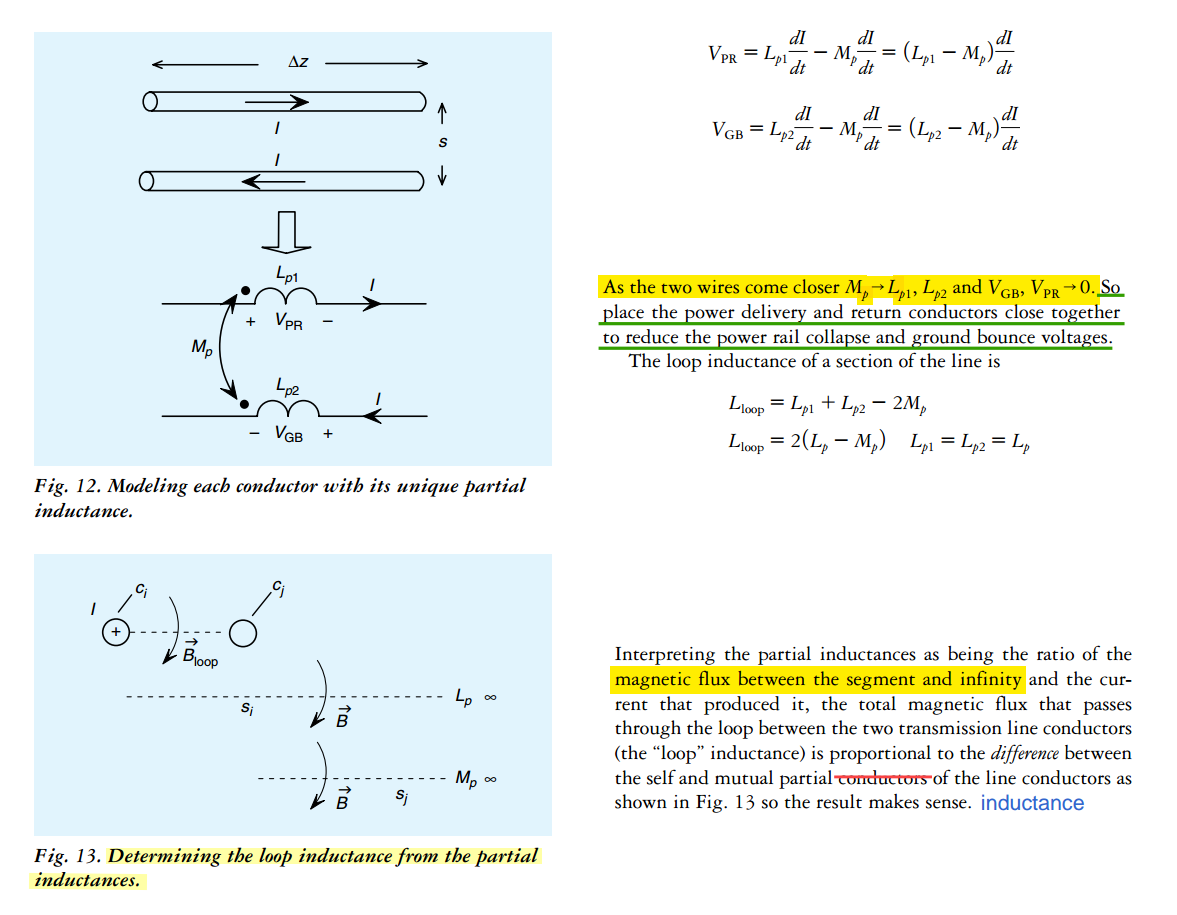
Loop Inductance is the sum of partial self-inductance and partial-mutual inductance

image-20250708230643776

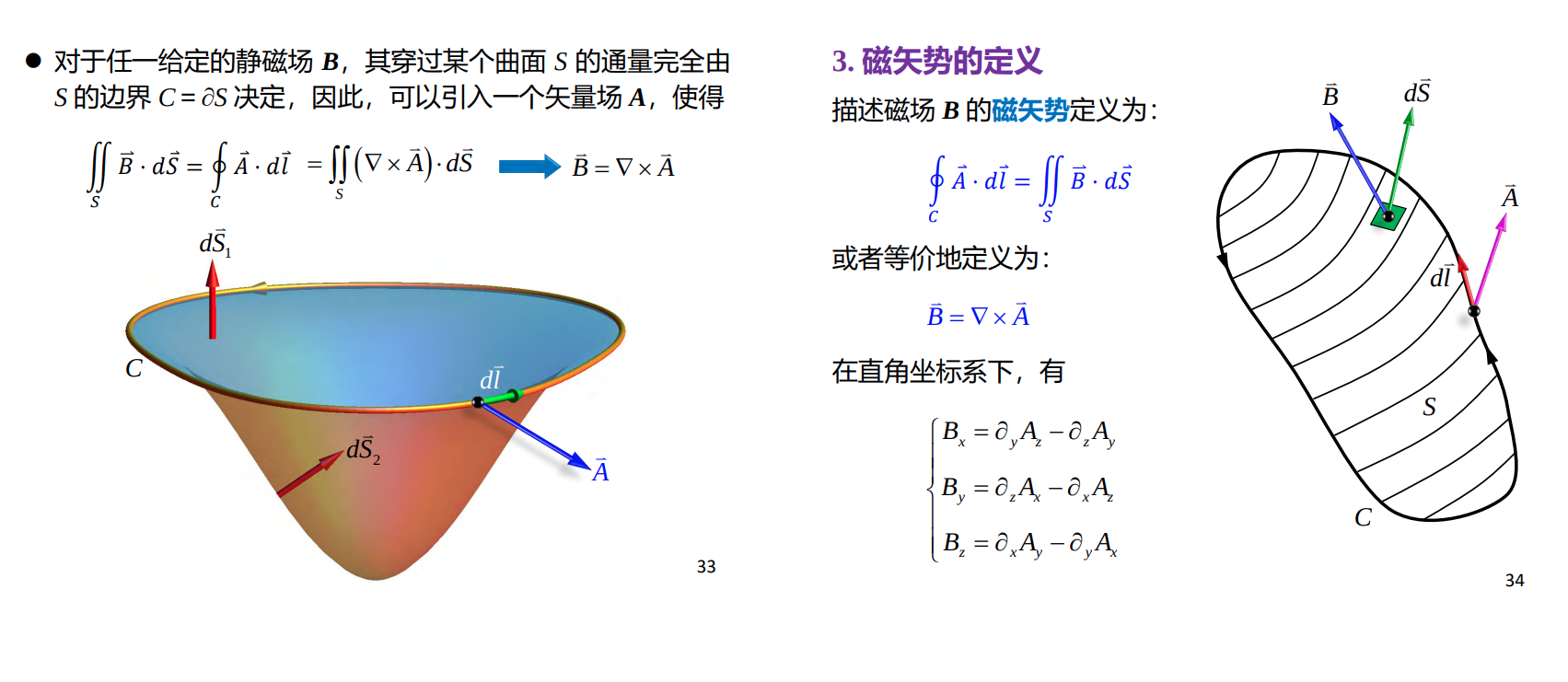
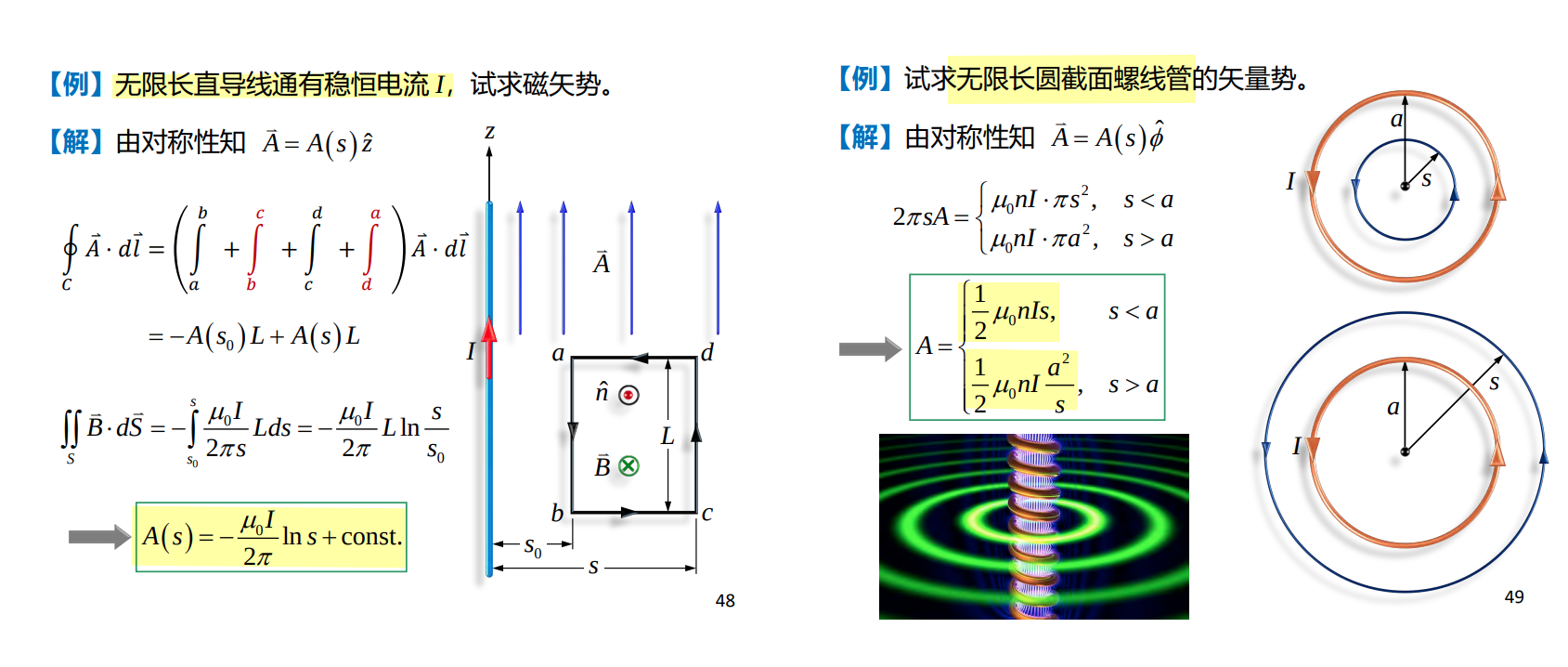
Magnetic Vector Potential (磁矢势)

Youjin Deng. 5-3 静磁场的基本规律 [http://staff.ustc.edu.cn/~yjdeng/EM2022/pdf/5-2(2022).pdf]

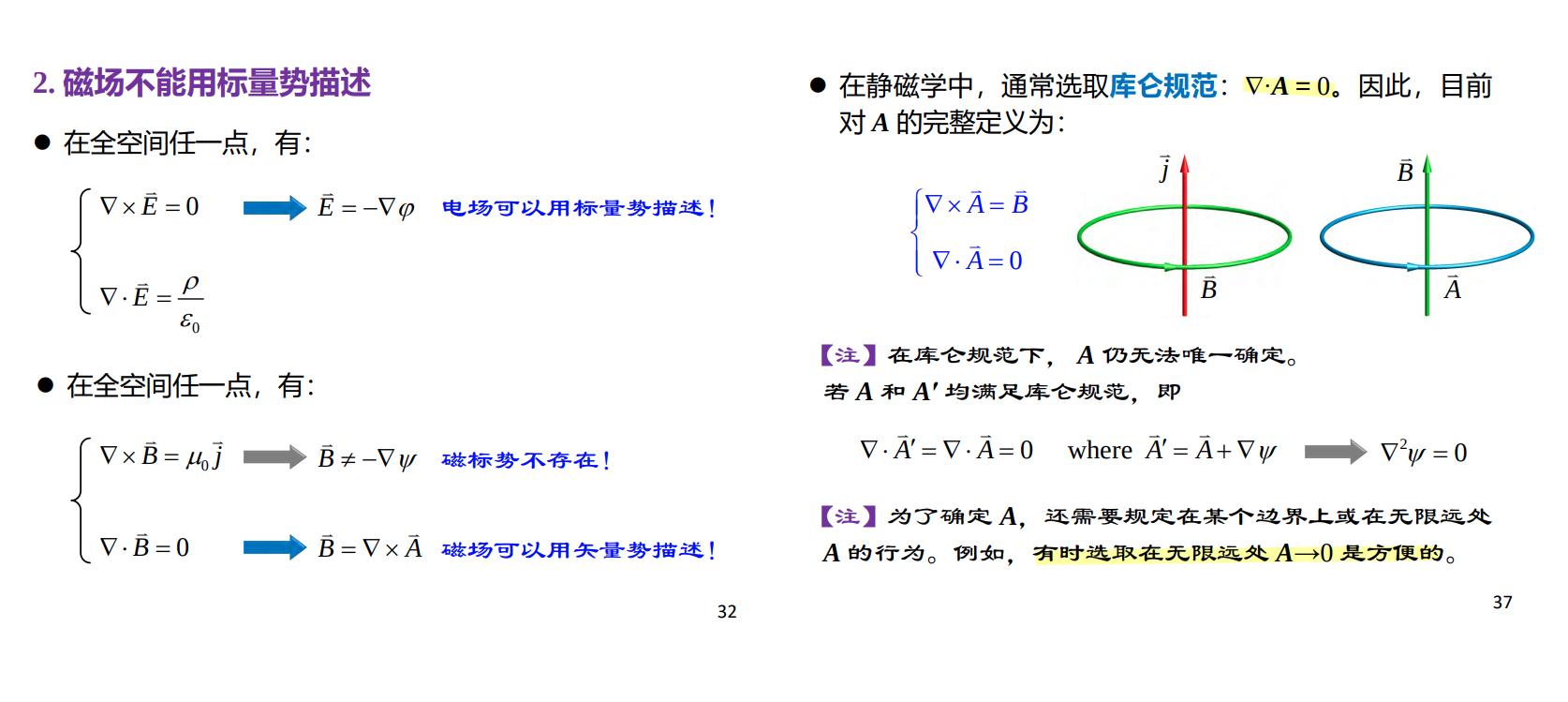
磁场不能用标量势描述

image-20250709195107708

image-20250709195217587

image-20250709200229266


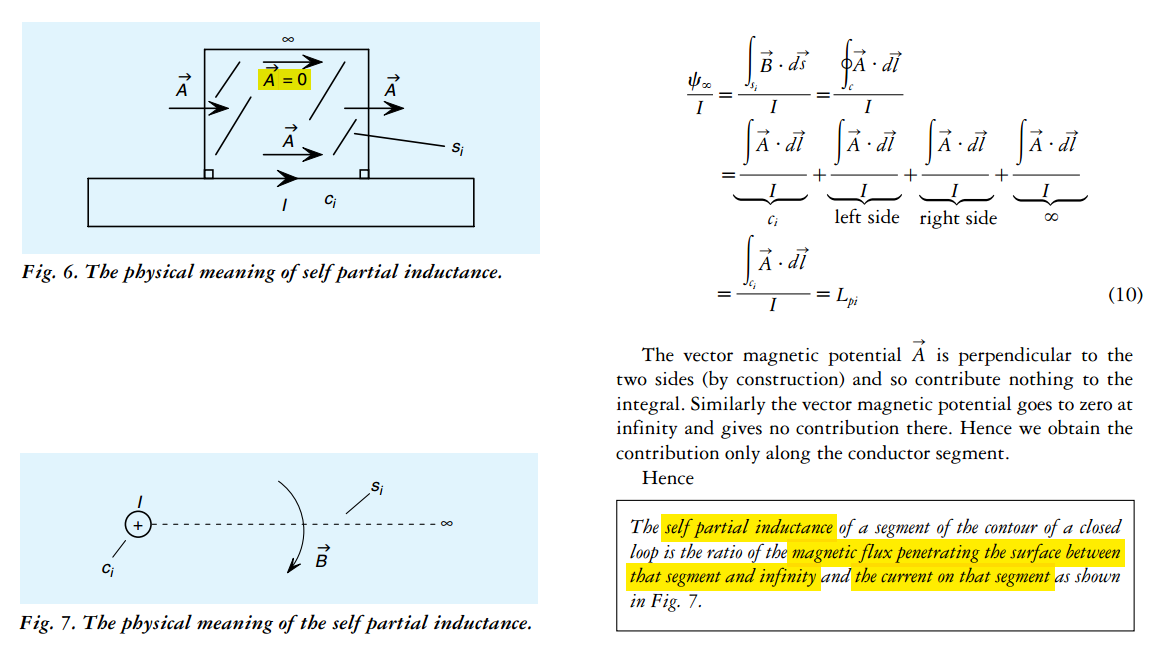
image-20250708231822291

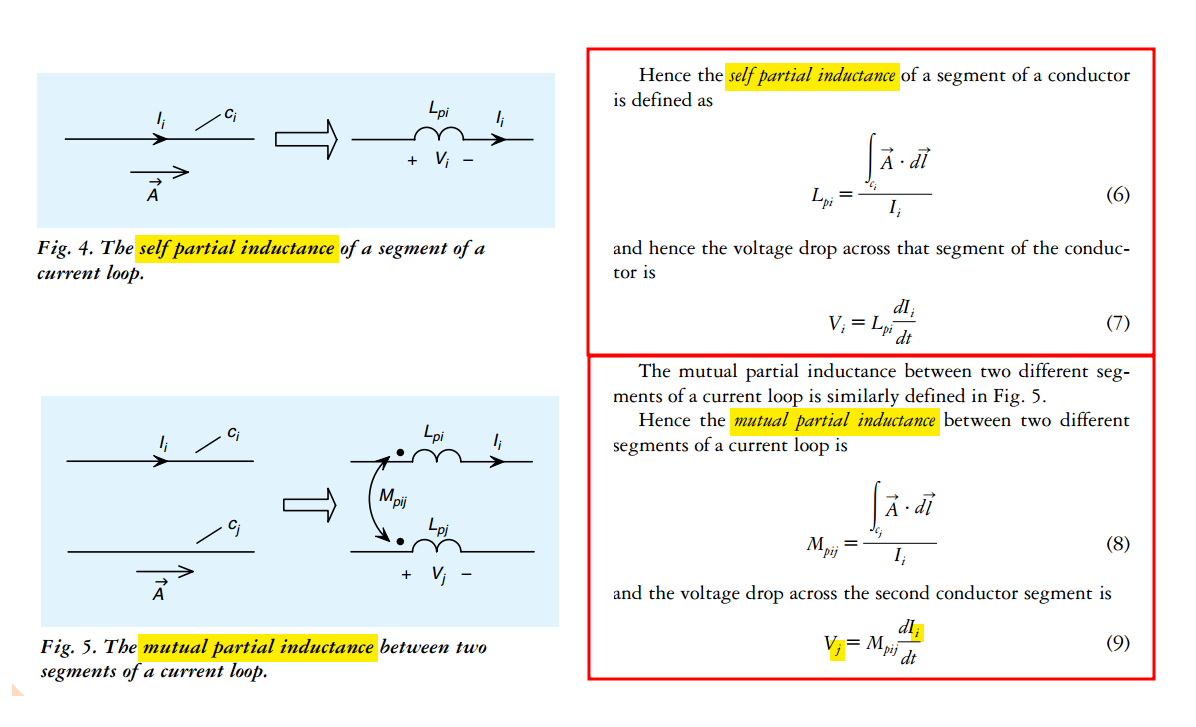
self partial inductance

image-20250708233924675

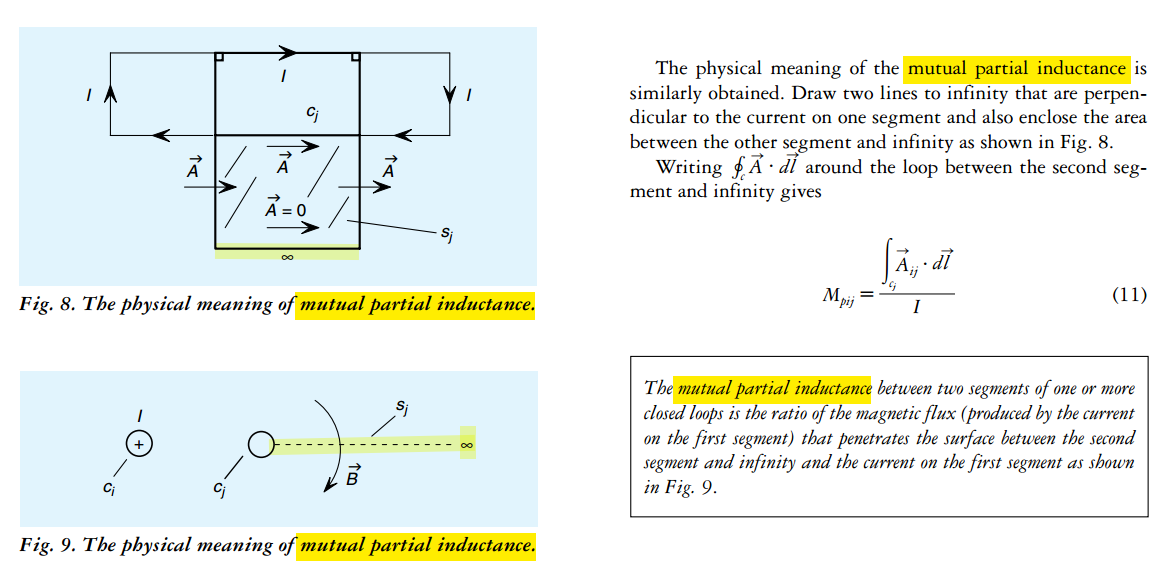
mutual partial inductance

image-20250708234512418

Ex. two-wire

image-20250709001127400


[https://www.oldfriend.url.tw/Q3D/ansys_ch_Partial_Loop_Inductance.html]

image-20250602120913866

img


Chapter 4.5. High Frequency Passive Devices [https://www.cambridge.org/il/files/7713/6698/2369/HFIC_chapter_4_passives.pdf]

image-20260418113018549

reference

Bogatin, E. (2018). Signal and power integrity, simplified. Prentice Hall. [pdf]

Paul, Clayton R. Inductance: Loop and Partial. Hoboken, N.J. : [Piscataway, N.J.]: Wiley ; IEEE, 2010. [pdf]

Spartaco Caniggia. Signal Integrity and Radiated Emission of High‐Speed Digital Systems. Wiley 2008


ISSCC2002. Special Topic Evening Discussion Sessions SE1: Inductance: Implications and Solutions for High-Speed Digital Circuits [vSE1_Blaauw], [vSE1_Gauthier], [vSE1_Morton, [vSE1_Restle]]

Y. Massoud and Y. Ismail, "Gasping the impact of on-chip inductance," in IEEE Circuits and Devices Magazine, vol. 17, no. 4, pp. 14-21, July 2001 [https://sci-hub.se/10.1109/101.950046]

Clayton R. Paul, Partial Inductance [https://ewh.ieee.org/soc/emcs/acstrial/newsletters/summer10/PP_PartialInductance.pdf]

Cheung-Wei Lam. Common Misconceptions about Inductance & Current Return Path [https://ewh.ieee.org/r6/scv/emc/archive/022010Lam.pdf]

Randy Wolff. Signal Loop Inductance in [Pin] and [Package Model] [https://ibis.org/summits/feb10/wolff.pdf]

ANSYS Q3D Getting Started LE05. Module 5: Q3D Inductance Matrix Reduction [https://innovationspace.ansys.com/courses/wp-content/uploads/sites/5/2021/07/Q3D_GS_2020R1_EN_LE05_Ind_Matrix.pdf]

image-20260321140400409

magnetic field (magnetic flux density, \(B\)), is the tesla (symbol: \(T\)), defined as one weber per square meter (\(Wb/m^2\))

Magnetic flux \(\Phi_B\) measures the total magnetic field (\(B\)) passing through a given surface area (\(A\)), representing the number of field lines penetrating that area. Measured in Webers (\(Wb\)),

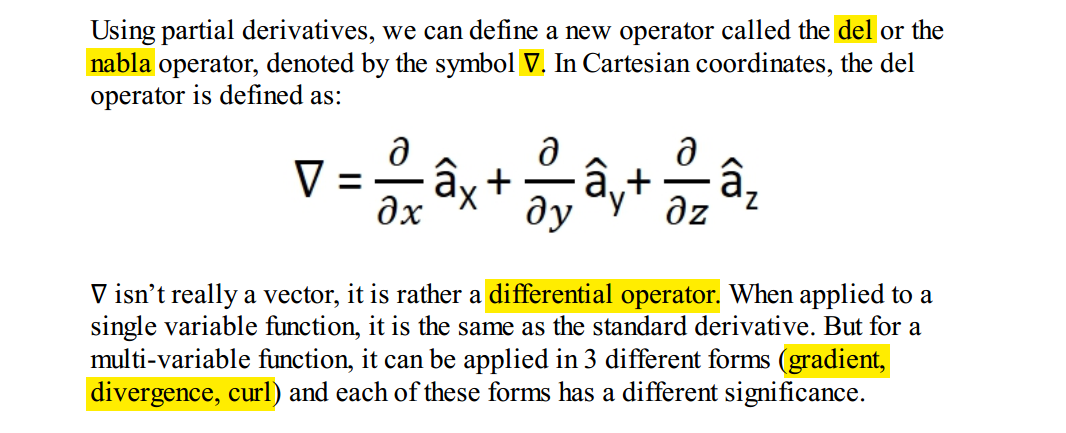
Vector Calculus

3Blue1Brown, Divergence and curl: The language of Maxwell's equations, fluid flow, and more [https://youtu.be/rB83DpBJQsE]

image-20260316220628358

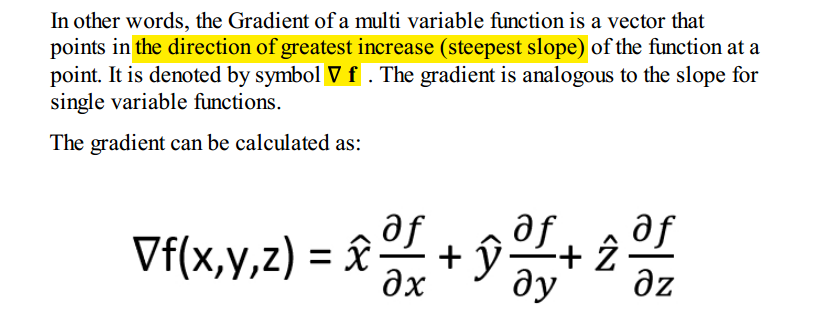
Gradient

image-20260316221131492

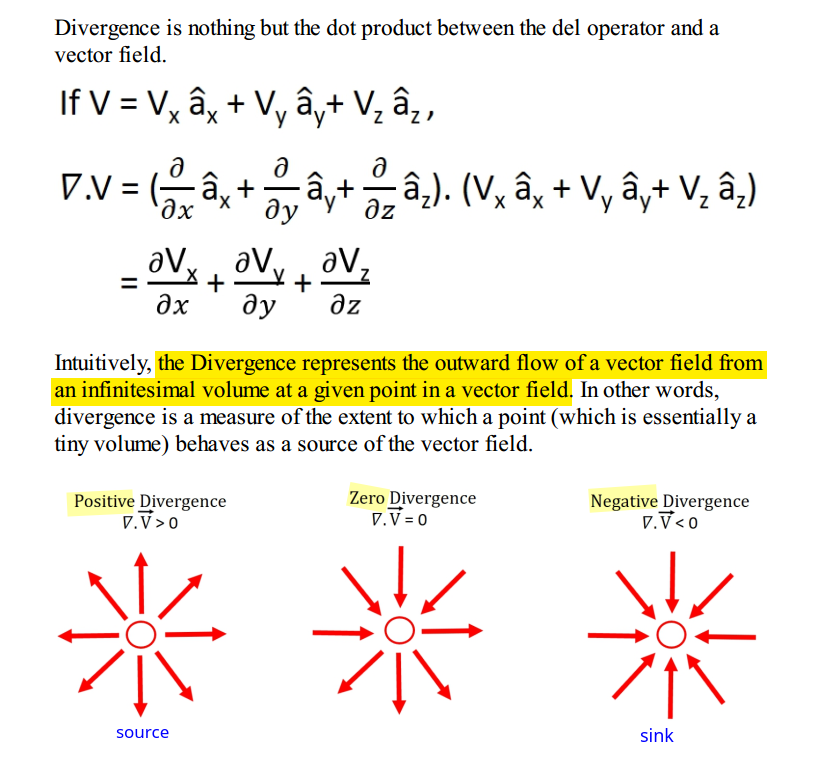
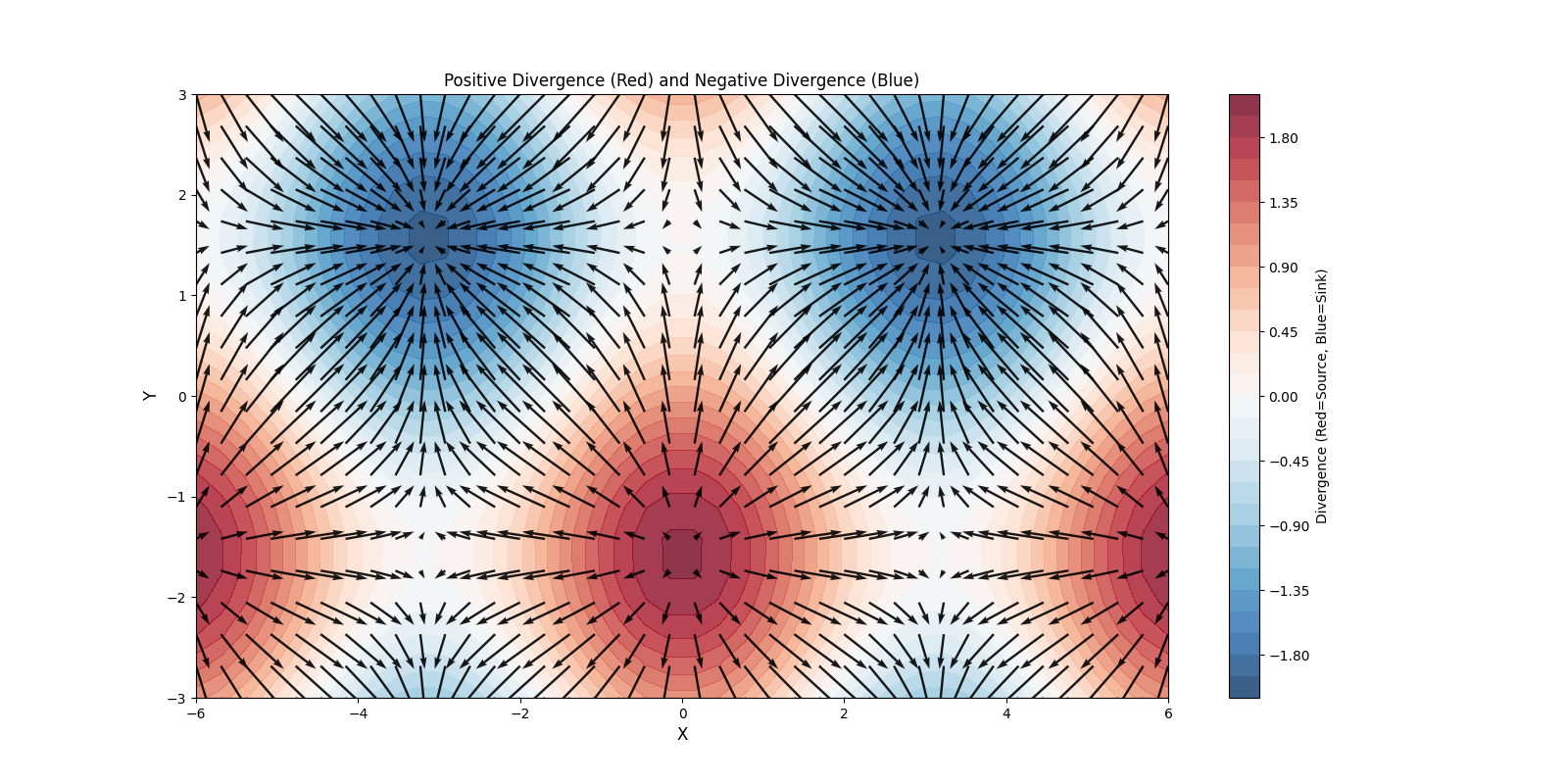
Divergence

image-20260316221847450

image-20260316222656776

1
2
3
4
5
6
7
8
9
10
11
12
13
14
15
16
17
18
19
20
21
22
23
24
25
26
27
28
29
30
# https://share.google/aimode/l3lNa2MRAOG8hkpOc

import numpy as np
import matplotlib.pyplot as plt

# 1. Define the grid
x = np.linspace(-6, 6, 40)
y = np.linspace(-3, 3, 20)
X, Y = np.meshgrid(x, y)

# 2. Define the vector field components F = [U, V]
U = np.sin(X)
V = np.cos(Y)

# 3. Calculate Divergence (Scalar Field)
div_F = np.cos(X) - np.sin(Y)

# 4. Create the plot
fig, ax = plt.subplots(figsize=(16, 8))

# Use 'RdBu_r' (reversed) so Positive = Red, Negative = Blue
contour = ax.contourf(X, Y, div_F, cmap='RdBu_r', levels=30, alpha=0.8)
fig.colorbar(contour, label='Divergence (Red=Source, Blue=Sink)')

# Plot Vector Field
ax.quiver(X, Y, U, V, color='black', alpha=0.9, scale=20)
ax.set_xlabel('X', fontsize=12)
ax.set_ylabel('Y', fontsize=12)
ax.set_title(r'Positive Divergence (Red) and Negative Divergence (Blue)')
plt.show()

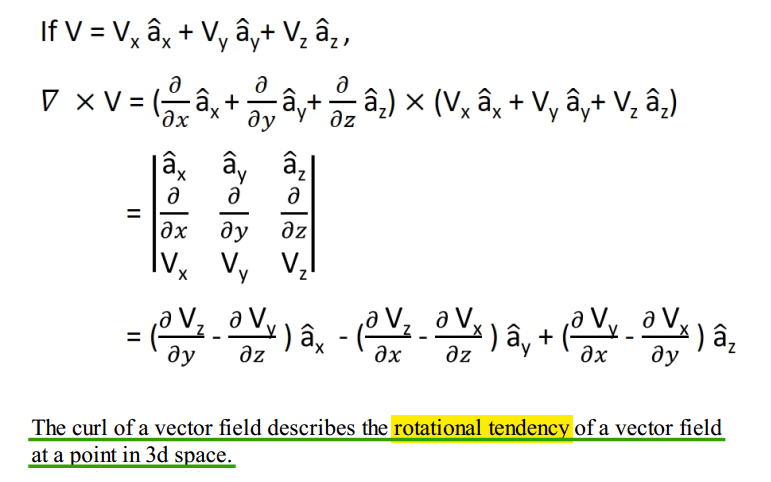
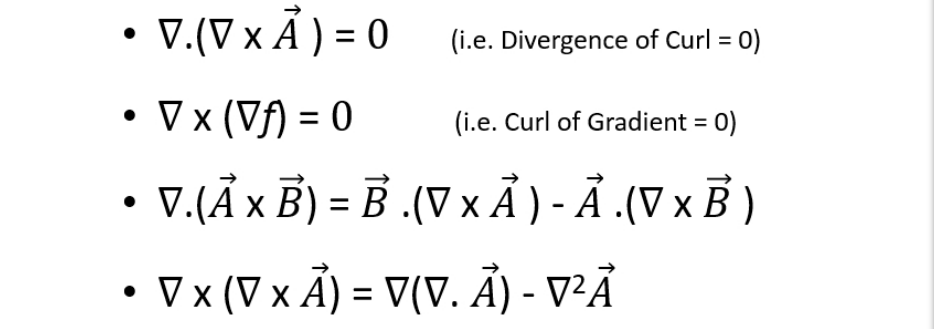
Curl

image-20260316222022456

image-20260316223410884

1
2
3
4
5
6
7
8
9
10
11
12
13
14
15
16
17
18
19
20
21
22
23
24
25
26
27
28
29
30
31
32
33
34
35
36
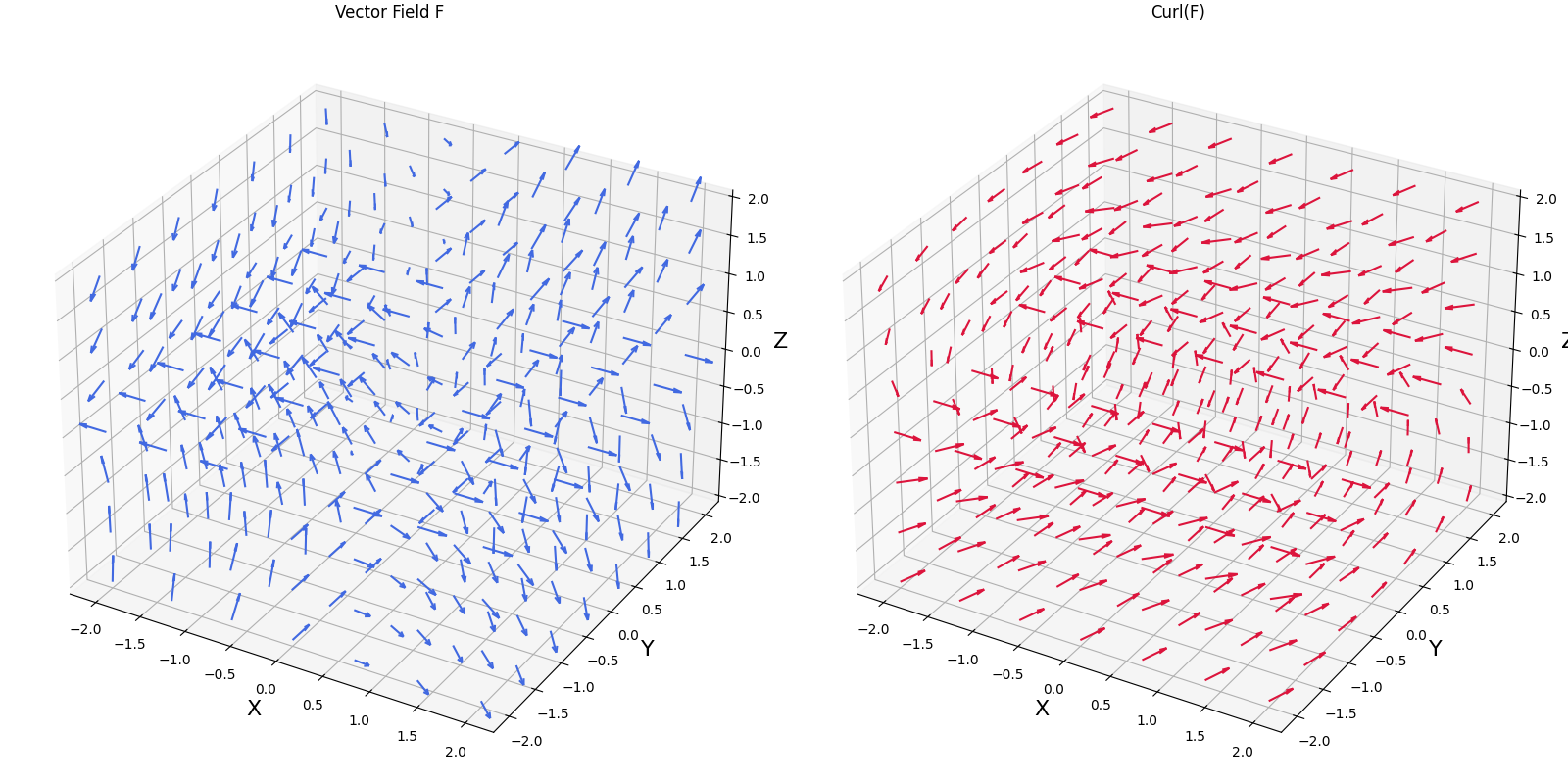
# https://share.google/aimode/hWb3cR4vCBoWV4Moi

import numpy as np
import matplotlib.pyplot as plt

# 1. Setup the coordinate grid
x = np.linspace(-2, 2, 7)
y = np.linspace(-2, 2, 7)
z = np.linspace(-2, 2, 7)
X, Y, Z = np.meshgrid(x, y, z)

# 2. Define the Vector Field F and Curl(F)
U, V, W = X, Y*Z, 3*X*Z
C_U, C_V, C_W = -Y, -3*Z, np.zeros_like(Z)

# 3. Create the plot
fig = plt.figure(figsize=(16, 8), constrained_layout=True)

# Subplot 1: Vector Field
ax1 = fig.add_subplot(121, projection='3d')
ax1.quiver(X, Y, Z, U, V, W, length=0.3, normalize=True, color='royalblue')
ax1.set_title('Vector Field F')
ax1.set_xlabel('X', fontsize=16) # Adding x-label
ax1.set_ylabel('Y', fontsize=16) # Adding y-label
ax1.set_zlabel('Z', fontsize=16) # Adding z-label

# Subplot 2: Curl
ax2 = fig.add_subplot(122, projection='3d')
ax2.quiver(X, Y, Z, C_U, C_V, C_W, length=0.3, normalize=True, color='crimson')
ax2.set_title('Curl(F)')
ax2.set_xlabel('X', fontsize=16) # Adding x-label
ax2.set_ylabel('Y', fontsize=16) # Adding y-label
ax2.set_zlabel('Z', fontsize=16) # Adding z-label

# plt.tight_layout(pad=3.0, rect=[0, 0, 1, 0.95])
plt.show()

image-20260321090249927


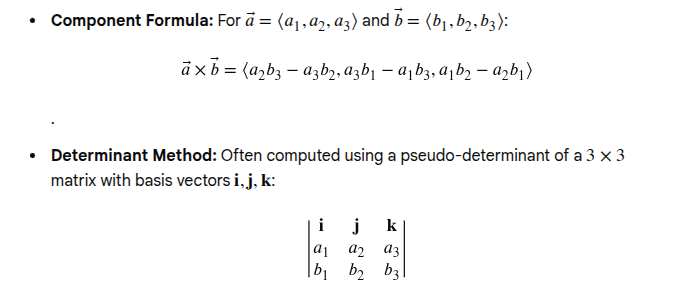
cross product [Google AI Mode]

image-20260321090724009

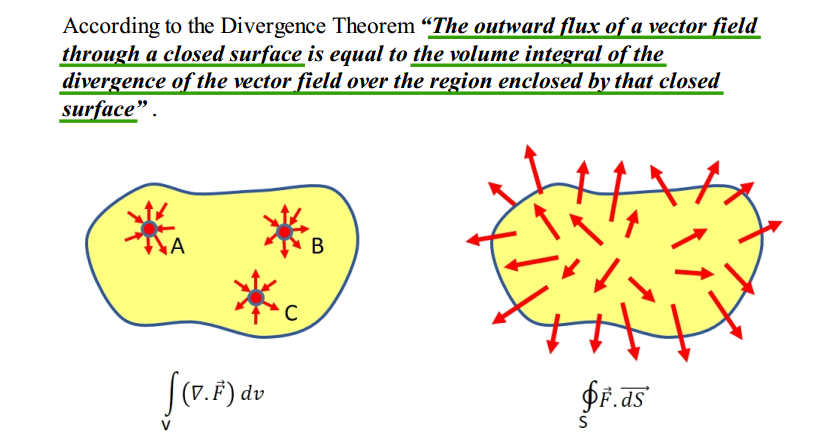
Divergence Theorem (Gauss's Theorem)

surface integral -> volume integral \[ \oint_S \vec{F} \cdot d\vec{S} = \int_V (\nabla \cdot \vec{F}) dv \]

image-20260321093235348

Divergence theorem is only applicable to closed surfaces

image-20260321093550711

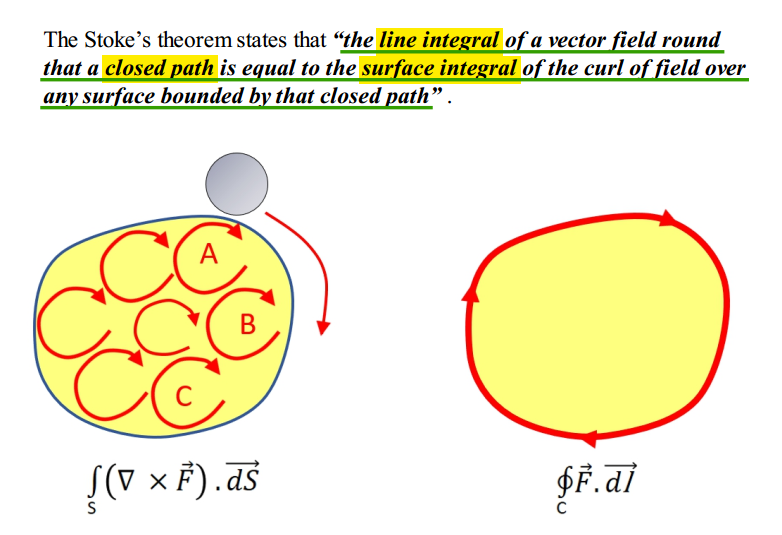
Stoke's theorem

line integral -> surface inegral \[ \oint_{c} \vec{F} \cdot \vec{dl} = \int_{s} (\nabla \times \vec{F}) \cdot \vec{dS} \]

image-20260321095927152

Magnetostatics

Magnetostatics is the study of magnetic fields in systems where the currents are steady (not changing with time)

image-20260321111009923

Magnetic Field Intensity(\(H\)) & Magnetic Flux Density(\(B\))

TODO 📅

Magnetic Potential

Magnetic Scalar Potential

TODO 📅

Magnetic Vector Potential

TODO 📅

Electrodynamics

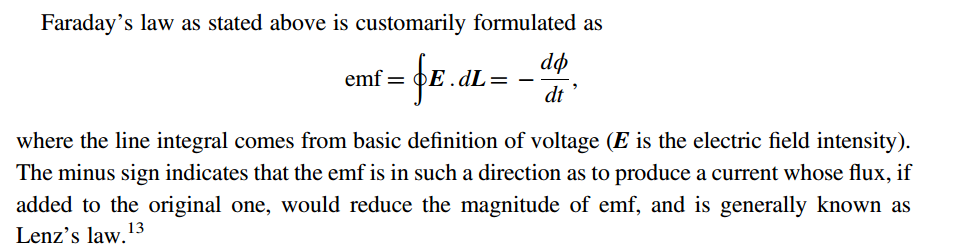
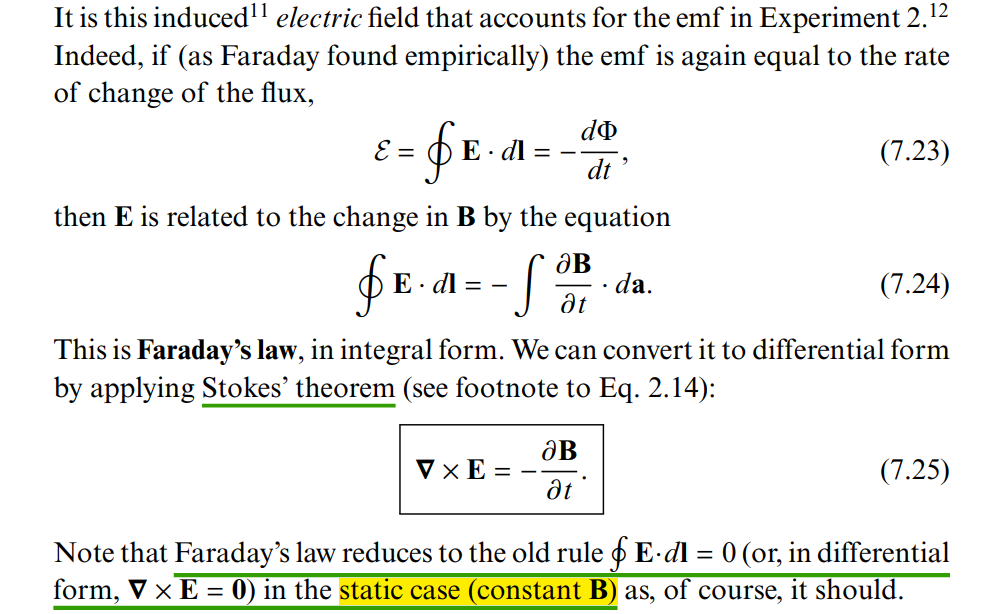
Faraday's Law

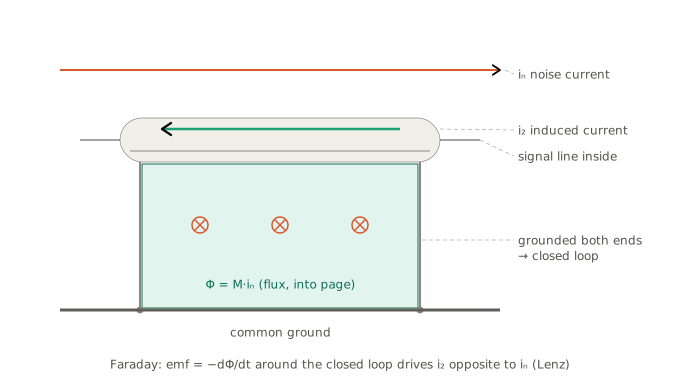
image-20260321145115368

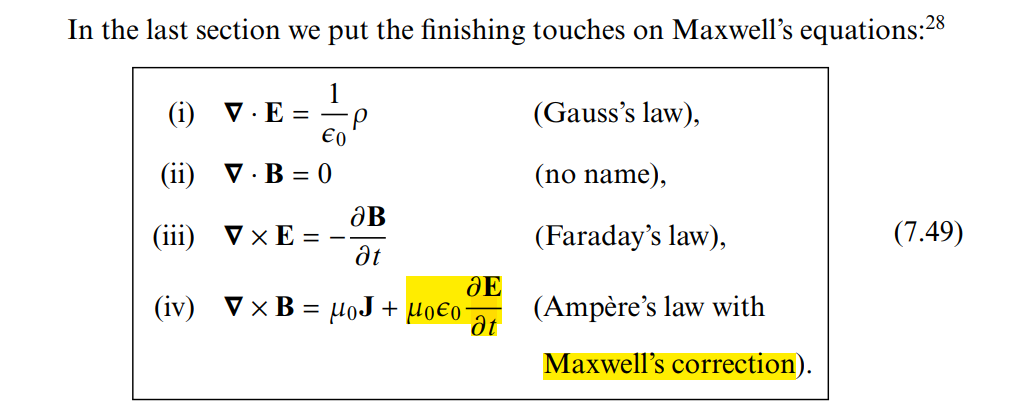
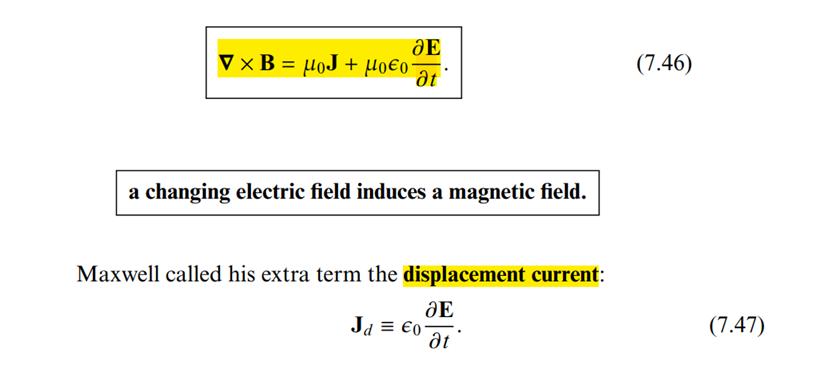
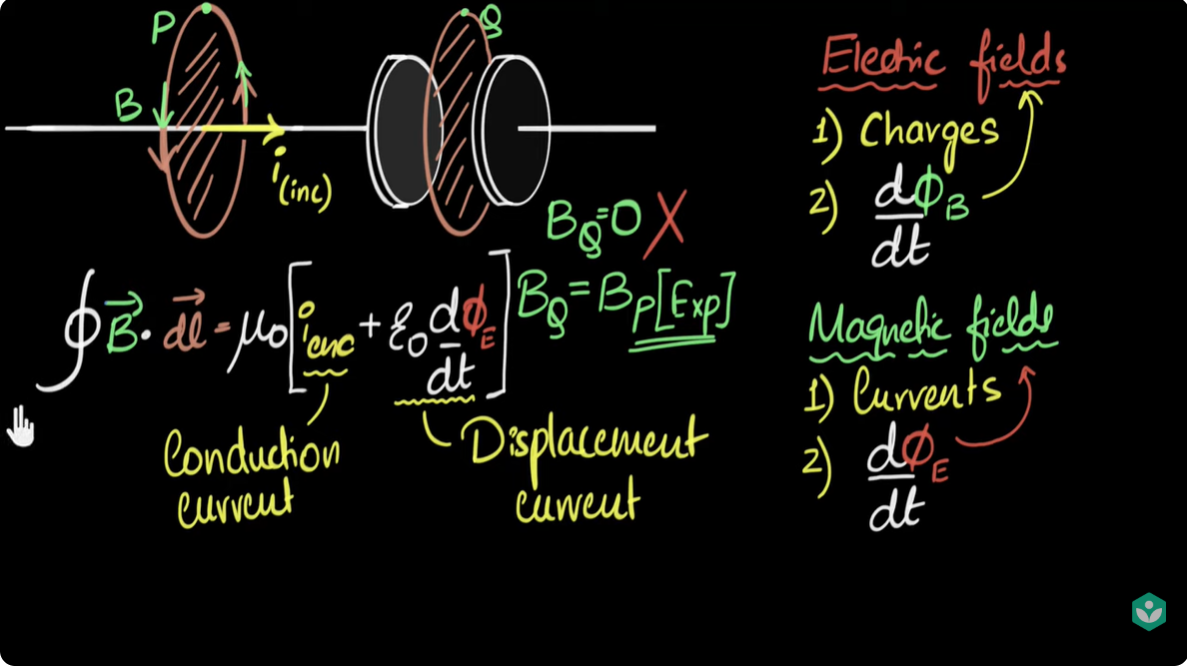
Ampère's law with Maxwell's correction

displacement current

image-20260321164106898


[https://youtu.be/t-W6_fn_1bI]

image-20260321164637168


[Google AI Mode]

image-20260321165601743

image-20260321165747417

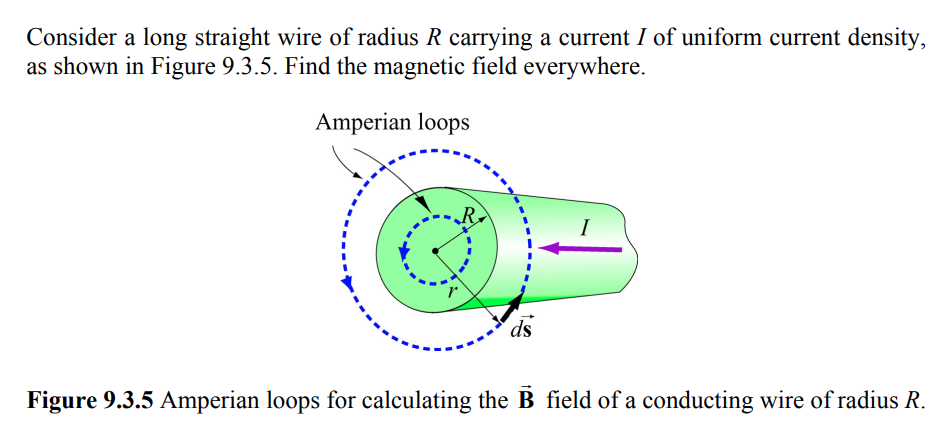
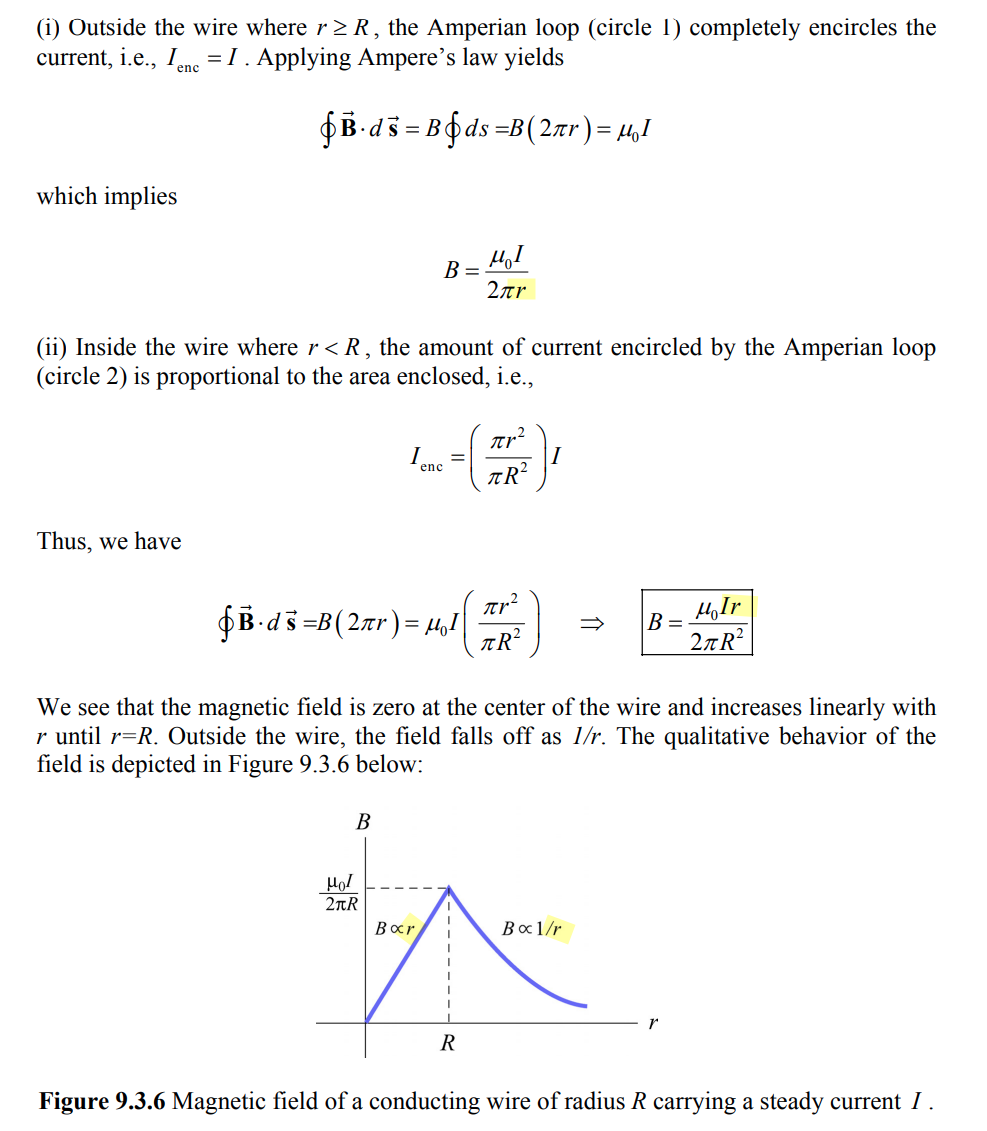
Field Inside and Outside a Current-Carrying Wire

Sources of Magnetic Fields [https://web.mit.edu/8.02t/www/802TEAL3D/visualizations/coursenotes/modules/guide09.pdf]

image-20260227012332063

image-20260227012324670

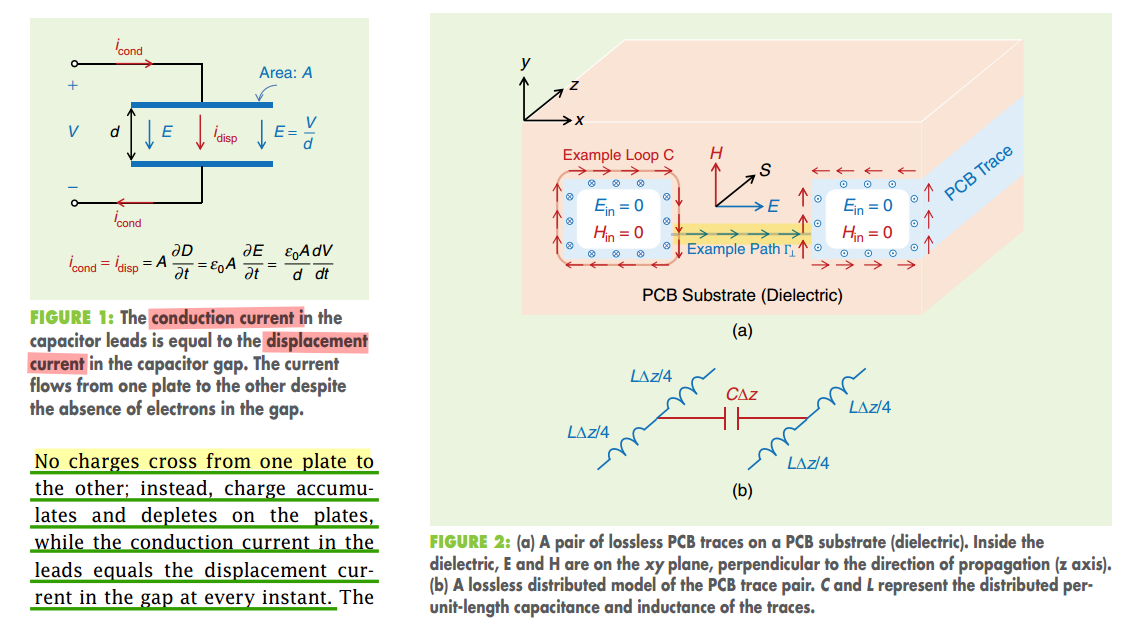
Displacement Current

A. Sheikholeslami, "Current Without Electrons [Circuit Intuitions]," in IEEE Solid-State Circuits Magazine, vol. 17, no. 4, pp. 8-10, Fall 2025

—, "Current Without Electric Field [Circuit Intuitions]," in IEEE Solid-State Circuits Magazine, vol. 18, no. 1, pp. 8-12, winter 2026

image-20260117100449115

energy and information are carried by electric and magnetic fields (\(E\) and \(H\)) rather than by electron drift

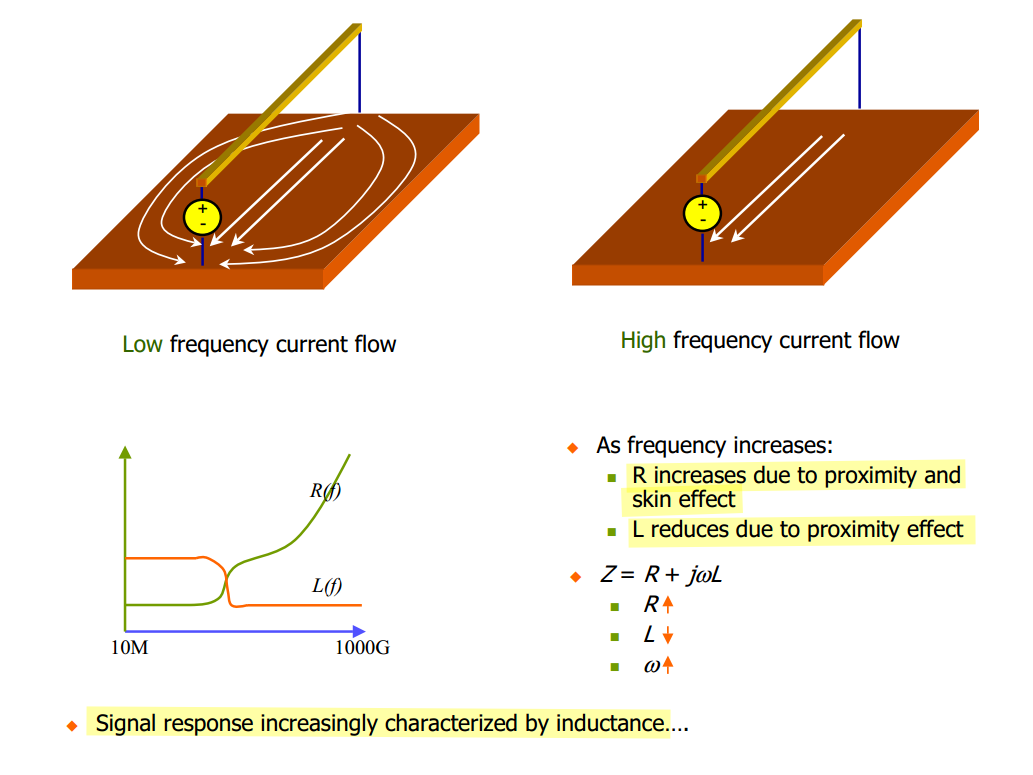
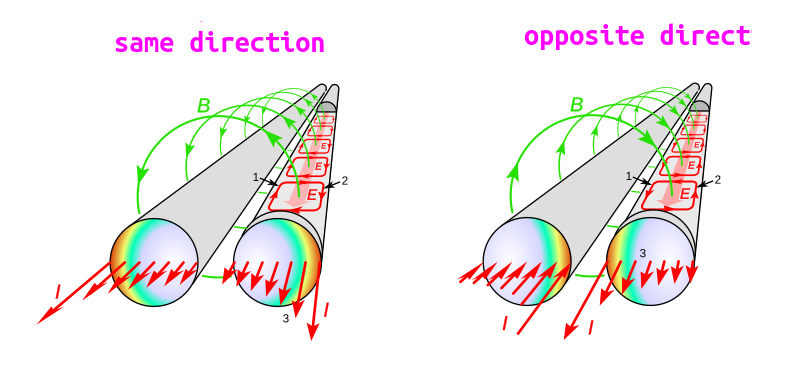
proximity effect & skin effect

  • Skin effect concentrates current near the surface of a single conductor, while proximity effect concentrates current in specific regions of multiple conductors due to their interaction
  • Skin effect is caused by the conductor's own magnetic field, while proximity effect is caused by the magnetic field of a nearby conductor

proximity effect is a redistribution of electric current occurring in nearby parallel electrical conductors carrying alternating current (AC), caused by magnetic effects (eddy currents)

image-20250705163405433


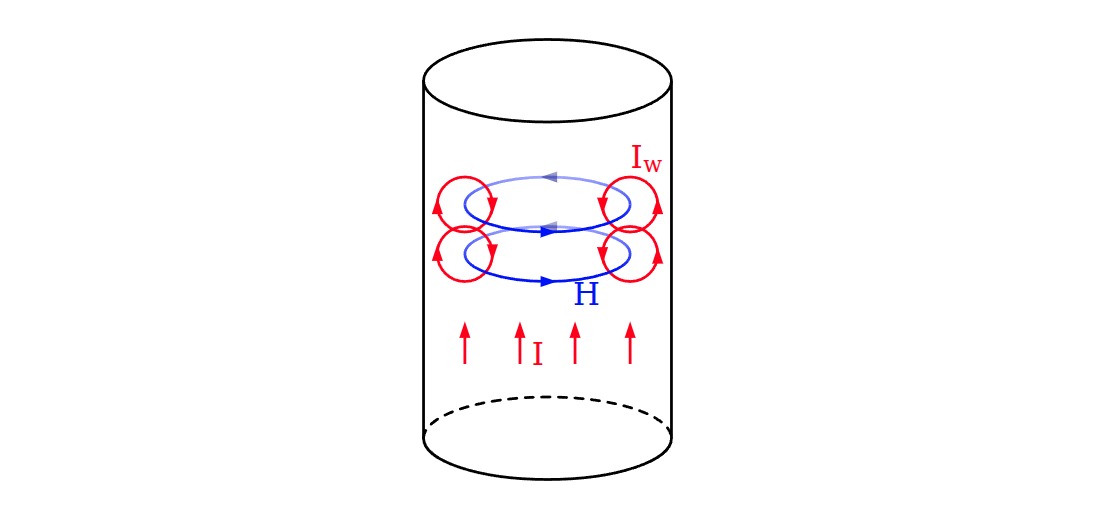
skin effect is the tendency of AC current flow near the surface (or "skin") of a conductor, rather than throughout its cross-section, due to the magnetic field generated by the current itself

image-20250705165353751

Cause of skin effect

A main current \(I\) flowing through a conductor induces a magnetic field \(H\). If the current increases, as in this figure, the resulting increase in \(H\) induces separate, circulating eddy currents \(I_W\) which partially cancel the current flow in the center and reinforce it near the skin


Eddy current

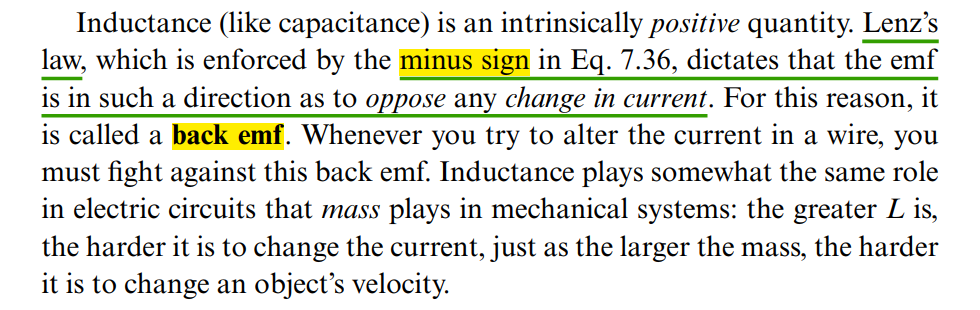
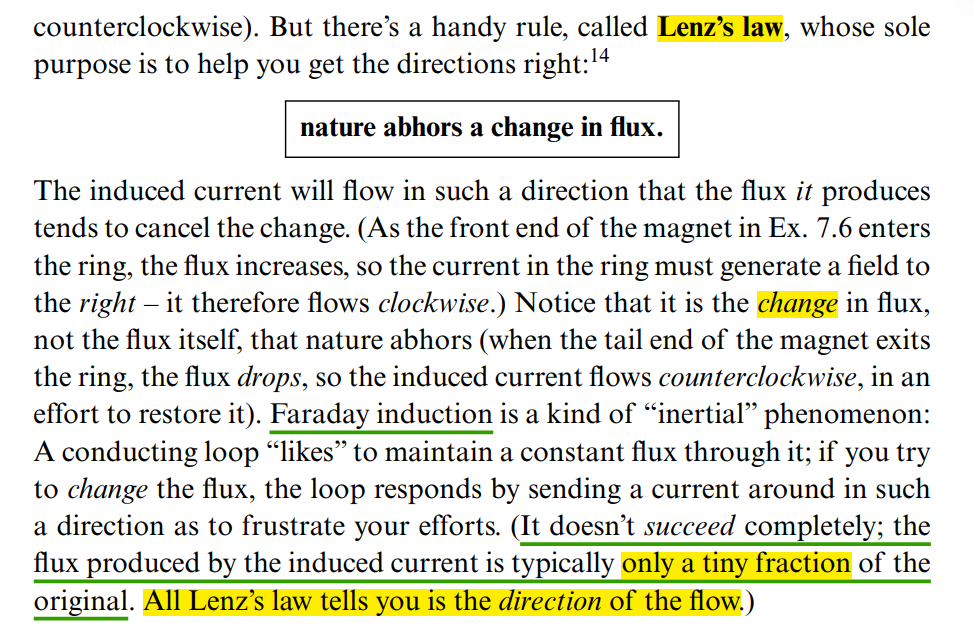
By Lenz's law, an eddy current creates a magnetic field that opposes the change in the magnetic field that created it, and thus eddy currents react back on the source of the magnetic field

Transformer

任何封闭电路中感应电动势大小,等于穿过这一电路磁通量的变化率。 \[ \epsilon = -\frac{d\Phi_B}{dt} \] 其中 \(\epsilon\)是电动势,单位为伏特

\(\Phi_B\)是通过电路的磁通量,单位为韦伯

电动势的方向(公式中的负号)由楞次定律决定

楞次定律: 由于磁通量的改变而产生的感应电流,其方向为抗拒磁通量改变的方向。

在回路中产生感应电动势的原因是由于通过回路平面的磁通量的变化,而不是磁通量本身,即使通过回路的磁通量很大,但只要它不随时间变化,回路中依然不会产生感应电动势。

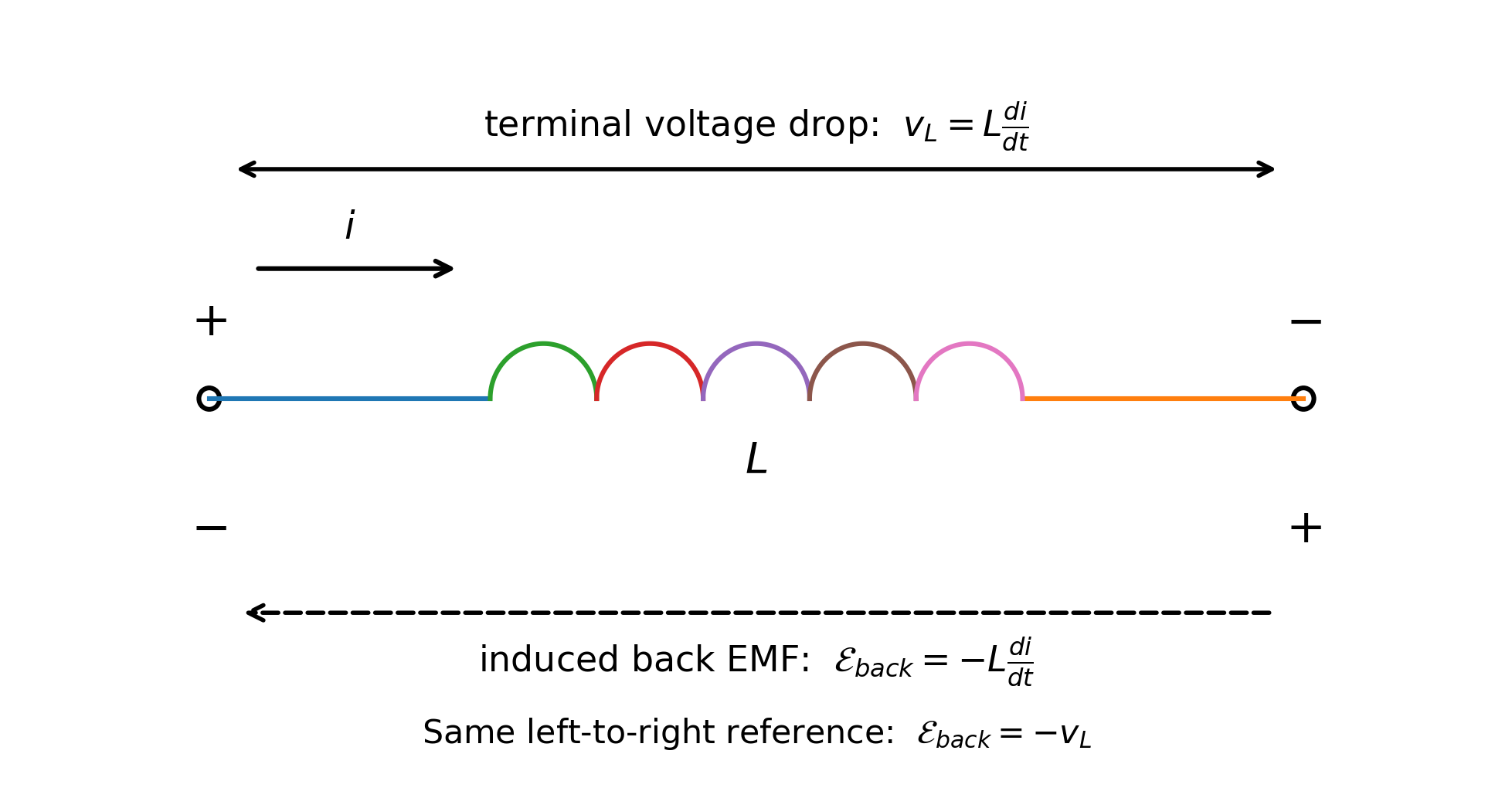
自感电动势

当电流\(I\)随时间变化时,在线圈中产生的自感电动势为 \[ \epsilon = -L\frac{dI}{dt} \]

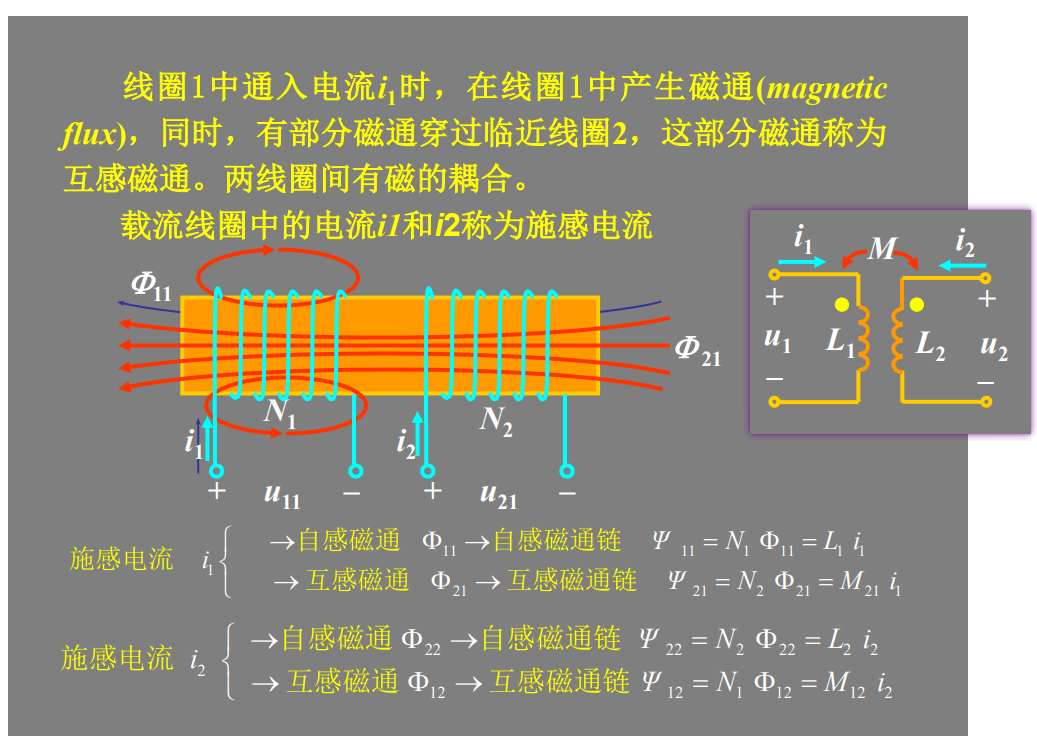
image-20240713131201618

image-20251022234419312

image-20240713145005306

image-20240713145212327


image-20240713140911612

magnetic flux

image-20240713135148710

magnetic linkage

image-20240713135236291

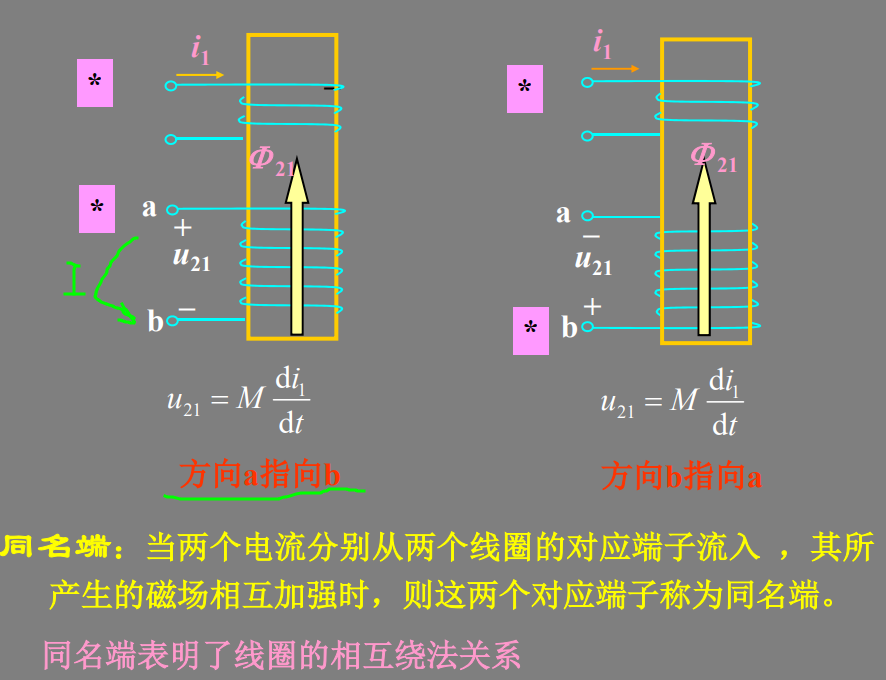
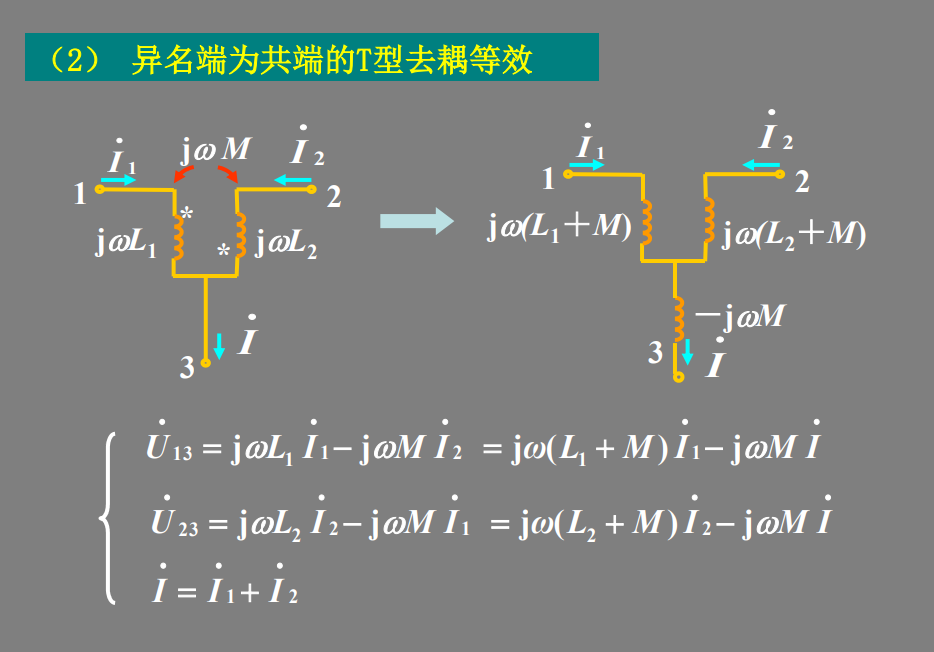
同名端:当两个电流分别从两个线圈的对应端子流入 ,其所 产生的磁场相互加强时,则这两个对应端子称为同名端。

image-20240713142238398

image-20240713142249362

image-20240713142506673

reference

Griffiths, David J. Introduction to Electrodynamics. Fifth edition. Cambridge University Press, 2024. [pdf]

David Smith, Electromagnetic Theory for Complete Idiot, 2021

邓友金. 电磁学 2022春 [http://staff.ustc.edu.cn/~yjdeng/EM2022/EM2022.html]

谢处方、饶克谨、杨显清等.《电磁场与电磁波》(第五版),高等教育出. 版社,2019.

Scott Hughes. Spring 2005 8.022: Electricity & Magnetism [https://web.mit.edu/sahughes/www/8.022/]

image-20260419092746250

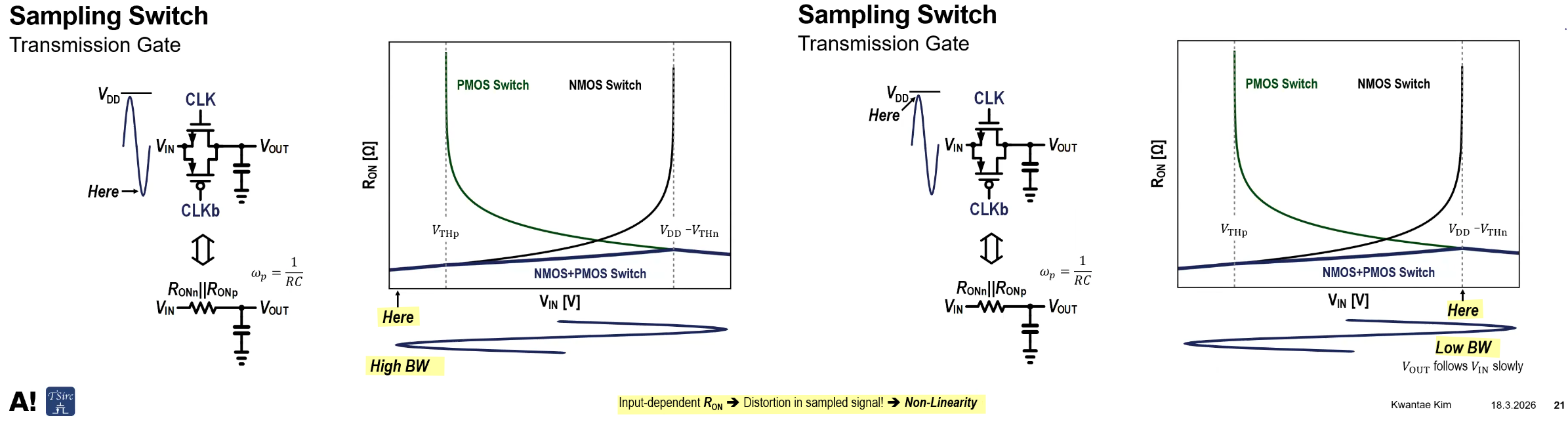
Switched-Capacitor Filter

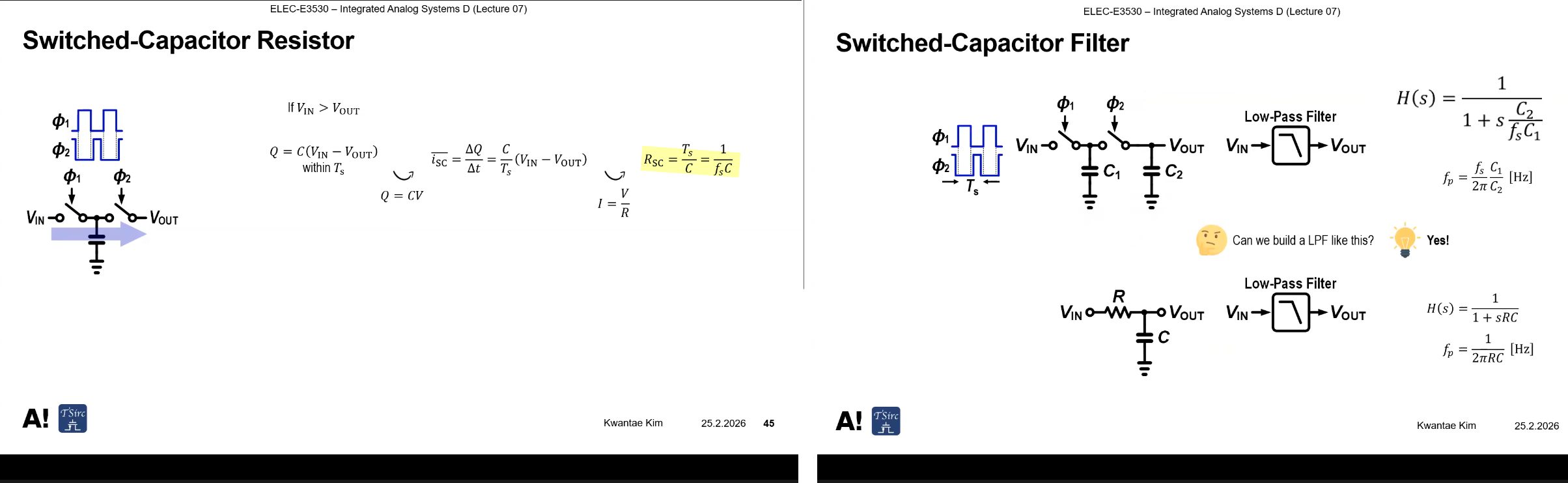
switched-Capacitor Resistor

image-20260319234852885

[https://youtu.be/G0lzrMll-Ho], [https://youtu.be/eMOFMjuKiJQ]

image-20260319235853713

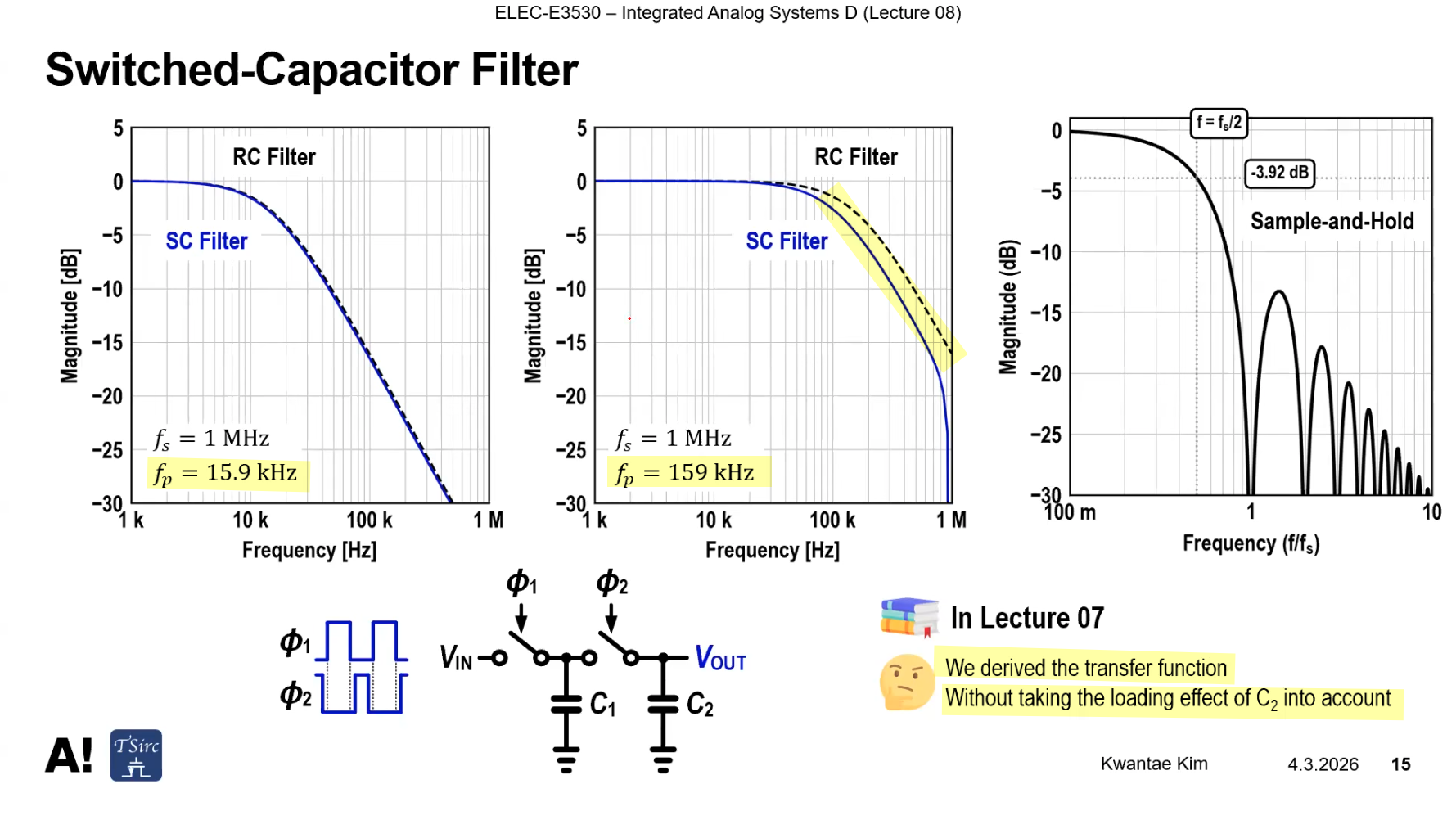
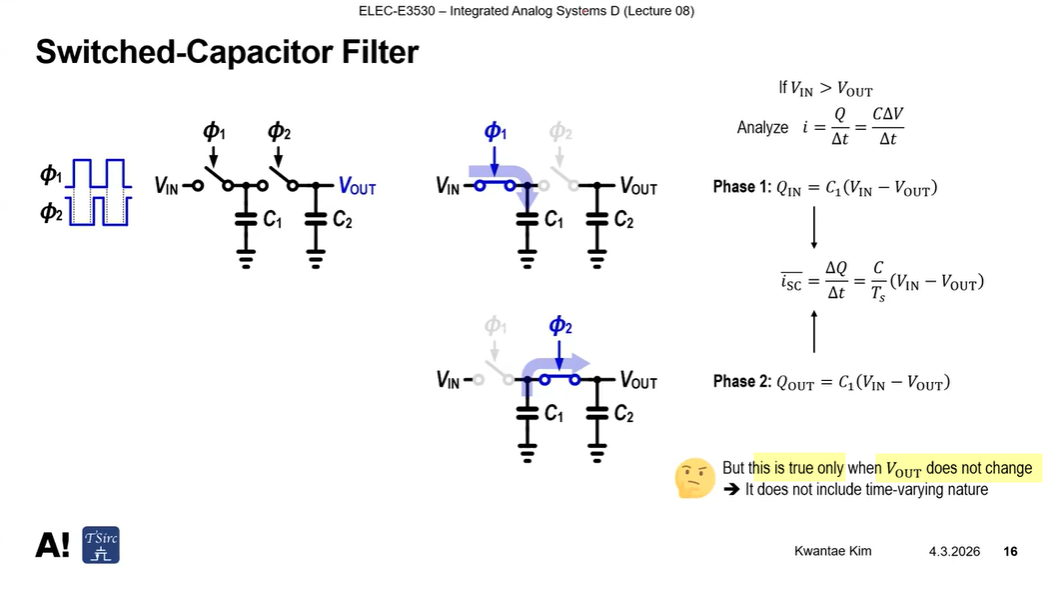
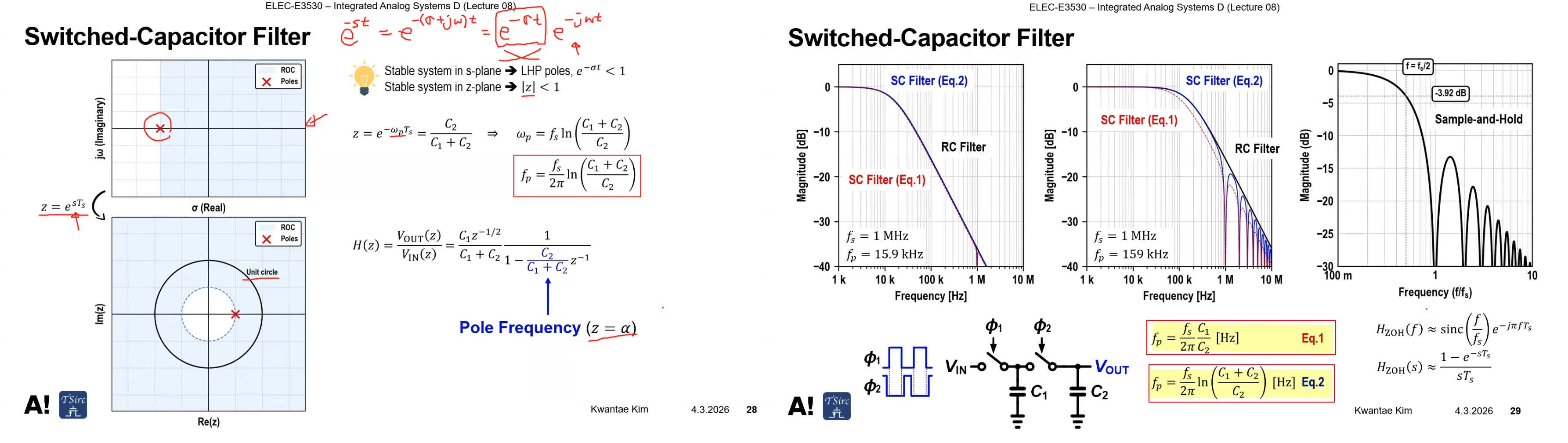
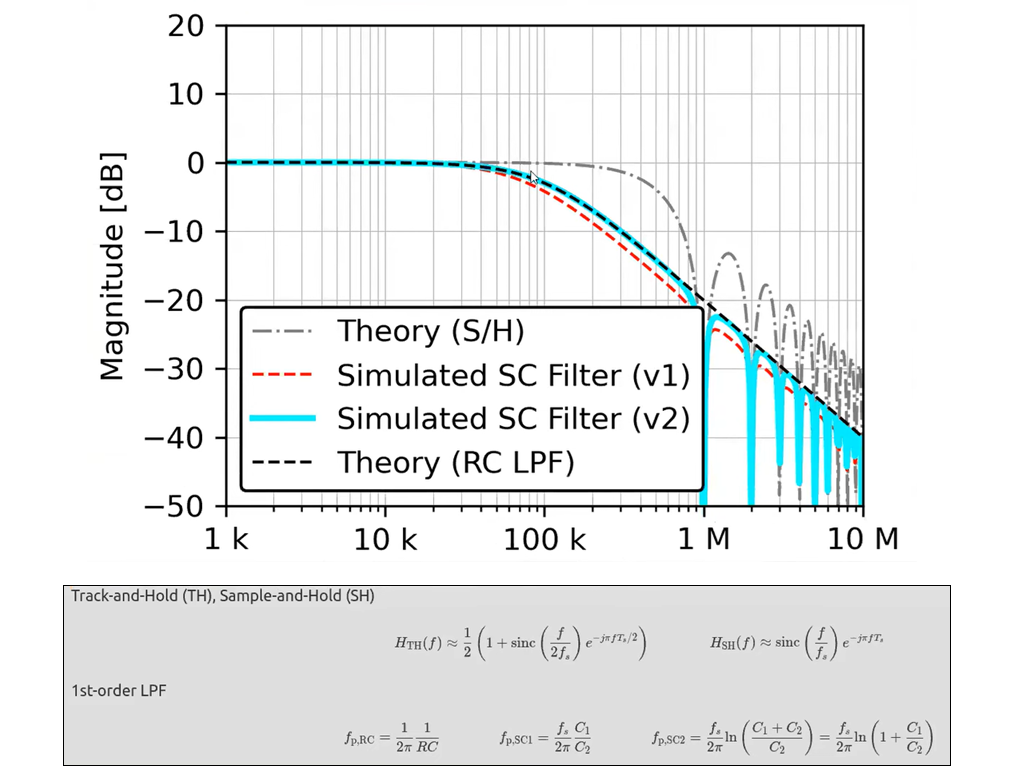
Due to not taking loading \(C_2\) into account, actual switched-capacitor filter deviate from equivalent \(R_{SC}\) + \(C_2\) low pass filter as \(f_p\) approaching to \(f_s\)

image-20260320213653416

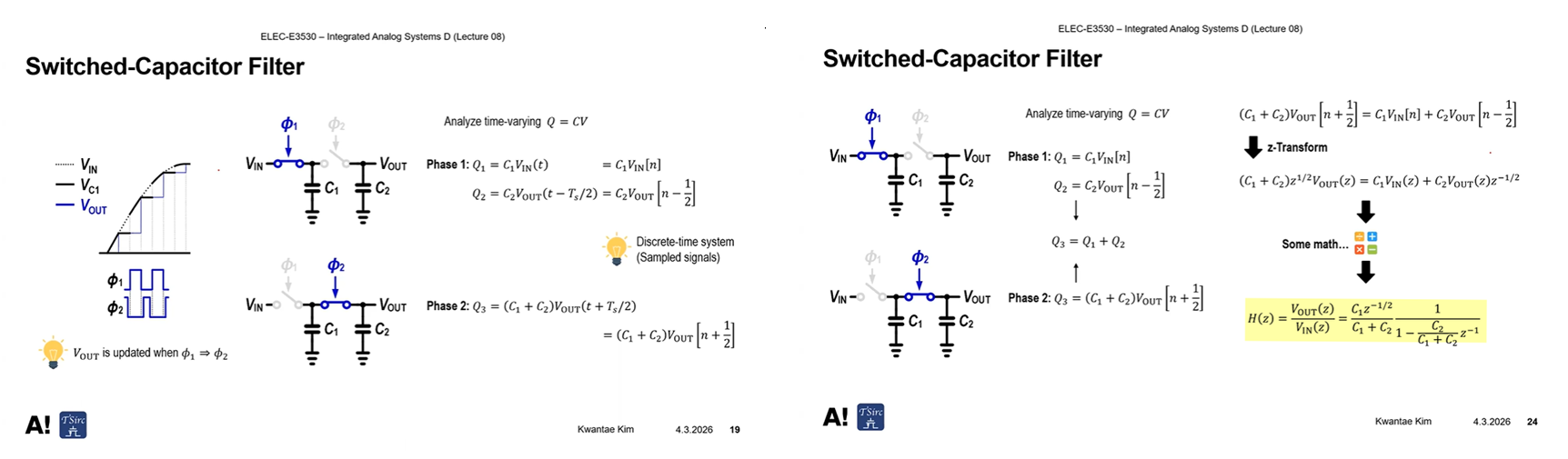
image-20260320225532492 \[ \color{red}H(z) =\frac{V_{OUT}(z)}{V_{IN}(z)}=\frac{C_1z^{-1/2}}{C_1+C_2}\frac{1}{1-\frac{C_2}{C_1+C_2}z^{-1}} \]


image-20260320225157429

image-20260320225029809

[https://youtu.be/eMOFMjuKiJQ]

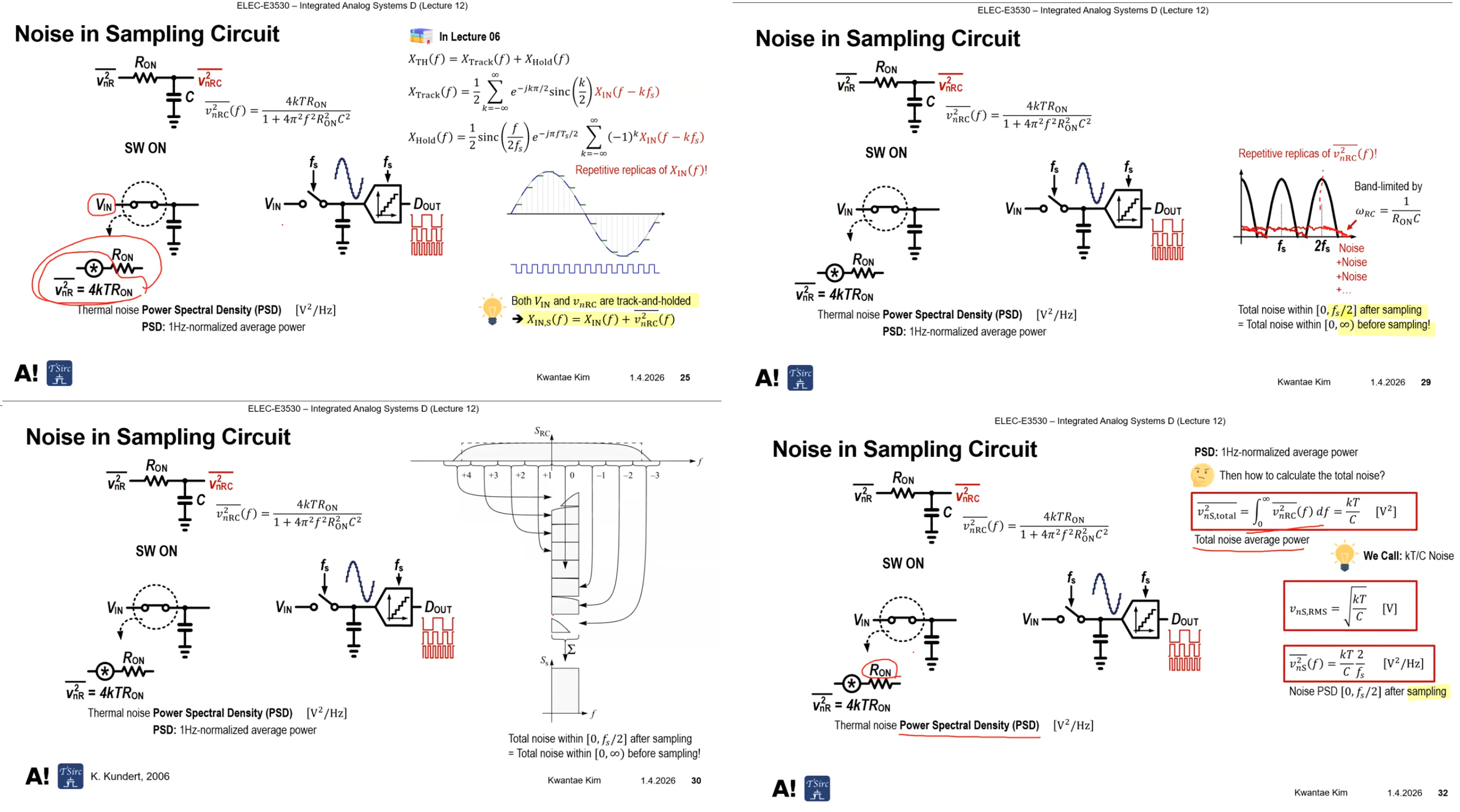
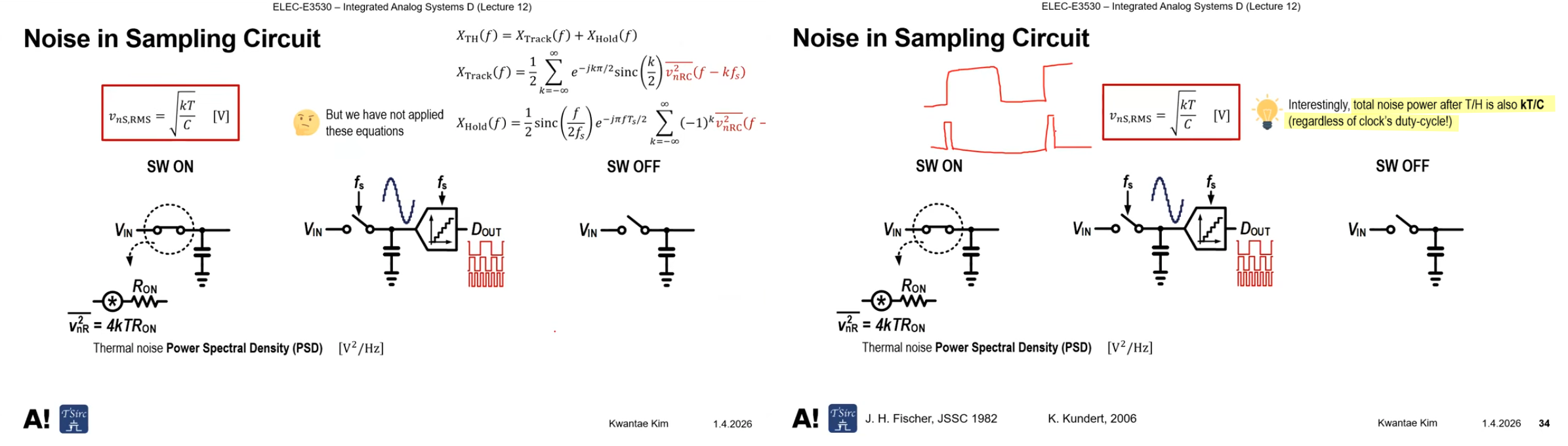
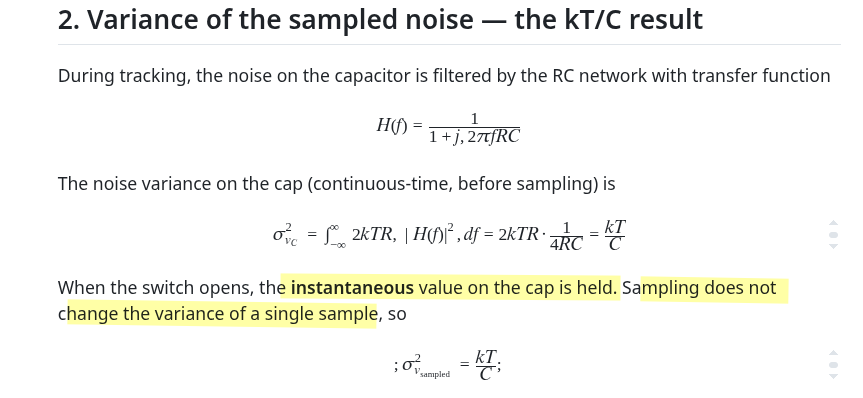
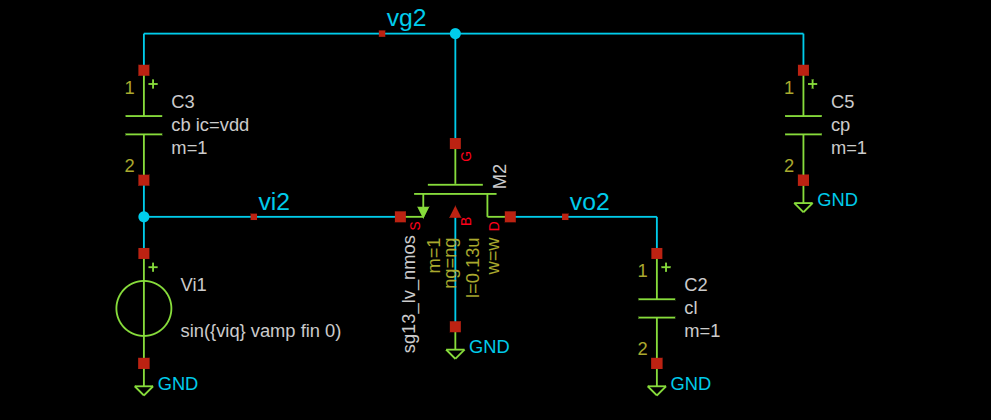
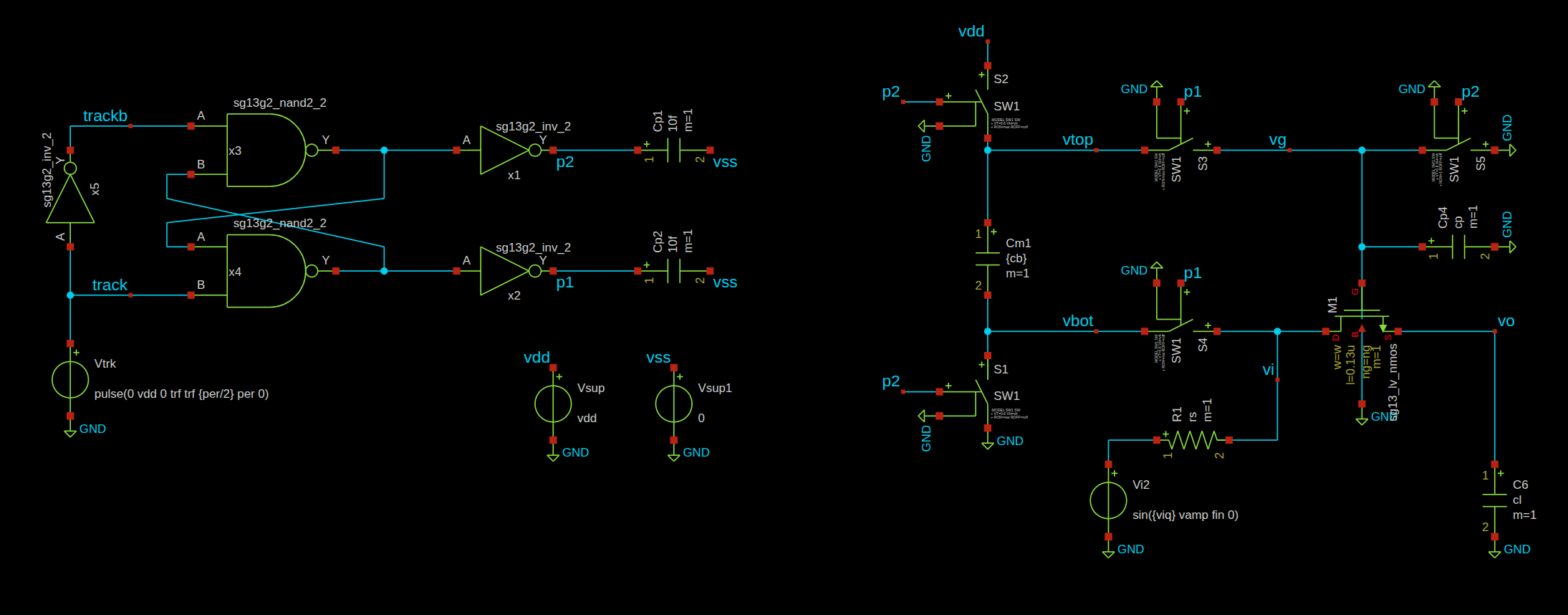
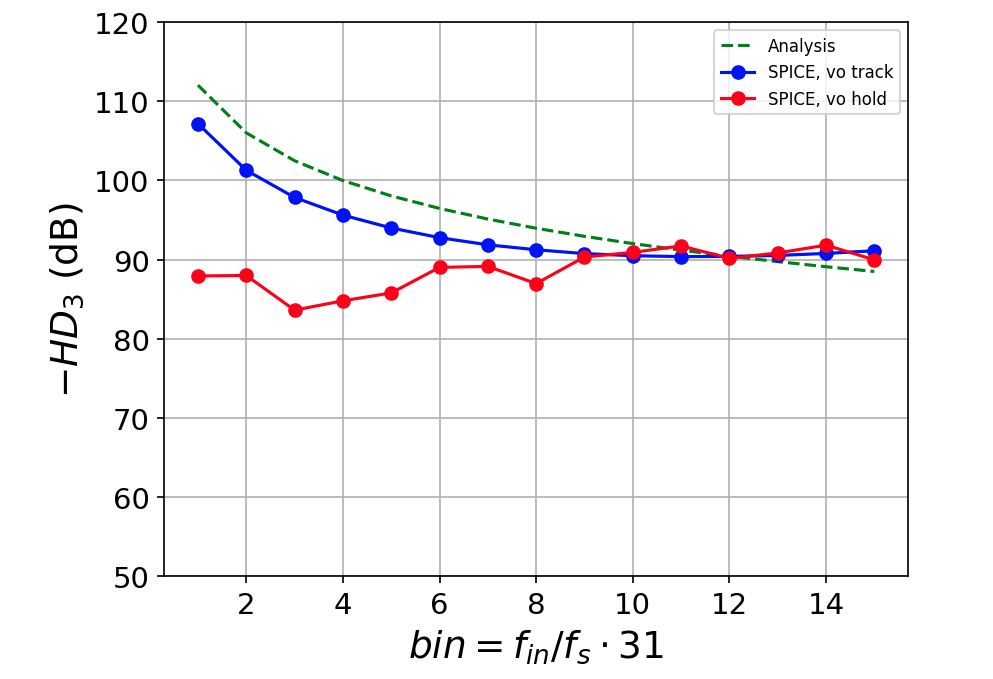
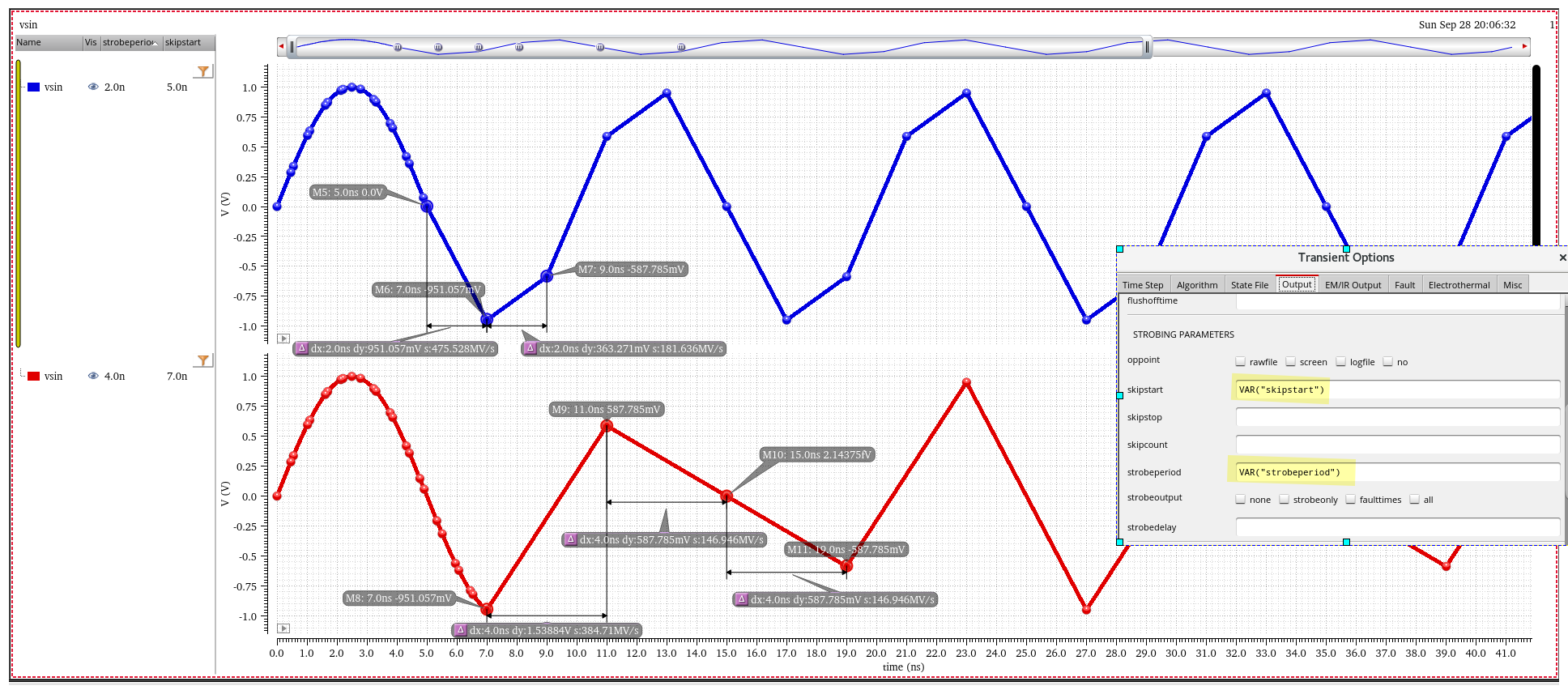
Track-and-Hold (TH)

image-20260301151636821

image-20260301151806948

image-20260301152756691

image-20260301152723365

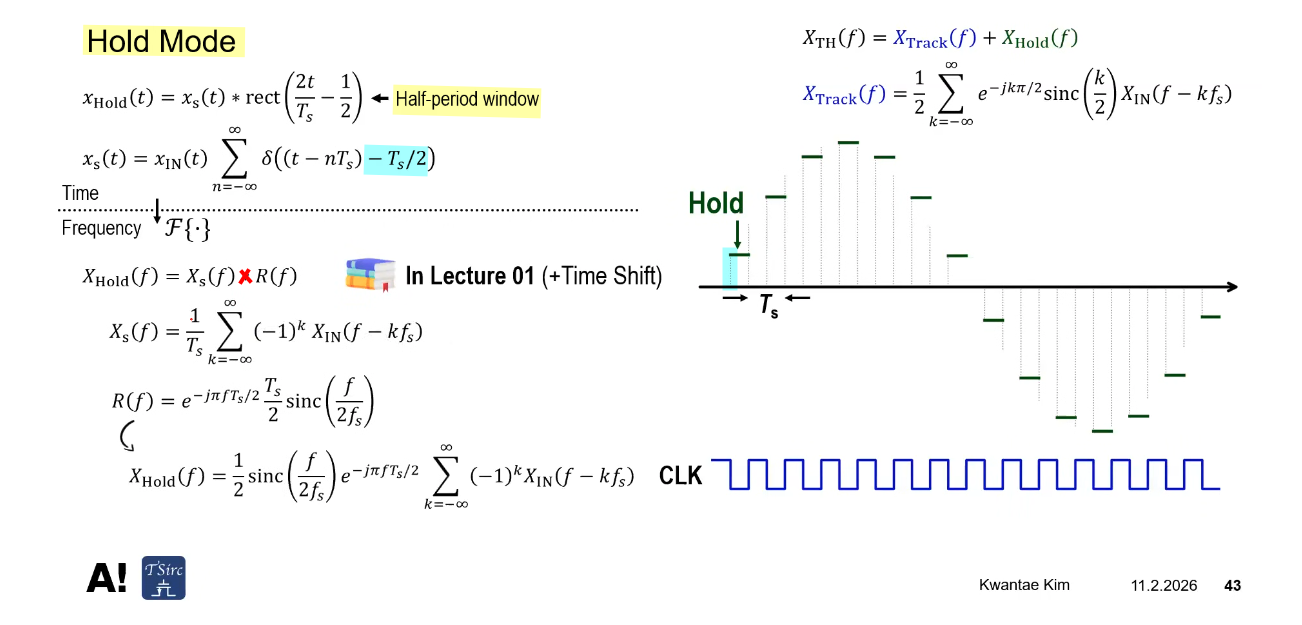
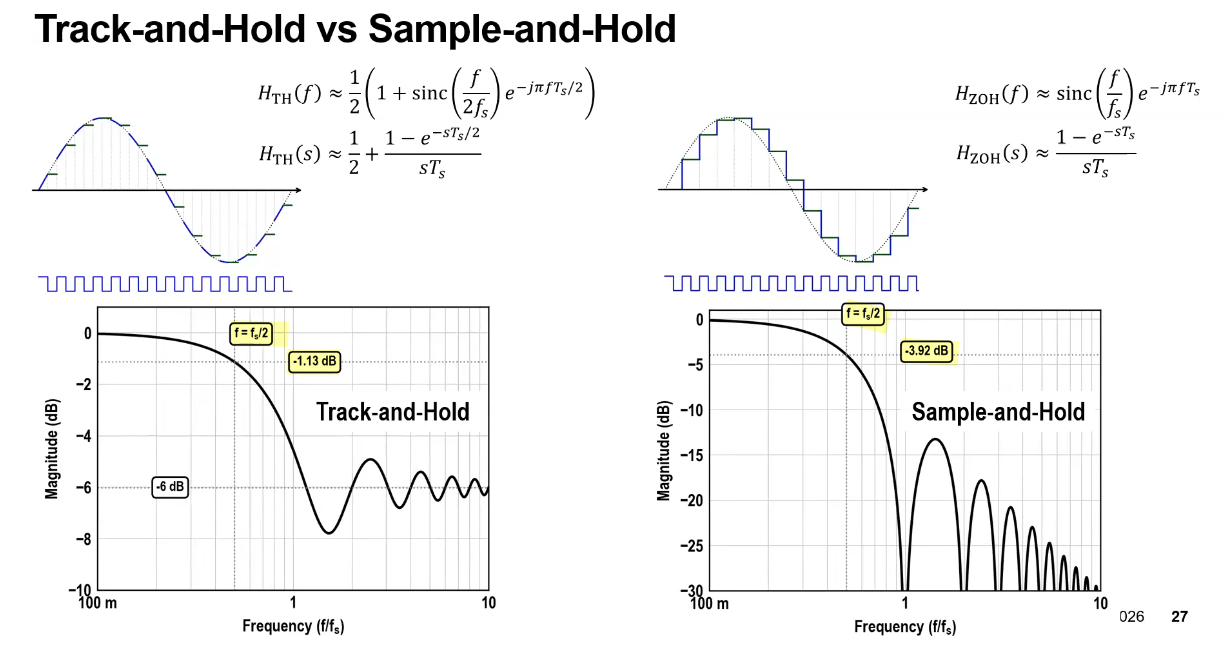
image-20260301153439749 \[ H_\mathrm{TH}(f) \approx \frac{1}{2} \left( 1 + \mathrm{sinc}\left( \frac{f}{2f_s} \right)e^{-j\pi f T_s/2} \right) \]

image-20260301154610913


PSS+PAC SImulaiton [https://youtu.be/VLdcY76V9Ss]

image-20260304214124216

Sample-and-Hold (SH)

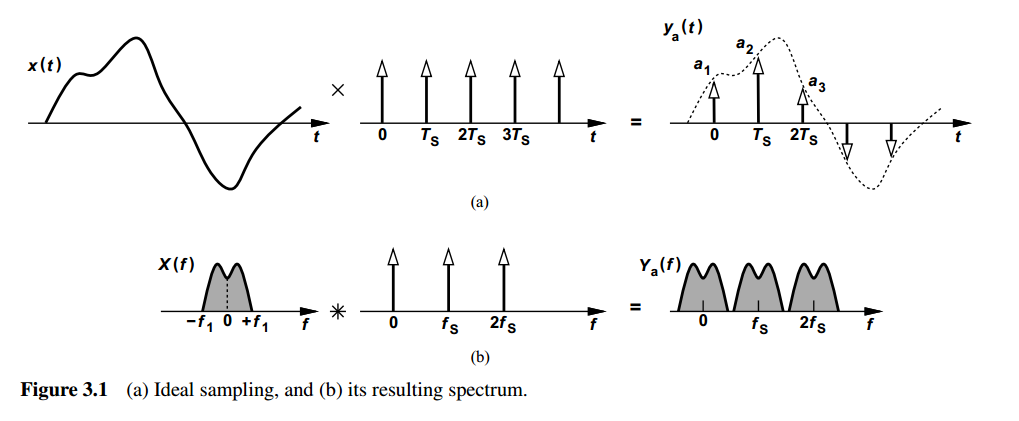
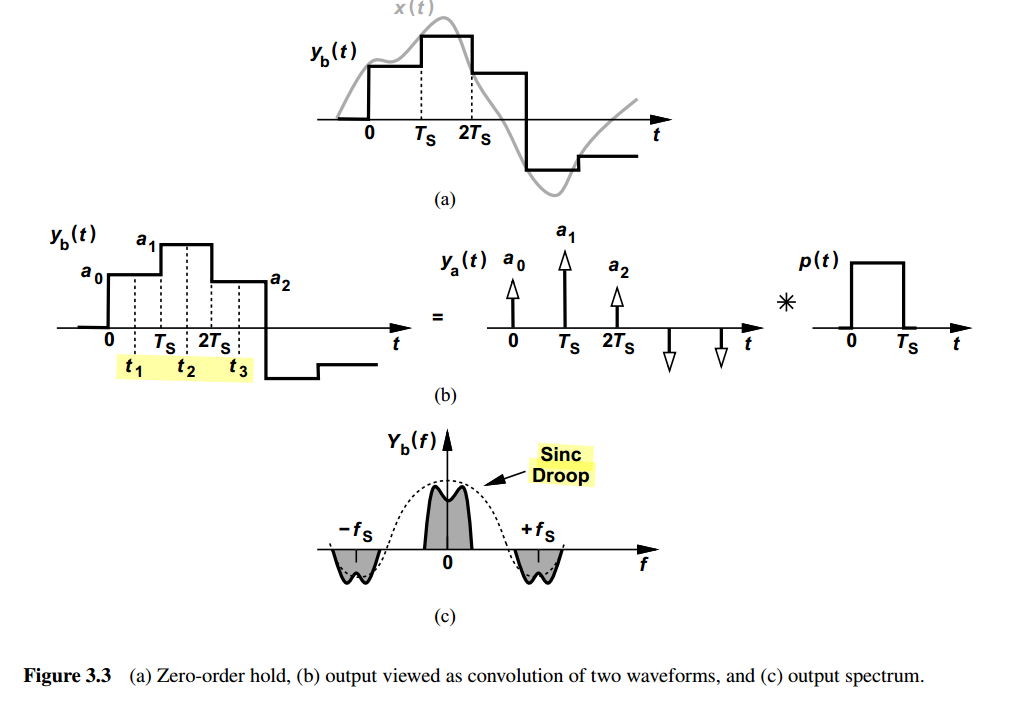
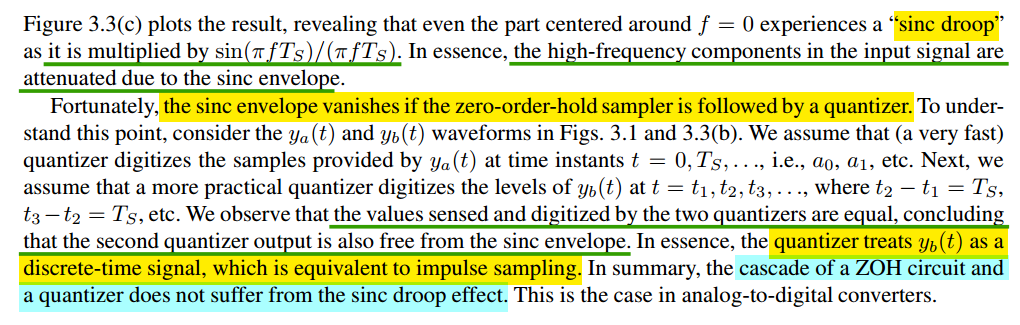
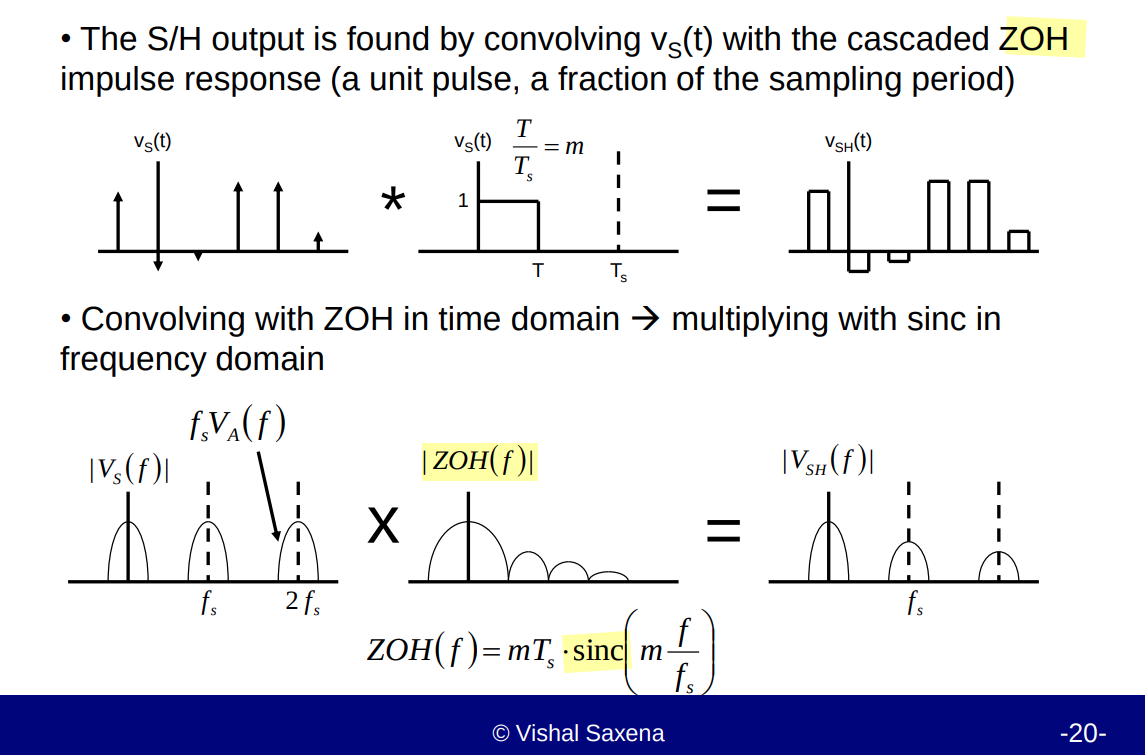
Zero-Order Hold

image-20260301151336134

image-20260301155443477

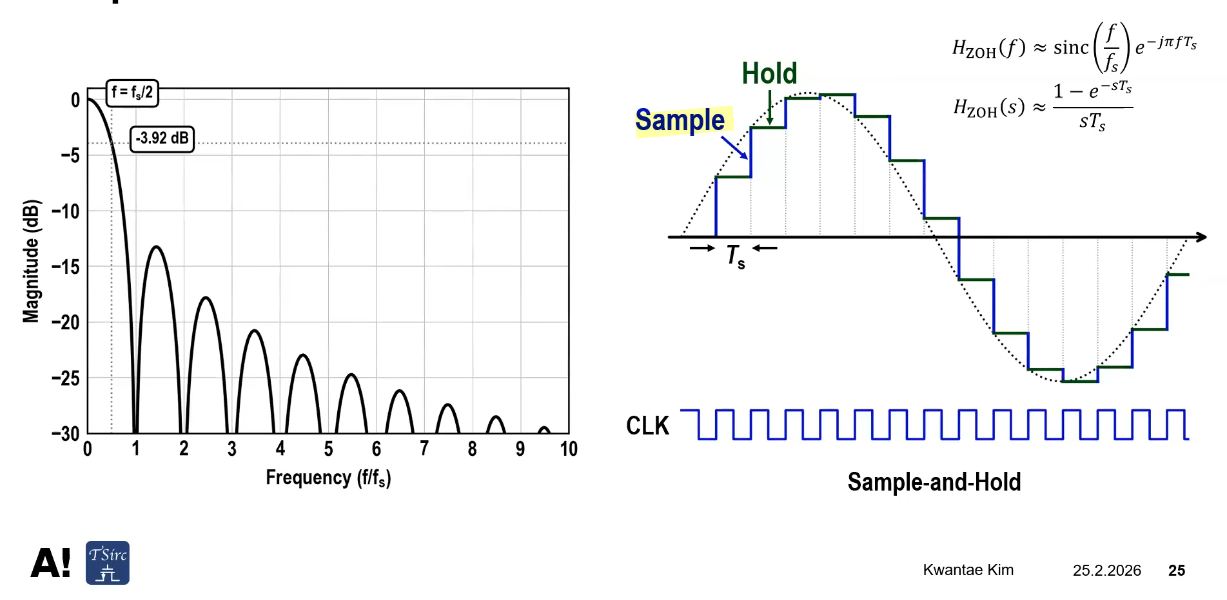
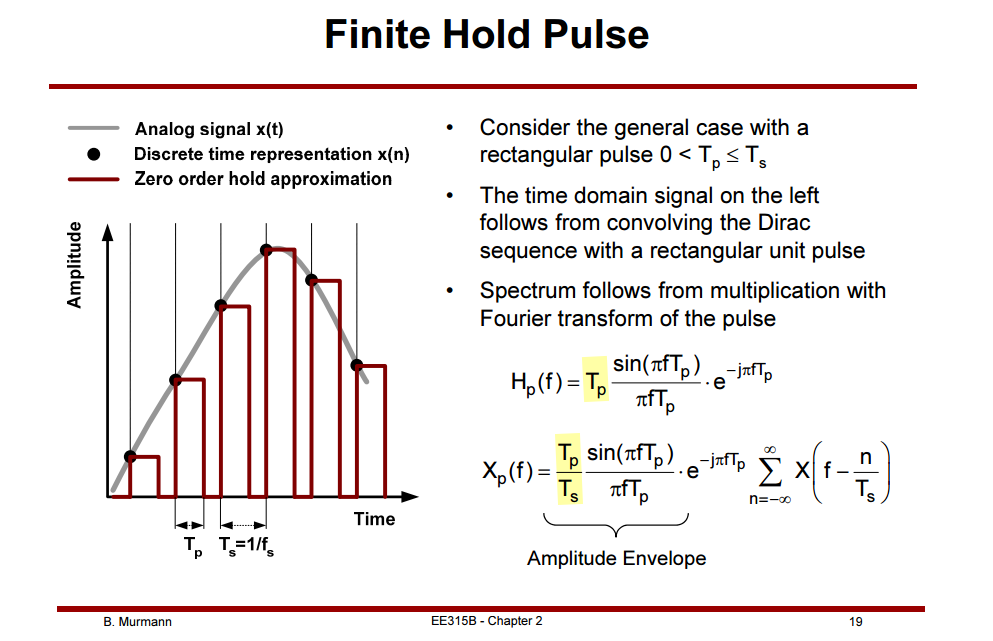
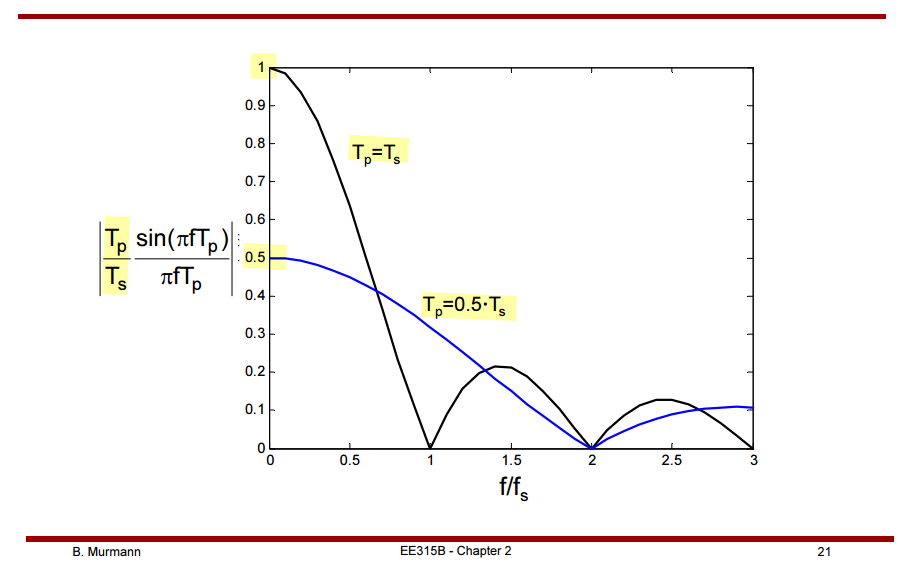
Given \(\color{red}T_p = T_s\) \[ H_\mathrm{SH}(f) \approx \mathrm{sinc}\left( \frac{f}{f_s} \right)e^{-j\pi f T_s} \]

image-20260301155553174


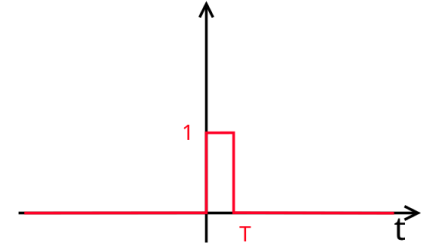
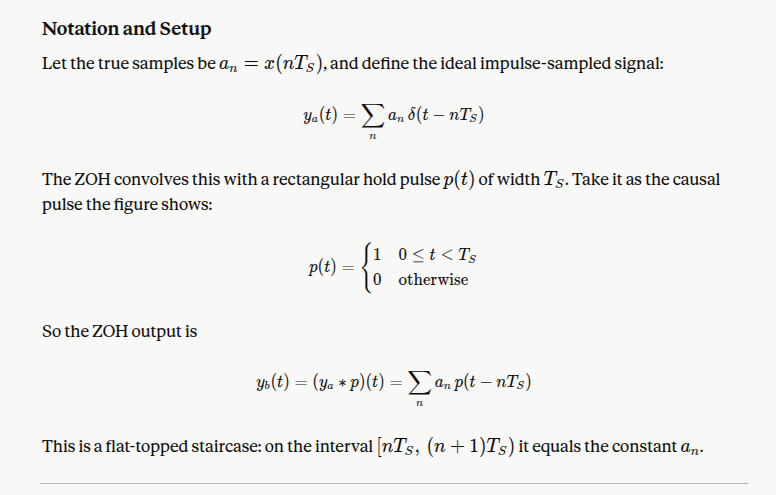
image-20240928101832121 \[ h_{ZOH}(t) = \text{rect}(\frac{t}{T} - \frac{1}{2}) = \left\{ \begin{array}{cl} 1 & : \ 0 \leq t \lt T \\ 0 & : \ \text{otherwise} \end{array} \right. \] The effective frequency response is the continuous Fourier transform of the impulse response \[ H_{ZOH}(f) = \mathcal{F}\{h_{ZOH}(t)\} = T\frac{1-e^{j2\pi fT}}{j2\pi fT}=Te^{-j\pi fT}\text{sinc}(fT) \] where \(\text{sinc}(x)\) is the normalized sinc function \(\frac{\sin(\pi x)}{\pi x}\)

The Laplace transform transfer function of the ZOH is found by substituting \(s=j2\pi f\) \[ H_{ZOH}(s) = \mathcal{L}\{h_{ZOH}(t)\}=\frac{1-e^{-sT}}{s} \]

image-20260301145922192

image-20260301145958979

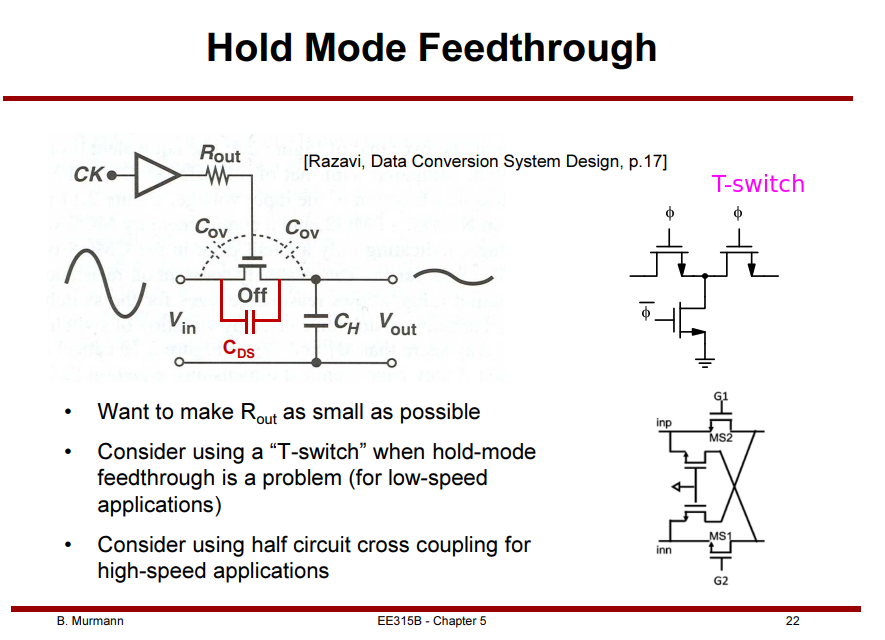
Clock Feedthrough

aka. LO leakage

TODO 📅

Integrator

TODO 📅

[https://www.eecg.utoronto.ca/~johns/ece1371/slides/10_switched_capacitor.pdf]

[https://www.seas.ucla.edu/brweb/papers/Journals/BRWinter17SwCap.pdf]

[https://class.ece.iastate.edu/ee508/lectures/EE%20508%20Lect%2029%20Fall%202016.pdf]

reference

Boris Murmann. EE315A VLSI Signal Conditioning Circuits [pdf]

Kwantae Kim. ELEC-E3530 Integrated Analog Systems D (5 ECTS) [video] [github]

R. S. Ashwin Kumar, Analog circuits for signal processing [https://home.iitk.ac.in/~ashwinrs/2022_EE698W.html]

R. Gregorian and G. C. Temes. Analog MOS Integrated Circuits for Signal Processing. Wiley-Interscience, 1986 [pdf]

Christian-Charles Enz. "High precision CMOS micropower amplifiers" [pdf]

Negar Reiskarimian. CICC 2025 Insight: Switched Capacitor Circuits [https://youtu.be/SL3-9ZMwdJQ]

Leeson's Model - LTI

M.H. Perrott [https://www.cppsim.com/PLL_Lectures/day2_am.pdf]

—. [https://ocw.mit.edu/courses/6-976-high-speed-communication-circuits-and-systems-spring-2003/ceb3d539691d5393a29af71ae98afb62_lec12.pdf]

Leeson's model is outcome of linearized VCO noise analysis

image-20250920125120068

image-20250920170108939

\[ Q = R_p\omega_0 C_p = \frac{R_p}{\omega_0 L} \]

where \(\omega_0 = \frac{1}{\sqrt{L_pC_p}}\)

image-20250920170331118

[https://stanford.edu/class/ee133/handouts/lecturenotes/lecture5_tank.pdf]

image-20250920171147163

image-20250920171411886


Carlo Samori ISSCC2016 T1: Understanding Phase Noise in LC VCOs

image-20251104233318469

Leeson's limitations

image-20251122144811362

Hajimiri's Model- LTV ISF

image-20251122143723827


image-20250629065454831

image-20250629073305626

ISF model

image-20251008184336891

image-20251008184349072

C. Livanelioglu, L. He, J. Gong, S. Arjmandpour, G. Atzeni and T. Jang, "19.10 A 4.6GHz 63.3fsrms PLL-XO Co-Design Using a Self-Aligned Pulse-Injection Driver Achieving −255.2dB FoMJ Including the XO Power and Noise," 2025 IEEE International Solid-State Circuits Conference (ISSCC), San Francisco, CA, USA, 2025

image-20251008185243498

image-20251008185406867


image-20250626210829173

[https://adityamuppala.github.io/assets/Notes_YouTube/Oscillators_ISF_model.pdf]

image-20250629080430980

Periodic ISF: Noise Folding

image-20250629080632902

When performing the phase noise computation integral, there will be a negligible contribution from all terms, other than \(n=m\)

image-20250629083344136

image-20250629083453955

Given \(i(t) = I_m \cos[(m\omega_0 +\Delta \omega)t]\),

\[\begin{align} \phi(t) &= \frac{1}{q_\text{max}}\left[\frac{C_0}{2}\int_{-\infty}^t I_m\cos((m\omega_0 +\Delta \omega)\tau)d\tau + \sum_{n=1}^\infty C_n\int_{-\infty}^t I_m\cos((m\omega_0 +\Delta \omega)\tau)\cos(n\omega_0\tau)d\tau\right] \\ &= \frac{I_m}{q_\text{max}}\left[\frac{C_0}{2}\int_{-\infty}^t \cos((m\omega_0 +\Delta \omega)\tau)d\tau + \sum_{n=1}^\infty C_n\int_{-\infty}^t \frac{\cos((m\omega_0 + \Delta \omega+ n\omega_0)\tau)+ \cos((m\omega_0+\Delta \omega - n\omega_0)\tau)}{2}d\tau\right] \end{align}\]

If \(m=0\) \[ \phi(t) \approx \frac{I_0C_0}{2q_\text{max}\Delta \omega}\sin(\Delta\omega t) \] If \(m\neq 0\) and \(m=n\) \[ \phi(t) \approx \frac{I_mC_m}{2q_\text{max}\Delta \omega}\sin(\Delta\omega t) \]

\(m\omega_0 +\Delta \omega \ge 0\)

image-20250629105156403

image-20250629100444702

A. Hajimiri and T. H. Lee, "A general theory of phase noise in electrical oscillators," in IEEE Journal of Solid-State Circuits, vol. 33, no. 2, pp. 179-194, Feb. 1998 [pdf]

image-20250629102112814


Corrections to "A General Theory of Phase Noise in Electrical Oscillators"

A. Hajimiri and T. H. Lee, "Corrections to "A General Theory of Phase Noise in Electrical Oscillators"," in IEEE Journal of Solid-State Circuits, vol. 33, no. 6, pp. 928-928, June 1998 [https://sci-hub.se/10.1109/4.678662]

Ali Hajimiri. Phase Noise in Oscillators [http://www-smirc.stanford.edu/papers/Orals98s-ali.pdf]

L. Lu, Z. Tang, P. Andreani, A. Mazzanti and A. Hajimiri, "Comments on “Comments on “A General Theory of Phase Noise in Electrical Oscillators””," in IEEE Journal of Solid-State Circuits, vol. 43, no. 9, pp. 2170-2170, Sept. 2008 [https://sci-hub.se/10.1109/JSSC.2008.2005028]

image-20250629104527666

image-20250629081831223

Given \(i(t) = I_m \cos[(m\omega_0 - \Delta \omega)t]\) and \(m \ge 1\)

\[\begin{align} \phi(t) &= \frac{1}{q_\text{max}}\left[\frac{C_0}{2}\int_{-\infty}^t I_m\cos((m\omega_0 -\Delta \omega)\tau)d\tau + \sum_{n=1}^\infty C_n\int_{-\infty}^t I_m\cos((m\omega_0 -\Delta \omega)\tau)\cos(n\omega_0\tau)d\tau\right] \\ &= \frac{I_m}{q_\text{max}}\left[\frac{C_0}{2}\int_{-\infty}^t \cos((m\omega_0 -\Delta \omega)\tau)d\tau + \sum_{n=1}^\infty C_n\int_{-\infty}^t \frac{\cos((m\omega_0 - \Delta \omega+ n\omega_0)\tau)+ \cos((m\omega_0-\Delta \omega - n\omega_0)\tau)}{2}d\tau\right] \end{align}\]

If \(m\ge 1\) and \(m=n\) \[ \phi(t) \approx \frac{I_mC_m}{2q_\text{max}\Delta \omega}\sin(\Delta\omega t) \] That is

\(m = 0\) \(m\gt 0\) & \(m\omega_0+\Delta \omega\) \(m\gt 0\) & \(m\omega_0-\Delta \omega\)
\(\phi(t)\) \(\frac{I_0C_0}{2q_\text{max}\Delta \omega}\sin(\Delta\omega t)\) \(\frac{I_mC_m}{2q_\text{max}\Delta \omega}\sin(\Delta\omega t)\) \(\frac{I_mC_m}{2q_\text{max}\Delta \omega}\sin(\Delta\omega t)\)
\(P_{SBC}(\Delta \omega)\) \(10\log(\frac{I_0^2C_0^2}{16q_\text{max}^2\Delta \omega^2})\) \(10\log(\frac{I_m^2C_m^2}{16q_\text{max}^2\Delta \omega^2})\) \(10\log(\frac{I_m^2C_m^2}{16q_\text{max}^2\Delta \omega^2})\)

\[\begin{align} \mathcal{L}\{\Delta \omega\} &= 10\log\left(\frac{I_0^2C_0^2}{16q_\text{max}^2\Delta \omega^2} + 2\frac{I_m^2C_m^2}{16q_\text{max}^2\Delta \omega^2}\right) \\ &= 10\log\left(\frac{\overline{i_n^2/\Delta f}\cdot \frac{C_0^2}{2} }{4q_\text{max}^2\Delta \omega^2} + \frac{\overline{i_n^2/\Delta f}\cdot\sum_{m=1}^\infty C_m^2 }{4q_\text{max}^2\Delta \omega^2}\right) \\ &= 10\log \frac{\overline{i_n^2/\Delta f}(C_0^2/2+\sum_{m=1}^\infty C_m^2)}{4q_\text{max}^2\Delta \omega^2} \\ &= 10\log \frac{\overline{i_n^2/\Delta f}\cdot \Gamma_\text{rms}^2}{2q_\text{max}^2\Delta \omega^2} \end{align}\]

ISF & \(1/f\)-noise up-conversion

TODO 📅

image-20250626211817628

ISF Simulation

image-20241113232703941

PSS + PXF Method

Hu, Yizhe. (2019). A Simulation Technique of Impulse Sensitivity Function (ISF) Based on Periodic Transfer Function (PXF). 10.13140/RG.2.2.32151.60323. [link]

TODO 📅

Transient Method

David Dolt. ECEN 620 Network Theory - Broadband Circuit Design: "VCO ISF Simulation" [https://people.engr.tamu.edu/spalermo/ecen620/ISF_SIM.pdf]

image-20241016211020230

image-20241016211101204

image-20241016211115630

To compare the ring oscillator and VCO the total injected charge to both should be the same

Demir's Model - NLTV PPV

image-20251122143914081

image-20250920101142887

PPV (Perturbation Projection Vector)

A. Demir and J. Roychowdhury, "A reliable and efficient procedure for oscillator PPV computation, with phase noise macromodeling applications," in IEEE Transactions on Computer-Aided Design of Integrated Circuits and Systems, vol. 22, no. 2, pp. 188-197, Feb. 2003 [https://sci-hub.se/10.1109/TCAD.2002.806599]

Helene Thibieroz, Customer Support CIC. Using Spectre RF Noise-Aware PLL Methodology to Predict PLL Behavior Accurately [https://citeseerx.ist.psu.edu/document?repid=rep1&type=pdf&doi=3056e59ea76165373f90152f915a829d25dabebc]

Aditya Varma Muppala. Perturbation Projection Vector (PPV) Theory | Oscillators 11 | MMIC 16 [youtu.be, notes]

Limit Cycles

[https://adityamuppala.github.io/assets/Notes_YouTube/MMIC_Limit_Cycles.pdf]

Nonlinear Dynamics

image-20250622202023590

image-20250920101927173

reference

Jiří Lebl. Notes on Diffy Qs: Differential Equations for Engineers [link]

Matt Charnley. Differential Equations: An Introduction for Engineers [link]

Åström, K.J. & Murray, Richard. (2021). Feedback Systems: An Introduction for Scientists and Engineers Second Edition [https://www.cds.caltech.edu/~murray/books/AM08/pdf/fbs-public_24Jul2020.pdf]

Strogatz, S.H. (2015). Nonlinear Dynamics and Chaos: With Applications to Physics, Biology, Chemistry, and Engineering (2nd ed.). CRC Press [https://www.biodyn.ro/course/literatura/Nonlinear_Dynamics_and_Chaos_2018_Steven_H._Strogatz.pdf]

Cadence Blog, "Resonant Frequency vs. Natural Frequency in Oscillator Circuits" [link]


Aditya Varma Muppala. Oscillators [https://youtube.com/playlist?list=PL9Trid0A4Da2fOmYTEjhAnUkGPxyiH7H6&si]

P.E. Allen - 2003. ECE 6440 - Frequency Synthesizers: Lecture 160 – Phase Noise - II [https://pallen.ece.gatech.edu/Academic/ECE_6440/Summer_2003/L160-PhNoII(2UP).pdf]

Y. Hu, T. Siriburanon and R. B. Staszewski, "Intuitive Understanding of Flicker Noise Reduction via Narrowing of Conduction Angle in Voltage-Biased Oscillators," in IEEE Transactions on Circuits and Systems II: Express Briefs, vol. 66, no. 12, pp. 1962-1966, Dec. 2019 [https://sci-hub.se/10.1109/TCSII.2019.2896483]

S. Levantino, P. Maffezzoni, F. Pepe, A. Bonfanti, C. Samori and A. L. Lacaita, "Efficient Calculation of the Impulse Sensitivity Function in Oscillators," in IEEE Transactions on Circuits and Systems II: Express Briefs, vol. 59, no. 10, pp. 628-632, Oct. 2012 [https://sci-hub.se/10.1109/TCSII.2012.2208679]

S. Levantino and P. Maffezzoni, "Computing the Perturbation Projection Vector of Oscillators via Frequency Domain Analysis," in IEEE Transactions on Computer-Aided Design of Integrated Circuits and Systems, vol. 31, no. 10, pp. 1499-1507, Oct. 2012 [https://sci-hub.se/10.1109/TCAD.2012.2194493]

Thomas H. Lee. Linearity, Time-Variation, Phase Modulation and Oscillator Phase Noise [https://class.ece.iastate.edu/djchen/ee507/PhaseNoiseTutorialLee.pdf]

Y. Hu, T. Siriburanon and R. B. Staszewski, "Oscillator Flicker Phase Noise: A Tutorial," in IEEE Transactions on Circuits and Systems II: Express Briefs, vol. 68, no. 2, pp. 538-544, Feb. 2021 [https://ieeexplore.ieee.org/stamp/stamp.jsp?tp=&arnumber=9286468]

Jaeha Kim. Lecture 8. Special Topics: Design Trade -Offs in LC -Tuned Oscillators [https://ocw.snu.ac.kr/sites/default/files/NOTE/7033.pdf]

A. Demir, A. Mehrotra and J. Roychowdhury, "Phase noise in oscillators: a unifying theory and numerical methods for characterization," in IEEE Transactions on Circuits and Systems I: Fundamental Theory and Applications, vol. 47, no. 5, pp. 655-674, May 2000 [https://sci-hub.se/10.1109/81.847872]


A. A. Abidi and D. Murphy, "How to Design a Differential CMOS LC Oscillator," in IEEE Open Journal of the Solid-State Circuits Society, vol. 5, pp. 45-59, 2025 [https://ieeexplore.ieee.org/stamp/stamp.jsp?arnumber=10818782]

Akihide Sai, Toshiba. ISSCC 2023 T5: All-digital PLLs From Fundamental Concepts to Future Trends [https://www.nishanchettri.com/isscc-slides/2023%20ISSCC/TUTORIALS/T5.pdf]


Pietro Andreani. ISSCC 2011 T1: Integrated LC oscillators [slides,transcript]

—. ISSCC 2017 F2: Integrated Harmonic Oscillators

—. SSCS Distinguished Lecture: RF Harmonic Oscillators Integrated in Silicon Technologies [https://www.ieeetoronto.ca/wp-content/uploads/2020/06/DL-Toronto.pdf]

—. ESSCIRC 2019 Tutorials: RF Harmonic Oscillators Integrated in Silicon Technologies [https://youtu.be/k1I9nP9eEHE]

—. "Harmonic Oscillators in CMOS—A Tutorial Overview," in IEEE Open Journal of the Solid-State Circuits Society, vol. 1, pp. 2-17, 2021 [pdf]

C. Samori, "Tutorial: Understanding Phase Noise in LC VCOs," 2016 IEEE International Solid-State Circuits Conference (ISSCC), San Francisco, CA, USA, 2016

—, "Understanding Phase Noise in LC VCOs: A Key Problem in RF Integrated Circuits," in IEEE Solid-State Circuits Magazine, vol. 8, no. 4, pp. 81-91, Fall 2016 [https://sci-hub.se/10.1109/MSSC.2016.2573979]

—, Phase Noise in LC Oscillators: From Basic Concepts to Advanced Topologies [https://www.ieeetoronto.ca/wp-content/uploads/2020/06/DL-VCO-short.pdf]

Jun Yin. ISSCC 2025 T10: mm-Wave Oscillator Design


Hegazi, Emad, Asad Abidi, and Jacob Rael. The Designer's Guide to High-purity Oscillators. [New York]: Kluwer Academic Publishers, 2005. The Designer's Guide to High-Purity Oscillators [pdf]

TODO 📅

reference

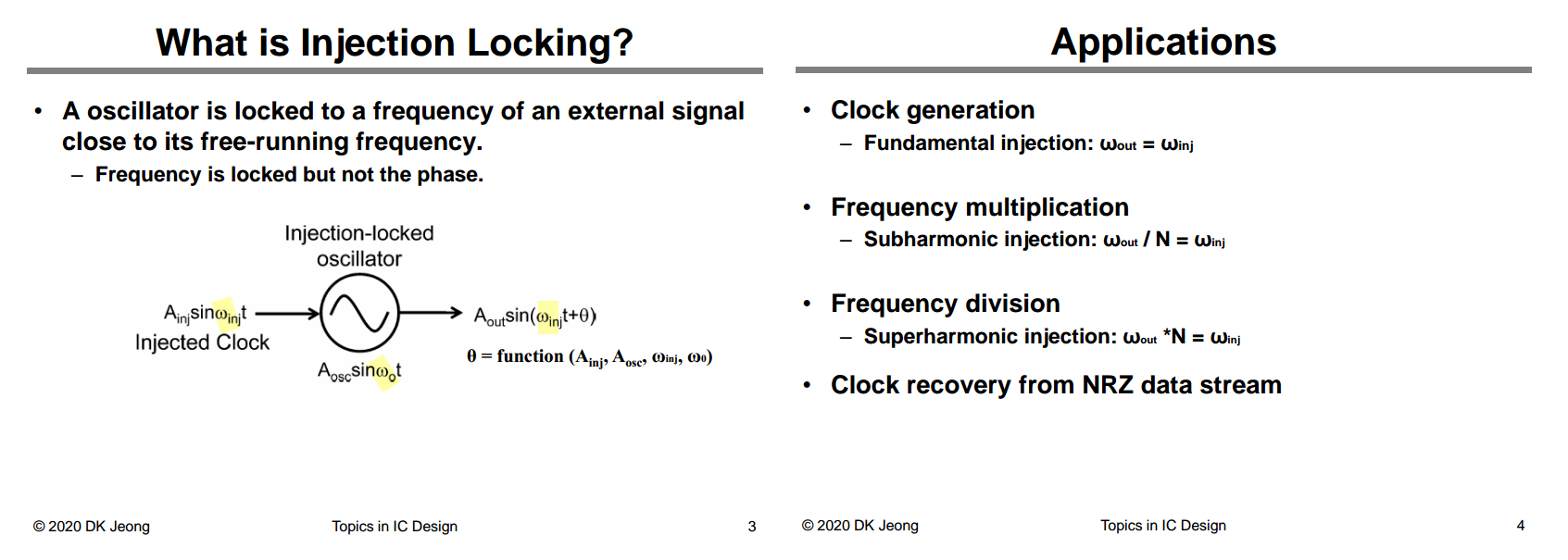
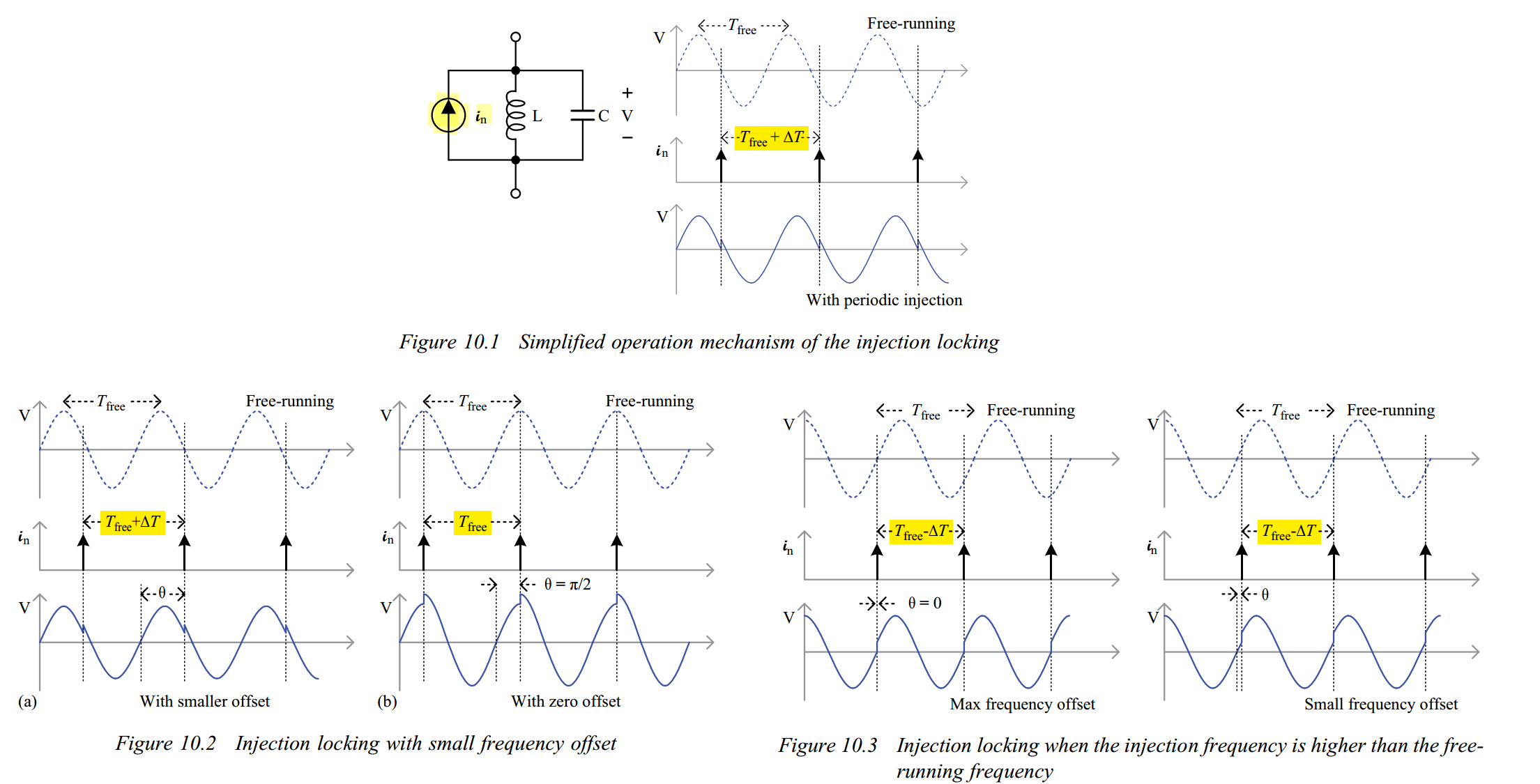
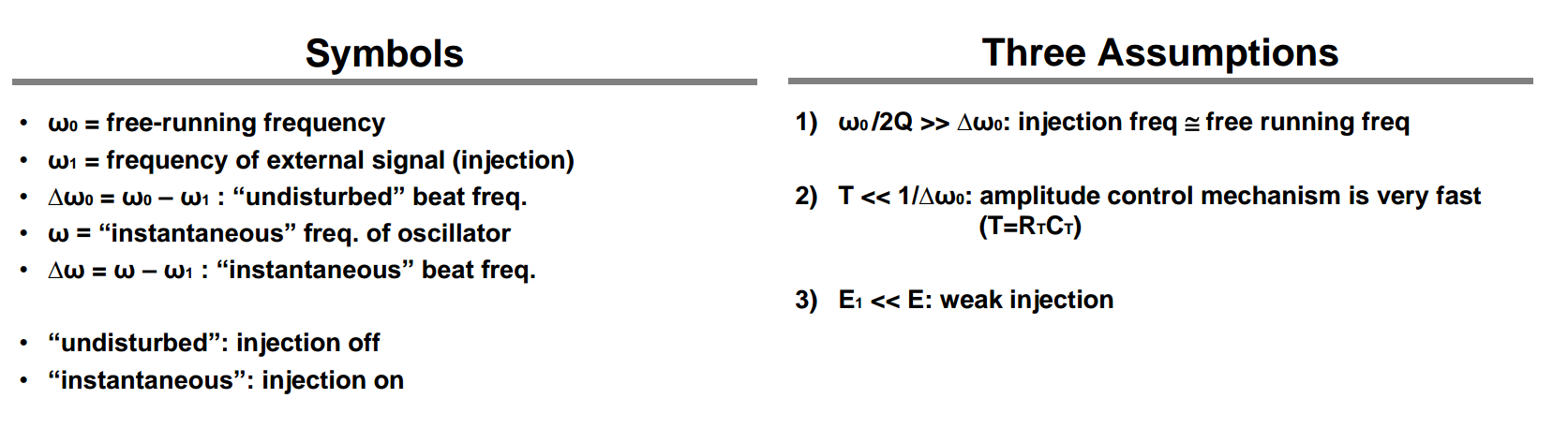
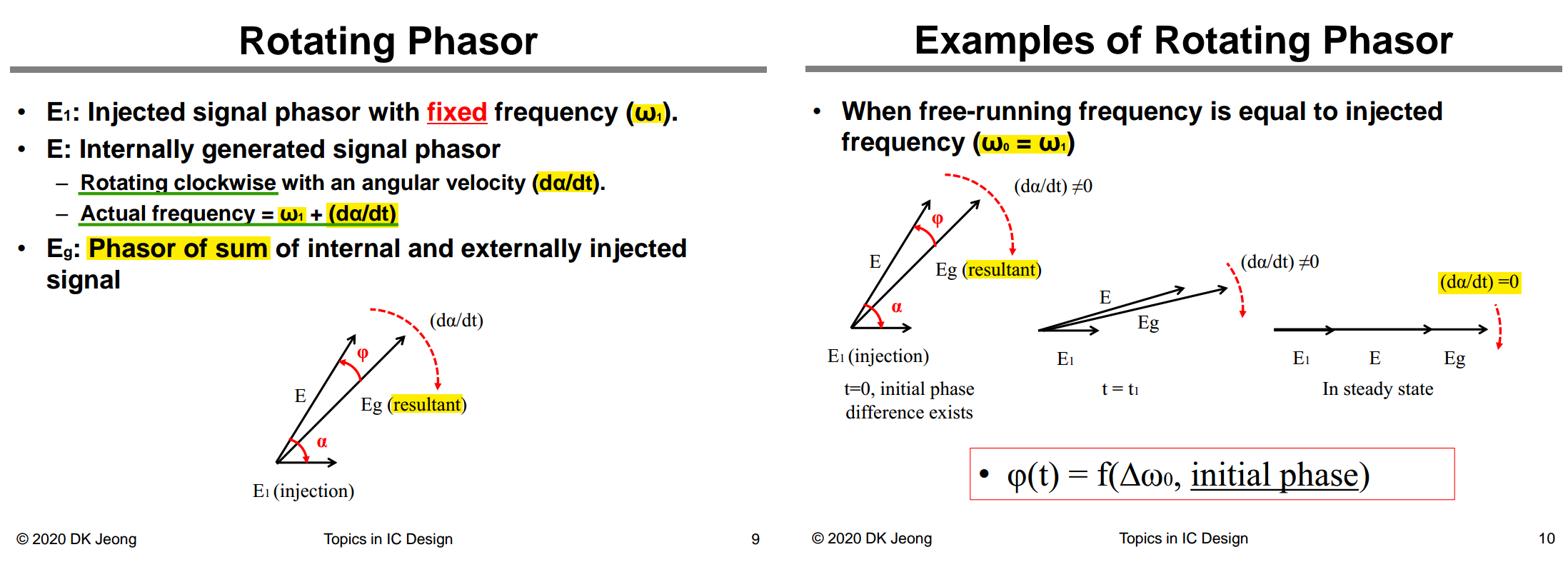
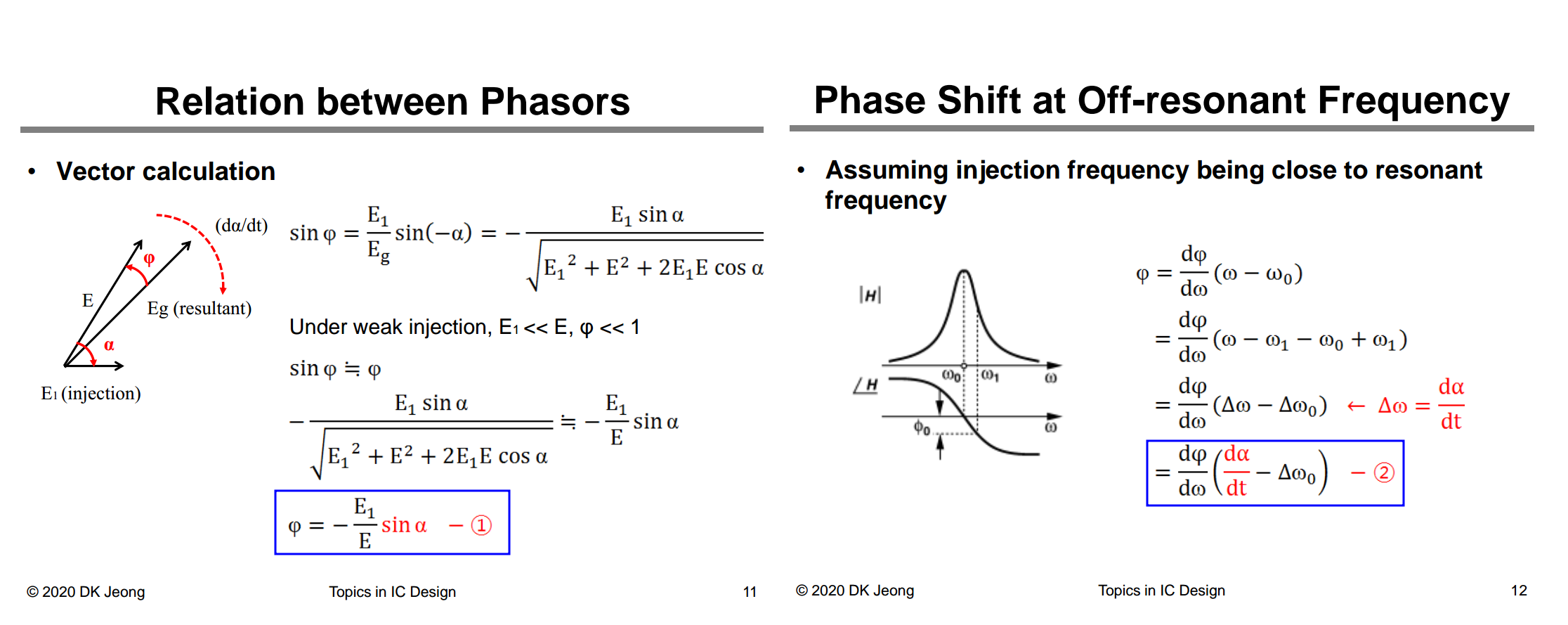
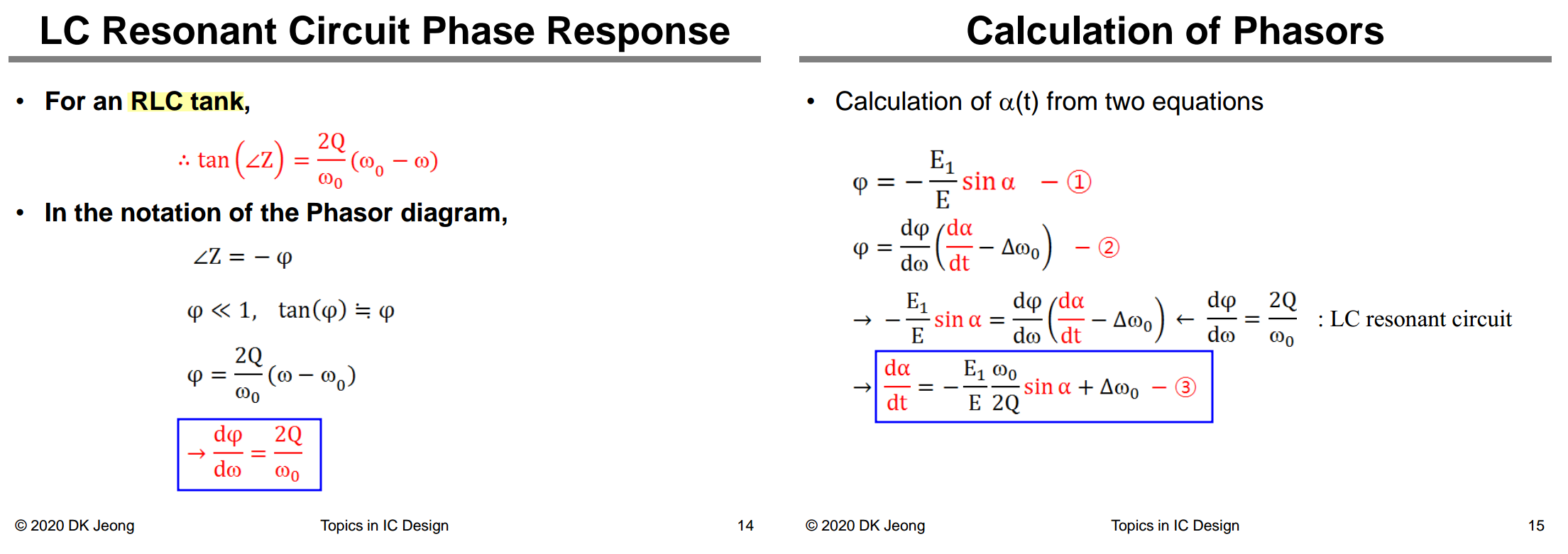
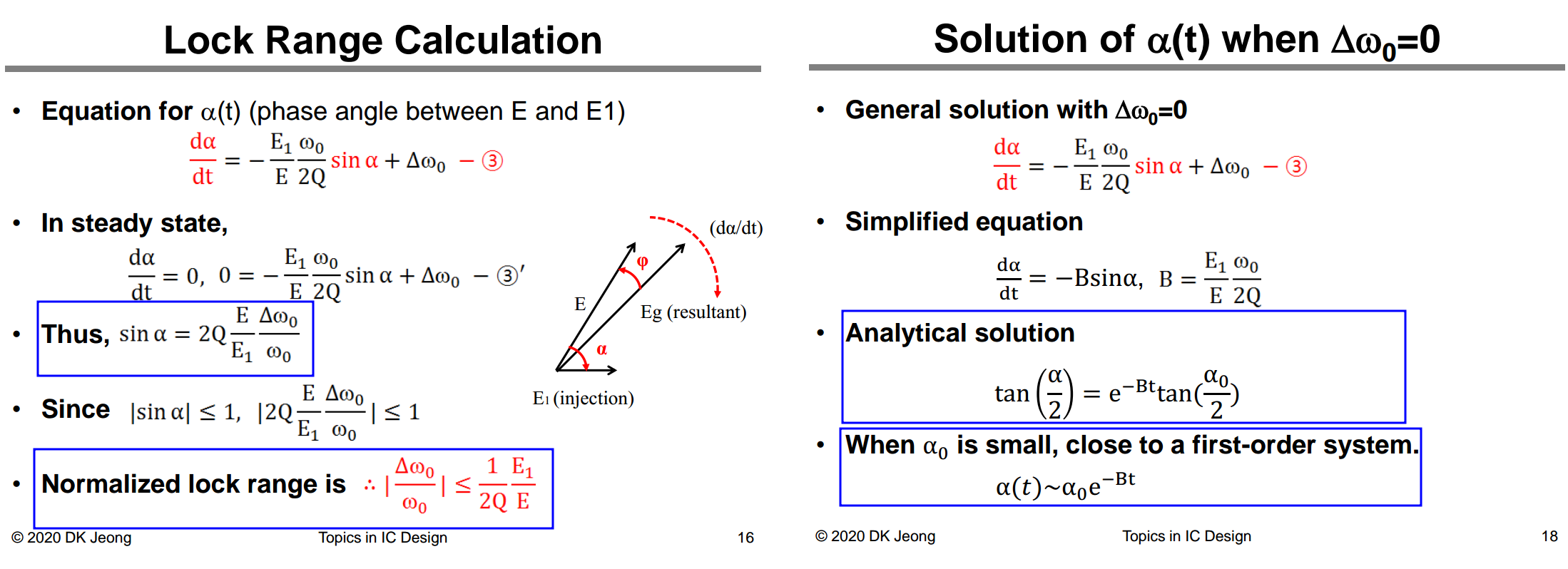
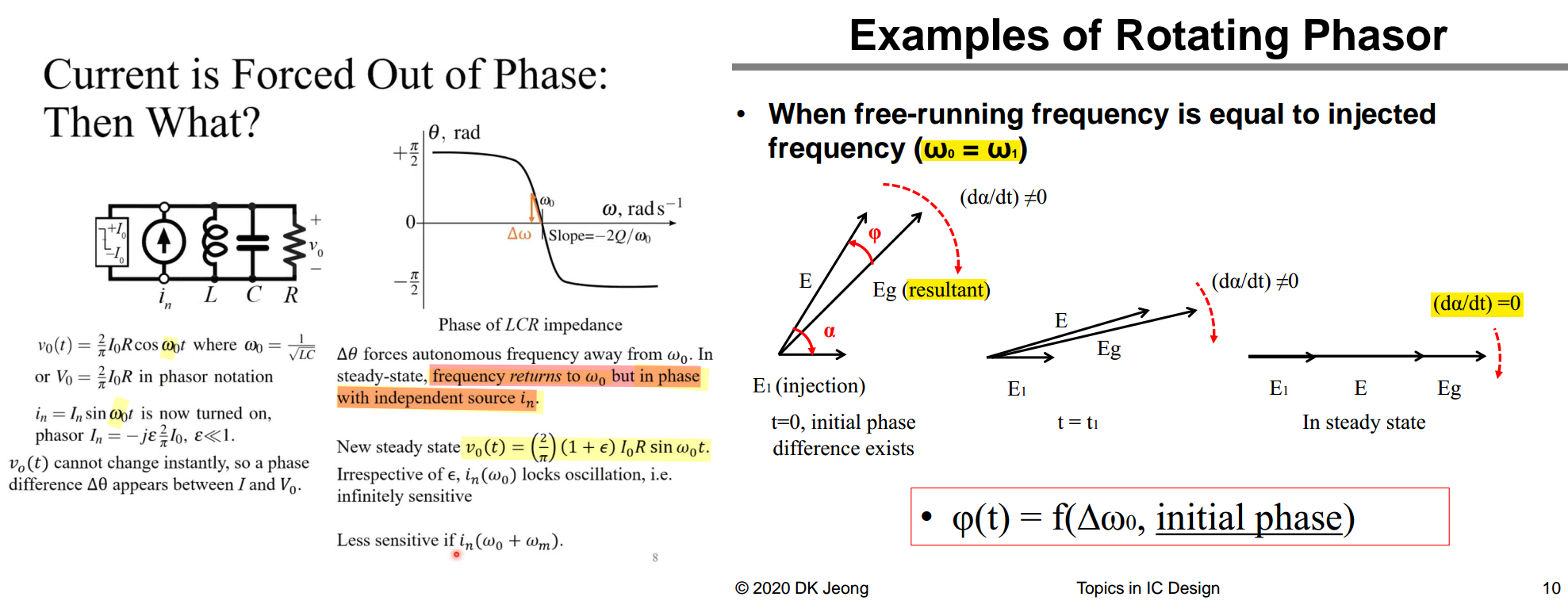
"Topics in IC (Wireline Transceiver Design): Lec 4 - Injection Locked Oscillators" [https://ocw.snu.ac.kr/sites/default/files/NOTE/Lec%204%20-%20Injection%20Locked%20Oscillators.pdf]

Cowan, Glenn. (2024). Mixed-Signal CMOS for Wireline Communication: Transistor-Level and System-Level Design Considerations

Mozhgan Mansuri. ISSCC2021 SC3: Clocking, Clock Distribution, and Clock Management in Wireline/Wireless Subsystems [https://www.nishanchettri.com/isscc-slides/2021%20ISSCC/SHORT%20COURSE/ISSCC2021-SC3.pdf]

Aditya Varma Muppala. Oscillator Theory - Injection Locking [note, video1, video2]

Min-Seong Choo. Review of Injection-Locked Oscillators [https://journal.theise.org/jse/wp-content/uploads/sites/2/2020/09/JSE-2020-0001.pdf]

Ali M. Niknejad. EECS 242 Lecture 26 Injection Locking [https://rfic.eecs.berkeley.edu/courses/ee242/pdf/eecs242_lect26_injectionlocking.pdf]

Tony Chan Carusone, 35 Injection Locked Oscillators [https://youtu.be/IgB2NRdUMVo]

maximum frequency

A conventional inverter-based ring oscillator consists of a single loop of an odd number of inverters. While compact, easy to design and tunable over a wide frequency range, this oscillator suffers from several limitations.

  • it is not possible to increase the number of phases while maintaining the same oscillation frequency since the frequency is inversely proportional to the number of inverters in the loop. In other words, the time resolution of the oscillator is limited to one inverter delay and cannot be improved below this limit.
  • the number of phases that can be obtained from this oscillator is limited to odd values. Otherwise, if an even number of inverters is used, the circuit remains in a latched state and does not oscillate.

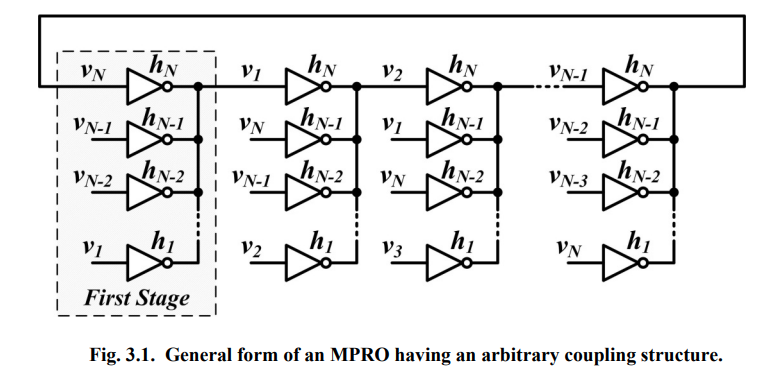
To overcome the limitations of conventional ring oscillators, multi-paths ring oscillator (MPRO) is proposed. Each phase can be driven by two or more inverters, or multi-paths instead of having each phase in oscillator driven by a single inverter, or single path.

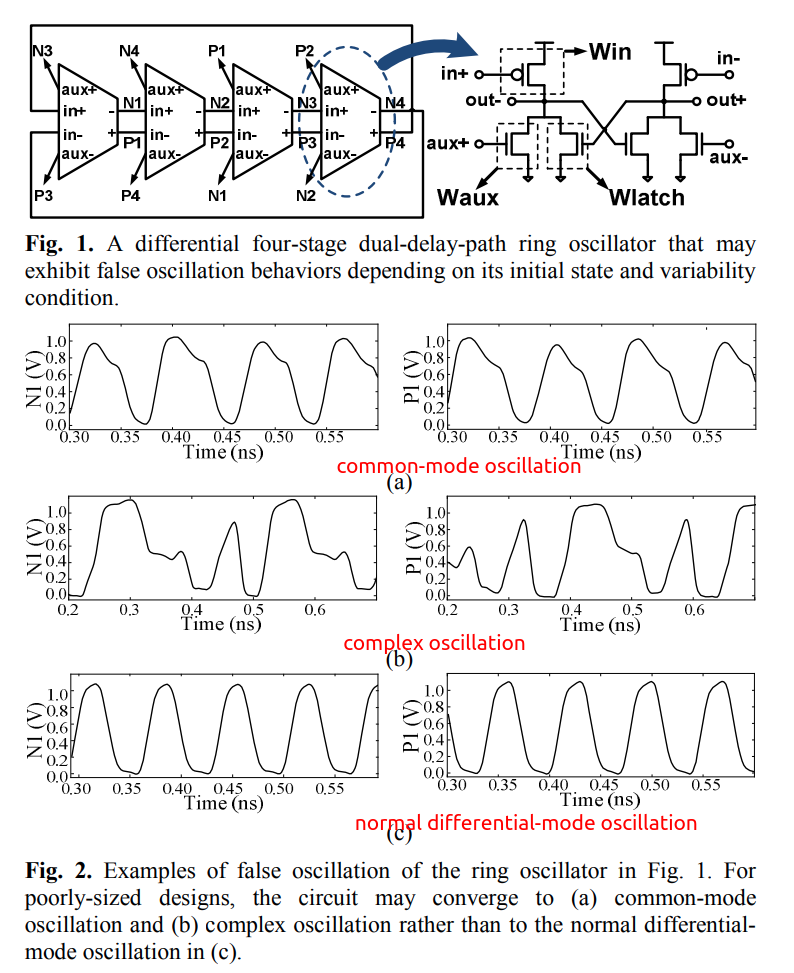
One thing that makes the MPRO design problem even more complicated is its property of having multiple possible oscillation modes. Without a clear understanding of what makes one of these modes dominant, it is very likely that a designer might end-up having an oscillator that can start-up each time in a different oscillation mode depending on the initial state of the oscillator.

image-20220320155440541

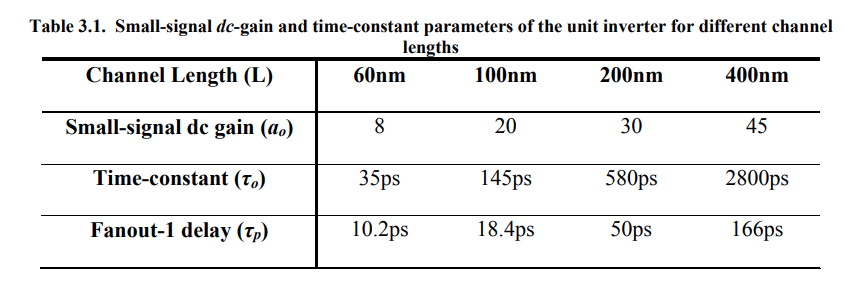
In practive, the oscillator starts first from a linear mode of operation where all the buffers are indeed acting as linear transconductors. All oscillation modes that have mode gains, \(a_n\), lower than the actual dc gain of the inverter, \(a_0\), start to grow. As the oscillation amplitude grows, the effective gain of the inverter drops due to nonlinearity. Consequently, modes with higher mode gain die out and only the mode that requires the minimum gain continues to oscillate and hence is the dominant mode.

The dominant mode is dependent only on the relative sizing vector

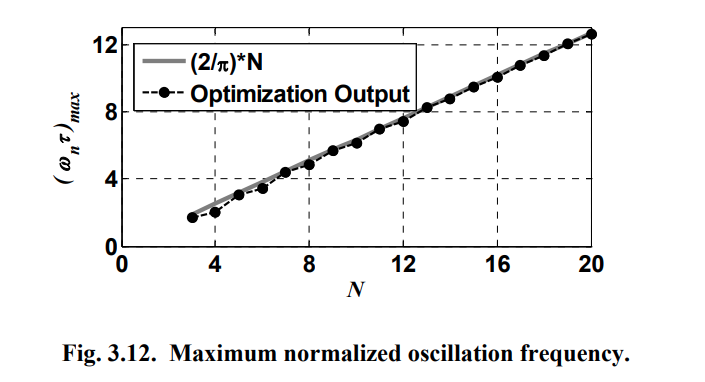
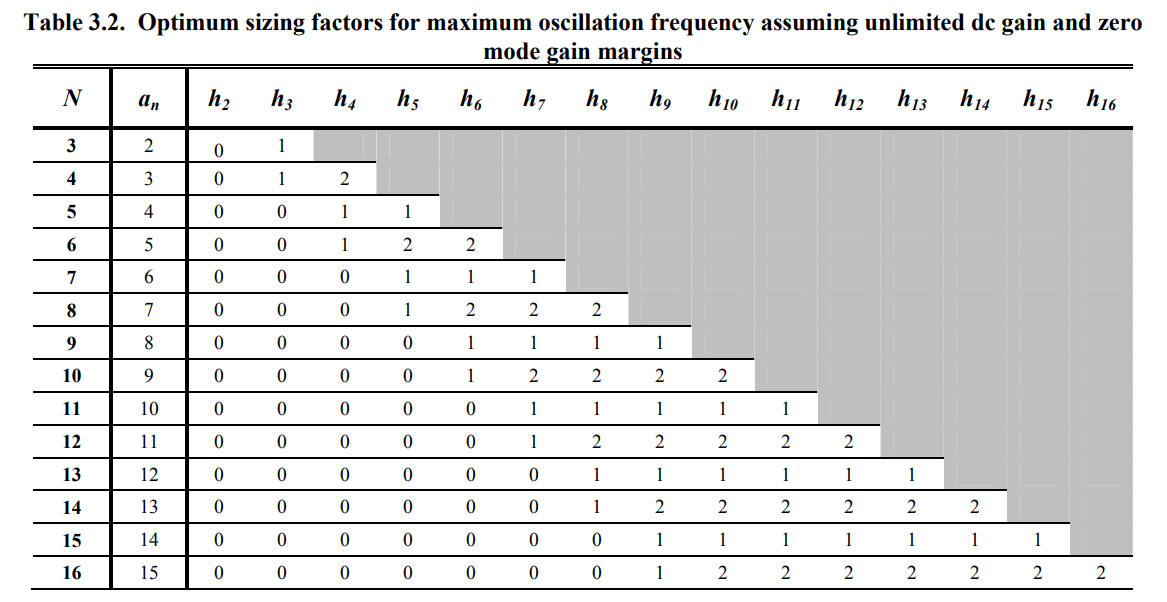
maximum oscillation frequency

The oscillation frequency of the dominant mode of any MPRO having any arbitrary coupling structure and number of phases is \[ f_{n^*} = \frac {1}{2\pi}\frac {(a_0-1) \cdot \sum_{i=1}^{N}x_isin\left ( \frac {2\pi n^*(i-1)}{N} \right)}{(a_0\tau _p - \tau _o)\cdot \sum_{i=1}^{N}-x_icos\left( \frac{2\pi n^*(i-1)}{N}+(\tau _o - \tau _p) \right)} \] image-20220320172952925

A linear increase in the maximum possible normalized oscillation frequency as the number of stages increases provided that the dc gain of the buffer sufficient to provide the required amplification

image-20220320170324494

image-20220320170523390

assuming unlimited dc gain and zero mode gain margins

mode stability

A common problem in MPRO design is the stability of the dominant oscillation mode. Mode stability refers to whether the MPRO always oscillates at the same mode regardless of the initial conditions of the oscillator. This problem is especially pronounced for MPROs with a large number of phases. This is due to the existence of many modes and the very small differences in the value of the mode gain of adjacent modes if the MPRO is not well designed.

In general, when the mode gain difference between two modes is small, the oscillator can operate in either one depending on initial conditions.

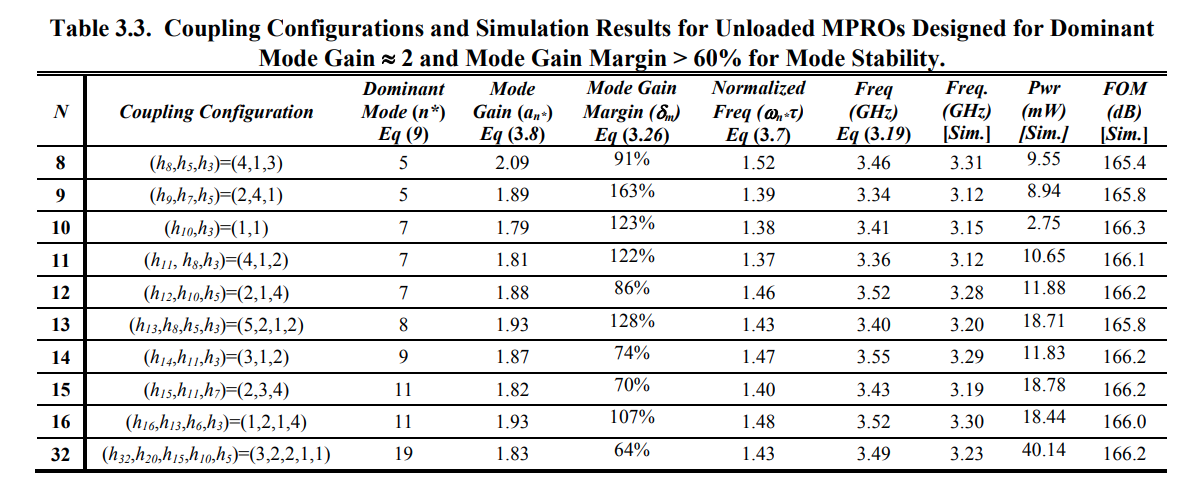
coupling configurations and simulation results

image-20220320165217231

Abou-El-Sonoun, A. A. (2012). High Frequency Multiphase Clock Generation Using Multipath Oscillators and Applications. UCLA. ProQuest ID: AbouElSonoun_ucla_0031D_10684. Merritt ID: ark:/13030/m57p9288. Retrieved from https://escholarship.org/uc/item/75g8j8jt

frequency stability

A problem associated with the design of MPROs is the existence of different possible modes of oscillation. Each of these modes is characterized by a different frequency, phase shift and phase noise.

Linear delay-stage model (mode gain)

mode gain is based on the linear model, independent of process but depends on coupling structure (coupling configuration, size ratio).

The inverting buffer modeled as a linear transconductor. The input-output relationship of a single buffer scaled by \(h_i\) and driving the input capacitance of a similar buffer can be expressed as \[\begin{align} h_ig_mv_{in}(t) + h_ig_oV_{out}(t)+h_iC_g\frac {dV_{out}(t)}{dt} &= 0 \\ a_nV_{in}(t)+V_{out}(t)+\tau \frac {V_{out}(t)}{dt} &= 0 \end{align}\] where \(g_m\) is the transconductance, \(g_o\) is the output conductance, \(C_g\) is the buffer input capacitance which also acts as the load capacitance for the driving buffer, and \(a_n = \frac {g_m}{g_o}\) is the linear dc gain of the buffer, and \(\tau=\frac {C_g}{g_o}\) is a time constant.

Similarly, \(V_1\), the output of the first stage in MPRO can be expressed \[ \sum_{i=1}^{N}h_ig_mV_i(t)+\sum_{i=1}^{N}h_ig_oV_i(t)+\sum_{i=1}^{N}h_iC_g\frac {dV_it(t)}{dt} = 0 \] Defining the fractional sizing factors and the total sizing factor as \(x_i=\frac{h_i}{H}\) and \(H=\sum_{i=1}^{N}h_i\) \[ a_n\sum_{i=1}^{N}x_iV_i(t) + V_1(t)+\tau\frac {dV_i(t)}{dt} = 0 \] where \(a_n = \frac {g_m}{g_o}\) and \(\tau=\frac {C_g}{g_o}\) are same dc gain and time constant defined previously

Since the total phase shift around the loop should be multiples of \(2\pi\), the oscillation waveform at the ith node can be expressed as \[ V_i(t) = V_o \cos(\omega_nt-\Delta \varphi \cdot i) \] where \(\omega_n\) is the oscillation frequency and \(\Delta \varphi = \frac {2\pi n}{N}\), \(N\) is the number of stages in the oscillator and \(n\) can take values between \(0\) and \(N-1\)

Plug \(V_i(t)\) into differential equation, we get \[ a_n\sum_{i=1}^{N}x_i\cos(\omega_n t-\frac{2\pi n}{N}i)+\cos(\omega_n t-\frac{2\pi n}{N}) - \omega_n \tau \sin(\omega_n t-\frac{2\pi n}{N}) = 0 \] By equating the \(cos(\omega_n t)\) and \(sin(\omega_n t)\) terms of the above equation, we get expressions for the oscillation frequency of the nth mode and the minimum dc gain required for this mode to exist. we refer to this gain as the mode gain \[\begin{align} \omega_n\tau &= \frac {\sum_{i=1}^{N}x_i \cdot \sin(\frac{2\pi n}{N}(i-1))}{-\sum_{i=1}^{N}x_i \cdot \cos(\frac{2\pi n}{N}(i-1))} \\ a_n &= \frac {1}{-\sum_{i=1}^{N}x_i \cdot \cos(\frac{2\pi n}{N}(i-1))} \end{align}\] where \(a_n\) should be greater than \(0\) for a existent mode

In practice, the oscillator starts first from a linear mode of operation where all the buffers are indeed acting as linear transconductors. All oscillation modes that have mode gains \(a_n\) lower than the actual dc gain of the inverter \(a_o\) start to grow. As the oscillation amplitude grows, the effective gain of the inverter drops due to nonlinearity. Consequently, modes with higher mode gain die out and only the mode that requires the minimum gain continues to oscillate and hence is the dominant mode

A. A. Hafez and C. K. Yang, "Design and Optimization of Multipath Ring Oscillators," in IEEE Transactions on Circuits and Systems I: Regular Papers, vol. 58, no. 10, pp. 2332-2345, Oct. 2011, doi: 10.1109/TCSI.2011.2142810.

Simulation-based approach

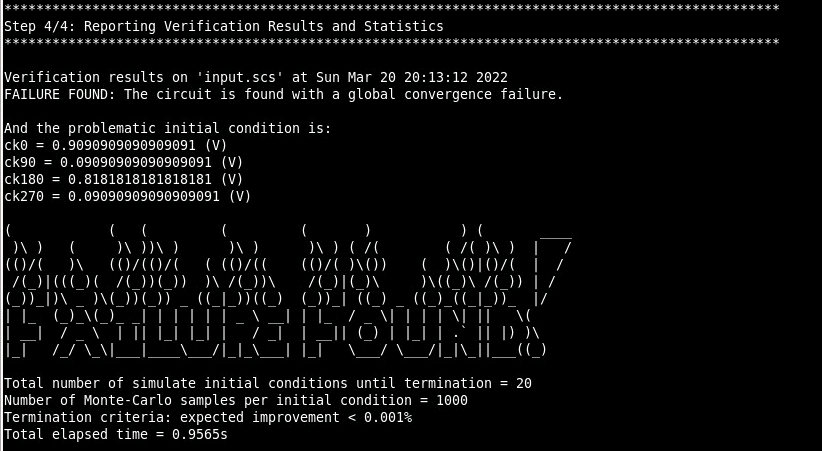
GCHECK is an automated verification tool that validate whether a ring oscillator always converges to the desired mode of operation regardless of the initial conditions and variability conditions. This is the first tool ever reported to address the global convergence failures in presence of variability. It has been shown that the tool can successfully validate a number of coupled ring oscillator circuits with various global convergence failure modes (e.g. no oscillation, false oscillation, and even chaotic oscillation) with reasonable computational costs such as running 1000-point Monte-Carlo simulations for 7~60 initial conditions (maximum 4 hours).

  • The verification is performed using a predictive global optimization algorithm that looks for a problematic initial state from a discretized state space
  • despite the finite number of initial state candidates considered and finite number of Monte-Carlo samples to model variability, the proposed algorithm can verify the oscillator to a prescribed confidence level

image-20220320183344877

  • The observation that the responses of a circuit with nearby initial conditions are strongly correlated with respect to common variability conditions enables us to explore a discretized version of the initial condition space instead of the continuous one.
  • the settling time increases as the initial state gets farther away from the equilibrium state allowed us to use the settling time as a guidance metric to find a problematic initial condition.

Selecting the Next Initial Condition Candidate to Evaluate

To determine whether the algorithm should continue or terminate the search for a new maximum, the algorithm estimates the probability of finding a new initial condition with the longer settling time, based on the information obtained with the previously-evaluated initial conditions.

GCHECK EXAMPLE

1
python gcheck_osc.py input.scs

output log:

1
2
3
4
5
6
7
8
Step 1/4: Simulating the setting-time distribution with the reference initial condition
...
Step 2/4: Simulating the setting-time distribution for randomly-selected initial probes
...
Step 3/4: Searching for Problematic Initial Conditions
...
Step 4/4: Reporting Verification Results and Statistics
...

image-20220320201718018

T. Kim, D. -G. Song, S. Youn, J. Park, H. Park and J. Kim, "Verifying start-up failures in coupled ring oscillators in presence of variability using predictive global optimization," 2013 IEEE/ACM International Conference on Computer-Aided Design (ICCAD), 2013, pp. 486-493 GCHECK: Global Convergence Checker for Oscillators](https://mics.snu.ac.kr/wiki/GCHECK)

PAM-4 Pattern Generation

Keysight Technologies PAM-4 Design Challenges and the Implications on Test [pdf]

PRQS (Pseudo Random Quaternary Sequence)

Ilya Lyubomirsky, Finisar. PRQS Test Patterns for PAM4 [https://www.ieee802.org/3/bs/public/15_09/lyubomirsky_3bs_01_0915.pdf]

TODO 📅

Unipolar & Bipolar Non-Return-to-Zero (NRZ)

Mathuranathan, Line code – demonstration in Matlab and Python [link]

image-20260301001320749

Comparing power spectral densities of bipolar NRZ and unipolar NRZ line codes

  • For unipolar NRZ line coded signal, the average value of the signal is not zero and hence they have a significant DC component

    The DC impulses in the PSD do not carry any information and it also causes the transmission wires to heat up. This is a wastage of communication resource

  • The bipolar NRZ signal is devoid of a significant impulse at the zero frequency (DC component is very close to zero)

    Furthermore, it has more power than the unipolar line code (note: PSD curve for bipolar NRZ is slightly higher compared to that of unipolar NRZ). Therefore, bipolar NRZ signals provide better signal-to-noise ratio (SNR) at the receiver.

Both Unipolar and Bipolar NRZ signal lacks embedded clock information, which posses synchronization problems at the receiver when the binary information has long runs of 0s and 1s

Baseline Wander

David A. Johns, ECE1392H - Integrated Circuits for Digital Communications - Fall 2001 [Equalization]

image-20260228231334894

image-20260228231511629


Pete Anslow, Ciena. Baseline wander with FEC [https://www.ieee802.org/3/bs/public/17_05/anslow_3bs_03_0517.pdf]

Vladimir Dmitriev-Zdorov. Baseline Wander, its Time Domain and Statistical Analysis [https://ibis.org/summits/feb19/dmitriev-zdorov.pdf]

Pavel Zivny, Tektronix. Baseline Wander: Systematic Approach to Rapid Simulation and Measurement [pdf]

Update on Performance Studies of 100 Gigabit Ethernet Enabled by Advanced Modulation Formats [https://www.ieee802.org/3/bm/public/sep12/wei_01_0912_optx.pdf]

Bandwidth of Digital Waveforms

NRZ Bandwidth

Maxim Integrated,NRZ Bandwidth - HF Cutoff vs. SNR [https://pdfserv.maximintegrated.com/en/an/AN870.pdf]

image-20240607221359970

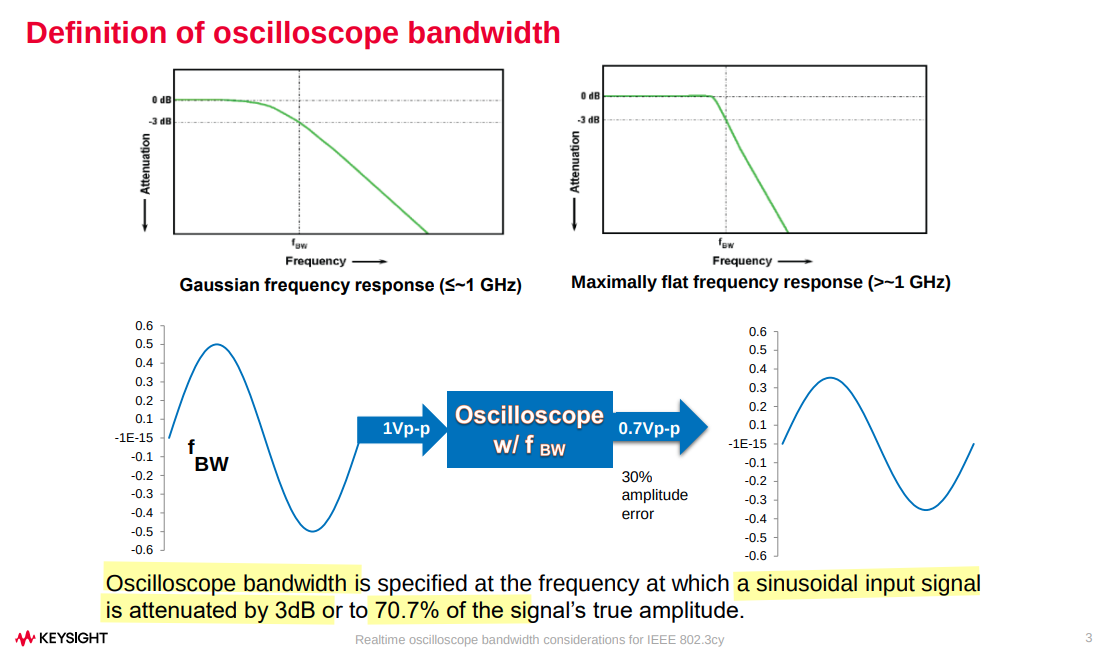
\(0.35/T_r\)

image-20250930165629384


32 to 56 Gbps Serial Link Analysis and Optimization Methods for Pathological Channels [https://docs.keysight.com/eesofapps/files/678068240/678068273/1/1629077956000/tutorial-32-to-56-gbps-serial-link-analysis-optimization-methods-pathological-channels.pdf]
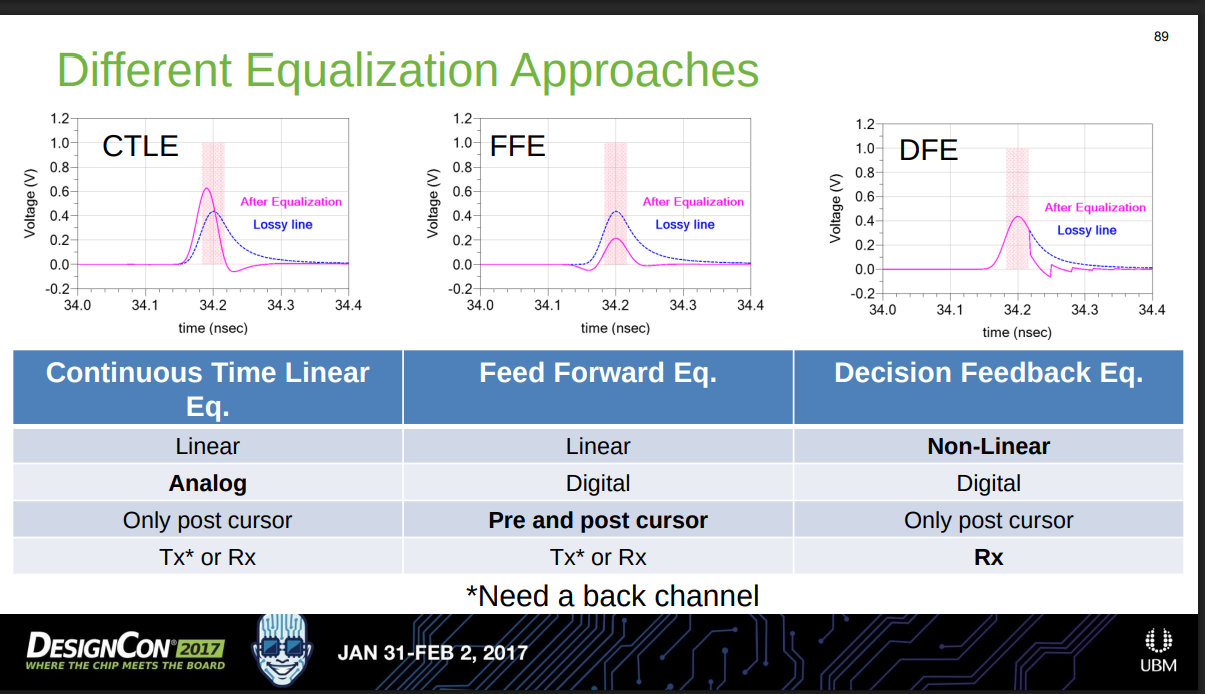
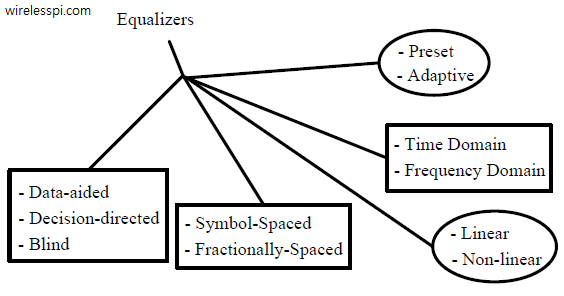
image-20250930165251231

Rise Time Sine Wave \[\begin{align} \sin 2\pi f t_{20} &= -1+2\times 0.2 = -0.6 \\ \sin 2\pi f t_{80} &= -1+2\times 0.8 = 0.6 \end{align}\] \[ f = \frac{\arcsin(0.6) - \arcsin(-0.6)}{2\pi (t_{80} - t_{20})} = \frac{0.2}{T_r} \]

Step Response RC Tank

\[\begin{align} 0.8 &= 1- e^{-\frac{t_{80}}{\tau_{RC}}} \to t_{80} = -\ln0.2 \cdot \tau_{RC} \\ 0.2 &= 1- e^{-\frac{t_{80}}{\tau_{RC}}} \to t_{20} = -\ln0.8 \cdot \tau_{RC} \end{align}\]

Then rise time of 20% to 80% is \[ T_{r} = \tau_{RC}\cdot \ln\frac{0.8}{0.2} = 1.3863 \cdot \tau_{RC} \] we have \[ f_{3dB} = \frac{1}{2\pi}\frac{1}{\tau_{RC}} = \frac{1}{2\pi}\frac{ 1.3863}{T_r} = \frac{0.22}{T_r} \]

Measurements Bandwidth

Minh Quach. 4/30/2004 Signal Integrity Consideration and Analysis -Frequency & Time Domain Measurements/Analysis [https://ewh.ieee.org/r5/denver/sscs/Presentations/2004_04_Quach.pdf]

image-20251213013257369

image-20251213013352969

image-20251213094209563

CMI & DMI

Ahmed Sada Staff Silicon Validation Engineer, Synopsys. Don't Be Intimidated: Manual Calibration for Stressed Eye Testing

Patrick Kennedy, Impact of Noise Coupler on 128 GT/s Rx Calibration and DUT Testing

Anritsu White paper: PCIe® 6.0: Testing for a New Generation [link]

sinusoidal differential mode interference (DMI), and common mode interference (CMI)

image-20250904225444111

image-20250904223855075


image-20250904204007383


Mike Dudek Marvell, Differential-mode to Common-mode and Common-mode to Differential-mode reflection specifications [https://www.ieee802.org/3/dj/public/25_07/dudek_3dj_01_2507.pdf]

Ali Ghiasi Ghiasi Quantum LLC, Differential, Conversion, and Common Mode Return Losses [https://www.ieee802.org/3/ck/public/20_07/ghiasi_3ck_03a_0720.pdf]

TODO 📅

Single-Ended & Differential Signaling

[https://web.stanford.edu/class/archive/ee/ee371/ee371.1066/handouts/markChapt.pdf]

image-20250817110423246

image-20250817111312267

image-20250817111157827


[https://www.allaboutcircuits.com/technical-articles/the-why-and-how-of-differential-signaling/]

image-20250817110059363

Since we have (ideally) no return current, the ground reference becomes less important. The ground potential can even be different at the sender and receiver or moving around within a certain acceptable range. However, you need to be careful because DC-coupled differential signaling (such as USB, RS-485, CAN) generally requires a shared ground potential to ensure that the signals stay within the interface's maximum and minimum allowable common-mode voltage.

Low-Latency PCIe

TODO 📅

AC-coupling vs DC-coupling

TODO 📅

PAM4

image-20250607083851955

image-20240808205451067

image-20240808205635598

Eye-Diagram and Bit-Error-Ratio (BER)

image-20250607082220455

image-20250607082510464

Noman Hai, Synopsys. CICC 2025 Circuit Insights: Basics of Wireline Transmitter Circuits [https://youtu.be/oofViBGlrjM]

JTOL btw DSP-based vs Analog PAM4 RX

image-20250525110540570

CC Chen, Why Analog PAM4 Receiver? [https://youtu.be/J2ojSMYiuBs]

challenges in DSP-based SerDes

image-20250524224829419

Parallel implementation

image-20250524235031104

image-20250525101922485

Loop-Unrolling DFE

image-20250525105017605

image-20250525191101301

Corresponding to the three distinct voltage thresholds in the PAM4 systems, it would need 12 slicers, 3 multiplexers, and one thermometer-to-binary decoder in each deserialized data path, even if only one tap of the DFE is unrolled

Look-Ahead Multiplexing DFE

image-20250525151918214

The look-ahead multiplexing technique brings the key benefit that the timing constraint can be significantly relaxed, as the iteration bound is doubled at the expense of extra hardware

image-20250525192228275

Synopsys Italia, Tech Talk: Introduction to DSP-based SerDes [https://youtu.be/puEP0DlVZGI]

Chen, Kuan-Chang (2022) Energy-Efficient Receiver Design for High-Speed Interconnects. Dissertation (Ph.D.), California Institute of Technology. [https://thesis.library.caltech.edu/14318/9/chen_kuan-chang_2022_thesis_final.pdf]

Forward Error Correction (FEC)

It is called "forward" error correction because it can correct errors even in the common situations where there is no backward channel

image-20250527212624165

Keysight Technologies. Tutorial – Why Use Forward Error Correction (FEC) [https://youtu.be/56nF4c61KR0]

Paul McLellan, What the FEC is Forward Error Correction? [https://community.cadence.com/cadence_blogs_8/b/breakfast-bytes/posts/fec]

DSP-Based SerDes

Tony Chan Carusone, Alphawave Semi. VLSI2025 SC2: Connectivity Technologies to Accelerate AI

image-20250706104500363


Jitter Performance Limitations

image-20250706110637804

Aliasing of baud-rate sampling

The most significant impairments are considered to be the sensitivity to sampling phase, and the effect of aliasing out of band signal and noise into the baseband

image-20250706103107037

image-20250706103231832

Tao Gui (Huawei), etc.. IEEE 802.3dj May Interim meeting San Antonio, Texas May 15, 2013: "Feasibility Study on Baud-Rate Sampling and Equalization (BRSE) for 800G-LR1" [https://www.ieee802.org/3/dj/public/23_05/gui_3dj_01a_2305.pdf]

D. S. Millar, D. Lavery, R. Maher, B. C. Thomsen, P. Bayvel and S. J. Savory, "A baud-rate sampled coherent transceiver with digital pulse shaping and interpolation,"in OFC 2013 [https://www.merl.com/publications/docs/TR2013-010.pdf]


image-20250706111818147

Tahmoureszadeh, Tina. Master's Theses (2009 - ): Analog Front-end Design for 2x Blind ADC-based Receivers [http://hdl.handle.net/1807/29988]

image-20250706113229251

Shafik, Ayman Osama Amin Mohamed. "Equalization Architectures for High Speed ADC-Based Serial I/O Receivers." PhD diss., 2016. [https://core.ac.uk/download/79652690.pdf]

ISI & DDJ filtering

image-20250104183820308

Modulation and SNR

Data and noise mutually uncorrelated

\[ x_{RX,n}[p] = d[p]h_{RX}[0] +\sum \text{ISI} + n[p] \]

image-20250101105936807

image-20250101110902006

"ISI cancellation" based equalization is conceptually more straightforward but suffers from SNR penalty or error propagation

Jitter Amplification by Passive Channels

image-20250103215417021

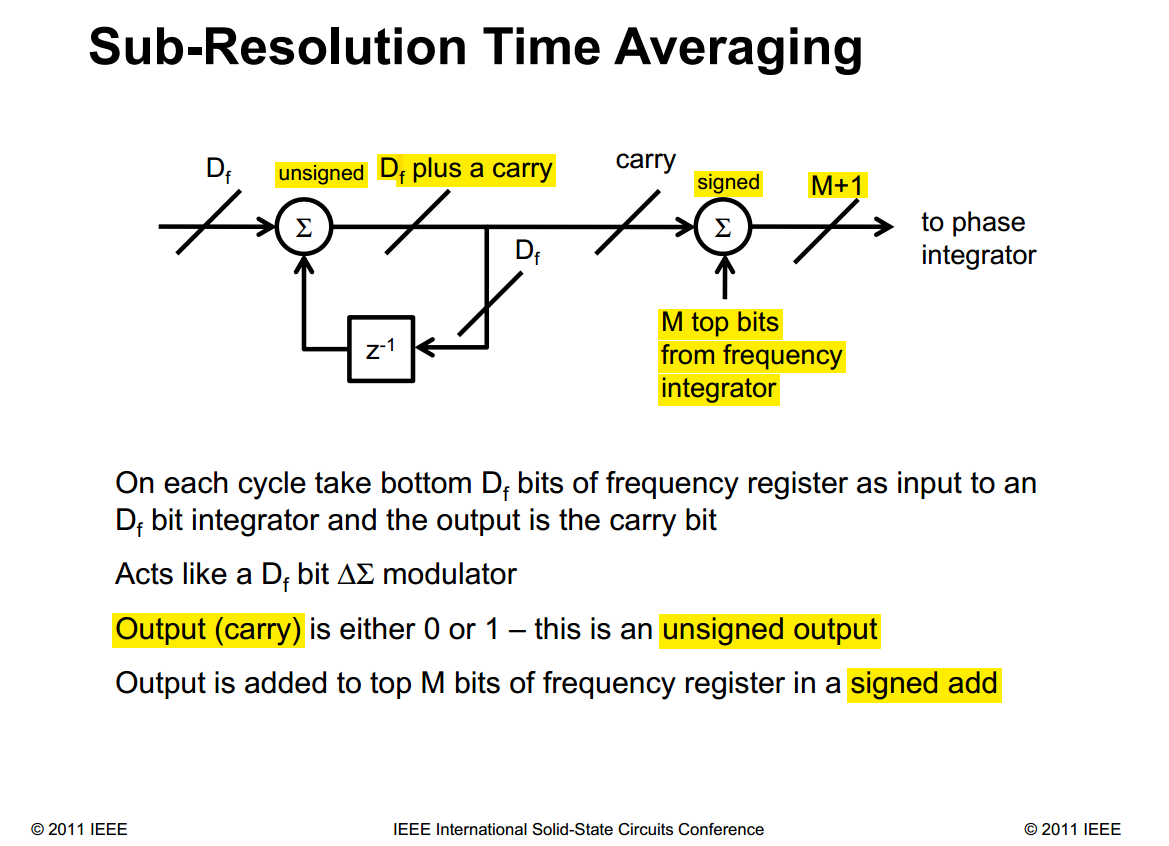
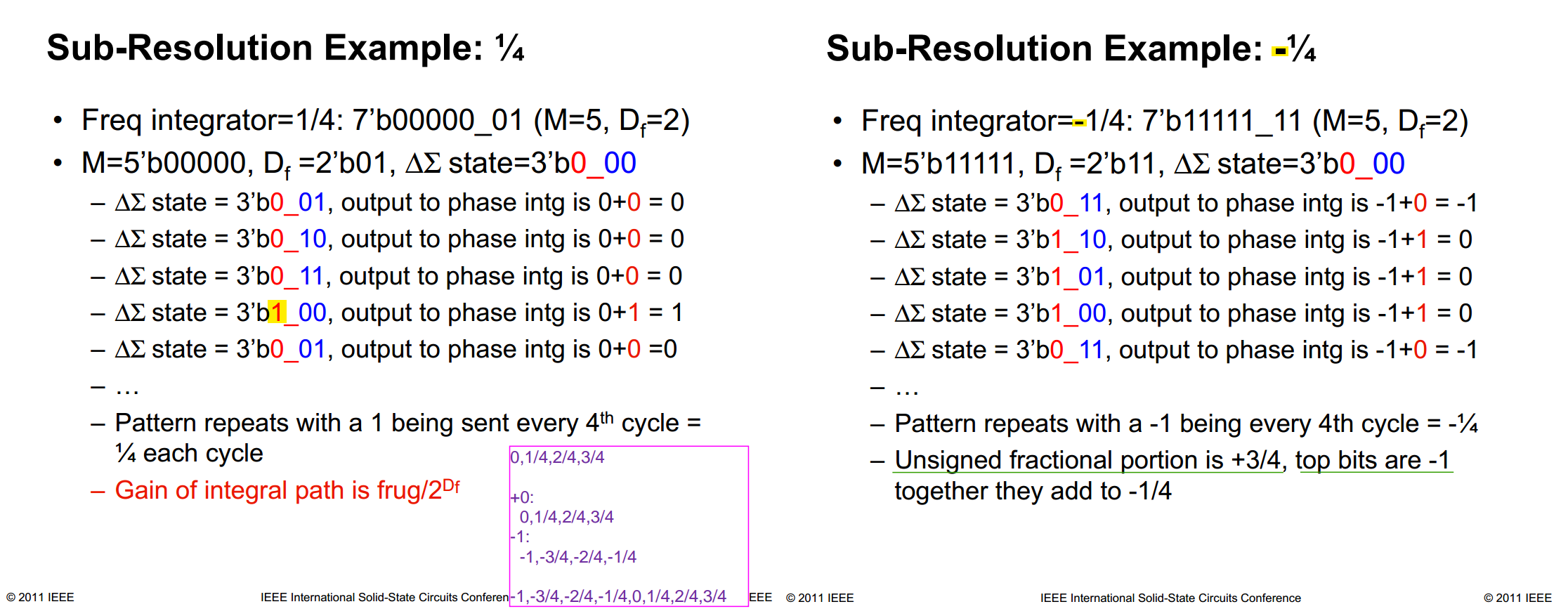
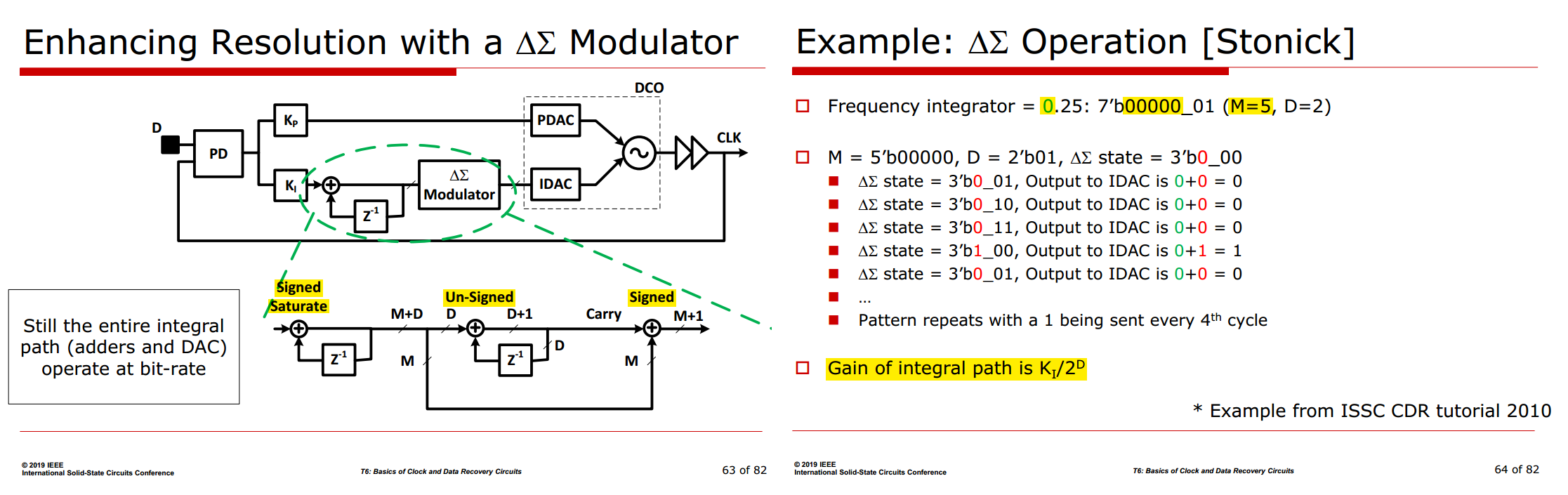
Enhancing Resolution with a \(\Delta \Sigma\) Modulator

Sub-Resolution Time Averaging

image-20241103160332995

\(\Delta \Sigma\) modulator effectively dithers the LSB bit between zero and one, such that you can get the effective resolution of a much higher resolution DAC in the number of bits

Decimation

how they affect sampling phase

image-20241020140430663

DLF's input bit-width can be reduced by decimating BBPD's output. Decimation is typically performed by realizing either majority voting (MV) or boxcar filtering.

Note that deserialization is inherent to both MV and boxcar filtering

image-20241019225016868

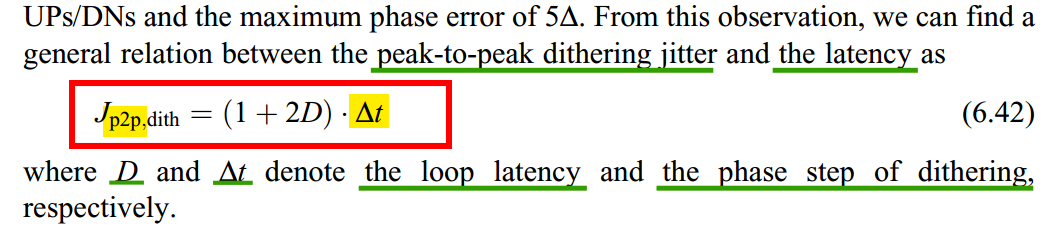
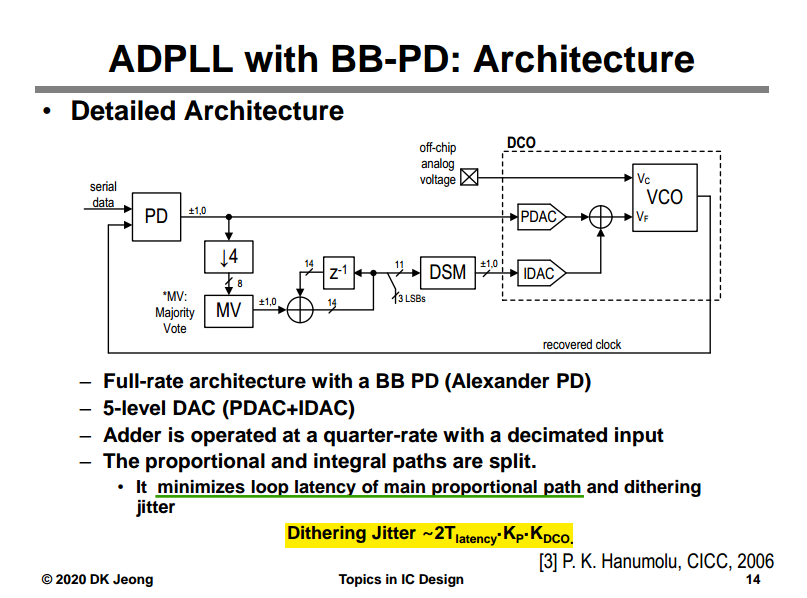
  • Decimation is commonly employed to alleviate the high-speed requirement. However, decimation increases loop-latency which causes excessive dither jitter.
  • Decimation is basically, widen the data and slowing it down
  • Decimating by \(L\) means frequency register only added once every \(L\) UI, thus integral path gain reduced by \(L\) in linear model
  • proportional path gain is unchanged

intg_path_decim.drawio

CDR Linear Model

image-20220504101924272

condition:

Linear model of the CDR is used in a frequency lock condition and is approaching to achieve phase lock

Using this model, the power spectral density (PSD) of jitter in the recovered clock \(S_{out}(f)\) is \[ S_{out}(f)=|H_T(f)|^2S_{in}(f)+|H_G(f)|^2S_{VCO}(f) \] Here, we assume \(\varphi_{in}\) and \(\varphi_{VCO}\) are uncorrelated as they come from independent sources.

Jitter Transfer Function (JTF)

\[ H_T(s) = \frac{\varphi_{out}(s)}{\varphi_{in}(s)}|_{\varphi_{vco}=0}=\frac{K_{PD}K_{VCO}R_s+\frac{K_{PD}K_{VCO}}{C}}{s^2+K_{PD}K_{VCO}R_s+\frac{K_{PD}K_{VCO}}{C}} \]

Using below notation \[\begin{align} \omega_n^2=\frac{K_{PD}K_{VCO}}{C} \\ \xi=\frac{K_{PD}K_{VCO}}{2\omega_n^2} \end{align}\]

We can rewrite transfer function as follows \[ H_T(s)=\frac{2\xi\omega_n s+\omega_n^2}{s^2+2\xi \omega_n s+\omega_n^2} \]

The jitter transfer represents a low-pass filter whose magnitude is around 1 (0 dB) for low jitter frequencies and drops at 20 dB/decade for frequencies above \(\omega_n\)

image-20220504104202197

  • the recovered clock track the low-frequency jitter of the input data
  • the recovered clock DONT track the high-frequency jitter of the input data

The recovered clock does not suffer from high-frequency jitter even though the input signal may contain high-frequency jitter, which will limit the CDR tolerance to high-frequency jitter.

Jitter Peaking in Jitter Transfer Function

The peak, slightly larger than 1 (0dB) implies that jitter will be amplified at some frequencies in the CDR, producing a jitter amplitude in the recovered clock, and thus also in the recovered data, that is slightly larger than the jitter amplitude in the input data.

This is certainly undesirable, especially in applications such as repeaters.

image-20220504110722442

Jitter Generation

If the input data to the CDR is clean with no jitter, i.e., \(\varphi_{in}=0\), the jitter of the recovered clock comes directly from the VCO jitter. The transfer function that relates the VCO jitter to the recovered clock jitter is known as jitter generation. \[ H_G(s)=\frac{\varphi_{out}}{\varphi_{VCO}}|_{\varphi_{in}=0}=\frac{s^2}{s^2+2\xi \omega_n s+\omega_n^2} \] Jitter generation is high-pass filter with two zeros, at zero frequency, and two poles identical to those of the jitter transfer function

image-20220504110737718

Jitter Tolerance (JTOL)

To quantify jitter tolerance, we often apply a sinusoidal jitter of a fixed frequency to the CDR input data and observe the BER of the CDR

The jitter tolerance curve DONT capture a CDR's true tolerance to random jitter. Because we are applying "sinusoidal" jitter, which is deterministic signal.

We can deal only with the jitter's amplitude and frequency instead of the PSD of the jitter thanks to deterministic sinusoidal jitter signal. \[ JTOL(f) = \left | \varphi_{in}(f) \right |_{\text{pp-max}} \quad \text{for a fixed BER} \] Where the subscript \(\text{pp-max}\) indicates the maximum peak-to-peak amplitude. We can further expand this equation as follows \[ JTOL(f)=\left| \frac{\varphi_{in}(f)}{\varphi_{e}(f)} \right| \cdot |\varphi_e(f)|_\text{pp-max} \] image-20250627204121289

Relative jitter, \(\varphi_e\) must be less than 1UIpp for error-free operation

In an ideal CDR, the maximum peak-to-peak amplitude of \(|\varphi_e(f)|\) is 1UI, i.e.,\(|\varphi_e(f)|_\text{pp-max}=1UI\)

Accordingly, jitter tolerance can be expressed in terms of the number of UIs as \[ JTOL(f)=\left| \frac{\varphi_{in}(f)}{\varphi_{e}(f)} \right|\quad \text{[UI]} \] Given the linear CDR model, we can write \[ JTOL(f)=\left| 1+\frac{K_{PD}K_{VCO}H_{LF}(f)}{j2\pi f} \right|\quad \text{[UI]} \] Expand \(H_{LF}(f)\) for the CDR, we can write \[ JTOL(f)=\left| 1-2\xi j \left(\frac{f_n}{f}\right) - \left(\frac{f_n}{f}\right)^2 \right|\quad \text{[UI]} \] At frequencies far below and above the natural frequency, the jitter tolerance can be approximated by the following \[ JTOL(f) = \left\{ \begin{array}{cl} \left(\frac{f_n}{f}\right)^2 & : \ f\ll f_n \\ 1 & : \ f\gg f_n \end{array} \right. \]

the jitter tolerance at very high jitter frequencies is limited to 1UIpp

image-20250627212710868

1
2
3
4
5
6
7
8
9
10
11
12
13
14
clc;
clear all;

f_fn = logspace(-1, 2, 60);
for xi = [2, 1, 0.5, 0.2]
jtol = abs(1- 1i*2*xi.*(1./f_fn)- (1./f_fn).^2);
loglog(f_fn, jtol,LineWidth=2)
disp(["min(JTpp)=", min(jtol),"@\xi=",xi])
hold on
end
grid on;
xlabel("f/f_n")
ylabel('JT_{pp}')
legend('\xi=2', '\xi=1', '\xi=0.5', '\xi=0.2')

CC Chen, Circuit Images: Why JTOL in a CDR? [https://youtu.be/kZExm9wy0G8]
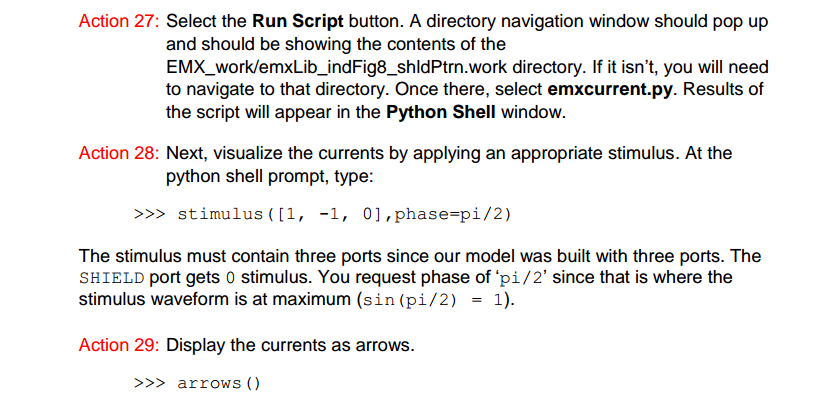
—. Why Pseudo-JTOL in a CDR Design or Verification? [https://youtu.be/DZyzLhk59aY]
image-20250627202659095

image-20250627203101366

image-20250627203654688

OJTF

Concepts of JTF and OJTF

Simplified Block Diagram of a Clock-Recovery PLL pll_block_diagram

Jitter Transfer Function (JTF)

  • Input Signal Versus Recovered Clock
  • JTF, by jitter frequency, compares how much input signal jitter is transferred to the output of a clock-recovery's PLL (recovered clock)
    • Input signal jitter that is within the clock recovery PLL's loop bandwidth results in jitter that is faithfully transferred (closed-loop gain) to the clock recovery PLL's output signal. JTF in this situation is approximately 1.
    • Input signal jitter that is outside the clock recovery PLL's loop bandwidth results in decreasing jitter (open-loop gain) on the clock recovery PLL's output, because the jitter is filtered out and no longer reaches the PLL's VCO

Observed Jitter Transfer Function

  • Input Signal Versus Sampled Signal
  • OJTF compares how much input signal jitter is transferred to the output of a receiver's decision making circuit as effected by a clock recovery's PLL. As the recovered clock is the reference for detecting the input signal
    • Input signal jitter that is within the clock recovery PLL's loop bandwidth results in jitter on the recovered clock which reduces the amount of jitter that can be detected. The input signal and clock signal are closer in phase
    • Input signal jitter that is outside the clock recovery PLL's loop bandwidth results in reduced jitter on the recovered clock which increases the amount of jitter that can be detected. The input signal and clock signal are more out of phase. Jitter that is on both the input and clock signals can not detected or is reduced

JTF and OJTF for 1st Order PLLs

jsa_1st_order_graph

neuhelium-jtf-ojtf

The observed jitter is a complement to the PLL jitter transfer response OJTF=1-JTF (Phase matters!)

OTJF gives the amount of jitter which is tracked and therefore not observed at the output of the CDR as a function of the jitter rate applied to the input.

A-jtf-ojtf

Jitter Measurement

\[ J_{\text{measured}} = JTF_{\text{DUT}} \cdot OJTF_{\text{instrument}} \]

The combination of the OJTF of a jitter measurement device and the JTF of the clock generator under test gives the measured jitter as a function of frequency.

image-20220716094732273

For example, a clock generator with a type 1, 1st order PLL measured with a jitter measurement device employing a golden PLL is \[ J_{\text{measured}} = \frac{\omega_1}{s+\omega_1}\frac{s}{s+\omega_2} \]

Accurate measurement of the clock JTF requires that the OJTF cutoff of the jitter measurement be significantly below that of the clock JTF and that the measurement is compensated for the instrument's OJTF.

The overall response is a band pass filter because the clock JTF is low pass and the jitter measurement device OJTF is high pass.

The compensation for the instrument OJTF is performed by measuring the jitter of the reference clock at each jitter rate being tested and comparing the reference jitter with the jitter measured at the output of the DUT.

jtf-ojtf

The lower the cutoff frequency of the jitter measurement device the better the accuracy of the measurement will be.

The cutoff frequency is limited by several factors including the phase noise of the DUT and measurement time.

Digital Sampling Oscilloscope

How to analyze jitter:

  • TIE (Time Interval Error) track
  • histogram
  • FFT

TIE track provides a direct view of how the phase of the clock evolves over time.

histogram provides valuable information about the long term variations in the timing.

FFT allows jitter at specific rates to be measured down to the femto-second range.

Maintaining the record length at a minimum of \(1/10\) of the inverse of the PLL loop bandwidth minimizes the response error

reference

Dalt, Nicola Da and Ali Sheikholeslami. “Understanding Jitter and Phase Noise: A Circuits and Systems Perspective.” (2018).

neuhelium, 抖动、眼图和高速数字链路分析基础 URL: http://www.neuhelium.com/ueditor/net/upload/file/20200826/DSOS254A/03.pdf

Keysight JTF & OJTF Concepts, https://rfmw.em.keysight.com/DigitalPhotonics/flexdca/FlexPLL-UG/Content/Topics/Quick-Start/jtf-pll-theory.htm?TocPath=Quick%20Start%7C_____4

Complementary Transmitter and Receiver Jitter Test Methodlogy, URL: https://www.ieee802.org/3/bm/public/mar14/ghiasi_01_0314_optx.pdf

SerDesDesign.com CDR_BangBang_Model URL: https://www.serdesdesign.com/home/web_documents/models/CDR_BangBang_Model.pdf

M. Schnecker, Jitter Transfer Measurement in Clock Circuits, LeCroy Corporation, DesignCon 2009. URL: http://cdn.teledynelecroy.com/files/whitepapers/designcon2009_lecroy_jitter_transfer_measurement_in_clock_circuits.pdf

VCO model

TODO 📅

respone to vctrl focus on phase

[https://designers-guide.org/verilog-ams/functional-blocks/vco/vco.va]

ADC Spec

TODO 📅

ENOB - Not sufficient & not accurate enough

  • Based on SNDR
  • Assume unbounded Gaussian distribution

quantization noise is ~ bounded uniform distribution

Using unbounded Gaussian -> pessimistic BER prediction

AFE Nonlinearity

"total harmonic distortion" (THD) in AFE

Relative to NRZ-based systems, PAM4 transceivers require more stringent circuit linearity, equalizers which can implement multi-level inter-symbol interference (ISI) cancellation, and improved sensitivity

image-20240923204055369

Because if it compresses, it turns out you have to use a much more complicated feedback filter. As long as it behaves linearly, the feedback filter itself can remain a linear FIR

image-20240923211841053

Linearity can actually be a critical constraint in these signal paths, and you really want to stay as linear as you can all the way up until the point where you've canceled all of the ISI

image-20240923222650556

A. Roshan-Zamir, O. Elhadidy, H. -W. Yang and S. Palermo, "A Reconfigurable 16/32 Gb/s Dual-Mode NRZ/PAM4 SerDes in 65-nm CMOS," in IEEE Journal of Solid-State Circuits, vol. 52, no. 9, pp. 2430-2447, Sept. 2017 [https://people.engr.tamu.edu/spalermo/ecen689/2017_reconfigurable_16_32Gbps_NRZ_PAM4_SERDES_roshanzamir_jssc.pdf]

Hongtao Zhang, designcon2016. "PAM4 Signaling for 56G Serial Link Applications − A Tutorial"[https://www.xilinx.com/publications/events/designcon/2016/slides-pam4signalingfor56gserial-zhang-designcon.pdf]

Elad Alon, ISSCC 2014, "T6: Analog Front-End Design for Gb/s Wireline Receivers"

BER with Quantization Noise

image-20240804110522955

\[ \text{Var}(X) = E[X^2] - E[X]^2 \]

image-20240804110235178

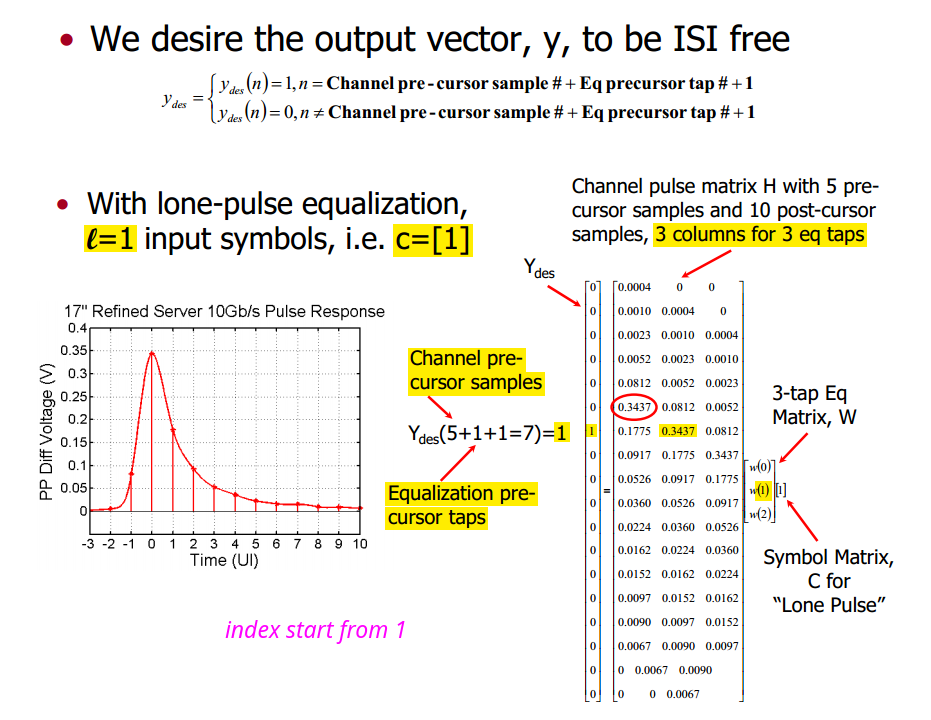
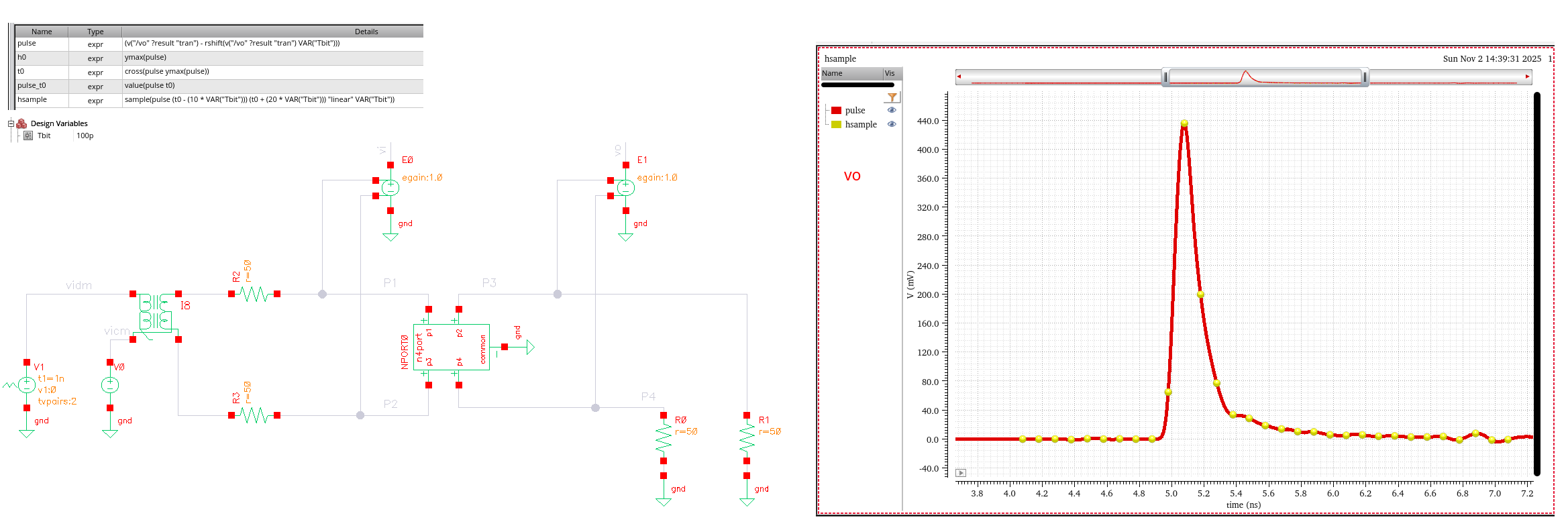
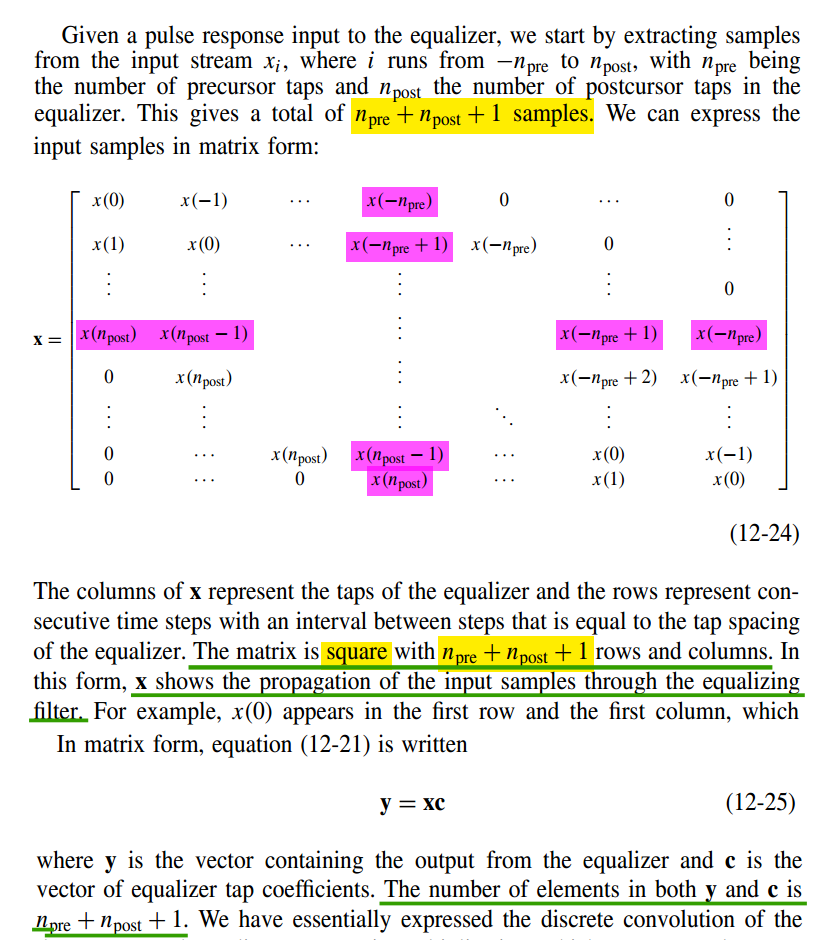
Impulse Response or Pulse Response

image-20240807221637401

image-20240807224407213image-20240807224505987

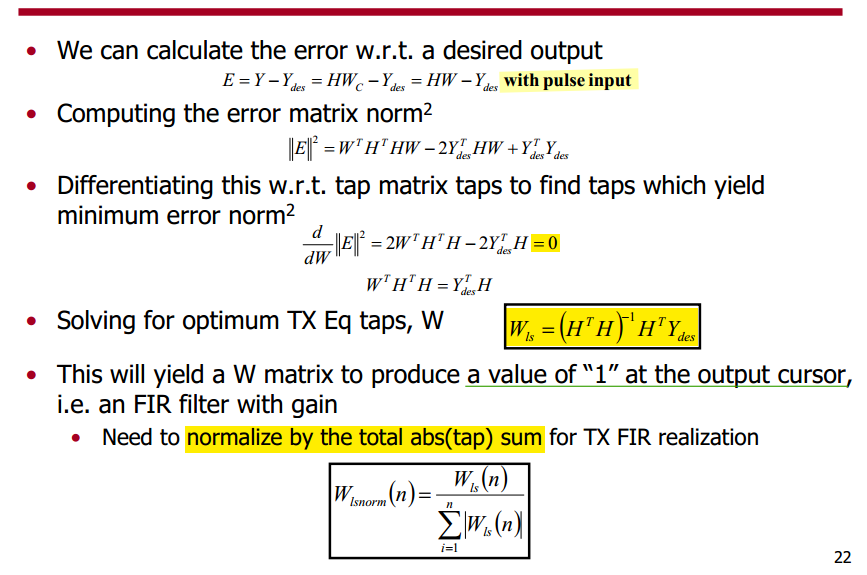
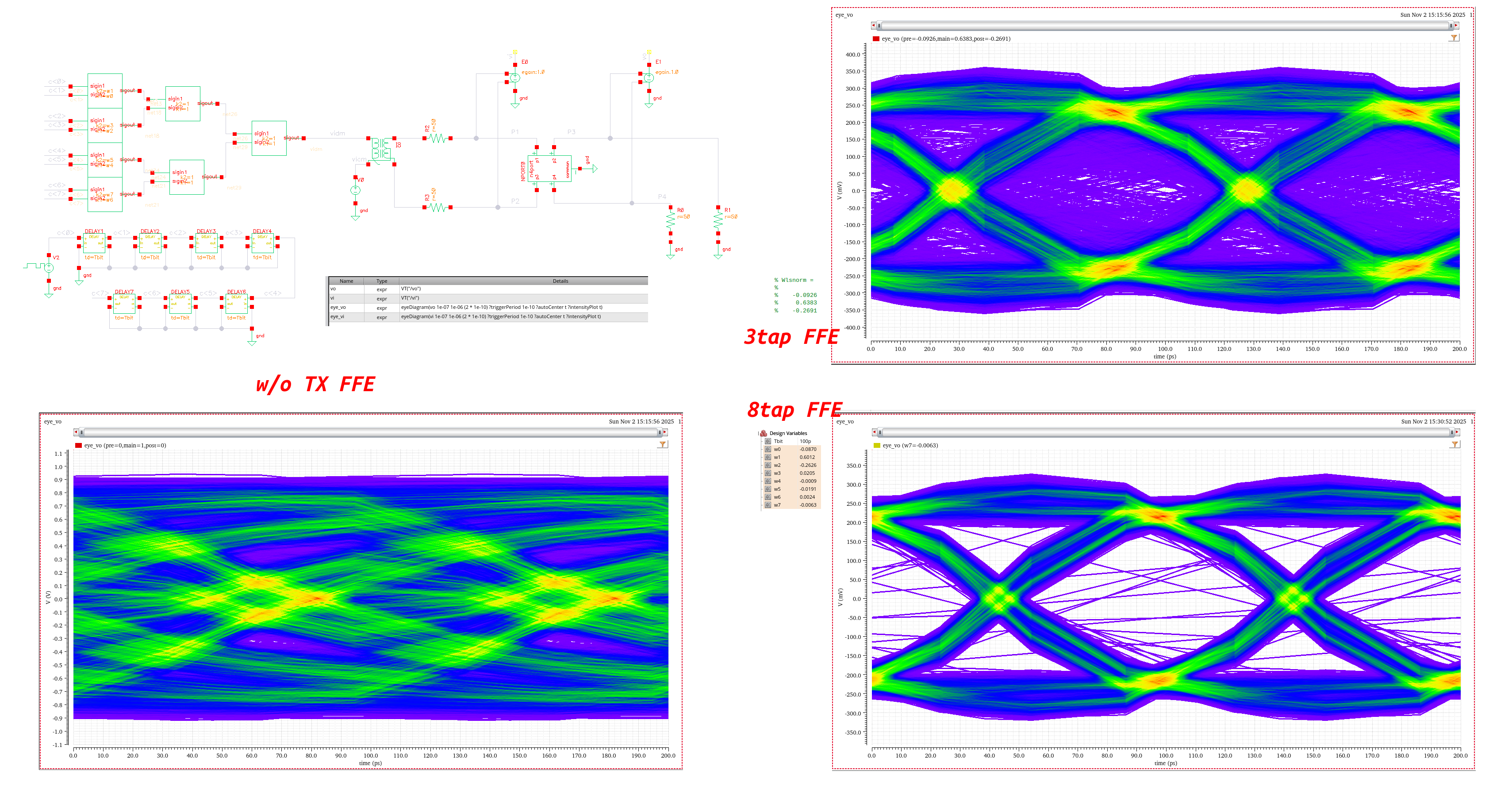
TX FFE

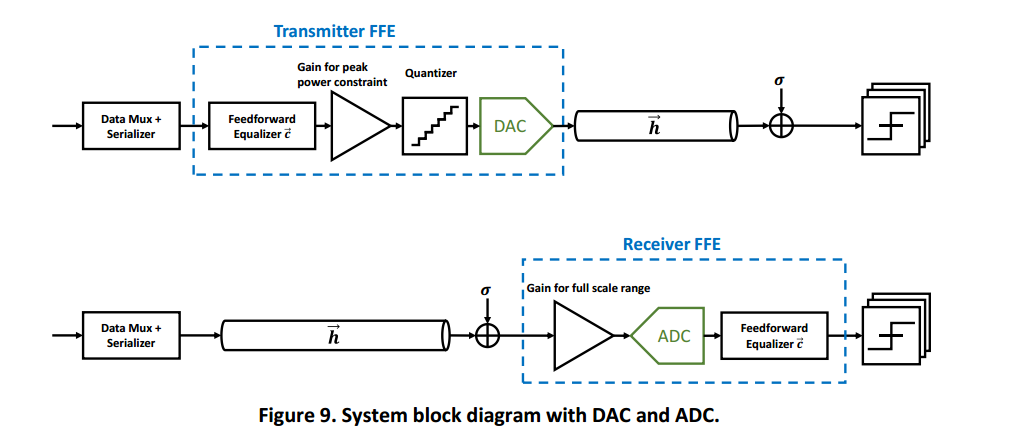
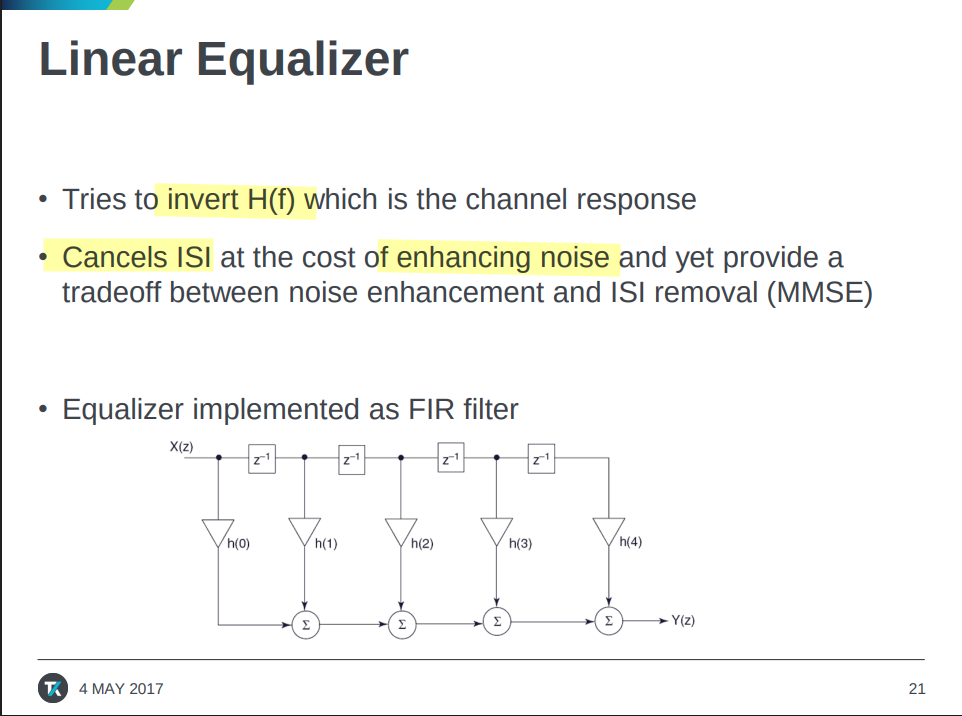
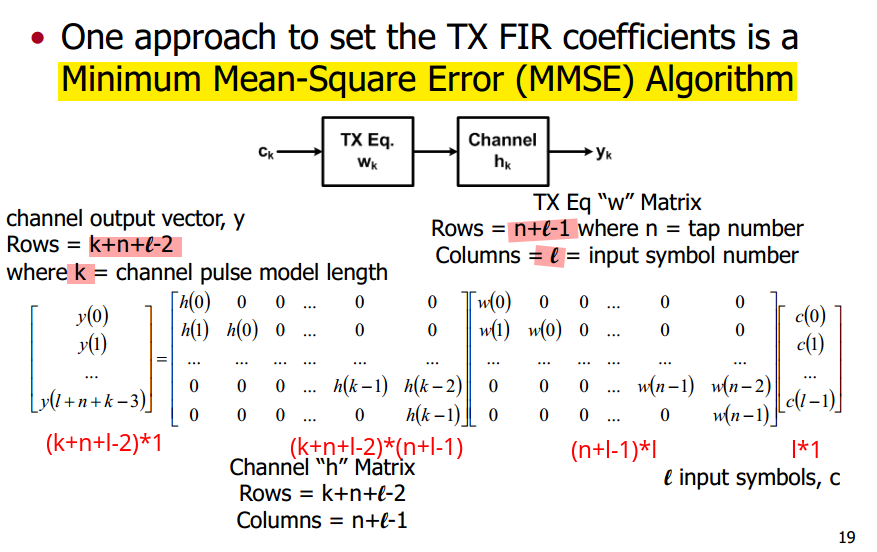
TX FFE suffers from the peak power constraint, which in effect attenuates the average power of the outgoing signal - the low-frequency signal content has been attenuated down to the high-frequency level

image-20240727225120002

[https://www.signalintegrityjournal.com/articles/1228-feedforward-equalizer-location-study-for-high-speed-serial-systems]

S. Palermo, "CMOS Nanoelectronics Analog and RF VLSI Circuits," Chapter 9: High-Speed Serial I/O Design for Channel-Limited and Power-Constrained Systems, McGraw-Hill, 2011.

Eye-Opening Monitor (EOM)

An architecture that evaluates the received signal quality

data slicers, phase slicers, error slicers, scope slicers

image-20240922143125270

image-20240922144605196

Analui, Behnam & Rylyakov, Alexander & Rylov, Sergey & Meghelli, Mounir & Hajimiri, Ali. (2006). A 10-Gb/s two-dimensional eye-opening monitor in 0.13-??m standard CMOS. Solid-State Circuits, IEEE Journal of. 40. 2689 - 2699, [https://chic.caltech.edu/wp-content/uploads/2013/05/B-Analui_JSSC_10-Gbs_05.pdf]

reference

G. Balamurugan, A. Balankutty and C. -M. Hsu, "56G/112G Link Foundations Standards, Link Budgets & Models," 2019 IEEE Custom Integrated Circuits Conference (CICC), Austin, TX, USA, 2019, pp. 1-95 [https://youtu.be/OABG3u2H2J4] [https://picture.iczhiku.com/resource/ieee/SHKhwYfGotkIymBx.pdf]

Paul Muller Yusuf Leblebici École Polytechnique Fédérale de Lausanne (EPFL). Pattern generator model for jitter-tolerance simulation; VHDL-AMS models

Anritsu Company, "Measuring Channel Operating Margin," 2016. [https://dl.cdn-anritsu.com/en-us/test-measurement/files/Technical-Notes/White-Paper/11410-00989A.pdf]

Kiran Gunnam, Selected Topics in RF, Analog and Mixed Signal Circuits and Systems

H. Shakiba, D. Tonietto and A. Sheikholeslami, "High-Speed Wireline Links-Part I: Modeling," in IEEE Open Journal of the Solid-State Circuits Society, vol. 4, pp. 97-109, 2024 [https://ieeexplore.ieee.org/stamp/stamp.jsp?arnumber=10608184]

H. Shakiba, D. Tonietto and A. Sheikholeslami, "High-Speed Wireline Links-Part II: Optimization and Performance Assessment," in IEEE Open Journal of the Solid-State Circuits Society, vol. 4, pp. 110-121, 2024 [https://ieeexplore.ieee.org/stamp/stamp.jsp?tp=&arnumber=10579874]

G. Souliotis, A. Tsimpos and S. Vlassis, "Phase Interpolator-Based Clock and Data Recovery With Jitter Optimization," in IEEE Open Journal of Circuits and Systems, vol. 4, pp. 203-217, 2023 [https://ieeexplore.ieee.org/stamp/stamp.jsp?tp=&arnumber=10184121]

loop dynamic

Hanumolu, Pavan Kumar. 2006. Design Techniques for Clocking High Performance Signaling Systems. : Oregon State University. https://ir.library.oregonstate.edu/concern/graduate_thesis_or_dissertations/1v53k219r]

Hae-Chang Lee, "An Estimation Approach To Clock And Data Recovery" [https://www-vlsi.stanford.edu/people/alum/pdf/0611_HaechangLee_Phase_Estimation.pdf]

R. Walker, “Designing Bang-Bang PLLs for Clock and Data Recovery in Serial Data Transmission Systems,” in Phase-Locking in High-Performance Systems, B. Razavi, Ed. New Jersey: IEEE Press, 2003, pp. 34-45. [http://www.omnisterra.com/walker/pdfs.papers/BBPLL.pdf]

J. Kim, Design of CMOS Adaptive-Supply Serial Links, Ph.D. Thesis, Stanford University, December 2002. [https://www-vlsi.stanford.edu/people/alum/pdf/0212_Kim_______Design_Of_CMOS_AdaptiveSu.pdf]

P. K. Hanumolu, M. G. Kim, G. -y. Wei and U. -k. Moon, "A 1.6Gbps Digital Clock and Data Recovery Circuit," IEEE Custom Integrated Circuits Conference 2006, San Jose, CA, USA, 2006, pp. 603-606 [https://sci-hub.se/10.1109/CICC.2006.320829]

Da Dalt N. A design-oriented study of the nonlinear dynamics of digital bang-bang PLLs. IEEE Transactions on Circuits and Systems I: Regular Papers. 2005;52(1):21–31. [https://sci-hub.se/10.1109/TCSI.2004.840089]

Jang S, Kim S, Chu SH, Jeong GS, Kim Y, Jeong DK. An optimum loop gain tracking all-digital PLL using autocorrelation of bang–bang phase frequency detection. IEEE Transactions on Circuits and Systems II: Express Briefs. 2015;62(9):836–840. [https://sci-hub.se/10.1109/TCSII.2015.2435691]


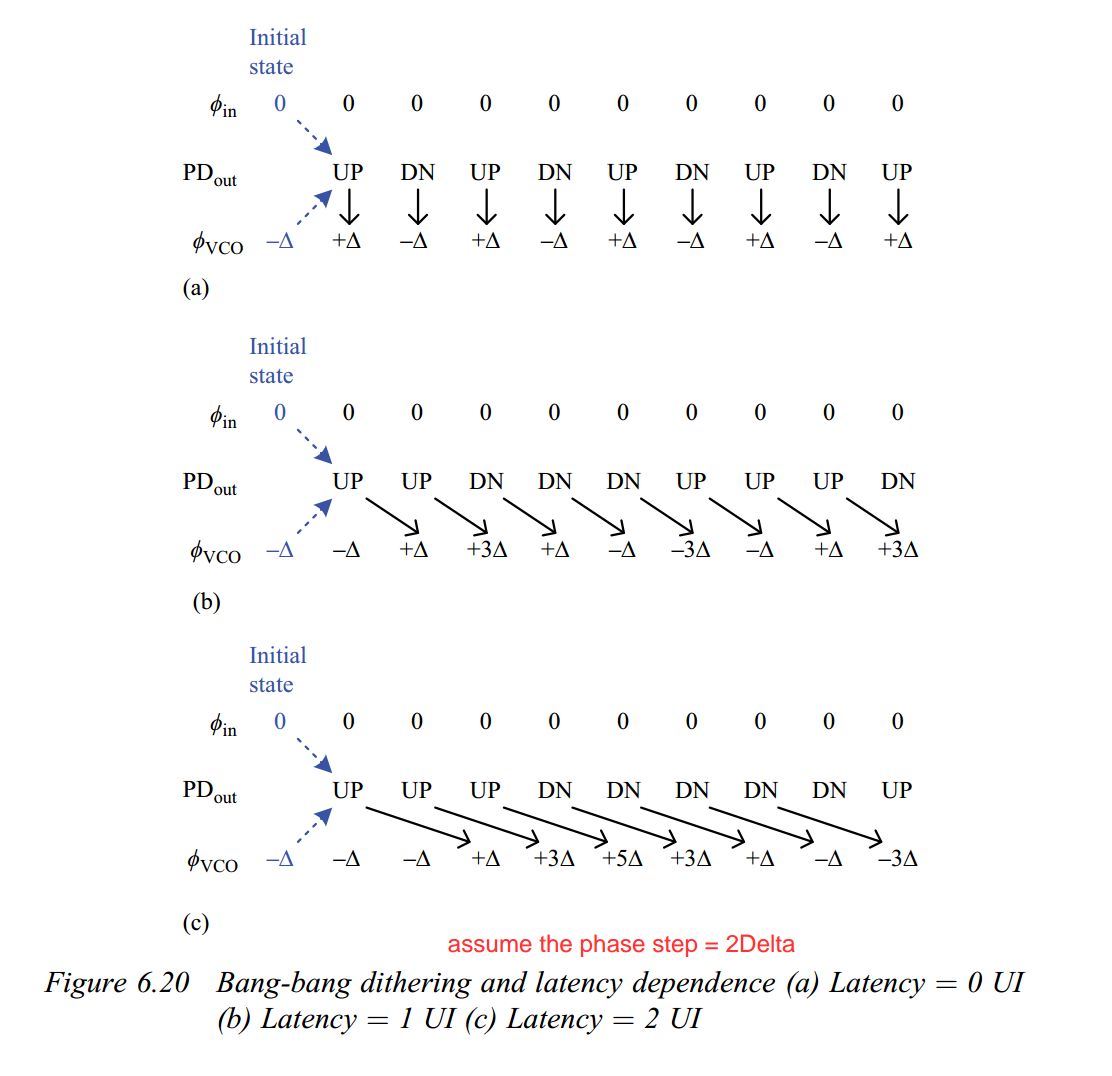
ditheringjitter.drawio

image-20240925213924764

CDR Loop Latency

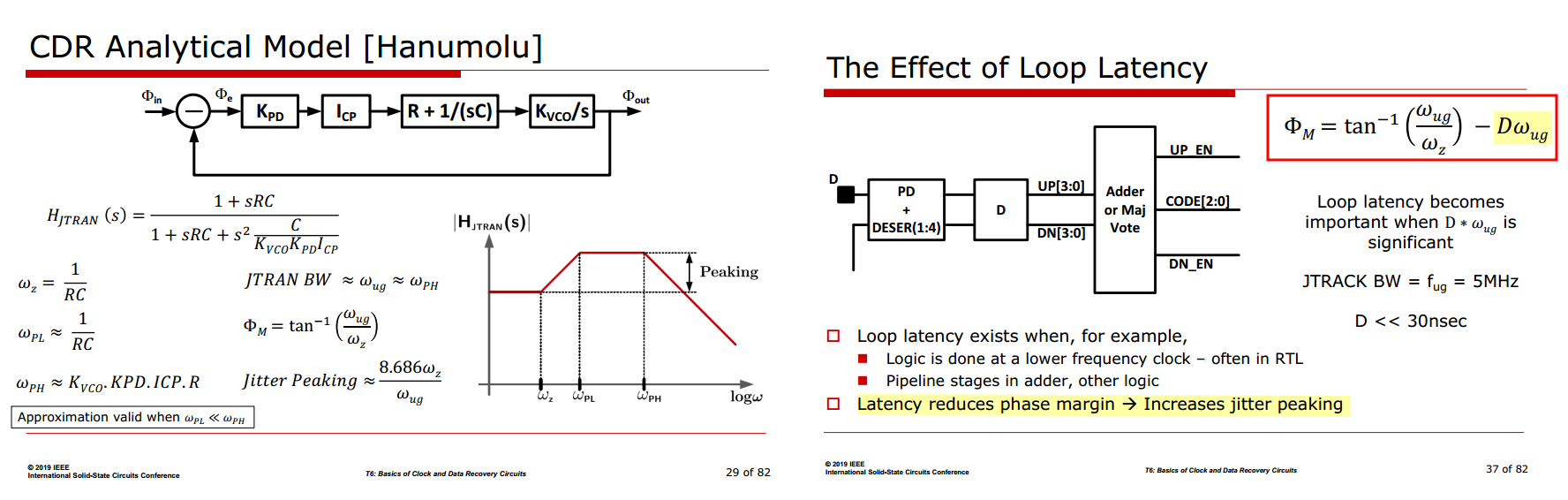
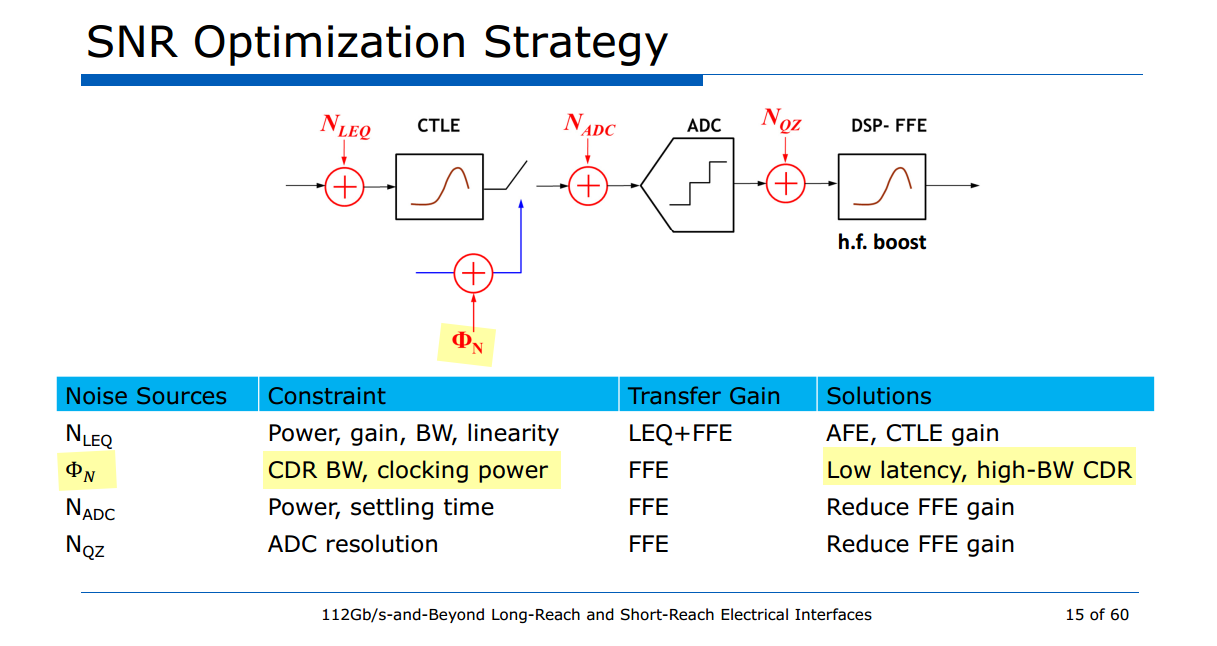
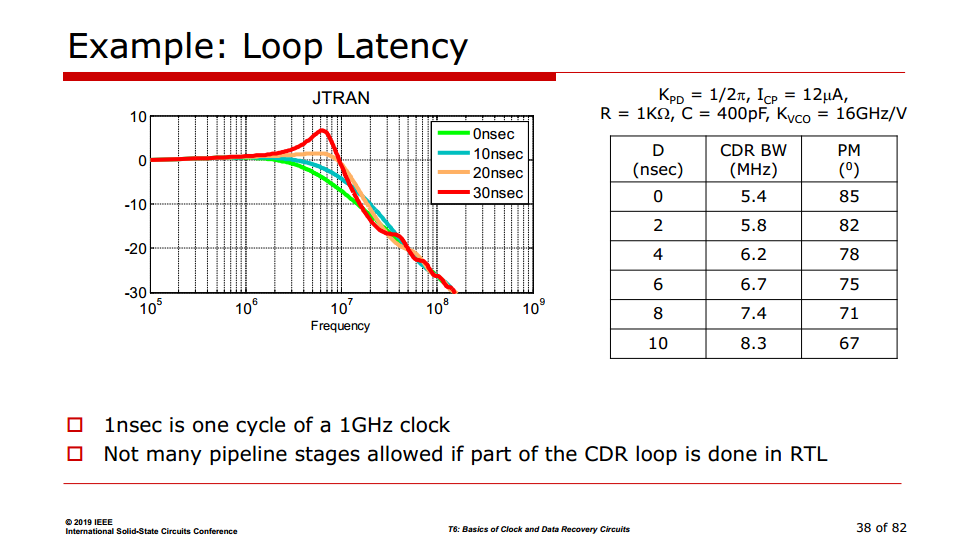
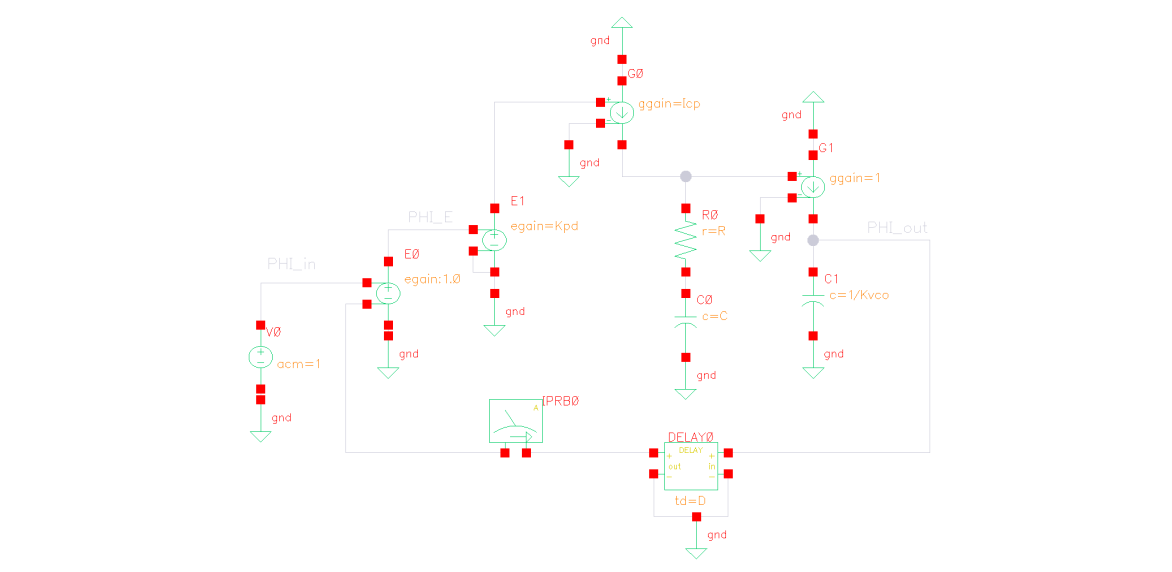
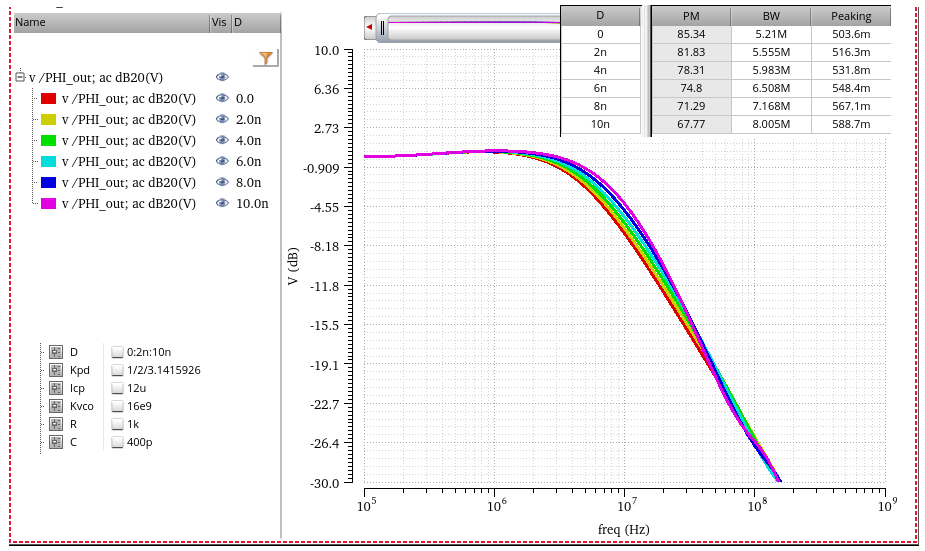
Denoting the CDR loop latency by \(\Delta T\) , we note that the loop transmission is multiplied by \(exp(-s\Delta T)\simeq 1-s\Delta T\).The resulting right-half-plane zero, \(f_z\) degrades the phase margin and must remain about one decade beyond the BW \[ f_z\simeq \frac{1}{2\pi \Delta T} \]

This assumption is true in practice since the bandwidth of the CDR (few mega Hertz) is much smaller than the data rate (multi giga bits/second).

Fernando , Marvell Italy."Considerations for CDR Bandwidth Proposal" [https://www.ieee802.org/3/bs/public/16_03/debernardinis_3bs_01_0316.pdf]

Loop Bandwidth

The closed-loop −3-dB bandwidth is sometimes called the “loop bandwidth”

Continuous-Time Approximation Limitations

A rule of thumb often used to ensure slow changes in the loop is to select the loop bandwidth approximately equal to one-tenth of the input frequency.

image-20240806230158367

image-20240928095850580

Gardner, F.M. (1980). Charge-Pump Phase-Lock Loops. IEEE Trans. Commun., 28, 1849-1858.

Homayoun, Aliakbar and Behzad Razavi. “On the Stability of Charge-Pump Phase-Locked Loops.” IEEE Transactions on Circuits and Systems I: Regular Papers 63 (2016): 741-750.

N. Kuznetsov, A. Matveev, M. Yuldashev and R. Yuldashev, "Nonlinear Analysis of Charge-Pump Phase-Locked Loop: The Hold-In and Pull-In Ranges," in IEEE Transactions on Circuits and Systems I: Regular Papers, vol. 68, no. 10, pp. 4049-4061, Oct. 2021

Deog-Kyoon Jeong, Topics in IC Design - 2.1 Introduction to Phase-Locked Loop [https://ocw.snu.ac.kr/sites/default/files/NOTE/Lec%202%20-%20Charge-Pump%20PLL%2C%20Freuqency%20Synthesizers%2C%20and%20SSCG.pdf]

Limit Cycle Oscillation

limit cycles imply self-sustained oscillators due nonlinear nature

Ouzounov, S., Hegt, H., Van Roermund, A. (2007). SUB-HARMONIC LIMIT-CYCLE SIGMA-DELTA MODULATION, APPLIED TO AD CONVERSION. In: Van Roermund, A.H., Casier, H., Steyaert, M. (eds) Analog Circuit Design. Springer, Dordrecht. [https://sci-hub.se/10.1007/1-4020-5186-7_6]

Digital CDR Category

image-20241024221619909

  • DCO part is analogous so that it cannot be perfectly modeled
  • Digital-to-phase converter is well-defined phase output, thus, very good to model real situation

Z-domain modeling

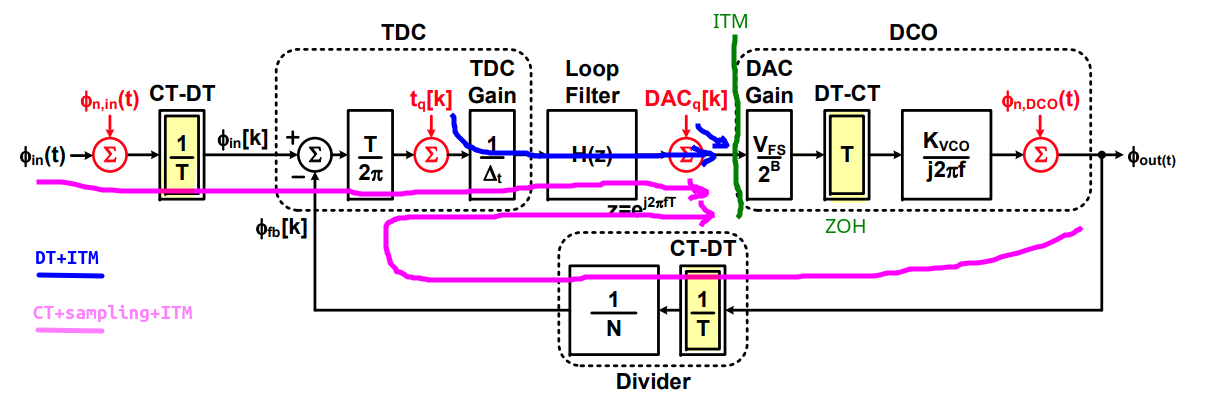
image-20241027001226490

The difference equation is \[ \phi[n] = \phi[n-1] + K_{DCO}V_C[n]\cdot T\cdot2\pi \] z-transform is \[ \frac{\Phi(z)}{V_C(z)}=\frac{2\pi K_{DCO}T}{1-z^{-1}} \]

where \(K_{DCO}\) : \(\Delta f\) (Hz/bit)

\(\Delta \Sigma\)-dithering in DCO

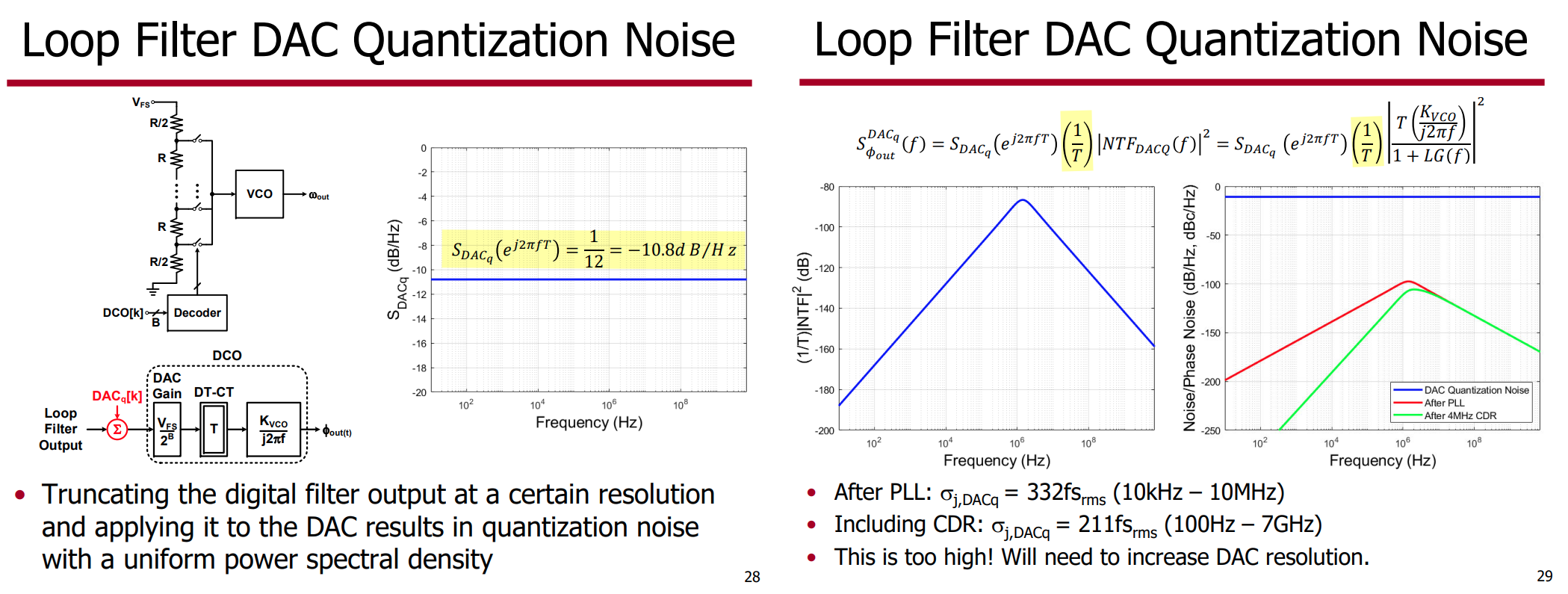
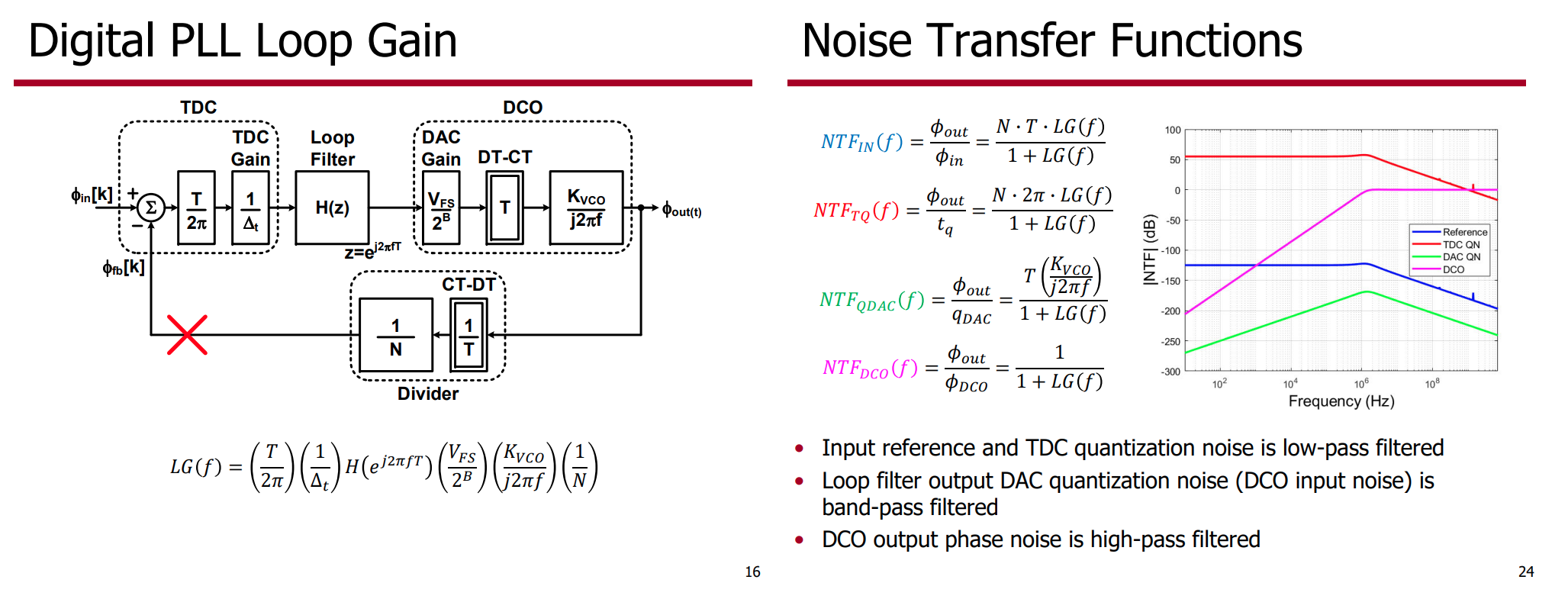
Quantization noise

image-20241019200102827

Here, \(\alpha_T\) is data transition density

BBPD quantization noise

DAC quantization noise

M. -J. Park and J. Kim, "Pseudo-Linear Analysis of Bang-Bang Controlled Timing Circuits," in IEEE Transactions on Circuits and Systems I: Regular Papers, vol. 60, no. 6, pp. 1381-1394, June 2013 [https://sci-hub.st/10.1109/TCSI.2012.2220502]

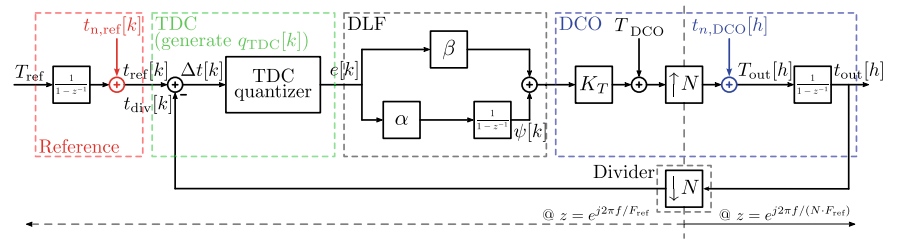
Time to Digital Converter (TDC)

Digital to Phase Converter (DPC)

IIR low pass filter

image-20241024232055792

simple approximation: \[ z = 1 + sT \] bilinear-z transform \[ z =\frac{}{} \]

image-20241024232111368

FAQ

PLL vs. CDR

PLL CDR
Clock edge periodic Data edge random
Phase & Frequency detecting possible Phase detecting possible ,
Frequency detecting impossible

PLL or FD(Frequency Detector) for frequency detecting in CDR

reference

J. Stonick. ISSCC 2011 "DPLL-Based Clock and Data Recovery" [slides,transcript]

P. Hanumolu. ISSCC 2015 "Clock and Data Recovery Architectures and Circuits" [slides]

Amir Amirkhany. ISSCC 2019 "Basics of Clock and Data Recovery Circuits"

Fulvio Spagna. INTEL, CICC2018, "Clock and Data Recovery Systems" [slides]

M. Perrott. 6.976 High Speed Communication Circuits and Systems (lecture 21). Spring 2003. Massachusetts Institute of Technology: MIT OpenCourseWare, [lec21.pdf]

Akihide Sai. ISSCC 2023, T5 "All Digital Plls From Fundamental Concepts To Future Trends" [T5.pdf]

J. L. Sonntag and J. Stonick, "A Digital Clock and Data Recovery Architecture for Multi-Gigabit/s Binary Links," in IEEE Journal of Solid-State Circuits, vol. 41, no. 8, pp. 1867-1875, Aug. 2006 [https://sci-hub.se/10.1109/JSSC.2006.875292]

—, "A digital clock and data recovery architecture for multi-gigabit/s binary links," Proceedings of the IEEE 2005 Custom Integrated Circuits Conference, 2005.. [https://sci-hub.se/10.1109/CICC.2005.1568725]

Fernando De Bernardinis, eSilicon. "Introduction to DSP Based Serial Links" [https://www.corsi.univr.it/documenti/OccorrenzaIns/matdid/matdid835215.pdf]

Yohan Frans, CICC2019 ES3-3- "ADC-based Wireline Transceivers" [pdf]


H. Kang et al., "A 42.7Gb/s Optical Receiver With Digital Clock and Data Recovery in 28nm CMOS," in IEEE Access, vol. 12, pp. 109900-109911, 2024 [https://ieeexplore.ieee.org/stamp/stamp.jsp?arnumber=10630516]

Marinaci, Stefano. "Study of a Phase Locked Loop based Clock and Data Recovery Circuit for 2.5 Gbps data-rate" [https://cds.cern.ch/record/2870334/files/CERN-THESIS-2023-147.pdf]

P. Palestri et al., "Analytical Modeling of Jitter in Bang-Bang CDR Circuits Featuring Phase Interpolation," in IEEE Transactions on Very Large Scale Integration (VLSI) Systems, vol. 29, no. 7, pp. 1392-1401, July 2021 [https://sci-hub.se/10.1109/TVLSI.2021.3068450]

F. M. Gardner, "Phaselock Techniques", 3rd Edition, Wiley Interscience, Hoboken, NJ, 2005 [https://picture.iczhiku.com/resource/eetop/WyIgwGtkDSWGSxnm.pdf]

Rhee, W. (2020). Phase-locked frequency generation and clocking : architectures and circuits for modern wireless and wireline systems. The Institution of Engineering and Technology

M.H. Perrott, Y. Huang, R.T. Baird, B.W. Garlepp, D. Pastorello, E.T. King, Q. Yu, D.B. Kasha, P. Steiner, L. Zhang, J. Hein, B. Del Signore, "A 2.5 Gb/s Multi-Rate 0.25μm CMOS Clock and Data Recovery Circuit Utilizing a Hybrid Analog/Digital Loop Filter and All-Digital Referenceless Frequency Acquisition," IEEE J. Solid-State Circuits, vol. 41, Dec. 2006, pp. 2930-2944 [https://cppsim.com/Publications/JNL/perrott_jssc06.pdf]

M.H. Perrott. CICC 2009 "Tutorial on Digital Phase-Locked Loops" [https://www.cppsim.com/PLL_Lectures/digital_pll_cicc_tutorial_perrott.pdf]

—, Short Course On Phase-Locked Loops and Their Applications Day 4, PM Lecture "Examples of Leveraging Digital Techniques in PLLs" [https://www.cppsim.com/PLL_Lectures/day4_pm.pdf]

—, Short Course On Phase-Locked Loops IEEE Circuit and System Society, San Diego, CA "Digital Frequency Synthesizers" [https://www.cppsim.com/PLL_Lectures/digital_pll.pdf]

Gain Kim, "Equalization, Architecture, and Circuit Design for High-Speed Serial Link Receiver" [pdf]


Deog-Kyoon Jeong Topics in IC(Wireline Transceiver Design) - 3.1. Introduction to All Digital PLL [https://ocw.snu.ac.kr/sites/default/files/NOTE/Lec%203%20-%20ADPLL.pdf]

—, Topics in IC(Wireline Transceiver Design) - 6.1 Introduction to Clock and Data Recovery [https://ocw.snu.ac.kr/sites/default/files/NOTE/Lec%206%20-%20Clock%20and%20Data%20Recovery.pdf]

High-speed Serial Interface Lect. 16 – Clock and Data Recovery 3 [http://tera.yonsei.ac.kr/class/2013_1_2/lecture/Lect16_CDR-3.pdf]

Shiva Kiran. Phd thesis 2018. Modeling and Design of Architectures for High-Speed ADC-Based Serial Links [https://hdl.handle.net/1969.1/192031]

—, et al., "Modeling of ADC-Based Serial Link Receivers With Embedded and Digital Equalization," in IEEE Transactions on Components, Packaging and Manufacturing Technology, vol. 9, no. 3, pp. 536-548, March 2019 [https://sci-hub.se/10.1109/TCPMT.2018.2853080]

K. Zheng, "System-Driven Circuit Design for ADC-Based Wireline Data Links", Ph.D. Dissertation, Stanford University, 2018 [https://purl.stanford.edu/hw458fp0168]

S. Cai, A. Shafik, S. Kiran, E. Z. Tabasy, S. Hoyos and S. Palermo, "Statistical modeling of metastability in ADC-based serial I/O receivers," 2014 IEEE 23rd Conference on Electrical Performance of Electronic Packaging and Systems [pdf]

John M. Cioffi. "Decoding Methods" [https://cioffi-group.stanford.edu/doc/book/chap7.pdf]

—. "Equalization" [https://cioffi-group.stanford.edu/doc/book/chap3.pdf]

Iain. What is Trellis Coding? [https://youtu.be/rnjy4_gXLAg]

—. Decoding Convolutional Codes: The Viterbi Algorithm Explained [https://youtu.be/IJE94FhyygM]

Noman Hai, Synopsys, Canada CASS Talks 2025 - May 2, 2025: High-speed Wireline Interconnects: Design Challenges and Innovations in 224G SerDes [https://www.youtube.com/live/wHNOlxHFTzY]

T. Chan Carusone, T. O. Dickson, S. Palermo, S. Shekhar and M. Mansuri, "Modern Wireline Transceivers," in IEEE Journal of Solid-State Circuits [https://ieeexplore.ieee.org/stamp/stamp.jsp?tp=&arnumber=11311714]y

Phase Noise Definition

image-20250104080553842

Eq. (3.25) is widely adopted by industry and academia

image-20250104080619943

using the narrow angle assumption, the two definitions above are equivalent

If the narrow angle condition is not satisfied, however, the two definitions differ

Phase Noise Profile

Power Spectral Density of Brownian Motion despite non-stationary [https://dsp.stackexchange.com/a/75043/59253]

white noise

\(1/f^2\) Phase Noise Profile

image-20250104084510063

image-20250104084814395

image-20250104085222610

image-20250104084925644

image-20250104085722649


image-20250601101355166

Sudhakar Pamarti. CICC 2020 ES2-2: Basics of Closed- and Open-Loop Fractional Frequency Synthesis [https://youtu.be/t1TY-D95CY8]

flicker noise

\(1/f^3\) Phase Noise Profile

\[ S_{\phi n} = \frac{K}{f}\left(\frac{K_{VCO}}{2\pi f}\right)^2 \propto \frac{1}{f^3} \]


image-20250104092711462

[https://dsp.stackexchange.com/a/75152/59253]

Free-running Oscillator

image-20250103224818171

Note that \(f_{min}\) is related to the observation time. The longer we observe the device under test, the smaller \(f_{min}\) must be

image-20250524081737793


image-20250104111025626


image-20250524082246710

Ali Sheikholeslami ISSCC 2008 T5: Basics of Chip-to-Chip and Backplane Signaling [https://www.nishanchettri.com/isscc-slides/2008%20ISSCC/Tutorials/T10_Pres.pdf]


image-20250606204607565

B. Casper and F. O'Mahony, "Clocking Analysis, Implementation and Measurement Techniques for High-Speed Data Links-A Tutorial," in IEEE Transactions on Circuits and Systems I. [https://people.engr.tamu.edu/spalermo/ecen689/clocking_analysis_hs_links_casper_tcas1_2009.pdf]

Lorentzian spectrum

image-20240720134811859

We typically use the two spectra, \(S_{\phi n}(f)\) and \(S_{out}(f)\), interchangeably, but we must resolve these inconsistencies. voltage spectrum is called Lorentzian spectrum


The periodic signal \(x(t)\) can be expanded in Fourier series as:

image-20240720141514040

Assume that the signal is subject to excess phase noise, which is modeled by adding a time-dependent noise component \(\alpha(t)\). The noisy signal can be written \(x(t+\alpha(t))\), the added excess phase \(\phi(t)= \frac{\alpha(t)}{\omega_0}\)

image-20250103211650043

The autocorrelation of the noisy signal is by definition:

image-20240720141525576

The autocorrelation averaged over time results in:

image-20240720141659415

By taking the Fourier transform of the autocorrelation, the spectrum of the signal \(x(t + \alpha(t))\)​ can be expressed as

image-20240720141813256

It is also interesting to note how the integral in Equation 9.80 around each harmonic is equal to the power of the harmonic itself \(|X_n|^2\)

The integral \(S_x(f)\) around harmonic is \[\begin{align} P_{x,n} &= \int_{f=-\infty}^{\infty} |X_n|^2\frac{\omega_0^2n^2c}{\frac{1}{4}\omega_0^4n^4c^2+(\omega +n\omega_0)^2}df \\ &= |X_n|^2\int_{\Delta f=-\infty}^{\infty}\frac{2\beta}{\beta^2+(2\pi\cdot\Delta f)^2}d\Delta f \\ &= |X_n|^2\frac{1}{\pi}\arctan(\frac{2\pi \Delta f}{\beta})|_{-\infty}^{\infty} \\ &= |X_n|^2 \end{align}\]

The phase noise does not affect the total power in the signal, it only affects its distribution

  • Without phase noise, \(S_v(f)\) is a series of impulse functions at the harmonics of \(f_o\).
  • With phase noise, the impulse functions spread, becoming fatter and shorter but retaining the same total power

image-20250626213351673

[https://community.cadence.com/cadence_technology_forums/f/rf-design/51484/comparing-transient-noise-pnoise-and-pnoise-with-lorentian-approximation-of-a-ring-oscillator/1382911]


image-20250815232359572

image-20250815234653864

Phase perturbed by a stationary noise with Gaussian PDF

image-20241227233228376

image-20241228022311313


If keep \(\phi_{rms}\) in \(R_x(\tau)\), i.e. \[ R_x(\tau)=\frac{A^2}{2}e^{-\phi_{rms}^2}\cos(2\pi f_0 \tau)e^{R_\phi(\tau)}\approx \frac{A^2}{2}e^{-\phi_{rms}^2}\cos(2\pi f_0 \tau)(1+R_\phi(\tau)) \] The PSD of the signal is \[ S_x(f) = \mathcal{F} \{ R_x(\tau) \} = \frac{P_c}{2}e^{-\phi_{rms}^2}\left[S_\phi(f+f_0)+S_\phi(f-f_0)\right] + \frac{P_c}{2}e^{-\phi_{rms}^2}\left[\delta(f+f_0)+\delta(f-f_0)\right] \] ❗❗above Eq isn't consistent with stationary white noise process - the following section

Phase perturbed by a stationary WHITE noise process

image-20241207091104944

Assuming that the delay line is noiseless

image-20241207100921644


image-20241207091457850

Expanding the cosine function we get \[\begin{align} R_y(t,\tau) &= \frac{A^2}{2}\left\{\cos(2\pi f_0\tau)E[\cos(\phi(t)-\phi(t-\tau))] - \sin(2\pi f_0\tau)E[\sin(\phi(t)-\phi(t-\tau))]\right\} \\ &+ \frac{A^2}{2}\left\{\cos(4\pi f_0(t+\tau/2-T_D))E[\cos(\phi(t)+\phi(t-\tau))] - \sin(4\pi f_0(t+\tau/2-T_D))E[\sin(\phi(t)+\phi(t-\tau))] \right\} \end{align}\]

where, both the process \(\phi(t)-\phi(t-\tau)\) and \(\phi(t)+\phi(t-\tau)\) are independent of time \(t\), i.e. \(E[\cos(\phi(t)+\phi(t-\tau))] = m_{\cos+}(\tau)\), \(E[\cos(\phi(t)-\phi(t-\tau))] = m_{\cos-}(\tau)\), \(E[\sin(\phi(t)+\phi(t-\tau))] = m_{\sin+}(\tau)\) and \(E[\sin(\phi(t)-\phi(t-\tau))] = m_{\sin-}(\tau)\)

we obtain \[\begin{align} R_y(t,\tau) &= \frac{A^2}{2}\left\{\cos(2\pi f_0\tau)m_{\cos-}(\tau) - \sin(2\pi f_0\tau)m_{\sin-}(\tau)\right\} \\ &+ \frac{A^2}{2}\left\{\cos(4\pi f_0(t+\tau/2-T_D))m_{\cos+}(\tau) - \sin(4\pi f_0(t+\tau/2-T_D))m_{\sin+}(\tau) \right\} \end{align}\]

The second term in the above expression is periodic in \(t\) and to estimate its PSD, we compute the time-averaged autocorrelation function \[ R_y(\tau) = \frac{A^2}{2}\left\{\cos(2\pi f_0\tau)m_{\cos-}(\tau) - \sin(2\pi f_0\tau)m_{\sin-}(\tau)\right\} \] image-20241207095906575

After nontrivial derivation

image-20241207104018395

image-20241227205459845


image-20241207103912086

Phase perturbed by a Weiner process

image-20241207103414365

image-20241207105127885

The phase process \(\phi(t)\) is also gaussian but with an increasing variance which grows linearly with time \(t\)

image-20241207110524419

\[\begin{align} R_y(t,\tau) &= \frac{A^2}{2}\left\{\cos(2\pi f_0\tau)E[\cos(\phi(t)-\phi(t-\tau))] - \sin(2\pi f_0\tau)E[\sin(\phi(t)-\phi(t-\tau))]\right\} \\ &+ \frac{A^2}{2}\left\{\cos(4\pi f_0(t+\tau/2-T_D)E[\cos(\phi(t)+\phi(t-\tau))] - \sin(4\pi f_0(t+\tau/2-T_D)E[\sin(\phi(t)+\phi(t-\tau))] \right\} \end{align}\]

The spectrum of \(y(t)\) is determined by the asymptotic behavior of \(R_y(t,\tau)\) as \(t\to \infty\)

❗❗ \(\lim_{t\to\infty}R_y(t,\tau)\) rather than time-averaged autocorrelation function of cyclostationary process, ref. Demir's paper

We define \(\zeta(t, \tau)=\phi(t)+\phi(t-\tau) = \phi(t)-\phi(t-\tau) + 2\phi(t-\tau)\), the expected value of \(\zeta(t,\tau)\) is 0, the variance is \(\sigma_{\zeta}^2=(k\sigma)^2(\tau + 4(t-\tau))=(k\sigma)^2(4t-3\tau)\) \[ E[\cos(\zeta(t,\tau))]=\frac{1}{\sqrt{2\pi \sigma_{\zeta}^2}}\int_{-\infty}^{\infty}e^{-\zeta^2/2\sigma_{\zeta}^2}\cos(\zeta)d\zeta = e^{-\sigma_{\zeta}^2/2}=e^{-(k\sigma)^2(4t-\tau)} \] i.e., \(\lim _{t\to \infty} E[\cos(\zeta(t,\tau))] = \lim_{t\to \infty}e^{-(k\sigma)^2(4t-\tau)} = 0\)

For \(E[\sin(\zeta(t,\tau))]\), we have \[ E[\sin(\zeta(t,\tau))] = \frac{1}{\sqrt{2\pi \sigma_{\zeta}^2}}\int_{-\infty}^{\infty}e^{-\zeta^2/2\sigma_{\zeta}^2}\sin(\zeta)d\zeta \] i.e., \(E[\sin(\zeta(t,\tau))]\) is odd function, therefore \(E[\sin(\zeta(t,\tau))]=0\)

Finally, we obtain

image-20241207114053083

image-20241227210018613

image-20241207114805792


image-20241207174403033

image-20241207181038749

image-20241208100556466

Amplitude Noise

image-20250609213352109

image-20250609213403991

P.E. Allen - 2003. ECE 6440 - Frequency Synthesizers: Lecture 160 – Phase Noise - II [https://pallen.ece.gatech.edu/Academic/ECE_6440/Summer_2003/L160-PhNoII(2UP).pdf]

reference

A. Hajimiri and T. H. Lee, "A general theory of phase noise in electrical oscillators," in IEEE Journal of Solid-State Circuits, vol. 33, no. 2, pp. 179-194, Feb. 1998 [paper], [slides]

—, "Corrections to "A General Theory of Phase Noise in Electrical Oscillators"" [https://ieeexplore.ieee.org/stamp/stamp.jsp?arnumber=678662]

—, RFIC2024 "Noise in Oscillators from Understanding to Design"

Carlo Samori, "Phase Noise in LC Oscillators: From Basic Concepts to Advanced Topologies" [https://www.ieeetoronto.ca/wp-content/uploads/2020/06/DL-VCO-short.pdf]

—, "Understanding Phase Noise in LC VCOs: A Key Problem in RF Integrated Circuits," in IEEE Solid-State Circuits Magazine, vol. 8, no. 4, pp. 81-91, Fall 2016 [https://picture.iczhiku.com/resource/eetop/whIgTikLswaaTVBv.pdf]

—, ISSCC2016, "Understanding Phase Noise in LC VCOs"

Antonio Liscidini, ESSCIRC 2019 Tutorials: Phase Noise in Wireless Applications [https://youtu.be/nGmQ0JdoSE4]

A. Demir, A. Mehrotra and J. Roychowdhury, "Phase noise in oscillators: a unifying theory and numerical methods for characterization," in IEEE Transactions on Circuits and Systems I: Fundamental Theory and Applications, vol. 47, no. 5, pp. 655-674, May 2000 [https://sci-hub.se/10.1109/81.847872]

Dalt, Nicola Da and Ali Sheikholeslami. "Understanding Jitter and Phase Noise: A Circuits and Systems Perspective." (2018) [https://picture.iczhiku.com/resource/eetop/WykRGJJoHQLaSCMv.pdf]

F. L. Traversa, M. Bonnin and F. Bonani, "The Complex World of Oscillator Noise: Modern Approaches to Oscillator (Phase and Amplitude) Noise Analysis," in IEEE Microwave Magazine, vol. 22, no. 7, pp. 24-32, July 2021 [https://iris.polito.it/retrieve/handle/11583/2903596/e384c433-b8f5-d4b2-e053-9f05fe0a1d67/MM%20noise%20-%20v5.pdf]

Poddar, Ajay & Rohde, Ulrich & Apte, Anisha. (2013). How Low Can They Go?: Oscillator Phase Noise Model, Theoretical, Experimental Validation, and Phase Noise Measurements. Microwave Magazine, IEEE. [http://time.kinali.ch/rohde/noise/how_low_can_they_go-2013-poddar_rohde_apte.pdf]

Pietro Andreani, "RF Harmonic Oscillators Integrated in Silicon Technologies" [https://www.ieeetoronto.ca/wp-content/uploads/2020/06/DL-Toronto.pdf]

Chembiyan T, "Brownian Motion And The Oscillator Phase Noise" [link]

—, "Jitter and Phase Noise in Oscillators" [link]

—, "Jitter and Phase Noise in Phase Locked Loops" [link]

—, "PLLs and reference spurs" [link]

Godone, A. & Micalizio, Salvatore & Levi, Filippo. (2008). RF spectrum of a carrier with a random phase modulation of arbitrary slope. [https://sci-hub.se/10.1088/0026-1394/45/3/008]

Bae, Woorham; Jeong, Deog-Kyoon: 'Analysis and Design of CMOS Clocking Circuits for Low Phase Noise' (Materials, Circuits and Devices, 2020)

  • proportional term (P) depends on the present error
  • integral term (I) depends on past errors
  • derivative term (D) depends on anticipated future errors

PID controller makes use of linear extrapolation of the measured output

PI controller does not make use of any prediction of the future state of the system

The prediction by linear extrapolation (D) can generate large undesired control signals because measurement noise is amplified, that's why D is not used widely


The Problem of "Sinusoids Running Around Loops"

The representative of Fourier transform \(\frac{1}{j\omega+j\omega_0}\) back in the time domain \(e^{-j\omega_0 t}\) is infinite extent in time

Running around a loop, chasing one's tail — these are thought pictures that only work in a discretized, time-sequenced conceptual framework that has a beginning and an end

Fix in your mind that oscillations are a type of resonance

System Type

Control of Steady-State Error to Polynomial Inputs: System Type

image-20240502232125317

control systems are assigned a type number according to the maximum degree of the input polynominal for which the steady-state error is a finite constant. i.e.

  • Type 0: Finite error to a step (position error)
  • Type 1: Finite error to a ramp (velocity error)
  • Type 2: Finite error to a parabola (acceleration error)

image-20260227020054150

If we consider tracking the reference input alone and set \(W = V = 0\)

The open-loop transfer function can be expressed as \[ T(s) = \frac{K_n(s)}{s^n} \]

where we collect all the terms except the pole (\(s\)) at eh origin into \(K_n(s)\),

The polynomial inputs, \(r(t)=\frac{t^k}{k!} u(t)\), whose transform is \[ R(s) = \frac{1}{s^{k+1}} \]

Then the equation for the error, \(R(s)-Y(s)\) is simply \[ E(s) = \frac{1}{1+T(s)}R(s) \]

Application of the Final Value Theorem to the error formula gives the result

\[\begin{align} \lim _{t\to \infty} e(t) &= e_{ss} = \lim _{s\to 0} sE(s) \\ &= \lim _{s\to 0} s\frac{1}{1+\frac{K_n(s)}{s^n}}\frac{1}{s^{k+1}} \\ &= \lim _{s\to 0} \frac{s^n}{s^n + K_n}\frac{1}{s^k} \end{align}\]

  • if \(n > k\), \(e=0\)
  • if \(n < k\), \(e\to \infty\)
  • if \(n=k\)
    • \(e_{ss} = \frac{1}{1+K_n}\) if \(n=k=0\)
    • \(e_{ss} = \frac{1}{K_n}\) if \(n=k \neq 0\)

where we define \(K_n(0) = K_n\)

rearrangement

loop-refactor.drawio

The closed loop transfer function of \(Y/X\) and \(Y_1/X_1\) are almost same, except sign

\[\begin{align} \frac{Y}{X} &= +\frac{H_1(s)H_2(s)}{1+H_1(s)H_2(s)} \\ \frac{Y_1}{X_1} &= -\frac{H_1(s)H_2(s)}{1+H_1(s)H_2(s)} \end{align}\]

loop-refactor-partion.drawio

define \(-Y_1=Y_n\), then \[ \frac{Y_n}{X_1} = \frac{H_1(s)H_2(s)}{1+H_1(s)H_2(s)} \] loop-refactor-partion-general.drawio

image-20240805231921946

Saurabh Saxena, IIT Madras. CICC2022 Clocking for Serial Links - Frequency and Jitter Requirements, Phase-Locked Loops, Clock and Data Recovery

derivative control

Introduction: PID Controller Design. [https://ctms.engin.umich.edu/CTMS/?example=Introduction&section=ControlPID]

Stability Criterion

Barkhausen criteria

Barkhausen criteria are necessary but not sufficient conditions for sustainable oscillations

image-20240720090654883

it simply "latches up" rather than oscillates

Nyquist Stability Criterion

Michael H. Perrott, High Speed Communication Circuits and Systems, Lecture 15 Integer-N Frequency Synthesizers[https://www.cppsim.com/CommCircuitLectures/lec15.pdf]

Zoran Gajic. Nyquist Stability Criterion [https://eceweb1.rutgers.edu/~gajic/psfiles/nyquist.pdf]

TODO 📅

image-20251122095944300

image-20251122095709631

reference

Gene F. Franklin, J. David Powell, and Abbas Emami-Naeini. Feedback Control of Dynamic Systems, Global Edition (8th Edition). Pearson. [pdf]

Åström, K.J. & Murray, Richard. (2021). Feedback Systems: An Introduction for Scientists and Engineers Second Edition [pdf]

Dawson, Joel L. A Guide to Feedback Theory. Cambridge: Cambridge University Press, 2021. [pdf]

Yan Lu, ISSCC2021 T10: Fundamentals of Fully Integrated Voltage Regulators [https://www.nishanchettri.com/isscc-slides/2021%20ISSCC/TUTORIALS/ISSCC2021-T10.pdf]

Jens Anders (University of Stuttgart, DE). ESSERC2025 Circuits Insights: The Magic of Feedback in Analog Circuit Design [https://youtu.be/NyXuA6WZ8Hg]

image-20241004163356709

charge pumps are capacitive DC-DC converters. The two most common switched capacitor voltage converters are the voltage inverter and the voltage doubler circuit


image-20241014211627207


voltage doubler

image-20241019092038444

output buffer capacitor

To achieve a stable DC output voltage

Step-Wise Ramp-Up

\[ V_{in} C_p + V_{out,n-1}C_o = (V_{out,n}-V_{in})C_p + V_{out,n}C_o \]

We derive a recursive equation that describes the output voltage \(V_{out,n}\) after the \(n\)th clock cycle \[ V_{out,n} = \frac{2V_{in}C_p + V_{out,n-1}C_o}{C_p + C_o} \]

Voltage Ripple & Droop

ripple_droop.drawio

\[\begin{align} (V_t - V_h)(C_p + C_o) &= \frac{I_{load}}{2f_{sw}} \\ (V_h - V_b)C_o &= \frac{I_{load}}{2f_{sw}} \end{align}\]

we obtain \[ V_t - V_b = \frac{I_{load}}{f_{sw}C_o}\left(1 - \frac{C_p}{2(C_p + C_o)}\right) \] That is, peak-to-peak ripple \[ \Delta V_{out,p2p} \approx \frac{I_{load}}{f_{sw}C_o} \space\space\space\space \text{if}\space\space C_o \gg C_p \]

Then, with aforementioned Step-Wise Ramp-Up equation, \(V_t = \frac{2V_{in}C_p + V_bC_o}{C_p + C_o}\) \[\begin{align} V_b &= 2V_{in} - \frac{I_{load}}{f_{sw}C_p}\left(1 + \frac{C_p}{2C_o}\right) \\ V_t &= 2V_{in} - \frac{I_{load}}{f_{sw}C_p}\left(1 - \frac{C_p}{2(C_p+C_o)}\right) \end{align}\]

Therefore, average output voltage \(\overline{V}_{out}\) in steady-state is \[ \overline{V}_{out} = \frac{V_t+V_b}{2}=2V_{in} - \frac{I_{load}}{f_{sw}C_p}\left(1 + \frac{C_p^2}{4C_o(C_p+C_o)}\right) \approx 2V_{in} - \frac{I_{load}}{f_{sw}C_p} \] which results in a simple expression for the output voltage droop

\[ \Delta V_{out} = \frac{I_{load}}{f_{sw}C_p} \]

The charge pump can be modeled as a voltage source with a source resistance \(R_\text{out}\). Therefore, \(\Delta V_{out}\) can be seen as the voltage drop across \(R_\text{out}\) due to the load current:

\[ R_{out} = \frac{\Delta V_{out}}{I_{load}} = \frac{1}{f_{sw}C_p} \] image-20241015072846141

multiphase CP

multiphaeCP.drawio

\[ (V_t - V_b) (C_p + C_o) = I_{load}\Delta t \]

Therefore peak-to-peak ripple \[ \Delta V_{out,p2p} = \frac{I_{load}\Delta t}{C_p+C_o} = \frac{I_{load}\Delta t}{C_{tot}} \]

where \(C_{tot} = C_p+C_o\)

with \[ \left\{ \begin{array}{cl} V_b &= 2V_{in} - \frac{I_{load}\Delta t}{C_p} \\ V_t &= 2V_{in} - \frac{I_{load}\Delta t}{C_p} + \frac{I_{load}\Delta t}{C_p+C_o} \end{array} \right. \]

Then \[ \overline{V}_{out} = \frac{V_t+V_b}{2}=2V_{in} - \frac{I_{load}\Delta t}{C_p}\cdot \frac{C_p+2C_o}{2C_p+2C_o} \approx 2V_{in} - \frac{I_{load}\Delta t}{C_p} \] That is output voltage droop \[ \Delta V_{out} = \frac{I_{load}\Delta t}{C_p} \]

reference

Bernhard Wicht, "Design of Power Management Integrated Circuits". 2024 Wiley-IEEE Press

Breussegem, T. v., & Steyaert, M. (2013). CMOS integrated capacitive DC-DC converters. Springer

Zhang, Milin, Zhihua Wang, Jan van der Spiegel and Franco Maloberti. "Advanced Tutorial on Analog Circuit Design." (2023).

Anton Bakker, Tim Piessens., ISSCC2014 T9: Charge Pump and Capacitive DC-DC Converter Design

Wicht, B., ISSCC2020 T2: Analog Building Blocks of DC-DC Converters [https://www.nishanchettri.com/isscc-slides/2020%20ISSCC/TUTORIALS/T2Visuals.pdf]

Hoi Lee, ISSCC2018 T8: Fundamentals of Switched-Mode Power Converter Design [slides,transcript]

0%